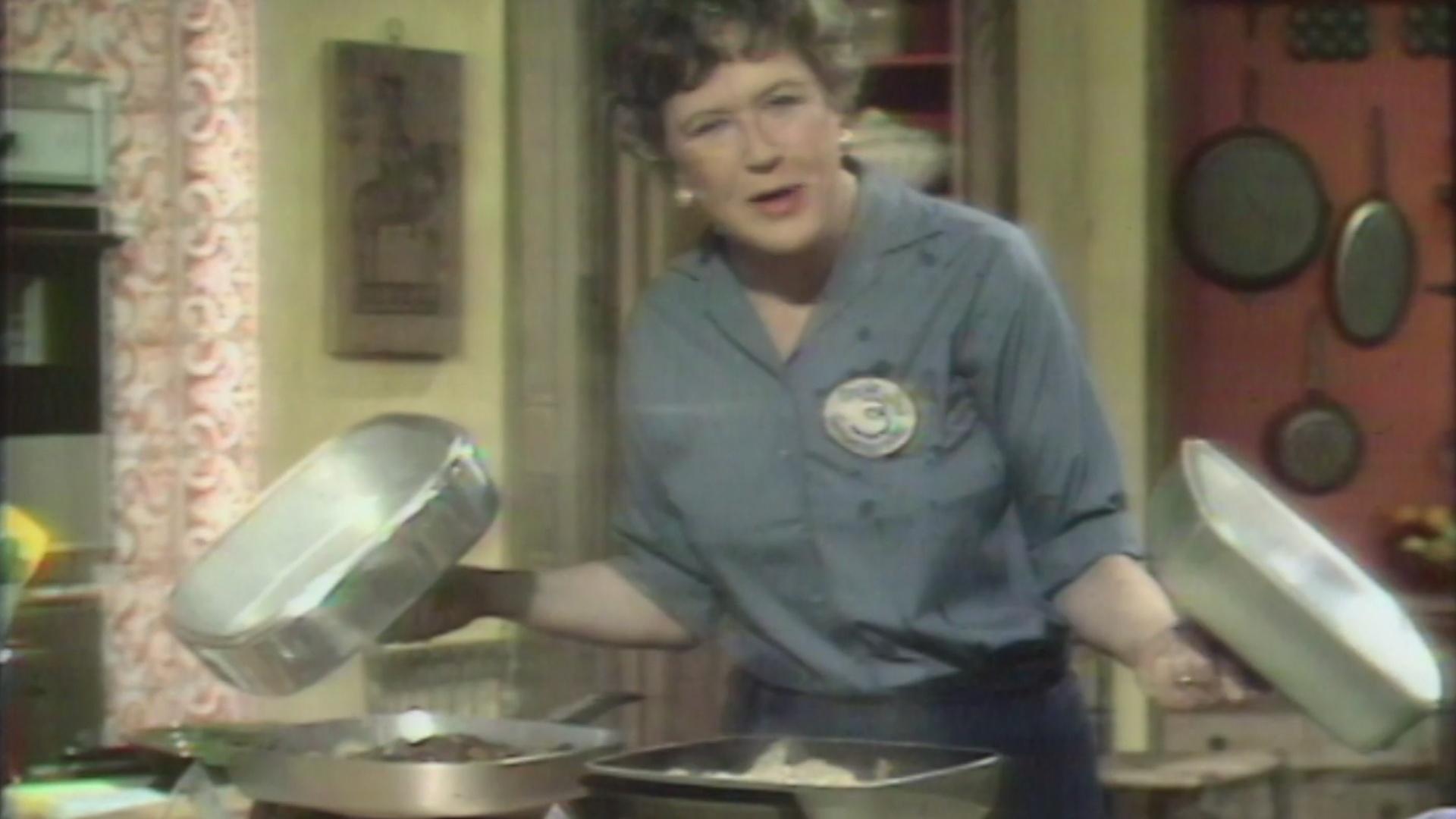
This is chicken in red wine, and this is chicken in white wine.
Although one is brown and one is white, they are sisters under the skin.
Youll meet them both when we make coq au vin, alias chicken fricassee, today on The French Chef.
ANNOUNCER: The French Chef is made possible by a grant from the Polaroid Corporation.
Welcome to The French Chef.
(chuckles) I shouldnt have been so violent.
But anyway, here are two famous chicken stews.
In this corner, we have coq au vin, and in this corner, fricasse de poulet a lancienne.
And the first one is a dark stew because its cooked in red wine, and the second one is a white stew because its cooked in white wine.
And both of them are garnished with little onions and mushrooms, and Im going to make both of them at exactly the same time.
Because they... cause youre going to see how things in cooking are related.
And that, really, these two recipes are practically the same.
And once that you know how to make these two chicken stews, the dark one and the light one, you can make any kind of a chicken stew.
And Im going to do them right now, together, and before your own eyes, so that youll see.
And seeing is believing.
And Im going to turn these way down so that they dont overcook, while we go over to the work arena.
And this one is going to be coq au vin.
Ill just put a little sign there to remind you.
And that one is going to be the fricasse de poulet a lancienne, which just means old-fashioned chicken fricassee.
And both of them have chicken in common, and mushrooms and onions, as well as a few other things.
But as you will see as we go along, what is common to them and what is uncommon to them.
And the coq au vin...
Both of them are stews.
And the reason theyre stews is because they cook in a liquid.
And one is brown, just because the chicken is browned, and one is white because the chicken isnt browned.
And for the coq au vin, you have to brown the chicken.
Thats one thing that gives you the brown taste.
So... and one thing that it begins with...
This is optional.
Im going to take this sign out now, cause you know which is which.
This is optional, but they are little lardons.
L-A-R-D-O-N-S, lardons.
Which you may omit if you want.
Theyre little bits of fat pork that are about an inch long and about a quarter of an inch in diameter.
And you brown them, and... then you brown the chicken in that.
And this is if youre in France-- you dont have any trouble getting what is known as lard de poitrine, which is fresh pork belly.
In this country, its difficult, so get anything thats fat and lean.
Like a little bit of the ends of chops, or some pork butt.
And if you cant get it, just omit it, but they do give a nice little flavor.
Then put some oil in your pan, and put in your lardons.
And then you saut them to render their fat.
And rendering, thats just like when you... when you cook bacon, the fat renders out.
You can sometimes cook things like, say, trout in bacon fat.
So the same idea is to cook chicken in the fat from these little pork bits.
And while this is browning, I shall discuss chicken.
And for both of these dishes, you use frying chicken.
And in old, traditional French recipes, you always have to get a whole chicken.
And that means you get the back and the neck and the white meat, even if you dont like white meat.
But whats nice in modern life is that you can get chicken parts so that you can get anything you like.
You can have nothing but drumsticks, or nothing but thighs, or nothing but breasts.
And if you want to be economical, you can just get chicken wings, which are half the price.
And they make a very nice stew, too.
And for a dark stew, of course, you dont have to have dark meat.
Its just the color of the liquid it cooks in that makes the difference.
And now the lardons Im going to take out.
You would cook them a little longer than this, because you want them to brown.
Im just giving you a token of some of this.
You take them out now, and then you add them again later.
And then you have your fat in the pan, and you use that to brown the chicken in.
And if you dont have lardons, you put in oil or... You put in enough oil just to film the pan.
And we have the pan on at about 350.
Id better put on my glasses, cause I cant see these little numbers.
About 350.
And then were going to brown the chicken.
And this has to be dried in an impeccably clean, colorfast purple towel.
And you dry the chicken pieces and put them in skin side down.
And this is very important.
Always when youre browning, you have your fundamental rules-- that you have hot fat and you have dry meat, and you dont crowd the pan.
Those breasts take up an awful lot of room.
Ive got in there-- those great, big things are the breasts.
Drumsticks and two wings.
And the reason that you brown is that the browning gives the... of course, gives color to a brown stew.
And then it also... also gives a very nice color to the skin.
And you keep turning it.
And you want the fat to be hot but not burning.
And if you dont have quite enough oil in the pan, add a little bit more.
Just so that the pan is always filmed.
And itll take about six to eight minutes, but just keep turning it and looking at it.
And these rules of hot fat and dry meat, and not crowding the pan, apply to any kind of a stew, whether its meat or chicken or veal.
And how much chicken to buy-- I think you really buy it by eye, and it depends on how much your family eats.
I should certainly think one breast is one big serving.
And if youre buying wings, you may want two or three pieces per person.
So while this is browning, we will get to the fricassee, or the white stew.
And this starts out with butter... in the pan, rather than fat.
Because the chicken is going to get what is known as seized, but its not to be browned.
I think I probably have enough butter in there.
Im going to take off this sign now, cause you know whats what.
And wait till the butter is hot and bubbling.
The pan should be about 275 to 300.
Obviously, the people who designed these little pans and numbers... ...didnt expect anyone really to see them.
Again, you dry your chicken.
And you want to be very careful in this, that its just... it gets seized, which means that the flesh stiffens.
Thats part of the cooking vocabulary.
But it just doesnt brown.
But when you feel the difference between squashy chicken and... squashy raw chicken and chicken thats been cooked about six or eight minutes, slowly, in butter, theres quite a bit of difference.
And its this... the... this preliminary seizing that makes the difference between an ordinary stew, where you just take your meat and drop it into liquid, and the fricassee type of stew, in which youve had this preliminary cooking in butter, which does give quite a definite difference in taste.
Its very subtle, but you can always taste the difference.
And now, when your chicken is browned... Im going to go back to the coq au vin now.
After six or eight minutes, you put in your onions.
And you have an onion flavoring.
And you can use either sliced onions, or if youre going to do the classic recipe, you use little white onions.
And these go into both... these go into both stews.
And I like to add them at this point, because then it helps them cook a little more.
These have been already peeled, but just putting them in right away allows them to cook.
Now back to your coq au vin.
You can... again, this is an optional step, but rather a nice one.
You can flame it in cognac.
Which is rather fun.
It isnt necessary, but I think its rather fun to do.
You want about a quarter of a cup in there.
And then, when its good and hot, light it.
Yee!
I think its mainly cause its fun for the cook to do.
Stir it around a little bit, standing well away so you dont burn off your hair.
And having a long spoon... And the reason that you flame it is to get rid of the alcohol taste, because you just want the... just want the taste of the cognac itself.
Then put out the flame by covering it.
And then that has been flamed.
The fricassee doesnt get flamed.
And now were back together again in the twin syndrome.
A little bit of salt on each.
And then a bay leaf for each.
And then for the coq au vin, you have thyme, because thats a more robust herb.
About a quarter of a teaspoon sprinkled on.
And for the fricassee, you have tarragon, which is a milder herb.
And then you cover-cook... slowly for five minutes.
Then after five minutes are up, you take off the covers, and you turn the chicken and season it on the other side.
Again, Im doing just a token.
You put on a little tiny bit of salt after youve turned it, and a little more thyme.
And back the cover goes.
And you do the same with the other.
Turning it around and putting on just a little bit more salt and a little more tarragon.
And then you cover-cook five minutes more.
And thats the same for both of them.
And then after youve had this ten minutes of very slow cover-cooking-- which, again, firms up the flesh a little bit-- then you flour both of them.
And you put on about three tablespoons of flour.
Thats about two, and thats about a third one.
As youll notice, with this kind of a recipe, exact measurements are not of great importance.
But the flour is going to thicken the sauce when you put the wine in, because flour is a thickening agent.
And the reason that you put it on now and then are turning the chicken in it, so that you can... so that youre cooking the flour.
And youre not going to get that sort of nasty, pasty taste of uncooked flour.
And you turn it and cook it for about two minutes.
And the reason you turn it is so that the flour and the fat or the butter will be blended together.
And its interesting that in French cooking you rarely if ever flour the chicken first and then brown it.
Because, if you did-- say, if you, like in the coq au vin... if youd floured the chicken first and then browned it, you wouldnt have the same taste, because you wouldnt have quite the same browning of the skin.
So...
I mean, thats quite a bit of a difference in French cooking.
Now, whichever recipe youre doing, youre now ready to add the liquid.
Now we have the coq au vin with the red wine.
And you get a good, robust red wine.
And about two cups go in.
Thats about half a bottle.
And that all cooks down.
And then to give added flavor, you put in a little brown chicken stock or brown beef stock.
I dont think I really have half a bottle of wine in there.
That seems like a lot of wine, but it all cooks down.
And notice that the chicken is not quite covered.
Its about two-thirds.
And then stir around to blend it.
And you could...
If there are any little bits of flour that are coagulated on the bottom, by stirring them around, you de-coagulate them from the bottom.
Let me get a better... Thats not quite scrapey enough.
I think a yellow spoon is the best thing for this.
And then, after youve gotten your liquid in, in go your little pork bits, your little browned lardons.
And they also give an additional flavor to it.
Then-- again, because coq au vin is robust-- you want to have garlic.
And you can either mince it up or put it through one of these fancy garlic presses.
I am very pro-garlic-press.
I know that some people feel that its a sin.
Mm-hmm.
And if you taste it now... And Ive got to have a little, tiny bit of tomato in.
This is either a small, fresh tomato or a little bit of tomato paste or puree.
And then, if you taste this now, its perfectly ghastly, because its raw wine, so just... Its just interesting just to taste it now.
(groans) You can see that it has... it has depth.
Something may happen to it, but its just... wine needs cooking.
Now, if youre doing the fric-a-say-- or fricassee-- again you have, this time, white wine.
And you put in about-- for this amount of chicken, a good half bottle of a good, dry white wine, like a Pinot Blanc, or a Macon if you get it.
And you got to be very careful with your white wine, that it has a good taste and is not sour in any way.
And then a little chicken stock, or even white canned chicken broth.
And again, the liquid doesnt quite come up to cover it.
And again, stir to mix.
And then this chicken doesnt get any more in the way of flavoring.
It has the onions and the tarragon.
And then both of these are going to get mushrooms later, but the mushrooms dont go in until the end.
And the sauce really hasnt thickened yet, because its going to cook down.
But you stir it around.
And then this is going to cook covered.
Whered I put my...?
There.
Its going to cook covered.
And now these are, again, twin chickens.
Because they, again, are going to cook for about 15 to 20 minutes, until they are tender.
And you want to watch it as you cook it.
Lift it up and see that its simmering quietly.
Take it and turn it over, and make sure that it really is cooking.
And as I said, the mushrooms go on later.
That one hasnt started to come up to the cooking.
So now were going to go back to the arena where we started out, and have a chicken test, and see when theyre done.
And I better get my glasses again so I can see these little... nasty little numbers.
There.
Now, these have been cooked, and theyre now sort of quieting down.
Let me get these out of the way.
And after 15 minutes of cooking, you want to test them and see how they are.
Because some of the chicken cooks faster than other pieces of chicken.
For instance, a white meat like the wings will cook faster than the drumsticks.
Take a little fork and press in, and the fork should enter easily so that you know that the chicken is done.
And whatever is done... like, theres a nice little piece thats done.
Theres a wing done, the breast done.
Then test the onions.
The fork should enter easily.
If the onions arent done, take all the chicken out.
And then, as soon as everything is done again, put it all back in again.
And do the same with your fricassee.
And then, after everything is done, you want to... we have our mushrooms.
Theres about half a pound, or about two cups, for each.
Two cups of mushrooms into your stew, whichever one it is.
And they just get in and just pushed down.
And if you find that your liquid has gotten a little bit... has boiled down a little bit, put in a little more... a little more broth, or even a little more water, if necessary.
And then push your mushrooms down in.
And then these are to cook with the mushrooms for about four or five minutes more, cause the mushrooms take just a very little time to cook.
And if you cook them too long, they lose quite a bit of their flavor.
Now youve seen how both of these are done and that theyre both... theyre both cooked in very much the same way, with the flouring and the covered cooking.
And so, really, theyre both fricassees, though we usually never think of a coq au vin as a fricassee.
But, technically, thats what they are.
And then after your mushrooms have cooked and everything is tender and youre ready to serve, you want to correct the seasoning.
Im going to... Thats still a little thick, I think.
And by correcting the seasoning-- you often see that in a recipe-- that means taste it very carefully and see whats lacking.
If anything.
That happens to be very good.
But if you felt that it didnt have enough salt or didnt have enough strength, put in some more bouillon.
If the sauce was too thick, as you saw that it was frequently, thin it out.
And on the other hand, if its too thin, boil it up rapidly, and that will thicken it again.
In other words, you want to taste it and it is absolutely perfect.
Then you get back to your fricassee, which is the same thing again.
Taste this very carefully.
And see what this needs.
Its always interesting to taste the difference, because its very definitely, even though they are cooked so much the same.
And you can... you can serve this just as it is, but in the traditional recipe, you put in some cream.
Heavy cream-- and that you can put in just as much as your conscience will allow you.
But the cream does a great deal to give it a lovely, sort of a velvety taste.
And then taste it again, with your impeccably clean spoon.
Thats a fresh, new spoon, cause Im so careful.
And you may find that it needs a little lemon juice.
So you have a little lemon, and you squeeze a few drops in.
And you keep on tasting that until it is absolutely right.
You can put in a little more cream if you want.
And then youre ready to serve.
And with the coq au vin, now thats all ready to serve, and Im going to put it out on a platter so that you can see how it looks.
I shall put it out terribly neatly.
Spooning things out.
What I think is very good about either of these two chicken stews is that you can do them ahead of time.
And as you get... when you get it ahead of time and its perfectly seasoned, baste it, and then let it cool to room temperature, and then cover and refrigerate it.
And you find very often, and particularly in a coq au vin, that its even better if you... if you do it the day before.
Then, now that Ive arranged that carefully, you can just pour the sauce right over.
And then, if you have a nice-looking frying pan like this, you can just serve it as is.
You dont even have to put it into another... into another platter.
So here, thats ready to go.
Le coq au vin, et la fricasse de poulet a lancienne, or old-fashioned chicken fricassee.
I think its fun that you can do... that these recipes turn out to be these little old twins.
So Im going to serve them... serve them both so you can see how theyre going to look.
Theres the fricassee, and there is le coq au vin.
And you can start out, say... with either one of them, rice is nice.
So put rice first on your plate.
And then... le coq au vin.
Theres a drumstick and some mushrooms and onions and a lovely little chicken wing and some sauce.
And then, as a little color, some green peas.
There you are.
And then with this, you would serve a red Burgundy wine or a nice... any nice, full-bodied wine, like a Pinot or something like that.
But a red Burgundy would be very nice.
Now, for serving the fricassee-- fricassee also loves rice.
Start with that on the plate.
And then...
The chicken.
This is a... people who loves drumsticks.
And another wing.
So you get the best of both ends.
And mushrooms and onions and a little bit of this lovely sauce.
And again, for color... ...some little peas.
And with this, some white Burgundy.
Now, these two twin chickens have a meaningful relationship in the truest and best sense of that word.
Youve got two great French classics in one.
And heres a tip.
Serve them together at the same meal, and you get to drink two wines.
So thats all for today on The French Chef.
This is Julia Child.
Bon apptit.
Captioned by Media Access Group at WGBH access.wgbh.org ANNOUNCER: This program was made possible by a grant from Polaroid Corporation.
Julia Child is the author of From Julia Childs Kitchen, which includes the recipes from this program.









 Passport








Follow Us