How Shifting Seasons Impact Amphibians
Ami Eckard-Lee: Did you know, over 40% of amphibian species are threatened with extinction, while hundreds of species have already gone extinct? And scientists are attributing this to changes in climate and habitat. But what exactly is happening to the habitat of our frog and toad friends? And what can we do about it? Shh, the show is starting!
Chloe Maier: Yuck, it’s disgusting.
AJ Stoffels: Here.
Chloe Maier: I mean, have you ever seen it like this?
AJ Stoffels: Well, no, never.
Chloe Maier: Who knows what it’ll be like for our kids? Or our kids’ kids? We are already seeing weird stuff.
AJ Stoffels: What’s that got to do with the pond?
Chloe Maier: Everything! Each year, it’s warmer. Okay, and warmer water means more algae. More algae means less water. Before you know it, the pond will be completely dried out and we’ll just be these dried husks baking in the sun.
Ami Eckard-Lee: Okay, time out. That was a play called Pond Life from the Climate Change Theatre Action Global festival. But we’ll catch up with those two fabulous frogs later. Right now, I want to figure out how these significant changes to the ecosystem affect frogs and toads, and how we can avoid this. Let’s hop on over to the lab to meet up with some researchers conducting a study on how winter temperatures impact tadpoles in the spring.
Jessica Hua: Winter is really important for amphibians because how winter temperatures change influence how much energy they use over winter. Amphibians have this adaptation where they can freeze solid.
Ami Eckard-Lee: What?
Jessica Hua: Yeah, so they could freeze completely solid to deal with cold temperatures. But if the temperatures are warm during the winter, they thaw, and then they refreeze, and they thaw, and they refreeze, and that’s really, really energetically costly. When spring comes and they want to reproduce, make more tadpoles, they have less energy to give to that next generation.
Hilary Dugan: Winter leads into spring, and that transition is just an incredibly kind of dynamic time of the year where the animals have evolved to know, like, what time of the year it is. There’s lots of food web interactions happening at the same time, right? I mean, the frogs need food, but the frogs also might be food. We call it phenology. That’s where the timing of these organismal events happening. And so, some years they all match up really nicely, and everyone has food, and some years, you get weird weather events where it, we call it mismatch, where one population might grow, but their, you know, their food source didn’t, and so it gets sort of, like, mismatched in timing.
Jessica Hua: Minor changes in temperature actually can have huge effects down the line, and oftentimes it’s cryptic until you understand the ecology of it. And not to mention, when you have these late winter storms, oftentimes there are pollutants involved. So, things like road salts are used to control ice, and when these pollutants run into the water, it can add another layer of stressor for these amphibians that are also dealing with changing temperatures. When there are salts in the water, tadpoles are more susceptible to their parasites.
Ami Eckard-Lee: Oh!
Jessica Hua: Diseases are emerging at unprecedented rates. Why?
Ami Eckard-Lee: Why?
Jessica Hua: Is it temperatures that are now different? Is it pollutants that are in the system? So, those are some of the questions that we ask in this lab.
Ami Eckard-Lee: Well, I also wanted to ask about that, because I think of a lab, and I think of test tubes, and chemicals, and lab coats, but you have kiddie pools. What is happening in this really cool setup here? What are you studying?
Jessica Hua: Here, what we’re looking at is how early life conditions influence susceptibility to disease and road salts.
Ami Eckard-Lee: Okay. What have you learned so far?
Jessica Hua: Imagine a scenario where a mom lays its eggs, and then you get this, like, winter storm that comes in. It freezes, and then it warms up again.
Ami Eckard-Lee: Okay.
Jessica Hua: Those tadpoles underwent a late winter storm.
Ami Eckard-Lee: Yeah.
Jessica Hua: Another set of tadpoles, there isn’t that late winter storm.
Ami Eckard-Lee: Yep.
Jessica Hua: So, now you have those two groups. If you expose the group that went under that late winter storm to road salts, they had that extra stressor. They’re much more susceptible to road salts than those that never had to deal with that late winter storm.
Ami Eckard-Lee: Okay.
Jessica Hua: So, if winter/spring transition temperatures continue to change, where there are these late, false spring storms, it can endanger tadpoles and make them more susceptible to pollutants in their environment.
Ami Eckard-Lee: Changes in the winter to spring phenology have cascading impacts on amphibians, the food web, and the entire ecosystem, many of which we still don’t understand. So, what can we do to learn more about the changes happening in the wetland ecosystems and to amphibian life cycles? Let’s meet up with a family in northern Wisconsin that volunteers with the DNR’s Wisconsin Frog and Toad Survey to learn more about how changes in phenology are affecting amphibians.
Travis Stuck: Frogs are amazing. We’re here as part of the Frog Survey, and we’re here primarily looking for, actually listening for frogs.
Rhonda Stuck: When I first started doing the Wisconsin Frog and Toad Survey, I did not know anything about frogs and toads and which was what. So, the DNR’s website has a wealth of information. I could listen to calls and learn how to identify the sounds I was hearing.
Travis Stuck: You don’t have to have any experience to do this. It’s really simple. The data sheet is up that anybody can take a little time and learn how to identify frogs.
Miles Stuck: You don’t really hear about this stuff anywhere else. It’s, so, in-person, it’s the best way to hear about it, learn about it.
Ami Eckard-Lee: Can you walk me through kind of what a survey night looks like for you?
Rhonda Stuck: We usually, we get our gear on. We get our data sheet ready and our little frog call cheat sheet. We hop in the car and we drive over, and as we get closer, we roll down our windows so we can start to hear the frogs through the just open windows. We get out quietly and we listen. We write down the number of species that we hear and how many. And we record the wind speed, the temperature, water temperature, is it overcast?
Ami Eckard-Lee: What is the purpose? What do you use the data for?
Travis Stuck: With consistent data gathering over a long period of time, they can track the population and distribution of frogs throughout the state of Wisconsin.
Miles Stuck: It just shows if they’re being affected, everything else is being affected.
Ami Eckard-Lee: Thanks to volunteers, researchers have decades’ worth of data on amphibian phenology that helps them determine when frogs and toads are emerging in the spring, what their populations are, and where certain species are located in the state. This data helps scientists determine what is causing population declines and helps lead us to solutions. Now, let’s see if we can meet up with those two frogs– I mean actresses– to talk about their ribbeting play. So, what is the CCTA? What is the Climate Change Theatre Action festival?
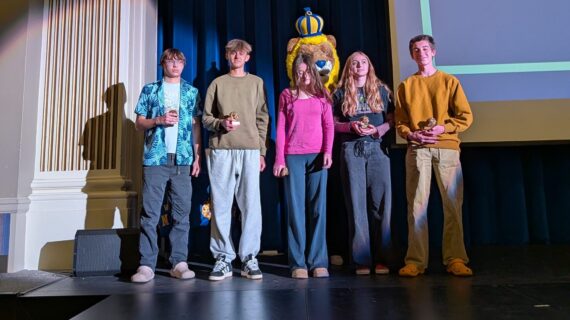
Chloe Maier: Yeah, so it’s like a worldwide global festival that brings together playwrights to put together and write, like, short plays that have to do with current climate issues.
Ami Eckard-Lee: How do you think artists and creatives can use their skills to help with climate change?
AJ Stoffels: I see theater as an amazing platform to bring up any issue under the sun because people like art. And so, if we’re able to use art to begin conversations about things that are so prevalent and so important, such as climate change, I think that’s a really important aspect of art.
Chloe Maier: I think what was cool is I was able to sort of live the theme of the play of, like, do something, do what you can, and what I was able to do was perform and put on art with my friends.
AJ Stoffels: The only thing we can do is what we can do.
Chloe Maier: What do you mean?
AJ Stoffels: I know it seems overwhelming, but this pond, our lives, you know, it’s all we got. And we got to do what we can while we’re still here to make things better. You know, how else are things gonna change?
Ami Eckard-Lee: We can all do something to help protect amphibians and their habitats. You can start at home by using less salt on your driveway or sidewalk in the winter, or become an advocate in your community for protecting ponds from pollutants like salt and other chemicals. Participate in citizen science programs that gather data, or help educate others and spread awareness. And don’t forget, art is a wonderful way to help people understand and empathize. We are all capable of making positive change. Right, you never know what ripple effect it’s gonna have.
Chloe Maier: Exactly.
Ami Eckard-Lee: Did you get my–
Chloe Maier: The pond pun?
AJ Stoffels: Oh, wait, that was good! That was good!
Chloe Maier: Wait, say it again and then we’ll laugh.
Ami Eckard-Lee: The ripple effect.
[all laugh]


 Passport



















Follow Us