







PBS Wisconsin Passport
Watch this video with
PBS Wisconsin Passport
Become a member of PBS Wisconsin, support your local community, and get extended access to PBS shows, films, and specials, like this one.
Rediscovering Catesby’s Carolina (Part 1)
01/07/19 | 26m 48s | Rating: TV-G
Mark Catesby journeyed to the Carolinas in 1722. The descriptions included in his book, the Natural History of Carolina, Georgia and the Bahama Islands seems outlandish considering the natural communities surrounding us today. Imagine a Carolina where Bison, Elk and Wolves roam vast grasslands, where fire, set by humans shape the land.


Copy and Paste the Following Code to Embed this Video:
Rediscovering Catesby’s Carolina (Part 1)
An English gentleman, Mark Catesby. Set out for Caroline in seventeen twenty two. He journeyed far inland. At a time when, really the European influence on the landscape, was pretty fresh.
What did he encounter? Where did you go? And how is the Carolina that we know today changed? Join me on today's expedition, as we begin to rediscover Catesby's Carolina.
Mark Catesby was an early eighteenth century British naturalist. His visits to the New World began in seventeen twelve, with his journey to Williamsburg, Virginia. He traveled in Virginia in the West Indies and returned to England in seventeen nineteen. His intrepid sense of adventure, lead wealthy patrons to send him back to New World, with the hopes of receiving natural history treasures.
To grow their collections and to grow in their gardens. Catesby journeyed back to America in seventeen twenty two and based his explorations from Charleston. At this time the British settlements extended inland only about sixty miles from the Carolina coast. Beyond this, most of Carolina was managed and controlled by native Americans.
It was into this territory that Catesby walked hundreds of miles. Not once but twice in seventeen twenty three and again in seventeen twenty four. He traveled once in the spring and again in autumn. To observe a full range of the plants and animals in the region.
We know that the based his explorations of the upstate. At an outpost called Fort Moore. But beyond this, historians have been at a loss to explain fully where he traveled or how far up the Savannah River he went. His publication of the natural history of Carolina, Florida and the Bahamas islands adorned with it's beautiful illustrations.
Earned him the love and respect of many to this day. And it also aroused interest in the natural history of Carolina. It's the illustrations that most people know Catesby from. But my interest is much deeper.
He collected thousands of plants and animals while here and sent them back to England. His notes in his collections combined with the words he printed in the natural history. Can allow us a glimpse into a very different look at what Caroline was like at the dawn of the dramatic change that would come from the European subjugation of the land. My colleagues Amy and Chris Blackwell and Mark Spencer from the natural history museum London and I have combined forces to make the relics that Catesby collected and the words he penned available to everyone.
Through our Botanica Carolina website. And we have used the full bounty of Catseby to generate hypotheses that can answer some of the most puzzling ecological questions in Carolina. His importance to the natural history is evident in the very names of the plants and animals found here. Some plant species get named after there discoverer.
Or sometimes just in honor of someone that the botanist describing the plant either admirers or that maybe helped him fund his work. Well Mark Catesby has a great number of plants that are named after him. And one of the really cool things about being one of the first botanists to really collect plants in North America. Means that the prettiest things aren't taken and they can be named after you.
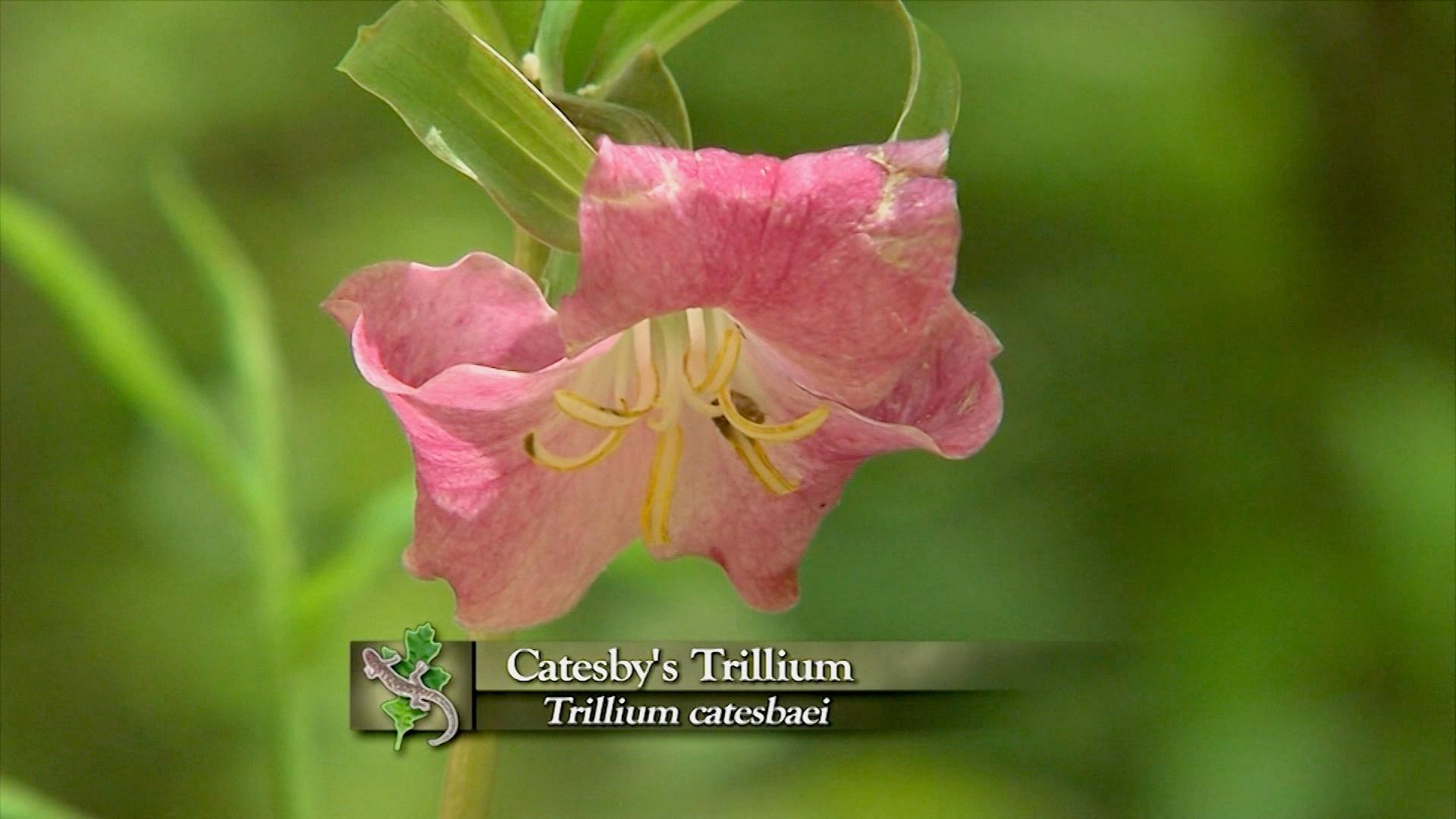
So this one in the spring here in the Carolinas. It's one of the most beautiful of all of our wild flowers. This delicate pink flower with parts in threes is called Catesby's Trillium. Trillium Catesbaei and obviously named in honor of Mark Catesby but also just one of the most splendid springtime plants and culturally in because the parts come in threes.
It has three leaves, three sepals, three petals, six stamens and a three or six parted ovary. All in multiples of three so tri Trillium great name for the genus of this plant. And Catesbaei is the latinized form of Mark Catesby's name. One of most beautiful plants of the spring named after Mr Catesby.
One the most beautiful plants in the summer and believe it or not even to me what is the most beautiful of the fall flowering Gentians. So being the first has its rewards. It's not just plants, its animals too. The Bull Frogg, the king of north American frogs.
Is Rana catesbeiana after Catesby. So many organisms we love today carry his name. But what did Catesby get really excited about. With all the incredibly beautiful plants that Catesby encountered during his visits to Carolina.
Which one was his favorite? Believe it or not, this one. Mountian Laurel, Kalmia latifolia. A plant that for us, who grew up in Appalachia.
This is a common plant. Coats the hillsides throughout most of the southern Appalachians. But Catesby didn't encounter it quite as commonly, as I did when I was growing up. You see it kind of tells us a little bit about where Catesby's route was and what was going on in the landscape around him.
In the way that he describes where he found this plant. He describes this plant as growing here and there, on rocky bluffs and over hangs over The streams and rivers. In places that would've been sheltered from fire for, one thing. But also, on little microsites, micro climates, north facing slopes, steep slopes, acid soils.
Where there might be slightly cooler climate. The kind of place where we still find Mountain Laurel not just confined to the mountains but all the way down the Savannah River drainage. All the way into Jasper County. Almost to the coast.
You can find mountain laurel. We certainly can't make any definitive statements about where Catesby went because he saw mountain laurel. That's far too broad a range. It's hard not to agree with Catesby that this is one of the most beautiful if not the most beautiful plant in Carolina.
The coloration is widely variable. This population that we're in right now has very white flowers, with these small purple streaks in them. The coloration varies to really dark and in fact the water coloring that Catesby did is of an extremely dark flowered individual. One that's much more similar to a cultivated form that we see today.
I'm gonna share thid story with you. When you look at these Stamens. the anthers, the part that contains the pollen is held way back here in these sacks. Sort of hidden in these projections and the Stamens are bent outward and they're actually under pressure.
They wanna spring free and when a large insect lands on this flower. Boom. All that pollen flies out. Lands on the back of the insect and is carried to the next flower.
Now during Catesby's time, just like today. The primary pollinator that would visit these flowers. That would cause that to spring are going to be things like bumble bees. Native bees to South Carolina.
Its amazing to see that this plant is actively choosing it's pollinator. We know very little about where Mark Catesby traveled beyond his business to Fort Moore. There simply weren't many place names for him to reference at the time. The route he took to get there is even a question.
There are clues in the plants he collected. Our research has shown that some of the plants have ranges that are highly restricted to particular soil or rock types. Like Delphinium carolinianum. Others have ranges the restricted to particular geographical areas like Lysunachia fraseri.
What we think we can piece together today from studying his collections is that his main route up or down from Fort Moore was the Savannah River. Though he may have made an overland trip to Fort Moore and returned via the Savannah. One thing we believe we can answer today, is how far up the Savannah drainage he traveled. Thanks to his collections.
one of the real mysteries and questions about Catesby's journeys is how far he got. He tells us that he came within sight of the Appalachian Mountains. We know he went to Fort Moore but how far did he go beyond that. Well the collections that he has made.
Tell us far more concrete evidence about where we think he might have gone to and how far abroad he may of journeyed because the collections aren't all represented by drawings, by water colors and then lithographs in the natural history. Two plants sort of solidify to me that he made it at least to within sight of the Appalachian Mountains. Places like maybe Anderson or southern Picken, southern Macomb county. One of them is right beside of me.
You see he collected this plant. This is hydrangea radiata and Catesby's specimens are so well preserved. That not only can we see the sterile Brax that surrounded the flowers on this fruiting specimen but we can still see the coloration. That gives this plant its common name.
The white leaf or silver leaf hydrangea. In addition to this, He collected another southern Blue Ridge escarpment endemic. One that wouldn't be described for well over a hundred years after he collected it. A plant called Lysimachia fraseri, Frasier's loosestrife.
Those two plants together taken collectively provide me with all the evidence I need to know that he got at least as far as the southern most lowest downstream population Lysimachia fraseri in Anderson County. In my opinion this intrepid explore braved it all the way up to places like this. Another interesting question that Catesby can help us answer. Is what the distribution of plants originally was at the time of European contact.
Plants like silver maple and Arrowleaf Sida are examples of plants that Catesby is helping us to interpret. But there are other showier examples. One of the most surprising and important contributions that Mark Catesby has made to our understanding of our flora and fauna. Is to help us to really get out what's native.
What is truly Carolinian and the tree behind me is an excellent example. This is southern catalpa and every single major flora and treatment of the plants and trees of the southern United States. Will tell us that, that tree is only native to the east Gulf coastal plain. It only ranges east to places like the panhandle of Florida and southwestern Georgia, naturally.
Well Catesby might make us change our minds about that. Catesby encounted this plant not in the east Gulf coastal plain but here in South Carolina in seventeen twenty three and seventeen twenty four. He collected two specimens that are in the Sloner barium and one that's at Oxford. And the labels are pretty telltale.
This plant was cultivated even by the late colonial times. An Catesby himself in his natural history tells us that he kind of takes responsibility for making it a popular plant in the colony. His labels actually tell us even more of the story and make a more convincing argument because one of his labels in the Sloner berrium reads like this. "They grow by riverside's.
Very remote from the settlements. In Rich land. Catalpa called so by the Indians." For that description far away from the settlements. Really removes the major argument that most people have had.
By saying that this was a plant that was introduced to the Carolinas from the east Gulf coastal plain. Because he says they were growing far from the settlements along the rivers. In this case, probably the Savannah River. Today they still grow here in South Carolina along the banks of Savannah River and also here in the South Carolina botanical garden.
This is just one example of many examples of plants that have obscure native ranges in the past and today we think of as being true members of the Carolina community. Catesby's contribution to science is greater than just understanding what occurs here. Did you ever wonder where the passenger pigeon got its name. Catesby called it the pigeo of passage.
And his ideas about bird movements are probably one of his greatest contributions to science. I always love going far field, way over to the Great Plains and finding something that can bring a connection right back home for me. Right back to my home in the Carolinas and and these birds. That are feeding out here are just that bird.
Those are Bobolinks. And that beautifully colored male believe it or not is a species of blackbird and they at least during migration form huge flocks. And they're gonna go from their breeding habitat, which is mostly centered in the northern Great Plains. All the way south to southern South America.
They travel a huge distance in migration. A long ways for a songbird. We don't have many song birds that go that far. They're moving kind of on the scale of many of the shore birds that we have here.
Like the upland sandpiper but the reason I say this brings connection home is that. We find these birds in the low country of South Carolina during migration. And believe it or not they used to be called the rice birds because they do feed on seeds and grains, in addition to insects. And when people would plant out rice.
They tried to time it so that they wouldn't hit the migration of bobolinks into South Carolina. Because if your field got over run with Boblinks your rice crop was ruined. So they got the name Rice Bird. Catesby, who lived during the seventeen hundreds was the first to propose that birds actually migrated and people didn't really understand what happened to birds in the winter time.
And he proposed that they flew distances. Flew south for the winter. Before that they thought they buried themselves in mud of ponds during the winter time. That's what the English scientists thought in eighteenth century but the Boblink helped him to solve that puzzle.
Because Mark Catesby saw the bobolink on its migration in the Carolinas. But he also found bobolink in the Bahamas and he thought that the Bobolink is moving north. And so, the discovery of migration is also linked to this bird and that's Mark Catesby's idea of birds of passage. Migrants, really got its start.
Another contribution of early colonial era naturalist. Is understanding how our choices in land management have impacted the distribution and the abundance of plants around us. Even though this little plant may not look like much. It happens to be one of the rarest plants in the United States.
This is American chaffseed, Schwalbea americana. And Schwalbea or American Chaffseed used to have a range that went from New York and Massachusetts all the way to Texas. And it plays a critical role in understanding the importance of fire on the landscape and how that's changed since the first Europeans sawed here. And how long has it been known from South Carolina.
Well before Mark Catesby an even earlier collector by the name of Joseph lord who settled Dorchester. Just outside the Francis Marion National Forest here. Was the first person I know of anywhere in the world to collect and try and preserve a specimen of this plant. At least for European botanists to look at.
Schwalbea americana used to be abundant in this type habitat. In fire maintained forest, woodlands, longleaf pine but other pinelands and other simply grasslands at that time from Massachusetts to Texas. American chaffseed extirpated. It's it's missing.
It's gone extinct locally. In many of the states that it used to occur in. The fact that this plant today is among the rarest plants in North America. Tells us a lot about how much change there's been and the choices that we've made in applying fire to the landscape.
One of my favorite stories related by Catseby himself in the natural history. Happened while he was in the low country at a residence. Not way out in the wilderness. The homes of this time period are few and far between today.
One example that survives is located at the South Carolina botanical garden. It originally was located in Berkeley county, South Carolina. Its the second oldest wood frame structure surviving in South Carolina today. It was built in seventeen sixteen.
The Hanover house. The type of house that Mark Catesby would have stayed in may have been a little more luxurious than this in some cases. But the Hanover house provides us a great example of what homes were like in at least the French Huguenot settlements at that time. And this bedroom provides us with a great example of the type of bed that Mark Catesby would have spent the night in.
And when he was a colonel Blake's house he had just left his bed. When a servant came in a few minutes later to take out the bed sheets and clean the bed. And when she pulled back the bed sheets imagine right there in the middle of the bed a great big rattle snake. That had crawled up in the bed and probably spent the night coiled up right next to you.
That would freak most of us out but I'm not sure really freaked out Mark Catesby. Because you see Catesby was one of the first people to recognize that the rattlesnake was not really an aggressor and he gave the rattle snake a fairly fair shake. The type of bed that they slept on back in those days is rather interesting because we used to like box springs underneath beds today. But you had to have something similar to this to keep your bed really even sleepable back during that time.
Because see beds back during Catesby's time. Were underlain with roping. And this Roping had to be tightened with a tool like this. So if you ever wondered where the term sleep tight came from.
Well Catesby would've had turned his bed each day to sleep tight. Otherwise he'd sink down to the floor. Well rattle snakes like the one that Catesby came across in that February day of seventeen twenty three. Have declined precipitously.
They have been Persecuted by man and in fact our largest species here in eastern North America in fact the largest of rattlesnakes in America has declined more rapidly and more extensively than any other. And that's certainly a species that Catesby would have encountered in his travels in the coastal plain. Though the eastern diamondback rattlesnake has suffered in many of its locations. There are still places where they are locally common.
The marine corps South Carolina department of natural resources and researchers from Marshall University have partnered at the Paris island marine corps recruit depot, to study these snakes. An integral part of the research here is understanding the snake's movements. Tracking the rattlesnakes in their natural habitat on the island. I went out with the researcher Jonathan Cooley to see what we can find.
You hear a little beep there. Yeah the signals getting stronger. Probably walk in right here. It seems to be right in this area.
Okay. There She is. Right there. Oh my gosh.
They really are well camouflaged. They certainly are. So how many of these animals are actually do you have telemetry devices on out here. I have thirty snakes right now being telemetered on Paris island.
Yeah and it's hard to believe. I mean you said this snake was here yesterday. They they can sit in the same spot for a while then. Yeah, I mean it's it's to their advantage to stay in one spot.
so they don't waste energy and moving from one place to another because they're an ambush predator. Right. That's so cool. You got a cool job.
Thank you I appreciate it. I love my job. Professor Jamie Waldron leads the research at Marshall she's an excellent resource to really get to know the rattle snakes their habits, characteristics and how they interact with us humans. I think that that the first thing to notice about this snake is she doesn't seem to be coming after us.
No she's doing in fact what they normally do. Which is that they want to avoid people. Were not a prey item. Right.
You know she's afraid of us. And so this is what they do. That is really pretty snake too its magnificent. and sometimes they'll stand there ground but the hide their head because you know they're they're not aggressive animals.
Yeah and it's kind of cool to see some of the similarities between what Mark Catesby talked about with rattlesnakes and the behavior that we just witnessed here. I mean we we came upon a snake. We got little close. She realizes we're here.
And instead of of really moving towards us or being aggressive. It's not. That's exactly what Catesby noted about Rattlesnakes. He's one of the few people who actually wrote a realistic story.
And I guess the first realistic story that we know of about rattle snakes and he talks about them not being aggressive unless they're actually really messed with. Right. Unfortunately when most people come across rattlesnakes they're in the road. And so when there on the road they feel vulnerable and they're more likely to rattle there more likely to to try to scare you off because, you know they're not hidden.
Even then they're trying to scare you off. There trying. There not trying to bite you. Right.
But thats image most people have of rattlesnakes. And that's a big pretty big snake. How big is this one. About a hundred thirty centimeters.
A hundred thirty centimeters. So about four a little over four feet long. which to me is pretty big but Catesby talks about rattlesnakes being eight feet long. And thats kind of the maximum for eastern diamondbacks rattlesnakes.
But not out of the question again. Not out but I've never been lucky enough to see one that big. Yeah. But they they can get quite large.
So it during his time here in seventeen twenties in South Carolina. Things would have been a lot different right. Of couse. For rattlesnakes.
What has happened to the population of snakes in general and the diamondback rattlesnake in particular since that time, Well eastern diamondback rattlesnakes are pine savannah specialists. You now and we know that's the most imperiled eco system and one of imperiled eco systems in North America. And so if you're a specialist in that system and it's gone. Naturally you are in trouble right.
And but rattlesnakes suffer disproportionately because there rattlesnakes and people are just naturally are afraid of them. So there's not a lot of support for there conservation at times. The attitude of the only good snake is a dead snake. Sure.
So you know they suffer because number one habitat loss. Number two they're not the most charismatic species and number three because there's actually collection pressures for these species as well. And you can't forget also about the incredible barries we place to cross these animal habitats swith roads. Which it has to be one of the largest contributors.
And housing developements. Especially when you're in a marsh area or a coastal area like this. Exactly. So you know this is not a savannah habitat and so it's not the kind of place that you know I would expect to see a diamondback.
That's right. The first time I came on to Paris island. That's exactly what I said. That I'm not going to find an eastern diamondback rattlesnake here.
I will find them in quail plantations and pine savannah. But what you have here is you have March. And and and that is a good surrogate habitat. And the marsh edge is right there.
Right there. The marsh edge is right over here. And what's interesting to know about diamondbacks is their a signal of good habitat management. You know they don't disperse very well.
And even if you have habitat looks like it's it's really good for diamondback. If there's been a lot at destruction historically you're not gonna have Diamondbacks there. So if there. It's a good indicator that habitats been high quality for a long time.
You're more likely to find endemic species were you find diamondbacks. between the South Carolina DNR and between the marine corps here Parris island we have learned a lot about diamondbacks. We know that the live a long time. Individuals can live over thirty years.
In the wild. In the wild. And we have adult females. We caught them one year and thirteen years later we caught them again they only grew a centimeter.
So they processed. We know that they don't disperse. The adults inparticular. Once they're in a spot there likely to leave it.
It takes them seven years to reach reproductive maturity. And do they reproduce every year? No no about every three or four years. Males will breed every year but a female they have to build up the fat reserves and that can take years.
Even as far back as the seventeen twenties Catesby had noted that these animals give live birth. Its a little different then a live birth that a mammal would give, right. Absolutely. They actually carry their eggs.
So they incubate eggs andthen the eggs hatch internally. And then the babies are born. There is a term for that and its called ovoviviparous. Ovoviviparous.
Ovoviviparous yes. Ovo meaning egg and viviparous meaning live birth. Exactly yeah. Incredible on this I feel so fortunate to be bale to come to this place first of all.
And to see these guys is absolutely incredible. Yeah. keep up the good work. Thank you very much.
Rattlesnakes arent the only species that impressed Catesby in coastal Carolina. He made numerous discoveries in the coastal plain and writes extensively also about the native people here. The age of discovery isn't over. We're still making discoveries today and learning amazing things about how our choices impact the world and just how long the world remembers us.
Catesby's Carolina may have been quite different in many regards from what we see today but what can Catesby tell us about just how much change has happened and what the forces driving those changes have been. Join me next time as we continue to explore Catesby's Caroline. To purchase a copy of expeditions with Patrick McMillan call toll free one eight hundred five five three seven seven five two or order online at ETVstore.org.
Search Episodes

Donate to sign up. Activate and sign in to Passport. It's that easy to help PBS Wisconsin serve your community through media that educates, inspires, and entertains.
Make your membership gift today
Only for new users: Activate Passport using your code or email address
Already a member?
Look up my account
Need some help? Go to FAQ or visit PBS Passport Help
Need help accessing PBS Wisconsin anywhere?

Online Access | Platform & Device Access | Cable or Satellite Access | Over-The-Air Access
Visit Access Guide
Need help accessing PBS Wisconsin anywhere?
Visit Our
Live TV Access Guide
Online AccessPlatform & Device Access
Cable or Satellite Access
Over-The-Air Access
Visit Access Guide




Follow Us