







PBS Wisconsin Passport
Watch this video with
PBS Wisconsin Passport
Become a member of PBS Wisconsin, support your local community, and get extended access to PBS shows, films, and specials, like this one.
Curious Glasgow
01/16/19 | 25m 4s | Rating: TV-G
Who is buried under Glasgow Cathedral and why? Who was Saint Mungo, and where can you see a modern version of him? What do the symbols mean inside Queen's Cross Church? Why does Glasgow City Chambers look like a palace? How did the creativity of one local man, Charles Rennie Mackintosh, leave a permanent mark on his city, and influence an entire artistic style?


Copy and Paste the Following Code to Embed this Video:
Curious Glasgow
This Scottish city is full of iconic architecture and friendly people. Welcome to Glasgow, or as the Glaswegians used to say, (speaks Gaelic) Remember when you were a child, and all you asked was why, why, why? Well, I never quite outgrew that whole quest for knowledge phase. In fact, I've made a career out of asking who, what, where, why, and how as an arts and travel journalist for the past 20 years.
So if I have an insatiable curiosity about the exciting, inspiring, beautiful world of art, architecture, and hidden history all around us, I bet you do, too. This isn't your typical "what to do on a vacation" travel show, oh, no. This is your all-access pass to a deeper understanding of the world's great art and architecture, people and places, history and "how did they do thats?" So come along on our educational journey, our field trip for grown-ups who have never quite grown up, and learn on Curious Traveler. (folk music) This Scottish city is known for its iconic architecture, from the Victorian to Art Nouveau.
It is also known for its quirky culture and colorful characters. It is time to get curious about Glasgow. Glasgow is the largest city in Scotland and thrives off the banks of the river Clyde. That river proved to be crucial to the prosperity of Glasgow as it became a major port and trade route to the Atlantic.
In fact, Glasgow was such an important center for trade that during the Victorian era it was dubbed the Second City of the Empire. Glasgow is less than an hour away from Edinburgh, Scotland's capital, yet it feels a whole world away in its gritty style and proud, artsy spirit. Next, where does the name Glasgow come from? Well, Glasgow comes from the Gaelic glaschu, meaning green glen or green hollow.
From those prehistoric beginnings a fella named Mungo comes onto the scene in the 6th century and built his church here. Thus, Glasgow begins. In its more modern history, Glasgow thrived thanks to trade with the Americas and during the industrial revolution thanks to its coal, iron, and something else it became known for worldwide, its shipbuilding industry. Later, we will see a very curious bit of that shipbuilding legacy in a place you wouldn't expect.
Glasgow's art and architecture is renowned as well, especially the works of one legendarily talented and quirky Glaswegian. So here's what I'm curious about in Glasgow. Who is this guy, and what does he have to do with this guy? Why does this civic building look like a palace and this art museum like a church?
Why is this cathedral so close to a river? Wait, where's the river? What does this symbol mean? Whose living room is this?
Who graffitied this wall, and why did they do such a good job? Where's Glasgow's statue of liberty? Who is this guy with the cool mustache, and how did he influence an entire artistic style? It is time to get curious about Glasgow.
We begin our exploration into curious Glasgow in the heart of the city, a district called Merchant City that hearkens back to those prosperous trading days of Glasgow. (ship horn blows) Merchant City was established in the 1750s and is full of neoclassical buildings, like this one, Merchant Square, part of Glasgow's old fruit market. Why this neoclassical style? Well, to copy Rome and Athens, of course, making the architectural statement that Glasgow was a new powerful center for commerce and culture.
There are many proud buildings from this era still standing today, like the Gallery of Modern Art with its Greek and Roman columns, pediment, and portico. But it is what's in front of the building that is truly curious, a statue of the Duke of Wellington, forever capped with a traffic cone. -
Man
Hello. -
Christine
This pranking tradition began in the 1980s, and apparently every time the authorities try to remove it, another one just pops up back in its place. So it has begrudgingly become a Glasgow icon, symbolizing the quirkiness of the city. Then there's Hutchesons' Hall, named for brothers George and Thomas Hutcheson, prominent philanthropists in Glasgow in the 1600s. Hutchesons' Hall was originally built as a hospital, and you can still see the names of hospital preceptors proudly hanging on the wall today.
Now it is a high-end restaurant with gorgeous architectural details and even a lounge all decked out in early 20th century glamor. The Merchant City buildings are all testaments to the prosperous time in Glasgow and in Scotland. We will learn later that a Glasgow architect and artist wasn't so found of this ultra-traditional style for his beloved city. But first we get curious about a building that is so lovely, so gilded, so over-the-top glamorous, how could anyone not like it?
The beautiful Glasgow City Chambers was completed in 1888 and is still one of the most opulent buildings in the entire city. Why go so glamorous for a city hall? Well, quite simply so that Glasgow could brag about its prosperity at the time. There's still a lot to brag about today, though.
This staircase that I'm standing on is still the tallest solid marble staircase in all of western Europe. Glasgow City Chambers was built when Glasgow was at its height of its Second City of the Empire status during the Victorian era. In fact, Queen Victoria herself opened Glasgow City Chambers in 1888. But if you missed that ceremony, you can still see the queen here.
You just have to look up, way up, over the main entrance. And if the queen looked up from her permanent perch, she would see a curious statue that looks like it belongs on the other side of the pond. (Yankee Doodle playing) This figure is actually the Statue of Truth, but doesn't it look a little familiar? Yep, this lady is affectionately known as Glasgow's own statue of liberty.
Next, there's another section of glorious Glasgow that isn't neoclassical at all. In fact, many of its buildings are a distinct brick red, like the famous Lighthouse and Mitchell Street building, the equally famous Willow Tea Rooms, and the Kelvin Grove Art Gallery and Museum. The Kelvin Grove looks a bit more like a church than an art gallery, though, thanks to this glorious concert pipe organ. Why is it here?
Well, this seemingly out-of-place object tells the curious history of the museum. In 1888, Glasgow held an international exhibition to show off to the world the scientific and cultural prowess of the city. The Palace of Fine Arts Hall became the Kelvin Grove Art Museum, and this pipe organ was part of the exhibition's concert hall. It is said that when the exhibition ended in 1901, the organ was placed here, because otherwise, quote, "the art gallery would be a body without a soul." And that artsy soul of Glasgow continues today with an uber-modern public art project that actually encourages artists to deface Glasgow's buildings.
And just in case you weren't sure that Glasgow is all about art, may I present to you the City Center Mural Trail with 24 larger-than-life images dotted throughout the city, including Glasgow's beloved St. Mungo. The Mural Trail project began in 2008 with the idea to add a big splash of color to the city. Subject matter goes from the inspirational to the just plain wow.
There's the just plain lovely Wind Power, celebrating Glasgow's sustainable energy efforts, and the "oh, my gosh, that's cute" with the Glasgow Panda, to comedian Billy Connolly, a famous Glasgow resident, to this mural titled Fellow Glasgow Residents, celebrating the city's furry friends. You can take The World's Most Economical Taxi. Then there's just the plain old cool with the Hip-Hop Marionettes. (record scratch) But back to where we began with this mural of St.
Mungo. St. Mungo is the patron saint of Glasgow, but let's be honest, this guy doesn't look like the saints we're used to seeing, right? Well, there is a curious story why.
The artist chose to use an everyday man as his model to show how saintliness and kindness can be found in the most humble of characters. Both this St. Mungo and the real St. Mungo are depicted with a tiny little bird.
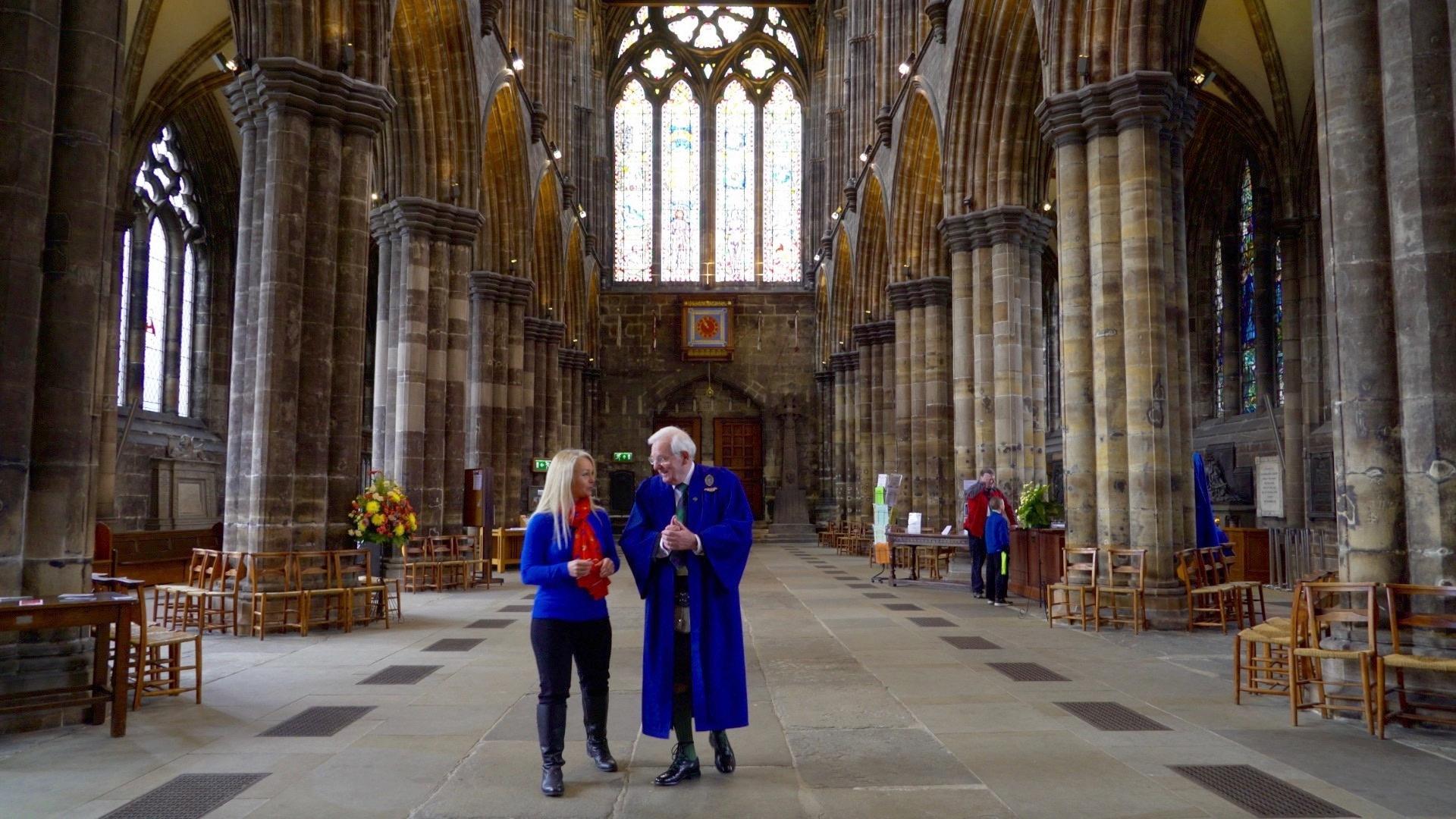
Why, well, to find out we go to where St. Mungo started Glasgow back in the 6th century. (choral music) This is Glasgow cathedral, a medieval work of art dear to the heart of Glasgow. Worshipers have gathered within these walls for more than 800 years.
The very first stone building was dedicated in 1136 in the presence of David I. Incidentally, it may well have been a Christian site even before that, because we think that St. Ninian established his first cemetery here in 397 So the history of this site is amazing. But the very first church on this site was around 550 AD, and that was established by Mungo, also known as Kentigern.
-
Christine
So now we get to our buddy, St. Mungo. He was a missionary in the 6th century, spreading Christianity throughout the Celtic kingdoms. It is believed that Mungo chose this spot for his church because it was close to an ancient waterway called the Molendinar Burn.
-
Bobby
Which was much more important at that time than the river, major river Clyde is today. That burn fed off five bread mills. Wow. And established where we are today.
And Glasgow grew from this site to the High Street and then down to the river Clyde, and then it started to expand. So this was at one time Glasgow. This was Glasgow. The river was covered over in the 1870s, and Glasgow continues to spread and grow.
But Glasgow Cathedral stays the same. You're also standing in the oldest building in the city. There is nothing older than this anywhere in the city. That is amazing.
Now back to St. Mungo, whose name is actually St. Kentigern, which is Celtic for "high lord, so. How did the name St.
Mungo come from St. Kentigern? Right, well, as a child he was christened Kentigern. He had a very poor start to life, but he was taken, him and his mother were taken into a monastery in Culross in Fife, and he trained there as a monk.
And it was St. Serf who called him Mungo, and the interpretation being "my dear friend." -
Christine
And St. Mungo was known for being a dear friend to all of God's creatures great and small, including a very special little bird. (bird chirping) The bird comes in when Mungo was training at the monastery with St. Serf.
The other boys were jealous of Mungo, and they suffocated, like, a robin. And when Mungo heard about it, he got a hold of the little bird. (exhales sharply) Blew into it, said a wee prayer, and the bird flew away. (mumbles) - Came back to life.
-
Christine
And this story is so dear to the hearts of Glaswegians that, look closely, St. Mungo's bird is part of Glasgow's city coat of arms along with the other symbols of St. Mungo's stories, the bell, the tree, and the fish. So since this was his church, it is fitting that St.
Mungo's final resting place is here as well. St. Mungo's tomb is in the lower level of the cathedral, which is a perfect spot to explore its curious architecture, because there are some divine mysteries to be solved here. More than the architects and engineers bring their recruits down here to see this, because so many, very few of the pillars are of the same circumference.
They're all kind of. - Amazing. Different weights and different weight loads, and we do not understand today how they were able to work all that out in the early 1200s. You would find a great difficulty even to use a computer to get this.
It's an amazing little architectural gem. -
Christine
It certainly is. Next, from the holy to the "holy cow, that's cool," we go from one Glasgow landmark to another, Glasgow Cathedral to the University of Glasgow. In 1451, Glasgow Cathedral helped to establish the University of Glasgow. It is one of United Kingdom's ancient universities.
The university was also part of the Scottish Enlightenment during the 18th century. Notable enlightenment alumni include economist Adam Smith. - Slainte. -
Christine
And philosopher Francis Hutcheson. -
Man
Slainte. -
Christine
So not only did Glasgow Cathedral help to establish this prominent institution, it also has an interesting tie to one of the university's colleges. Want to guess what the medical school is named? The St. Mungo's College of Medicine.
But today we get curious about a different building on the University of Glasgow campus, the Hunterian Museum, which just happens to be the oldest public museum in all of Scotland. It was founded in 1807 during the Scottish Enlightenment, and it continues to enlighten today. And today when you visit the Hunterian, you'll be invited right inside someone's home, a very important Glaswegian's home. Charles Rennie Mackintosh was and is internationally renowned as an artist, a designer, and an architect.
But the largest collection of his works is right here in Glasgow. Why, well, because he's from here. Charles Rennie Mackintosh was born in 1868 here in Glasgow. He went on to leave his mark on his hometown through architectural designs like the Glasgow School of Art, considered the first Art Nouveau architecture in Great Britain, the Lighthouse, and the ethereal Willow Tea Rooms.
But he is perhaps best known for his wacky and wonderful furniture design. Experts are still trying to label his style, which is part Art Nouveau, part Arts and Crafts, and definitely quirky original and lovely. His works are known for their whimsical little flowers with winding stems, beautiful and powerful female images, and sometimes just downright weirdly tall chairs. Which brings us back to the Hunterian and this special gallery, which doesn't look much like a gallery, does it?
This is The Mackintosh House, the painstakingly reassembled home of Charles and his wife Margaret, who was also an artist. They lived nearby the university for years, and you don't have to guess what their home looked like, because it looked just like this. After Charles and Margaret passed, their nephew gifted their entire estate to the University of Glasgow. Then the university decided that they would create a museum in the Mackintoshes' honor, but not just any museum.
In fact, they recreated the Mackintoshes' home piece by piece. So all the furniture that you see here today is in the exact same spot as it was in the original home. So today when you visit, you feel like you're a guest. But just don't touch the furniture, because it is still art.
How cool is this? Today you can walk through Mackintosh's living room and dining room and bedroom, everything except the bathroom and kitchen, well, because nobody wanted to do the dishes. The details are stunning, from a delicate silk screen design on a chair to more Art Nouveau imagery on a cabinet to a metalwork of mother and child. But we don't want to overstay our welcome here at The Mackintosh House, so time to go from Mackintosh's furniture to an entire building he designed.
And this building houses everything from aliens to Noah's ark. What do you get when you combine a Gothic window, a Norman church, a Scottish baronial mansion, and a splash of Art Nouveau? Well, the incredibly eclectic mind of Charles Rennie Mackintosh, manifested here in Queen's Cross Church. That's right, an entire church done up in his wacky and wonderful style.
And he was critical of Greek and Roman buildings. So pre (mumbles), late 1700s, The Merchant City image and earlier, there was a lot of wealthy people who thought, I'll build a building. I'll just take an idea from Greece and plunk it in parts of Glasgow. Mackintosh felt that Scotland had an architectural heritage of castle and baronial style, and he wanted to take that forward in a modern context.
So he was quite purist. He very much had a view that buildings should be harmonious to it's landscape. -
Christine
Mackintosh designed Queen's Cross in the late 19th century when he was just a young trainee architect. Mackintosh was given a free reign. So here you're almost, like, seeing one of the first buildings that Mackintosh had complete control on. -
Christine
Well, almost complete control. There was one piece of instruction. -
Stuart
It was generally part of the design brief was to design a plain church. They didn't want-- - Okay. The preachers didn't want ornamentation, so they wanted very much a kind of clean cut. They didn't like ornamentation.
Mackintosh encompassed very surreptitiously some details (mumbles) So the more you look around the building, the more details you start to see. -
Christine
At first glance, Queen's Cross seems incredibly simple, right? Just dark wood and bright white, but at closer inspection, there are dozens of sneaky little details carved into the wood. They seem like they were intentionally hidden, just waiting to be discovered. This is the genius of Mackintosh, both simple and detailed and a little mysterious, too.
And Mackintosh didn't write down any meanings behind some of the-- So you have to sort of guess and interpret what he was going to say. Well, a bit like a piece of music that you enjoy it, and he's leaving it to you to interpret. It's great when we have schoolchildren here, primary school, and they're so open to imagination. And he's leaving it for the imagination.
-
Christine
So part of the fun of enjoying his work is trying to interpret his work. So this element up here, I see some more natural elements. We've got kind of a stretched oval shape, maybe looks like an apple, or what do we have there? -
Stuart
Mackintosh plays in the oval. You'll see with his famous chairs, like the Argyle Chair which is oval-backed which has the swallow bird detail here. Here we think, again, Mackintosh didn't write or explain anything, that one here, this is possibly a pelican. It was the myth of the pelican feeding its young its blood.
Eaten, bites itself or what, yeah. Yeah, for its blood, so that was one theory. Oh, my gosh! That's possibly the pelican in that detail.
-
Christine
It is believed that this symbol is of the Pelican in Her Piety story, where the pelican mother feeds her children from her own blood. I know, it's a little gross. But it is a symbol of self-sacrifice, and it has been used in everything from church windows to coats of arms to pub signs. Even Queen Elizabeth I liked it.
But my personal favorite is the state seal of Louisiana. I see it now. You see it? That's so funny, 'cause when I first looked at it, it looks like it's an apple kind of growing like this.
But now I see the pelican looking down, and this way, her wings go like that. -
Stuart
'Cause I think in this building, you'll see-- -
Christine
Oh, wow. -
Stuart
All Mackintosh buildings have the bird in some form. - Yeah. In the building. You know, but here you're seeing it very much, it's in the (mumbles) -
Christine
But there is another theory to the meaning of this symbol. Look again, see those little seedlings? It is possible that those are the seedlings from the Parable of the Sower Bible story, with the bird here protecting the seedlings, which symbolize Christian teachings. And you can also see a larger version here inside the church.
If you look up at the top there, you'll see runic symbols? Yeah? There's a theory that's seedlings and various forms of germination. -
Christine
Oh, wow. Even the ceiling is unique. To me, this looks like an upside-down Noah's ark. I really doubt that was Mackintosh's intention.
What do you think his intention was? No, I think that possibly, I think at time Glasgow was the shipbuilding capital of the world. Most of the, it was a very industrial city, got, like, in a homage to, as you said, Noah's ark as the ship and the element there that you learn that sort of safety of this building. -
Christine
From Noah's ark to a protective mystical birdie, to Medieval and Gothic with a splash of Art Nouveau, Mackintosh was a pioneer of a whole new style that the world had never seen. What better tribute to Glasgow? So from Scotland's largest city with a little birdie on its seal with ancient Greek and Roman architecture at its center and modern art splashed on every available space that leads you on a trail through Glasgow's history and spirit and pride. And there's a special pride with a certain saint who takes on many forms and is revered inside a church with ancient origins that brings us to a church so avant-garde it's almost futuristic designed by another famous Glaswegian who left a permanent mark on his beloved city through his imagination, quirky spirit, and art that you can experience when he invites you into his home or even his ark.
Glasgow has so much to be curious about. Thank you for joining us on our educational journey, and hopefully now you're even more curious about the who, what, where, why, when, and how of curious Glasgow. As the Glaswegians say, too-doo-loo-doo-loo. (folks music)
Search Episodes

Donate to sign up. Activate and sign in to Passport. It's that easy to help PBS Wisconsin serve your community through media that educates, inspires, and entertains.
Make your membership gift today
Only for new users: Activate Passport using your code or email address
Already a member?
Look up my account
Need some help? Go to FAQ or visit PBS Passport Help
Need help accessing PBS Wisconsin anywhere?

Online Access | Platform & Device Access | Cable or Satellite Access | Over-The-Air Access
Visit Access Guide
Need help accessing PBS Wisconsin anywhere?
Visit Our
Live TV Access Guide
Online AccessPlatform & Device Access
Cable or Satellite Access
Over-The-Air Access
Visit Access Guide




Follow Us