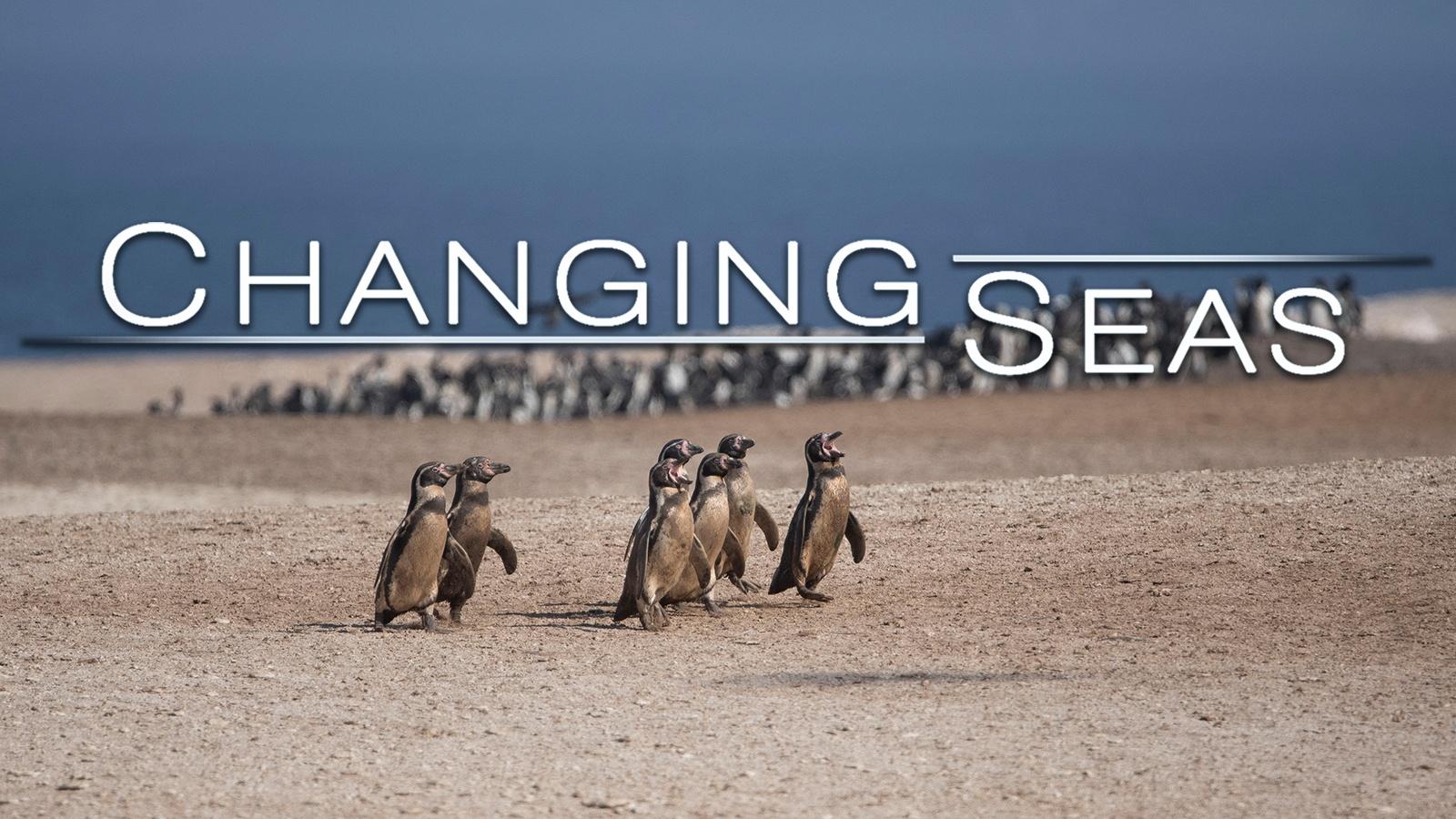
Peru s arid coastline is home to one of the world s great natural spectacles. In Punta San Juan, where the desert meets the sea, the seabirds reign. These are like some of the largest aggregations of seabirds in the world. And they aren t alone thousands of South American sea lions and fur seals add to the impressive cacophony of sounds. You can find so many numbers of animals in a small place. It's so unique. It is amidst this explosion of life - these hundreds of thousands of guanay cormorants, Peruvian pelicans and Peruvian boobies, that another, slightly clumsier, species of bird lives as well. Punta San Juan is the most important breeding colony for Humboldt penguins in Peru. We can have 2000 breeding pairs reproducing at the same time. Humboldt penguins are very charismatic. The reason why Humboldt penguins are living so far north near the tropics is because they live in an environment with cold water. These flightless birds may look adorably goofy on land, but they are highly adapted for life at sea. They are like torpedo-shaped seabirds It's like they fly underwater and they can reach high speeds, they are very, very fast swimmers. What is life like for a desert penguin? And what challenges do these animals face in today s ever-changing world? Major funding for this program was provided by the Batchelor Foundation, encouraging people to preserve and protect America s underwater resources and by the Arthur Vining Davis Foundations, strengthening America s future through education. Additional funding was provided by The William J. and Tina Rosenberg Foundation and by the Do Unto Others Trust. This is an avian domain. Located in Peru s southern Ica province, Punta San Juan is part of the Peruvian government s national reserve network of 33 islands and peninsulas. This reserve s objective is protecting seabirds and marine mammals. Especially seabirds that produce guano. Initially this all started just for the guano birds. To have more guano and be able to export and sell this commodity. This was a very important economic activity in Peru in the past. After a while we also started taking into consideration other species. So there were laws to avoid, for instance, hunting penguins and protecting fur seals, sea lions. Guano - the poop produced in large quantities by guano birds like guanay cormorants and Peruvian pelicans and boobies, is harvested commercially for use as fertilizer. Peru is the largest guano producer in the world, and its guano reserves are co-managed by two government agencies the Agriculture Ministry s AGRORURAL which monitors the guano birds and oversees the harvest process, and the Environmental Ministry s SERNANP, which is in charge of managing the reserves. At Punta San Juan, these two agencies work in partnership with scientists from the Punta San Juan Program, a long-term monitoring and field research project. Around the 80s, Dr. Patricia Majluf started researching fur seal ecology and population dynamics here at Punta San Juan. Later, researchers came not only to study fur seals, but also penguins. Field coordinator Marco Carde a is passionate about the Humboldt penguins. He s been monitoring the local colony since 2001. We do weekly counts to see how the population is doing over the years, and then we can make annual, seasonal and overall comparisons. The cold Humboldt current is what makes this region one of the most productive marine ecosystems in the world. As trade winds push the Pacific ocean s upper layer of water offshore, it s replaced with colder, nutrient-rich waters that well up from the deep. These nutrients fuel plankton growth near the surface, which forms the base of this vibrant marine food chain. Punta San Juan is special because it's close to the core upwelling system of the Humboldt current. The distance from the coast to where food is available is fairly short. This allows the animals to return for mating and breeding. At Punta San Juan, Humboldt penguins have two breeding periods each year. One starts in April going until July, and the other one goes from August or September until December. At Punta San Juan Humboldt penguins breed in three different types of nests. The first ones are on the edge of these clifftops, in areas where there is a lot of guano. The other type of nest they use is what we call a burrow. They are like holes with tunnels inside. And finally, we have a nest that appear between rocks and boulders on crevices. Given the penguin s skittish nature, scientists monitor the superficial nests from a safe distance. Humboldt penguins are very scared of humans. And if a researcher approached these nests, it will create a chaos and a lot of these nests will be lost because if they leave the nest content without protection, seagulls, turkey vultures will predate on them. We monitor them with help of a telescope. We count the nests, we count the number of pairs breeding there, the number of adults, the number of chicks and this help us understand their breeding cycle and also their population trends. Humboldt penguins tend to be monogamous, and after mating the female lays two eggs, roughly four days apart. These two eggs are cared for by both parents. They take turns staying with the eggs during the 40 day incubation period. Once the eggs hatch, both parents take turns feeding the chicks over a 72 to 75 day period. To find food, groups of penguins leave their nests each morning to make the long journey across the barren desert and down steep cliffs to reach the sea. Along the way, the hesitant birds frequently stop to contemplate their next move, or get scared and turn around. And sometimes, aggressive and raucous neighbors block the path. Once the penguins reach the water, it s time for a bath. The birds need to preen and streamline their feathers to insure proper insulation before venturing out to feed in the cold water. Meanwhile, the nesting colony is a loud and busy place. Patient parents guard their nests and chicks while they wait for their mates to return from the sea. The daily reunion is a happy occasion marked with an elaborate ritual. Soon, the hungry chicks will start begging for food, which the returning parent regurgitates for them. Eventually the parents stop feeding the chicks, so the chicks can leave the nest with their parents, or with other adults, to venture on their first trip out to the sea. To gather more in-depth information about breeding penguins, experts visit certain nests once a week for a more hands-on approach. We select nests that are better protected or covered, where the adult wouldn t be able to escape or abandon the eggs or the chicks. The scientists check on the embryonic chick development inside the eggs, and they also work up parents and chicks. So, this is a Humboldt penguin chick, it s about four or five weeks old, and you can see it has a specific type of feathers that only chicks have, it s not waterproof, these kinds of feathers. We measure their flippers, their feet and their beak. Tape on the chicks flippers indicates which one hatched first. Scientists also weigh the animals This one is one kilo and 300 grams. and record similar measurements of the parents, as well as check their microchips for identification. It allows us to observe any changes in the incubation period or the chicks growth rate. By weighing and measuring the chick we obtain information about the parents feeding. Tagging the animals allows us to track the age of individuals, the couple s faithfulness as well as their breeding times. The handling takes no more than 7 or 8 minutes. We are the only breeding colony that has such a long-term data set. We have at least 18 years of information collected using the same methodologies. After the adults reproductive period ends in December, they undertake a very long trip to over-feed themselves, to prepare for the coming molt. The three week long molt allows the penguins to replace their worn feathers with new plumage. This will ensure proper insulation when they eventually return to the sea to replenish their fat reserves and start the breeding cycle again. During this molt, they stay on the beaches, which is the best time to count the penguins along the entire coastline. In the 1850s, naturalists visiting guano islands estimated that the population ranged in the hundreds of thousands. Because of drastic declines and ongoing fluctuations since then, the International Union for Conservation of Nature currently lists Humboldt penguins as vulnerable. Humboldt penguins aren t well studied overall, and experts say it s difficult to estimate the population across the penguin s entire breeding range, which runs from Foca Island in northern Peru to Metalqui Island in southern Chile. This is due in part because of the challenges that come with counting animals along the remote and rugged coastline, but also because of inconsistencies in counting methods between Peru and Chile. The Chileans have conducted the census while penguins were breeding, and we ve done it during the molting period. In the future, both Chile and Peru needs to have a unique protocol for counting so we can compare our numbers and have a total account of Humboldt penguins in the whole range. In 2015, there were 20,000 penguins in Peru. The number has been decreasing, and Peru s population is now down to 9,300 individuals in Peru, according to the latest counts from 2019. Penguin population numbers are prone to fluctuate because of changes in food availability caused by El Ni o events. During El Ni o years, the winds weaken, causing the upwelling of cold, nutrient-rich waters to cease. The consequent warming of the ocean surface further weakens the winds and strengthens El Ni o. Major prey species such as anchovy move to deeper waters and further south. So that means that the predators like penguins, sea lions and all the species that depend on the anchovies are in crisis because anchovy disappear. They cannot hunt them because they are either too deep or too far away. Penguins also face many man-made threats that can negatively impact their population numbers. Historically, guano harvesting had the biggest impact since penguins rely on guano for their nesting material. And the guano campaigns extracted all the guano with no regards for the breeding areas of this species. The use of guano as fertilizer traces all the way back to the Incas, but it didn t really start taking off commercially until the 1850s, when increased demand from Europe turned guano harvesting into a lucrative enterprise. Guano workers used to hunt or poach the penguins to be sold in the local market for food. And also a lot of disturbance on the penguin colony. So they harvested the guano where the penguins were nesting. Starting in 2001, the Punta San Juan Program began working closely with the Peruvian government to make the local guano harvest there more sustainable. For example, they no longer harvest in an area that extends 15 to 20 meters inland from the cliff, so the penguins have guano for their nests. And in 2007 and in 2012, improvements were made by planning the harvest around the guano birds and the penguins breeding seasons. To provide the penguins with safe passage along their daily feeding paths, visual barriers were placed strategically to conceal the workers from the skittish birds view. And that's been very successful. I think the conditions are getting better and programs at Punta San Juan can be used as models for others sites for guano harvesting. In addition to humans, a number of natural predators also pose a threat to the penguins on land. In the 1940s walls were built around peninsulas like Punta San Juan to increase guano production by creating artificial islands where the birds could breed without disruption from people or other terrestrial predators. Today these walls are starting to crumble, giving stealthy hunters a way in Lately, one of the concerns we ve had is that foxes are coming in much more frequently. This definitely has an impact, not just on the penguins, but on the other species like the guano birds. One fox here can eat 20 penguins, 40 penguins in a year. And this might sound a small number, but this is not sustainable in time. Captured foxes are relocated elsewhere, but they aren t the only predators that have found their way onto the reserve So this area are nests of the penguins and also the Inca turns and we find the rats here. Lyanne Ampuero works as a research assistant for the Punta San Juan Program. In 2014, while working on a study on Inca terns, she discovered signs of rats near the bird s burrows. I discover like forty nests with eggs and were all of them were predated. What I immediately do is set traps. The next morning I trap a couple of rats. That was really like shocking for everybody. If penguins leave their nest, rats will also eat their eggs or attack chicks. To eradicate the problem, Lyanne is experimenting with a variety of traps and plans to use a type of poison that only impacts the rats, but not the seabirds which may feed on their carcasses. And predators aren t the penguins only current threats. Across their range, habitat loss, pollution and overfishing all pose issues. The anchovy fishery is very important for the Peruvian economy. Every year between four or five or six millions of tons are fished by the commercial fishery. And the effect on penguins and other seabirds is direct. So less food, less numbers of animals. While the reserves offer protection on land, the animals are largely unprotected while at sea. Here in Punta San Juan, it's only protected 200 meters from the coast. And that's it. To better understand the penguins life at sea, and suggest future protections, scientists have started studying their movements and foraging behavior. Dr. Carlos Zavalaga, has studied penguins off and on for the last 30 years. In the fall of 2019, he and his students conducted seabird research on Gua ape Norte, a remote guano island in the north of Peru. Now we have about quarter million of Peruvian boobies here on Gua ape Norte and about 150,000 guanay cormorants. So they are breeding in large numbers. There are probably around a thousand Humboldt penguins on the Island. Carlos is also conducting a study that looks at the interaction of penguins with fisheries that use nets close to the islands where penguins nest and rest. One of the major reasons why Humboldt penguins are in low numbers, at least in comparison to historical records, is because they die as a consequence of entanglement in fishing nets. Between 92, 93 and 94 about a thousand of penguins died entangled in fishing nets around the Punta San Juan area. And we don't know how often it happens. It's very difficult to monitor and so what we want to know is where the penguins are going when they are feeding. And at the same time where are these fishing boats fishing, based on interviews to fishermen and other sorts of data. To identify areas where the penguins might overlap with the fishing vessels, Carlos attached specialized data loggers on nesting penguins at Pachacamac Island, near Peru s capital Lima. All of them need to have small chicks we need to be sure that the penguin will come back to the nest because we need to recover the device. And then we take the penguin out from the nest and attach the logger on the lower back using a waterproof tape. And then we release again the penguin in the nest. These loggers are capable of recording depth and location every 10 seconds, giving experts an idea of where the animals travel to feed. We return two or three days later and again recapture the penguin and retrieve the logger. And then we return the penguin to the nest, then we are ready to download information to the computer. Past tagging of penguins on Pachacamac Island showed the animals traveling in all directions. But the most important finding is that the two mile protected area around Isla Pachacamac is not enough to protect them. They go 20, 30 miles away looking for food. And this area, just watching the preliminary data, is also an important area for fishing. We need more data of course, but with this preliminary results, we can see that the area of overlapping between penguins and the fisheries is very high. Carlos says once he has collected all the necessary data he plans to present his findings to the government, so it can consider extending protected areas where fishing isn t allowed or require fishing gear that minimizes the bycatch of penguins. Penguins have long captured the hearts and minds of people around the world. And like us, they depend on a healthy land and sea to survive. If they disappear, that means that we are changing things in such a way that it could affect the way we live. This is like a mirror for us, if they are well there are indicators that the whole system is well. Major funding for this program was provided by the Batchelor Foundation, encouraging people to preserve and protect America s underwater resources and by the Arthur Vining Davis Foundations, strengthening America s future through education. Additional funding was provided by The William J. and Tina Rosenberg Foundation and by the Do Unto Others Trust.









 Passport








Follow Us