








PBS Wisconsin Passport
Watch this video with
PBS Wisconsin Passport
Become a member of PBS Wisconsin, support your local community, and get extended access to PBS shows, films, and specials, like this one.
Fishing the Flats for Science
11/01/18 | 26m 42s | Rating: TV-G
Flats fishing is popular with recreational anglers in the Caribbean and the Florida Keys. But until recently, little was known about tarpon, bonefish and permit – the species most coveted by sports fishermen. Now scientists are studying the fish to better understand their movements, habitat, and spawning behaviors.


Copy and Paste the Following Code to Embed this Video:
Fishing the Flats for Science
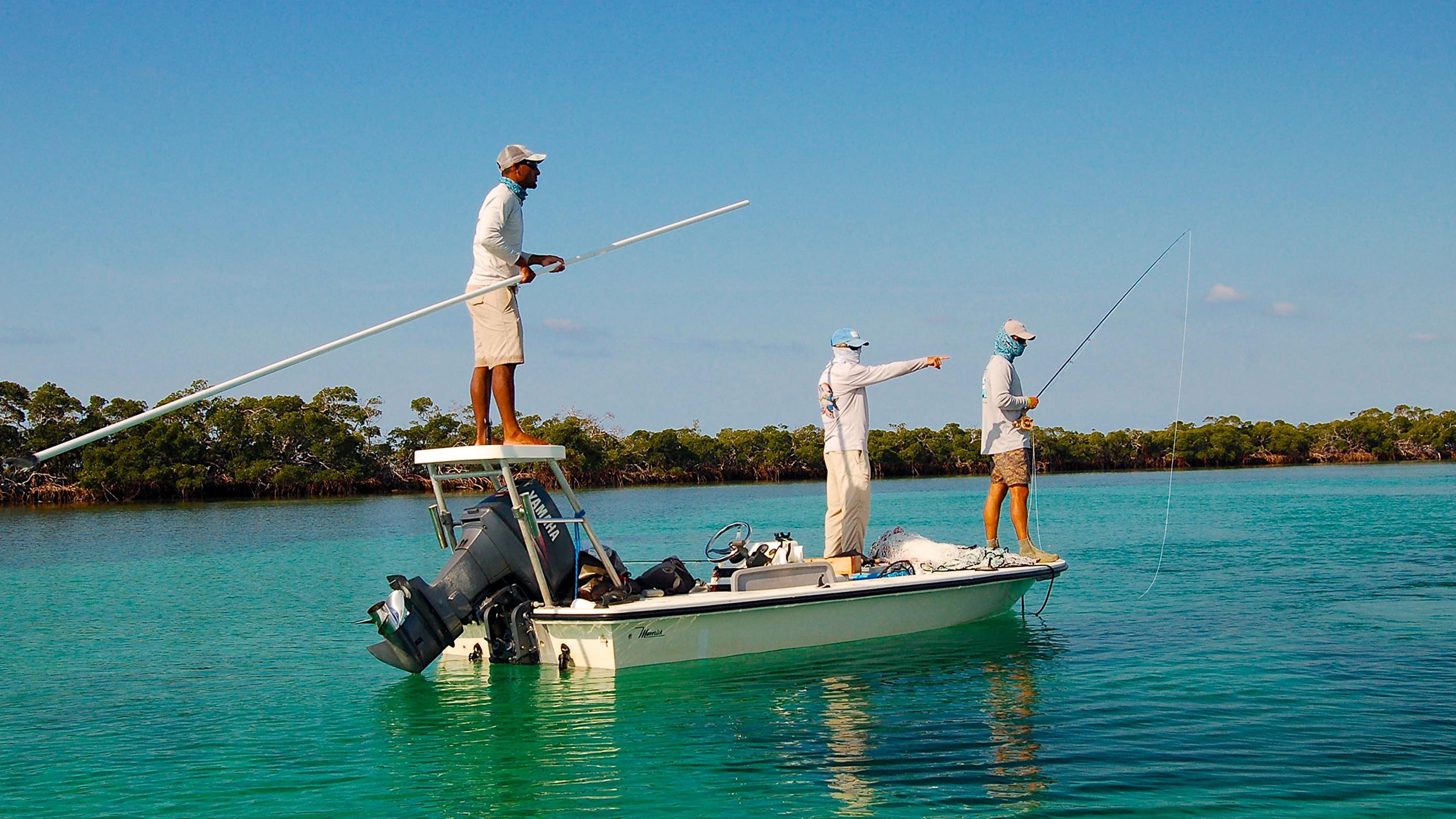
They are vast expanses of serene, crystal-clear waters, as far as the eye can see. It is an absolutely unique place. It s usually less than six feet of water that is a matrix of sand, seagrass, little corals and sponges that offers good foraging grounds for many different species. The fish are just going about their business. You just see them in their own element eating and cruising and it s really neat to see. These are the Flats - a place where recreational anglers pursue the legendary bonefish, tarpon and permit. There's no other place I'd rather be fly fishing than on the flats. Flats fishing is just a very romanticized, dramatic thing. It s just the allure, poling around these flats and trying to find a fish. Oh, come on. What is that? Is that fish? Flats fishing is not like you drop a piece of shrimp to the bottom and wait for the fish to eat it. Flats fishing is a hunt. It's very much a stalking game, it's like hunting except you get to release the fish when you catch it. You actually have to see the fish before you throw the fly. You're trying to trick a fish into eating a completely artificial fly that you've often tied yourself out of materials. It's pretty challenging especially when weather conditions aren't in your favor. You're not thinking about anything else when you're out on the flats. Research commissioned by the Bonefish and Tarpon Trust has shown these recreational fisheries are worth big money. There s a study, in 2009, in the middle of the recession, found that the annual economic impact of the bonefish catch and release fishery in the Bahamas was 141 million dollars. We are in the process of redoing that study now and preliminary estimates are that it's more than 200 million dollars. In the Florida Keys, the flats fishery, which is bonefish, tarpon and permit, the annual economic impact is over 460 million dollars. But in some areas, these fish are on the decline. In order for us to pass this down, we have to secure what we have now. And in order to do that, you've got to work with the researchers. What does scientific research reveal about bonefish, tarpon and permit? Can it help to ensure their survival into the future? Major funding for this program was provided by the Batchelor Foundation, encouraging people
to preserve and protect America s underwater resources. And by
Diver s Direct and Ocean Divers; The Do Unto Others Trust; The Charles N. and Eleanor Knight Leigh Foundation. And by the following. The Florida Keys - fabled fishing grounds where history is made. The Keys is really the birthplace of the flats fishery, it started here post World War II and has just really has taken off since. In the world of fly fishing and saltwater flats fishing, the Florida Keys is hallowed grounds in many ways. People come from all over to the Florida Keys and try to catch some of the tarpon, the permit, the bonefish that are found in the flats in the back country here. So that's really important to this community, not only economically but also culturally. On the Florida Keys heyday, it was the world number one destination to go flats fishing. Islamorada was the fishing capital of the world. But now, we've virtually lost our bonefishery. By the 1990s, guides and anglers had noticed a major decline in bonefish. To understand what was happening, a group of them came together in 1997 and created what is now known as the Bonefish and Tarpon Trust, or BTT for short. They quickly realized that nobody knew anything about bonefish, tarpon, or permit from a scientific perspective so they became a science-based conservation organization. BTT conducts some of that research with our own staff, but we also do a lot of external funding, So, we'll work with colleagues in universities, other non-profits to get a lot of research done. Experts speculate one of the reasons for the decline in bonefish could be habitat degradation and loss. The basis for healthy fisheries is healthy habitat. We have water quality issues from leaky septic tanks that occur in the Lower Keys and major water management issues in the Northern Keys that have caused algal blooms and sea grass die-offs at unprecedented scales. We're seeing some issues with pollution, things like nutrients and other contaminants getting into the water that impact the habitat quality and potentially even the fish themselves through disease or parasites. We let the data lead the way and advocate for the types of regulations and restoration that are needed to fix the system. Nicknamed the gray ghost, bonefish are listed as near threatened by the International Union for Conservation of Nature, and in Florida, they are catch and release only. The species of bonefish that we fish for in the flats, albula vulpes, is one of four species total in the Caribbean and one of three that you might catch on the flats. But, albula vulpes is well over ninety-eight percent, ninety-nine percent of what anglers catch and you can't tell a difference by looking at them, it's only genetics. Where d they go? I see tailing fish. BTT scientists quickly realized that to understand bonefish populations and behavior they needed to expand their research to a regional approach. One place where bonefish populations are still healthy is the Bahamas. Bonefish are very culturally significant to the Bahamas, you can find it on our ten-cent coin, and people have been eating bonefish for generations, it actually used to be a staple of the Bahamian diet prior to food imports coming from abroad. The only way you can legally catch bonefish is via hook and line and that's for your own personal consumption, there's no buying or selling of bonefish. These days, the majority of bonefish are caught by sports fishermen who practice catch and release. To make management recommendations that adequately protect the fish and their habitats, experts needed to understand their movements. A lot of marine fish aggregate to spawn, they don't spawn where they live most of the year. We wanted to figure out from how far bonefish will travel from a home site to a spawning location. To do so, scientists capture the fish and tag them. We use a 50-foot soft mesh seine net, that's about four feet deep. Once we spot a school we'll try to basically encircle them. Once we've encircled them, we'll take a few fish put them in a holding pen, and then we'll start working them up from there. First thing we do when we work up these fish, we're going to pop them on our measuring board, get a fork length measurement, we're going to put a tag in that fish. We'll also use a syringe with a plastic tube and we can sample eggs from the females and determine if they're spawning ready. In addition to the external dart tags, scientists also surgically insert acoustic tags in some fish. We put them in large females. Because those are the ones that are definitely going to spawn. Acoustic tags put out a supersonic ping, that we can't hear but we have underwater receivers that can detect those pings. These underwater receivers are placed at regular intervals across a study site. Each time a fish swims by a receiver its individual ID is detected and recorded for download later. Looks like we got a bunch of detections at the full moon at the beginning of March and then we had fish 11790 show up just today. Over the last eight years we've been doing work in the Bahamas, we've tagged over thirteen thousand bonefish around the Bahamas and had close to seven hundred recaptures. Seventy-two percent of them were caught within a mile of where they were originally tagged. And then of that 72 percent, 69 percent were caught in the exact same spot. So, these fish have really, really small home ranges. But, we also found that they'll make really long-distance movements for spawning. We were able to see that was around the full and new moon between October through April, which is spawning season. We've had multiple fish from the west side of Abaco do 140 miles round trip just to get to a spawning site and back. We also had one fish, it was also tagged out in Abaco as part of a spawning run, and then was caught later on the north side of Grand Bahama. During the day, bonefish that are ready to spawn gather in groups, or so-called pre-spawning aggregations, near deep water, before moving offshore at night. As the sun sets they become more active and you'll see them starting to gulp at the surface or even jump out of the water and porpoise. It's pretty unique from a biological standpoint. And it really only happens for about 20 minutes, half an hour as they're making that movement from these transitional habitats to the deep drop off. And we're kind of hypothesizing that they're actually gulping air to fill up their swim bladders and maybe fill up their gastrointestinal tract and then they go off the wall down deep and that compresses the air and at the same time they're making their eggs really big and puffy and slippery. And when you go down the air compresses, and if you come up fast the air expands and it helps to push the eggs out and then the male then releases the sperm, and then they fertilize the eggs and then drift around in the ocean. The eggs hatch offshore in open water and drift around as larvae for about 40 to 70 days. Eventually the larvae move into shallow, inshore waters where they settle and metamorphose into baby bonefish. The theory is that when fish spawn offshore, the ocean currents transport some of those larvae back to the same area where the fish grew up. But then some of the larvae are transported to other islands, so that gives their genes a chance of surviving even if there's a catastrophe in the location where the parents grew up. And since we live in a place that has high frequency of hurricanes, that's a pretty good strategy. To understand exactly where the currents might take the larvae, scientists conducted computer modeling research. And that has shown that there's a high probability of connectivity between the Florida Keys, southwest Cuba, the Yucatan Peninsula like Mexico and Belize, and other locations. And it looks like there's a lot of connectivity between the north coast of Cuba and the Bahamas. Understanding how bonefish populations are connected helps scientists determine if conservation strategies should be local or regional, and knowing fish migration routes and spawning locations allows them to advocate for habitat protection. Fish populations can recover from overfishing, but if they lose their habitats the game's over. We've been working with Bahamas National Trust and Nature Conservancy in the Bahamas to use some of our information on bonefish habitat use, spawning migrations and spawning sites to help them identify places for protection. The Bahamas National Trust is charged with managing the natural resources of the Bahamas and the Trust manages 32 national parks. Back in 2015, we got five new national parks put in place. And this was based mainly on the work that was conducted through the assistance of Bonefish Tarpon Trust. The main purpose of these parks was to stop unsustainable development, so for example the East Grand Bahama Park was under threat of sand mining, so if that happened, that would have not only possibly killed off the bonefishery but a lot of other economic important fisheries. We do a lot of work with the fishermen, the guides, the communities, Bahamas National Trust and other organizations on education. Because conservation will only work if the people who live in those areas buy into it. It's a lot of, you know, stuff that they share with me that I had no idea. So, they educate a lot of the guides when they come here. Even though I know a lot over 19 years of doing it, the science part of it is new for me and it helps me understand some stuff I was wondering about years ago. So, we're working now to take what we learned from the Bahamas and figure out where exactly they spawn in the Keys so we can not only protect those areas, but understand how those areas are being used, how things like pollution or boat traffic may impact that and also look at migration pathways. Eat it, eat it, eat it, eat it! Another popular game fish that spends time on the flats is the Atlantic tarpon, whose range extends from the U.S. to Brazil and Africa. Tarpon and bonefish are in the same family. They're a very old lineage Small tarpon- we're talking like six to twelve inches. Medium size, you'll get into the 50-pound range. And then big tarpon, two hundred plus pound. Recreational anglers like to target them because of their size and the fact that they jump. That's pretty, pretty dramatic and really gets the heart pumping. The last 20 feet bringing them to the boat is the hardest. Nicknamed the Silver King, tarpon migrate to the Florida Keys between March and June. A lot of times we'll see you know, thousands of fish under the bridges cruising through the Lower Keys and the Middle Keys. These are basically pre-spawning aggregations. We have yet to identify where they're spawning offshore. Recreational anglers enjoy hooking the fish that aggregate beneath the bridges, but they aren t the only ones looking for a catch. Large sharks often prey on tarpon fighting on the line, or exhausted fish that have been let go. This has scientists worried. As soon as they re stressed or tired and the sharks kind of win. You know, is fishing for them under the bridges having a significant impact on their populations? As an angler and as a scientist, I want to answer it for both sides. It s understanding the predator-prey interactions that's really going to be the next step in terms of tarpon ecology and tarpon conservation. Like their colleagues in the Bahamas, Andy and his team from the University of Massachusetts Amherst, also use acoustic tags to track the movements of tarpon. We're tagging from all the way around the west coast of Florida up into the Carolinas. Tarpon spend time in a variety of habitats ranging from offshore to inshore wetlands and coastal estuaries. With acoustic telemetry we can put these tags in tarpon that are 15 pounds or a 150 pounds. And that's allowed us to really start to uncover some really neat movement patterns that we wouldn't normally have predicted. So, for instance we ve had some tarpon that were tagged in the Lower Keys, that are in the 40 to 50-pound range that we wouldn't necessarily equate to a fish that's migrating a lot, to then have shown up past Cape Canaveral and then returning back to the Keys for successive years. We had one of our tarpon that was tagged here show up off of the Chesapeake. And so that's, that s pretty major. The acoustic telemetry is great, because there's a lot of other scientists that use the same receivers and it allows us to share data. The International Union for Conservation of Nature lists Atlantic tarpon as vulnerable, based on past harvest and habitat loss. See that group right there of happy guys going left? Currently their management varies by location, creating potential conservation challenges along their migratory routes. In Florida, tarpon are catch and release only except for people who want to harvest the tarpon for a world record. In order to do so they have to have a special tarpon tag. Fish that are over forty inches in length have to stay in the water, you can't bring them into the boat. There isn't a lot of harvest in Florida, but if they go to other states where they're still legally allowed to be harvested, then that's a concern. I think we all have to work together to think about the conservation of these species. Because of their migratory nature and the fact that they get intercepted all along the way, the economic value of the tarpon fishery is huge. Most fly-fishermen agree that of the three species they like to catch on the flats, one is the most challenging. You might consider bonefish the gateway drug. And then you migrate up to tarpon, which is a little bit harder. The inevitable end of the road leads to permit. It's right at the top of the fly-fishing food chain as far as being difficult and hard to do. Even God has a hard time catching permit on fly. You can do everything exactly right in your mind, at least, and they still might not eat your fly. Permit are one of the more spooky fish that exist and it s really just the chase, the chance and the glory of just holding that fish that really drives people. It's a lifetime achievement for many of the anglers that come down here. Just how difficult it is to catch permit on fly is evident at the March Merkin invitational fishing tournament held in Key West each year. You look at a three-day tournament with 26 boats and one team caught two fish. Last year one team caught one fish and granted we had really tough weather, but it's - it really is like a legitimately special thing. It's very difficult but these guys are some of the top people in the world, top anglers and top guides that fish this tournament. That s a perm-perm. Oh boy a little close. Fudge, oh he s coming back for it. Did he eat it? No. These fish see a lot of angling pressure and when you catch them often, they get smart about it. It's definitely the big leagues of fishing down here. It s probably- the permit fishery down here has got to be one of the best, but also one of the most challenging in the world. Proceeds from the March Merkin tournament help to fund Project Permit, a research project spearheaded by Dr. Jake Brownscombe from Carleton University. Permit are in the jack family. 60 pounds is the world record. They're found only in the Western Atlantic, Caribbean Sea and the Gulf of Mexico. Because there's no monitoring done on these species, we don't really have a sense of exactly what's been going on with their population numbers over time. From my experience interacting with the fishing guides down here, especially those that have been around for quite a while, the permit numbers have been declining pretty significantly. So that's got me personally very concerned about these species. Permit spend time on the flats as well as on nearshore reefs and wrecks. In 2016, Jake started an acoustic tracking project in the lower Florida Keys. The goal is to better understand the permits movement patterns. Whether they're moving throughout, all the Florida Keys, or connecting up farther north in Florida or if they remain resident in smaller areas. As well as whether they're moving between the flats, and the reefs and the shipwrecks. This is particularly important information because on the flats, it's primarily a catch and release fishery. On the reefs and on the shipwrecks, they have a tendency to be harvested more often. It's just a different group of anglers. In the first year of tracking we found that over forty percent of the fish that visit the flats also go out to the Florida reef tract. Many of these fish are doing it multiple times a year and again always returning back to the exact same flat. Even if it's 50, 60 miles away. So that's telling us that these fish that are comprising mainly a catch and release fishery here on the flats are also becoming more vulnerable to harvest through that other fishery on the Florida reef tract. This connectivity is particularly important during spawning season, when the fish are especially vulnerable to fishing pressure. They spawn in big aggregations where they migrate in mass off to offshore wrecks and reefs. This is a really important part of their life cycle where they're contributing to the population. And so, we need to understand when and where that they're doing this spawning behavior and try to afford them some protection when they are doing that. In 2011, at the urging of local guides and the Bonefish and Tarpon Trust, the Florida Fish and Wildlife Conservation Commission created a Special Permit Zone. And that changed the regulations for permit. It made a closed harvest season within the Keys where people couldn't keep permit during their spawning season, which at that time was documented from May to July. The new regulations also changed bag limits during the months when harvest is permitted. You can keep one fish per day over 22 inches in fork length. Outside of that zone the regulations are not as strict. But in recent years, new information about spawning times came to light. Anglers reported to us that permit were spawning a month earlier than they used to twenty years ago. And they reported to us that people were going out there and harvesting these spawning fish at pretty high numbers and they were not being protected by the closed season that's already in place. These observations were confirmed by the tracking study. They're actually showing up on the reef in very specific spots in these very large schools starting in April. And so, using that information we were able to get the harvest closure period extended to cover April as well. So, this is a really important conservation measure, and we're really happy that we were able to make a difference in the management and conservation so quickly with this project. It s very exciting and we're all very proud of this accomplishment. The Bonefish and Tarpon Trust, together with its scientific collaborators, is using research findings to conserve and restore the flats fisheries for many generations of anglers to come. And they re joined in their efforts by local fishing guides, who share in their mission. A lot of them donate their time to helping us out to tag these fish. It wouldn't be possible to get this done without them. I think they've become really good friends and allies in the research and also understanding that how the data from this work can lead to conserving bonefish and tarpon and permit. You need to protect what you love to do try to keep it around for as many generations as possible. Our goal, and BTT's goal, is to save the fisheries for the future. Major funding for this program was provided by the Batchelor Foundation, encouraging people Diver s Direct and Ocean Divers; The Do Unto Others Trust; The Charles N. and Eleanor Knight Leigh Foundation. And by the following.
Search Episodes

Donate to sign up. Activate and sign in to Passport. It's that easy to help PBS Wisconsin serve your community through media that educates, inspires, and entertains.
Make your membership gift today
Only for new users: Activate Passport using your code or email address
Already a member?
Look up my account
Need some help? Go to FAQ or visit PBS Passport Help
Need help accessing PBS Wisconsin anywhere?

Online Access | Platform & Device Access | Cable or Satellite Access | Over-The-Air Access
Visit Access Guide
Need help accessing PBS Wisconsin anywhere?
Visit Our
Live TV Access Guide
Online AccessPlatform & Device Access
Cable or Satellite Access
Over-The-Air Access
Visit Access Guide




Follow Us