








PBS Wisconsin Passport
Watch this video with
PBS Wisconsin Passport
Become a member of PBS Wisconsin, support your local community, and get extended access to PBS shows, films, and specials, like this one.
Eau Claire
04/04/19 | 26m 46s | Rating: NR
Eau Claire really IS the definition of renaissance. As John Gurda said, if you were familiar with this northwestern Wisconsin city 20 years ago, you’re not familiar with it now unless you live in Eau Claire!


Copy and Paste the Following Code to Embed this Video:
Eau Claire
It's a chilly day in Northwest Wisconsin. This is our fall episode in Eau Claire. (upbeat music) So it took us eight seasons but we're here. We're in Eau Claire. Which is a really large city in this part of the state and we're in Eau Claire. Finally. It's a nice city. It is. Yeah well what does Eau Claire mean? It means clear water, John. Clear water. In French, and that tells you a couple things. First of all this was French territory during the fur trade days. And secondly it's one more city that was built on water. We've heard that story before. -
John M
A few times. -
John G
Once or twice. It came to life right here at the confluence of the Eau Claire and the Chippewa rivers. Early on they were highways that moved both people and goods for millennia actually. And then in more recent times it became kind of channels for lots of logs and lumber making one way trips downstream. -
John M
And when did that begin? 1840s, when lumbering starting. And the bigger river here is the Chippewa, drains a huge portion of Northwest Wisconsin. And that watershed was pretty much covered with these dense forests of white pine. So the Chippewa was big enough to float all these logs downstream to the Mississippi, it's about 50 miles downstream from us. And had the power to drive mills as well. So Eau Claire had both logs and lumber. And two sides of the same coin. It's hard to believe today, but there's one report that said that during the peak of the spring log drive, 10 million logs floated through Eau Claire every single day. -
John M
Which is, the thought of that's remarkable. -
John G
It is. The thought of someone trying to count them. -
John M
Who counted those? -
John G
It's pretty amazing as well. A lot of them stayed here and they were sawed into boards and shingles and lath. At one time by 1870 there were 22 saw mills here. Most of 'em right here in this region. And they had lots and lots of jobs. 1872 the city incorporates with around 2300 people. A decade later it's got more than 10,000. So you have lots of people here. And all those mill hands had 110 saloons to choose from. -
John M
110 saloons. -
John G
110. That's a lot even by Wisconsin standards. -
John M
And so did that mean it was kind of a rough city? A rough time around here? Little rough for a few decades John. But it didn't last all that long. What happened was the destruction was so complete. The white pine were pretty scarce by the 1890s. So Eau Claire had to find something else to do. And it took a while but what they did was they turned from lumber to industry. So you had plants right around here that made everything from saw mill machines to pressure cookers. But the big one began in 1917, when Gillette Tire opened its first plant just upstream on the Eau Claire. That became as Uniroyal, by far the biggest employer in the entire area. About 1300 jobs. Uniroyal. Yup. Yeah, and is it still here? Closed back in 1991. It did, okay. And that caused a lot of anxiety. But Eau Claire was already in the process of reinventing itself. Back in 1916, which is a year before the tire plant opened, a state teacher's college had opened in the area just south of downtown. That became in time UW Eau Claire, which has around 10,000 students and is always ranked as among the top public universities in the Midwest. So a lumber town, a factory town, becomes a college town. So that's part of the transformation. More recently you have technology firms opening here as well. And a real cultural renaissance. And the key figure there is a guy named Justin Vernon, a musician, whose best known project is Bon Iver. He could live anywhere, but he has chosen to stay here and help make his hometown kind of an indie hot spot, and it certainly is. And it all comes together here downtown. I've spent time in Eau Claire over the years, haven't been back for a while. I didn't recognize the place! These new office buildings, new housing, new arts facility, new park land. So when you think of all the things that have happened here along the river banks, you've got the logs floating down, and factories rising from the banks. And now the arts flourishing here. It's a remarkable transformation. -
John M
Big transformation. -
John G
Yup. -
John M
Yeah, population? -
John G
About 70,000 and still growing. -
John M
And location? -
John G
West Central Wisconsin. And it's on the Chippewa and Eau Claire rivers right here. A bit north of Interstate 94 and about 80 miles east of Minneapolis, Saint Paul. And we've been here all day and it's a fall day. Our last episode and I'm telling you we've seen a lot of bikers. -
John G
Oh a lot. Wonderful trail. A biking mecca as well. -
John M
It is. The state trail down here runs for 30 miles and it's paved. Black top all the way down to Durand. -
John M
And is that where you've been all day? No I've been sort of trying to stay out of the rain John. Thanks John. -
John M
See ya John. See ya. Born in Eau Claire. Menards. There's 300 stores in 14 states, born right here in Eau Claire. Presto Industries. How do we know it? Presto pressure cookers. You know what they're known for now? Pizza ovens, air fryers, waffle makers. I have all of them! I'm standing in front of Banbury Place. I wish you could be here because I smell rubber. This used to be a huge tire company. Gillette Tire Company. It merged with Uniroyal and BF Goodrich. Then it became Michelin Tires. Now it's Banbury Place and we're going in to talk to an artist who works in this old tire factory. A lot of people don't know we're here. Yeah. Many people I knew worked here at Uniroyal. -
John
What else goes on in this building? We have people that upholster furniture upstairs. There's a few woodworkers in the building. Claymore Pottery. The guy that roasts coffee. This is James, he's from The Sticker Spot. Hey James. Art studio slash yoga. And then there's The Painted Lotus. That's another gallery. We have three fitness places now. This is it. This is my studio. It's pretty eclectic. Yeah. I have a lot of my stuff in here. A lot of friend artists. -
John
Who does the jewelry? I have a friend named Destiny. These aren't really for warmth. No they're for. It's for? Flair. Flair. -
Jeanine
You'd look really good with one on. Thank you. Allie does the horse paintings you see in here. That's all done with her fingers. That horse painting. How long have you been in this space? It'll be two years in May. This pour painted stuff, this is the stuff we do in the workroom and a lot of people come in and we do workshops and they get to make them. It's called pour painting? So you're gonna fill this cup with the colors that you want. I wanna share art with people. One, two, three. That's what my main thing is. Not sharing just my art. But sharing art with people and letting people know that you don't have to be traumatized by art. You know how many people walk in my door and say I cannot do that? John, you are like an artist! And can I tell you they're all so different? -
Jeanine
They are so different. -
John
But it's a set. -
Jeanine
Right. -
John
God, I'm an artist. -
Jeanine
Yes you are. How cool is that? -
John
How did you pick this school to come to? I toured the campus, I liked it. Really it was just a hunch. I wanted to get the real college experience. You know you move away, you meet new people and that's exactly what I did. It's pretty nice actually. -
John
It's a nice campus. -
Jacob
Oh yeah definitely. Wisconsin's most beautiful campus actually. We got middle campus, we got upper campus. Where is the hill people complain about? Oh that's around the corner over there. It is? -
Jacob
You kinda base your day off of how many times you have to walk up the hill if you're a freshman, honestly. Probably halfway up you'll be out of breath. -
John
You're a senior now? -
Jacob
Yeah. Yeah, and you're graduating with a degree in what next year? Finance. And what are you gonna do? I actually just got a full time offer. You did? From my internship, yup. -
John
Congratulations, how great is that? Where are we right now? We're on the bridge. The famous footbridge. And where does it go, from where to where? From Water Street to campus. It's the connector. It's really the connector. Have you ever heard of bridge face? -
John
Bridge face, no, never have. Yeah bridge face. Walking across the bridge in the dead of winter. When your nose hairs freeze and you're drippin' icicles. It's called bridge face. Bridge face yup. -
John
And you get it? -
Jacob
Oh yeah you for sure get it! -
John
Only here. -
Jacob
If you choose to walk across the bridge that is. That's why you take the bus! The hill and the bridge. -
John
And what would you tell people if they were thinking of coming here? What would you tell 'em? -
Jacob
I would say just do it. Just do it, yup. It's a great decision. And this is Davies? This is the union? Yup, this is the student center. Everybody comes here in between classes. They get some food. There's a couple student org things in here that you can join.
Chancellor
So you're in the heart of the campus at least from the student perspective. WR Davies Center, it opened in 2012. This place is always hopping. So we have a little over 11,000 students on campus. This was the original dining room. We call it the heritage room. -
John
The heritage room. No charge, so students can make a reservation for this. We sometimes have candidate interviews. This institution went through a huge growth period in the sixties. You know we had fewer than 1000 students in 1960 and we went over 10,000 by 1970. It's a beautiful building. And it works doesn't it? It works really well. You know not only does it provide the food service, a place to study. But this is the entertainment hub of the campus as well. And when you have the state's largest and I would argue best undergraduate music program, this is a place to see any kind of entertainment. -
John
You would argue that would ya? Yes, do you wanna talk about it? (laughing) I believed you. We have a little slogan called The Power of AND. So you can be in the marching band and be a biochemistry major. Almost 10% of the student body is engaged in our music programs. Even though they may be an accounting major or a chemistry major. We're not gonna put you in a box. Yes, we're interested in what you're passionate about studying and we'll help you find that. But you're not just your major. You're more than your major. We have the only nursing school in the UW system west of Madison. So it's a very competitive nursing program. And we have some unusual programs like communication sciences and disorders. Speech pathology, therapy, et cetera. And that Master's program is the most competitive program we have. -
John
Can we talk about this tree? What is the tree? The tree is our Council Oak. It's called the Council Oak, because that is where warring tribes or tribes with different points of view, this is where they met to resolve those issues. To seek wisdom and reflection. And I will tell you every student on campus pretty much knows what the Council Oak is. So Jake you know the chancellor told us some stuff about campus.
Jake
I'm sure he didn't tell you about Water Street. He didn't say a word about Water Street.
Jake
Yeah, that's right! So there's really three parts to this town. There is downtown, there is campus, and there is Water Street. And here we are on Water Street. Right there, Pioneer Tavern, my sister's favorite. She graduated in '87. If you're over 50 I bet you love this bar. It's called The Joynt. It's famous for a great juke box, jazz, and blues, and folk. And it's the best bar in town as they say to talk and drink, The Joynt. If you're a student at UW Eau Claire, or you've been a student, since 2006 you know this place. Jake said come on join me. I'm like no, I've been in recovery 28 years. I was pickled for a long time in my life. No more pickling. Yeah but enjoy. Where are we going right now? We're going into the cook shanty and the bunkhouse. We're at the Logging Camp Museum. -
Rebecca
Paul Bunyan Logging Camp Museum. It's an 1890's logging camp. At this camp it would've been maybe about 30 to 40 men. -
John
Yeah, they would stay here for the duration. They would stay here for the duration of the logging season, which would usually be from early November until early April. Lumberjacks made a dollar a day. They worked six days a week from sunup to sunset. They didn't get paid until the end of the cutting season. But they came here and they slept here. They were fed. -
John
What did they serve? Was it typical fare? Well you know the food was high in fats and carbohydrates. The men had to eat about 8000 calories a day. Because that was your fuel to get out and work. -
John
And what happens here is that there's a huge amount of kids that come in here. -
Rebecca
We'll have different groups that come from the community too. So here we're going into the bunkhouse. It's a great tour for these kids then. And do they love it? Oh it's wonderful. They love it. They love it because you're really going back in time and being in a building with artifacts that actually were used by lumberjacks here in Wisconsin and in this area. This is where you're gonna spend your time when you're not out working or eating. You're sleepin' two down and two up. So you've got a bunk buddy. And y'all give off a little bit of body heat right? So you help to keep each other warm. Eau Claire really was founded on the logging business. But at one point there were 20 different saw mills here in Eau Claire. -
John
Was this a good job? I would think so. Because it was steady employment. You were being fed. It was a dangerous job. That's the big catch, that being a lumberman was not a safe job. In this bunkhouse there were fleas, lice, and bed bugs. Yeah. I did not ask for an application. Won't be working here. Ooh, I feel itchy! I am standing in front of the house where Pauline Phillips used to live. Yeah, she lived down the street from her twin sister Esther. Do you know who I'm talking about? Dear Abby and Anne Landers. They lived here for a time. They moved out in like 1955. And in 1972 Dear Abby wrote a love letter to the city of Eau Claire because she called it a sweetheart of a city. We have a historian and he said he had been here not that many years ago and that when he came back he didn't recognize it. There is something really exciting about Eau Claire, Wisconsin.
Zach
Yeah, if you go back 40 years, the downtown actually was let me say close to thriving. This is the Jamf Theatre. And in the mid eighties, that all stopped. Everything went out to the highway corridors. One of the largest black box theaters in the US. And this was kind of a ghost town. About 12 years ago, Royal Credit Union built their headquarters right across the river here in Phoenix Park. Phoenix Park was built by the city at the exact same time. And that was the first kind of major development in about 40 years down here. So that kinda paved the way about 12 years ago for all of this to start happening. -
John
We are standing, where are we standing right now? -
Zach
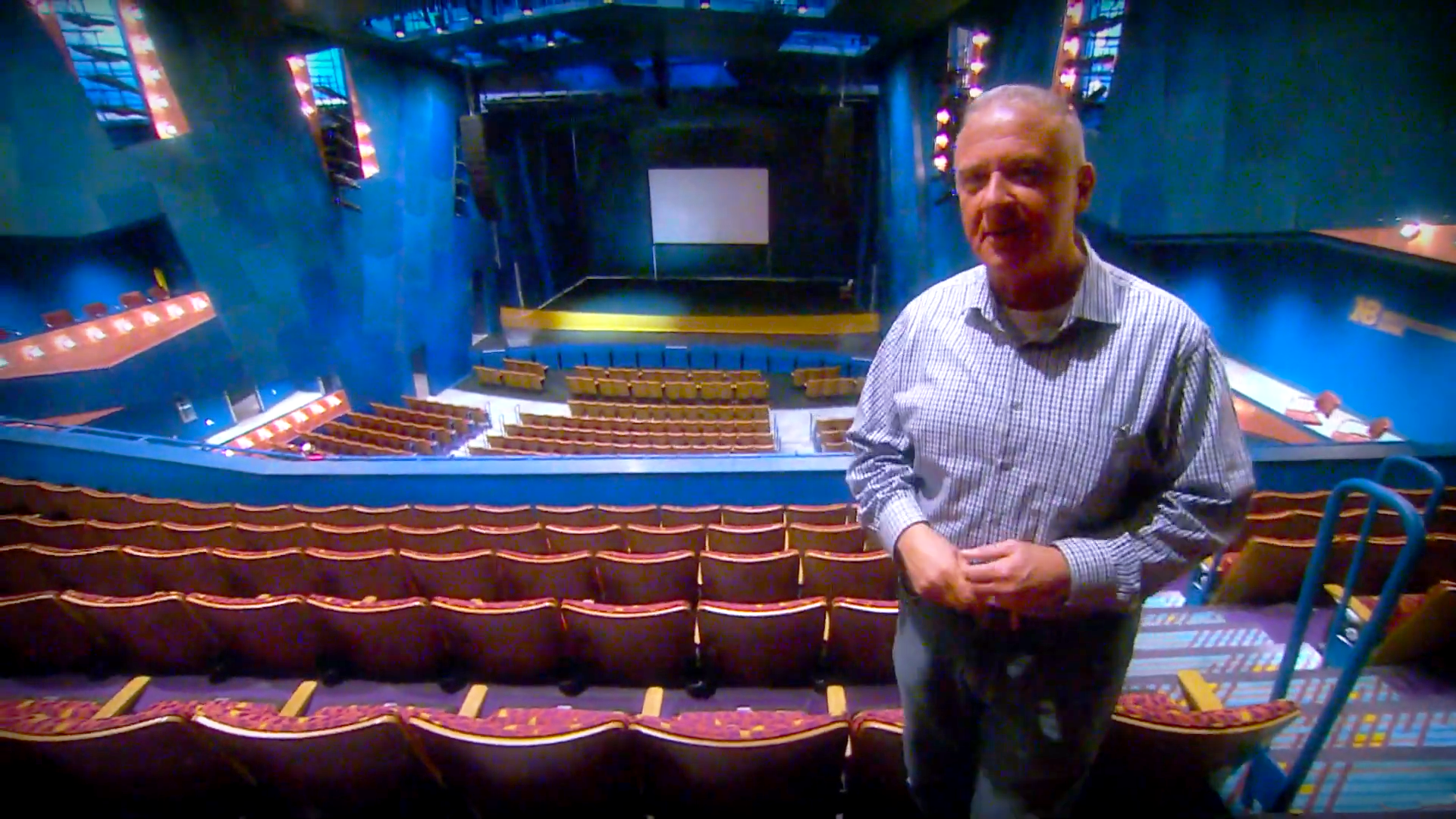
We are here in the Pablo Center at the Confluence. And then this building, when it was announced in concept really became this beacon of development. And this is the RCU Theater, which is the large theater at the Pablo. Just over 1200 seats. It's a remarkable theater. Yeah, you look at this idea of connectedness, and people of all generations want to be more connected than they wanted to be 20 years ago. And so you see all ages wanting to be part of these things and have these experiences. All around the building has really tried to be inclusive to make sure this is a community building available to community members and community organization. The next one that we were involved in was the what's now the Lismore Hotel. And we had this vision that downtown isn't dead. It's become a really popular kind of ad hoc meeting spot. We use it for meetings all the time. We actually have two apartment projects that we're working on right now. And it's been incredibly fun to be a part of and it's humbling for us to see all of these things happening. And this has been all about economic development. How do we kind of raise everything up and we're gonna be spending a lot of time making sure that there's opportunities and access for everyone to be a part of that.
John
Did you know Eau Claire has a huge bicycling culture? I'm in front of Shift cyclery and coffee bar. That's right, bicycles and coffee all in the same place. Nice. This is Nick Meyer. How are you sir? Good. You're the editor? You're the owner, Volume One? Yeah when we first started, there was of course a lot of media organizations telling the stories of the news of the day. But a lot of the cultural happenings of the community were kind of slipping through the cracks. When the very first issue of Volume One came out, people said well that's great, you covered everything there is to cover that was anything good in town. Now I mean, you know we put an issue out every two weeks and we can't even fit everything that's happening. We tell the stories and hopefully it inspires people to keep doing things. And then there's more stories to tell and it just, it keeps the fire burning. The resources are deep. I mean we have enormous amounts of information in the magazine about what there is to do in this community. But we really are, we're a little bit different because we're not just the paper. We also produce a lot of what's happening in the community too. This is the Sounds like Summer Concert Series. All original music, all about this local music scene. So we put on a lot of events, major concert series in the parks. Art festivals and food festivals. Food trucks, restaurant week, all those types of things that we're doing events around the calendar. And then of course we have our retail store. In our lower level of our office. So we actually produce items about and for the community and we elevate other makers from throughout the community and sell their wares in our store as well. So there's really several different platforms from which we try and tell the story of this community and help it grow into a flourishing place. And then we also do kinda help support the Oxbow Hotel across the street. That's its own separate business. But that's something that I've been involved with some friends and some partners as well. So we help make sure that's a success as well out of this office too. This was actually a really popular hotel in the fifties and sixties. -
John
It's nice, I love the fact that there was a record player in my room. Yeah, I think it's a chance to kind of enjoy your hotel room in a way that you may not normally. We also have our whole Oxbow Outfitters program. The trail network here is absolutely amazing and gorgeous and, that's a big part of what we do here too. Is trying to get people to experience the outdoors of this community. Hey we're at Carson Park, home of Eau Claire baseball. They had a class C minor league team called the Eau Claire Bears. And who played for them? Hank Aaron, Joe Torre, Bob Uecker, all played baseball right here in Eau Claire. You didn't know! Neither did I. We're in Eau Claire. We're talking youth hockey. This is not Michael. You are the president of the Eau Claire Youth Hockey Association. Correct, youth hockey has been around in Eau Claire for quite a while. We have 300 members of Eau Claire Youth Hockey as of last year. So 300 members, does that mean there are 300 kids who come out to play? -
Joe
Yes. -
John
There are? -
Joe
Correct, ages from four to 14. Each level brings a different ability to them. They kind of start at mini mites, learning to skate. Learning to fall down and the biggest challenge is learning when you fall down, how to get back up off the ice. -
John
I'm sure. Now you got all this equipment on. It's baggy, it's bulky. And then they get the hang of it and each level they get to do, work on new skills and new development. So it's fun to watch. -
John
And Eau Claire is a big hockey town? -
Matt
It is yeah, right now we feed basically almost four high school teams. We have Eau Claire North, Eau Claire Memorial, ECA Stars, which is our girls program for the high schools, and then we have Regis Altoona. -
John
It's an important part of this community. -
Joe
It is yeah. Do you wonder if Eau Claire has a fascination with Mona Lisa? No, it's a smart marketing move by this place called Mona Lisa's. So I have eaten at Erbert and Gerbert's in Stevens Point, in Madison, and here's a fun fact. Guess where its birthplace is? Right here in Eau Claire. Erbert and Gerbert's birthplace. And I don't know if that's Erbert or Gerbert. But he's part of the sculpture tour in Eau Claire. 54 original sculptures. It's a rotating tour but guess what? My favorite sculpture on the tour, look at this. It's not on the tour, it's permanent. Who doesn't love a good gargoyle? (crowd cheering in unison) John! So you realize that if you say you're coming to Eau Claire, they say are you going to the Court-N-House? This is what they say. So you've got a reputation that precedes you. -
Jim
Best reputation to have. Yeah, and did it have the reputation before you got here? It had a reputation for good burgers and that there and we just kind of grew from that there. Welcome, we have tables all the way in the back as well. -
Jim
And for eight years now we've been the best burger, best fish fry, and best all around bar food in Chippewa Valley. -
John
How great is that? Can I get some gloves and help you?
Whitney
You can, we're making California burgers. -
Jim
They show up. -
John
They do!
Jim
We get a lot of people, they say yeah we went on the best burger in Eau Claire and you pop up. This is about our max that we can make at a time which happens, could happen often during the week. Especially on our Thursday nights when we have two for ones. -
John
I can help serve too. -
Whitney
Okay. -
John
How long have you had this place? -
Jim
16 years. -
John
16 years. -
Jim
We farmed for 35 years. Dairy farmed and then. Wow. Who still needs one? Me, it's me, it's me, it's me. Oh it's you, there we go. Thank you. You're welcome. And we just woke up one morning and said it ain't goin' nowhere so we sold it. And I always knew this was a good bar, from growing up in Eau Claire. -
John
Sure. This is a great hamburger. So who else works here? Now who didn't want cheese at this table? -
Jim
Well my two daughters. What's it like working with your dad? Oh... it's, it's great. He's got so many stories. Did you just hear yourself? I did. I didn't know what I wanted to say! Ohhhh. People like to come and see him and hear his stories and talk to 'em and. -
John
I love that your mom's working too. Hey ma. Hi. -
Whitney
At some point in time, everybody has been working here. -
John
I bet. Well he has, he parked himself just so you know. He did, I'm sure. At the end of the bar. That's perfect. And he's talkin'. Yes, he likes that. But you gotta watch him because he doesn't like wait on the people around him 'cause he's so busy talking. So they've got empty drinks for like, they could have 'em for hours and they would all just still be there talkin'. That's all right. It's a good business isn't it? Yeah, yeah, it's been great. We started small and we became something just awesome now in town. We've been voted best burger, best fish fry. We have great bloodys, we have awesome staff. We just have great camaraderie around here and we really pride ourselves on that. You should pride yourself on that. Did you know that Eau Claire is the world's largest producer of horseradish? No, I swear. Right her in Eau Claire. No horse or radish in it, just so you know. Is that your daughter Rachael? -
Bee
Yes. -
John
Hi Rachael. Hi. We're at the Pan Asia Kitchen. Can you talk about your restaurant? -
Bee
This is pretty much family business. So who in your family works here? That's two of my daughter. This is my wife. Daughter in-law, nephew, and we have three, four more. When you say Pan Asian food, what kind of food is that? Pan basically means unity. And then Asia, unity of Asian foods. -
John
Of all, of all Asian food. We feature a lot of food like Hmong, Chinese, Vietnamese, Korean. It's bean sprouts and Thai. And you've expanded some yes? We did. We actually on the other side, our dining area was a little bit smaller. So we only had about four tables. -
Bee
This dining probably seat about close to 100. -
John
And you're lunch and dinner every day? -
Bee
Yes. -
John
And is it always a lunch buffet? -
Bee
Lunch buffet. -
John
But not dinner buffet. -
Bee
Not dinner. We stay pretty busy. That's cheok wa deo, Malaysian dish. -
John
You do a lot of to go or delivery? -
Bee
We don't do delivery. -
John
You don't do delivery. -
Bee
Yeah we do to go. These are home made, you made 'em. Home made. -
John
And are these your mom's recipes? Oh this is good. Not my mom recipe. Pretty much my recipe. -
John
Your recipes. Yeah. And this sauce is very good for that too. This is? -
Bee
That's home made, the plum sauce. Mm hmm. What are you makin'? Mongolian beef. Mongolian beef. Did he teach you how to make this? He did? What's most popular? General Tso's. General Tso's pretty much very popular around here. The Pad Thai, and also the Thai spring roll. -
John
Why'd you pick this location? -
Bee
This is pretty good traffic. Close to town. -
John
Oh good traffic, oh yeah. Ready? One, two, three, yup. I knocked it over, you go first. -
John
I know Kubb, just so you know. I've played. In Stoughton, on this show. But before that I didn't know anything about it.
Eric
People say the Vikings played it a thousand years ago and we don't really know if they played it or not. But the thing that we do know is it was first named in the Swedish history books on the island of Gotland in about the 1920s. And it really expanded a lot in the 1980s. Wisconsin's kind of the hotbed for Kubb right now. And you know I think Eau Claire is kind of this mecca or the place that people want to come to play in the tournament in the championships. But there's Kubb tournaments all around the state right now. -
John
And why is it so hot in Wisconsin? -
Eric
Well I mean the first tournament in the US was started right here in Eau Claire. The US championship. -
John
It was. -
Eric
Yup. -
John
How's it goin? He's won the past two years. Isn't that great? -
Eric
And most I would say the overwhelming majority of clubs and tournaments that have started outside of Eau Claire have resulted from people coming here and playing. -
John
Being here. -
Eric
And there's a king in the middle. Right, he's like the eight ball. If you knock him over during the game, you lose. -
Man
Oh! Don't graze that one. -
Man
Stay away from the king! -
Eric
The object is to clear all the kubbs on your opponent's side. And then once you do that, then you can attack the king and try to knock the king over. -
John
And this is a game anybody can play right? -
Eric
That's the beautiful thing about the game. So men and women can compete in the same level against each other. Age is not an issue. From what I know we have the largest weekly Kubb league in the world. Finally after eight seasons I understand the word renaissance. It means Eau Claire! I'm here with the City Manager, Dale Peters. You have 30 seconds. This is the drill, to tell us why Eau Claire, Wisconsin, is the best place in the world to live, work, and play. And City Manager, you can start now. Well, we are known for our economic development and job growth. We have one of the best universities in the Midwest. We're a top tier green city. We have 40 miles of bike trails. We have two beautiful rivers. We have a flourishing arts and music community. We thrive on collaboration and diverse ideas. We have excellent health care. As you know we're the Kubb capital of North America. We are a bird city, a tree city. Five, four. A playful city. Three, two, -
Dale
An All America city. -
John
Two, well now that's it you're done. Thank you so much, that was perfect. So right here the Delaney Inn. Ooh. Ooh! Did you get that?! And turned into Banbury buh buh. (laughing) Eric knows that he's doing so he taught me how to play. And then he beat me in like three minutes! What happened to the other one? -
Woman
He went to The Pickle! -
John
He went to The Pickle! (laughing) This episode of Around the Corner with John McGivern would not be possible without the generous financial support of all of our underwriters. Underwriters, thank you. -
Woman
The Greater Milwaukee Foundation's Ernest C and Florence M Schocke Fund and by the David A and Nancy E Putz Fund. The Greater Milwaukee Foundation, inspiring philanthropy, serving donors, and strengthening communities now and for the future. -
Man
Michels Corporation. Serving the energy, transportation, telecommunication, and utility industries. Michels, constructing North America's infrastructure for our future. -
Woman
We Energies Foundation and Wisconsin Public Service Foundation are proud to support public television. Together we create a brighter future for the communities we serve. ATC moves electricity from where it's generated to communities where it's needed. American Transmission Company. Helping to keep the lights on, businesses running, and communities strong. (river flowing)
Search Episodes

Donate to sign up. Activate and sign in to Passport. It's that easy to help PBS Wisconsin serve your community through media that educates, inspires, and entertains.
Make your membership gift today
Only for new users: Activate Passport using your code or email address
Already a member?
Look up my account
Need some help? Go to FAQ or visit PBS Passport Help
Need help accessing PBS Wisconsin anywhere?

Online Access | Platform & Device Access | Cable or Satellite Access | Over-The-Air Access
Visit Access Guide
Need help accessing PBS Wisconsin anywhere?
Visit Our
Live TV Access Guide
Online AccessPlatform & Device Access
Cable or Satellite Access
Over-The-Air Access
Visit Access Guide




Follow Us