








PBS Wisconsin Passport
Watch this video with
PBS Wisconsin Passport
Become a member of PBS Wisconsin, support your local community, and get extended access to PBS shows, films, and specials, like this one.
Santa Clara, Hour 3 (2015)
05/03/15 | 53m 1s | Rating: TV-G
Part 3 of 3 in Santa Clara, CA, features great finds that include a Booker T. Washington archive collected by Washington's former teacher; a 17th C. Chinese transitional wine pot that was mistaken for a teapot; and an Eanger Irving Couse painting featuring an iconic subject for the artist


Copy and Paste the Following Code to Embed this Video:
Santa Clara, Hour 3 (2015)
Which Antiques Roadshow guest struck it rich? Hey! Or struck out? Eh. It hung for years in my father-in-law's garage with a thumbtack holding it up. Yay.
APPRAISER
Is that your favorite? We love the hedgehog. Okay. That was sort of loose information. I don't have any reason to believe that that's necessarily true. All in Santa Clara, California. Stay tuned. Welcome to Antiques Roadshow. Hi, I'm Mark Walberg, in Santa Clara, California. Santa Clara was the top spot for ticket submissions for this season's eight-city tour. Over 22,000 people applied for the 3,000 pairs of tickets available. Clearly, this is a place that loves its old treasures. Let's see what's been picked for our cameras today.
WOMAN
I brought a piece of artwork that was given to my husband and I when my in-laws both passed away, that was given to them many years ago. I know just a little bit about the artist. He actually was in San Jose for an exhibit back in the '50s, and he stayed with my in-laws, and his name is something Tretchikoff is his last name. They always called him "Tretchy."
APPRAISER
Well, his name was Vladimir Tretchikoff, and it's true, he was nicknamed Tretchy, and mostly everybody called him that. He actually was born in Siberia in 1913, I believe. And he was a self-taught artist. He traveled the world. He went to China, Singapore, Indonesia, and he mostly was known for very realistic portraits of the people that were living in these places. He was one of the first artists to make lithographic reproductions of his work. And he sort of had this motto that he went by, which was, "Bring art to the people." So he made lots of reproductions. And here we have one of his most famous paintings, called Chinese Girl, completed in Cape Town, South Africa, where is where he ended up settling. It's actually said that this painting had more copies printed than copies of the Mona Lisa. That's how many of them are out there. So he really was a self-promoter. Art critics kind of disliked this approach. They felt that he was devaluing his original work by putting so many copies out there. They nicknamed him the "King of Kitsch" because they thought that he was really just, you know, he was making his work something that wasn't that special. However, we found that not to be true. Over time, because people saw his work so much, they really started to love him. And now his paintings are quite desirable. This work that you brought in is an oil-on-canvas painting. We do have his signature on the lower left, "Tretchikoff," and then under that there's an "S.A.," which may be for South Africa. And I believe it says "1954," though it's a little bit hard to discern that date. It's in very good condition. If we were estimating this painting for auction, I would place an auction estimate of $50,000 to $70,000. That's amazing. It takes my breath away, really. Okay. That's very surprising, to be honest with you. It hung for years in my father-in-law's garage with a thumbtack holding it up. And this book as well also has some value to it. It has sold at auction. It sells at auction for around $150. Okay. I think yours is probably a little bit more valuable than that because it does have the personal inscription to your in-laws. And this is a limited edition book. There were only 1,500 copies made. I think with the inscription, the book is actually more like $500. But the important thing is that this book adds a provenance to the painting, which we wouldn't have otherwise. So you brought an interesting pot. And I'm going to actually start off by looking at the mark on the bottom. Certainly the name Glen Lukens is a very popular Southern California name. There was some question when you first brought it in whether the signature was right or not, but part of the signature is actually under the glaze, so the signature is right as rain. Tell me where you acquired it from. This was among my mother's things, and I just remember that it has always been around, but it isn't something that would have been in her taste, and she liked finer things. And so it must have been something somebody gave it to her, and she valued it for some reason, but I don't know what that is. I went online and looked up Glen Lukens and found that he had been an instructor at Fullerton College, which is close to where I live, and then he then moved on to the University of Southern California, and I think spent most of his life there. So that's pretty much what I know. Well, he came to the University of Southern California in 1936. He was probably one of the most influential potters in the American studio pottery movement. Wow. But he was totally a glaze guy, and he would go out to the desert and find all these alkalines, and do experiments with these alkalines to come up with these interesting glazes. And liked the combination of light and dark, and the combination of almost these fluorescent glazes with these light colors that we find down here. As well as he liked almost inferior glazes. He liked defects. And he created these defects with some of the heavy dripping on the glazes and with all this crackling effect that he did. This was totally him. And it was tremendously, tremendously well respected, not only as a Southern California artist, but throughout the country. I would suspect it's made somewhere around 1950. Really? It could be made a little bit earlier. Huh, okay. He's very well respected. You'll find his works in a number of museums. He was prolific, and there's certainly a value to the different styles of works. This drip glaze has a different audience than some of his more matte glazed items. In a well-advertised auction of art pottery, I would suspect it would sell in the $4,000 to $6,000 range. Wow. If you were insuring it, I would insure it for closer to $7,500. Wow. Oh, great, well, thank you so much.
WOMAN
Aunt Lucy was born in Fredonia, New York, and her father was a surgeon in the Civil War. And she was very civic-minded. And after the Civil War, General Armstrong started Hampton Institute in Virginia, and Lucy was a teacher, and she went to teach at Hampton. And she actually taught Booker T. Washington and maintained a friendship with him throughout her life. Aunt Lucy taught Booker T. Washington. That's amazing. (chuckling): Yes. I think it was sometime around 1872 to 1875. I'm just starting to dig out some of these family things and find them and put them together. You've brought just a few of the treasures of a much larger collection. Aunt Lucy and Booker T. Washington formed a relationship, a friendship, that lasted until the end of his life, which would have been in 1915. Right. Booker T. Washington was one of the great 19th century African-American leaders. He was one of the last of the leaders that had been born into slavery. His much later published autobiography Up From Slavery in 1901 was a classic in African-American literature at that time. And I think that it's an extraordinary relationship that Aunt Lucy founded with him. He went on in his more mature years to be selected to be the first leader of the Tuskegee Normal and Industrial Institute. It's an 1897 letter to Aunt Lucy from Booker T. Washington. We have an invitation for a commemoration at the institute. Here we have a first edition of a Booker T. Washington book. This particular copy is inscribed to Aunt Lucy from Booker T. Washington. These are just some real treasures. Just for the few items you brought here today, the photographs, the invitation, the letter, and the signed first edition book, I would put an estimate at retail of between $6,000 to $8,000 for the collection. Nice. Yeah, wow. That's amazing. This has been in my family for many generations, at least back to my great-grandmother, but maybe before. I remember it in my grandmother's house, I remember it in my mother's house for many years, and it runs, it chimes. It's interesting, I have to keep it dead flat because if it's slightly tipped, it gets prissy and it won't run. Right. So I have to put it in a right place. Yeah, it needs to be balanced for sure. It's nice. It's certainly the longest surviving member of your family. Yes. (chuckles) Well, it's a special clock, it really is. It's special because of the painted panels that it has. This is a French clock. Although it says, "Alex M. Hays & Company, New York," that was just a retailer. It was made circa 1870, 1880. Really, the start of the aesthetic movement with these beautiful prunus blossoms and the birds and the butterflies. And you can see that it's done on the sides as well, these panels. And on this side. And then on the back you'll see that it has this frosted glass. It's a wonderful size, and the fact that these panels are in such great condition. The garniture set, however, has had some wear to it. So these garnitures have been really over-cleaned. You can see where it's missing a lot of the original gold paint where the white shows through. These are purely decorative, really no function other to help decorate the clock. The movement was made by Japy Frres, and you can see the movement in the back. It's a really nice quality movement. But it's just a time and strike, no added complications. It keeps time, it strikes the hour on the hour. As you said, you appreciate it. And half-hour. And the half-hour as well, that's correct. Just to let you know, once as it passes, which is nice. And this is a movement we see in a lot of clocks. But they were brothers that were really amazing industrialists, made... from coffee grinders, to typewriters... Some people refer to these as crystal regulator clocks. You can see the detail with the nice beveled glass. It has its original hands. It's just in wonderful condition, and it's a clock that I don't see a lot of. This clock with the garniture set in a retail situation would probably sell for $4,500. Wow, that's great. (squeals softly) My father gave it to me on my first birthday, and it's been in my room ever since, next to my bed, wherever I've lived. And he died three years later, so I actually never found out too much more about it. So I don't know if it's real or not. The artist, as I'm sure you already know, is Joan Mir. It's signed right down here in pencil, and it's also a numbered edition. It's numbered over here on the lower left, 37 of 60. This is right as rain. It's etching and aquatint. Mir was Spanish. He moved to Paris right around 1920. And it was the Paris of Gertrude Stein, Pablo Picasso, Ernest Hemingway. Art and music and literature and collectors were all coming together, and you see a resurgence of what's called Livres d'Artiste, or "artist's books." And these are books where an author and an artist would really collaborate to create something that was meant to be more integral. It wasn't just a matter of an artist illustrating a book that he'd read. And this is actually one of 23 images that Mir made for a series called, The Ring of Dawn, by the poet Ren Crevel. The poet died in '35. This series wasn't actually published until '57. If you were to put this up at auction today, you could expect it to bring $6,000 to $8,000. Really? Yes. Wow. That's a nice first birthday present. It is indeed. These belonged to my grandfather. And it is some reins, rawhide reins, and hobble made by Luis B. Ortega, and also a book that he signed to my grandfather, and some handwritten instructions, because my grandfather needed some assistance with knowing how to tie something. And they became friends when my grandparents lived up in Cottonwood, California, by Redding. The king of rawhide braiding was Luis Ortega. And if you were a reining horseman, especially in California, you had to have Ortega gear. Now, Ortega learned from a Chumash Indian man, who was born in 1805 and died in 1915. So when Ortega was a little boy, he was sitting around watching this guy make this stuff. It's not easy to make. It doesn't look like it. It's not. You start with a cowhide that's a dried-out, stiff cowhide and you start cutting strings in a big circle all the way around, smaller and smaller until you get to the center. And you make these strings that are less than a quarter of an inch wide. And these are about a 16th of an inch wide. Oh, wow. So you cut those strings out of rawhide, and then you're ready to start braiding. And it's a very tedious, time-consuming effort and takes a lot of skill. And the thing that's great about the reins is that he signed them. And it's hard to sign something like this, there's no place to sign it. But here, he signed it on the inside of the popper. What you have here are what are called closed reins with a romal. The reins are closed here and the romal goes back and across your hip when you ride, and you ride with one hand. These are hobbles. Put them on the horse's front feet so they don't run away. Ortega had three levels of gear, basically. His basic level was all straight rawhide, was one color just like this. His second level is what this is. It's two colors. Kind of a salmon red color and rawhide. He dyed this rawhide. His number three level had three colors, and often the reins had silver ferrules between them, and they were his top-of-the-line show things. So these are kind of in between. He wrote two books, and they often come as a set. And the interesting thing also you have is this is a drawing and a letter he did of how to tie a hackamore. And the hackamore is the first stage of training a California horse. So you got a really neat collection here. Can you tell me when the reins and the hobbles were made, and the letter? I was told that they were made about 1955. He was honored as a master artisan by the National Endowment for the Arts in the '80s. These pieces, if they were for sale at an auction, you're probably $4,000 to $6,000 for the reins. Wow. Probably around $2,000 to $3,000 for the hobbles. The hobbles? The book's worth about $200. Oh, my gosh. And the letter's probably worth $200. Oh, wow. This stuff is highly collected. For this grouping, $7,000 to $10,000. Wow. Well, it's very sentimental to me, so it's not going anywhere. I bet. So it is something that I inherited from my father. He spent years collecting. He did have an antique store, and so as a child, my brother and I would go find antiques with him, and so part of the Coke tray collection was something that I zeroed in on and liked, even as a child. Some would have dings or would be damaged, and then we would find a better, more mint condition tray, and then he would then sell the other trays as part of his antique store. He was a professional, so he knew what he was doing, and this is a good lesson to all people who are collecting, and going out and doing it. This is the way to do it. You constantly upgrade. You sell what you have to get a better one, and you got to witness that. So you spent years combing through the markets, and he slowly curated this collection that you guys put together, together really. Right. You have a really wide range. You have celebrities, you have Johnny Weissmuller, and he's with Maureen O'Sullivan in this tray. Johnny Weissmuller, obviously, who famous played Tarzan, and starred with Maureen O'Sullivan in Tarzan. He's a very desirable tray. You have Frances Dee, you've got Madge Evans over here, and these are some of the more glamorous representations. You've got Norman Rockwell up next to you. We have a sporting image here, we have the girl with straw, we have the 1932 yellow bathing suit beauty, who's a pin-up. So it's a really wide range, and it's a testament to how much Coca-Cola obviously knew its market. They were constantly changing with the times, keeping up to date on what was going to sell their product. One of the other things you mentioned is the other reason you do trade up through time is because condition is so important. And that is what struck me about your collection. You've got really vibrant colors, beautiful representations, great imagery pulled throughout the years, and this is just a small segment of your collection. So do you know what your father paid for the collection that we see here? He would typically pay anywhere from $25 to $120, maybe $150 for a tray. I was surprised that you picked some of the collection that you did here, because these were some the ones that my father had also valued as the highest. There's a method to our madness. You knew what you were doing. These weren't the only ones. Honestly, your collection is so deep, we could have picked another ten or 15 out of the collection. These are some of the most rare. One of the more popular ones is the Johnny Weissmuller. The only thing detracting from the value on this one is the scratch here. Yeah. And you have a little bit of a scratch over Maureen O'Sullivan. So that's going to detract slightly. It's still, in this condition, is going to be worth $1,500. Wow. You also have the Norman Rockwell, which is $1,500. Frances Dee, $1,500. The rest are all about $1,000 apiece. Wow. So all together here is about $8,500, if I've done my math correctly, in a fair market environment. For insurance or for retail, it would probably be even more than that. You said you and your brother helped your dad. Why did you get this collection? Growing up as, you know, part of an antique family, you always have antiques in your home, as well as your store. And as children you learn everything is for sale. You're describing a kid who grows up on a farm and doesn't want to name the barnyard animals. So you never tried to become attached to the property? Yeah, but obviously I was. And one day I came home from high school, and the wall where most of these were mounted was empty. And I was just broke down and just, you know, was horrified that they had been sold. And my dad did not realize how much that I was attached to the collection. So he went back, and negotiated, and bought it back. And I can see you're emotional about it because obviously, your father means a lot to you. It's a really touching and sweet thing that he did for you. So this is kind of a legacy of your father. It is a legacy. My mother was a concentration camp survivor. She spent three years in the concentration camp called Theresienstadt, also known as Terezin, and she and her parents were imprisoned there for three years. Theresien was known for having a lot of artists and musicians. It was used as a model camp to try and show the rest of the world, "Look, we're treating everybody really well." And there was an artist there that acquired potato sack bags and used the bags as canvas to paint these three paintings that I guess are supposed to depict his vision of the camp. The big fear in the camp was if your number got called, that meant that you were going to be sent away, and "away" turned out to be Auschwitz. This artist got sent away to Auschwitz, and when he left, he gave the paintings to my grandfather, said, "Hold on to these, I'll be back for them," and he never made it back. During the remaining time in the camp my grandfather hid them. When my mother and her parents were liberated, he managed to take them with him to their next stop, which was a displaced persons camp, and then from there they emigrated to the United States. And I grew up with these paintings hanging on my family wall. The paintings are very unusual because of the subject matter and the artist. Franz Peter Kien was a well-known Czech artist for his work in the camp there at Terezin. These things become very difficult to value in a modern sense because they, frankly, they are priceless. They are monuments to man's inhumanity to man. And his work is credited largely for depicting the camp and getting the message out that this was not the model camp, but was actually a tragic situation. We look at the paintings and we notice that he signed his name in different ways on some of the different artworks. But I also found examples of his name being listed several different ways in the histories as well. Holocaust-related material is a very sensitive subject. It's something that comes onto the market very infrequently, and that makes it fairly difficult to value. We've been searching for some comparisons. Most of the man's work is in museums. I believe there are some pieces in Yad Vashem. There really isn't a whole lot to go on as far as a market value. But looking at other artists and other surviving camp material that is documented, we were able to reach a conclusion. But one of the key points in that is the documentation. Not only do you have the paintings on potato sacks, but you have the documentation of your family material also. We've got your mother's pass. This is her pass from the displaced persons camp, I believe. Yes. And then a work pass stamped with the appropriate markings. There are people who believe that-- for understandable reasons-- that the buying and selling of anything related to this is profiting from the suffering. But in one great respect, having a value associated with material like this ensures that should this, for some reason, not be in the safe hands of a family, like you, that it will survive to be brought into the hands of responsible custody, and eventually in a place where it can stand as testimony to what these individuals endured and achieve its proper place in history. And in the realm of militaria, we deal with things that are a tangible artifact of tragedy. And that's really what we have here. A lot of the material today on the market that has to do with the Holocaust is actually counterfeit. That tells you several things. First, it's insult to injury for the individuals that survived this. But secondly, it does tell you that there is a demand, that the people who are interested in history, the people who collect World War II memorabilia, and the museums are hungry for artifacts to display to tell this story. I believe that in 2014, an auction estimate for this would have to be in the neighborhood of $10,000 to $15,000 for the three works. Okay. Yeah, as I said, I feel similarly that it's not a monetary thing. For me, the significance is telling the world what went on. I'm glad that you were able to appreciate the sentiment and the value.
WALBERG
The Computer History Museum in Mountain View, California, chronicles the evolution of calculating masterpieces that have helped shape the world we live in. Behind me are components of the Sage, a Cold War relic originally designed to detect enemy bombers over the United States. Deployed in the early '60s, it weighed 300 tons, and cost about $10 billion. It had only a fraction of the computing power of the smartphone on your nightstand. Appraiser Brian Witherell and I explored more of the Computer History Museum's treasures and came upon the cornerstone of a Silicon Valley icon, the first Apple computer. Well, Brian, we're all familiar with the look of a personal computer at home, but it's a far cry from what we're looking at here. But this is sort of the birth of that, isn't it? It is indeed, yeah. The Apple I was designed by Steve Wozniak, known as "The Woz." It's a milestone. It's really a technological breakthrough for us. The 1970s was an exciting time. The Home Brew Computer Club was a group of people that were meeting to share ideas, share technology. And what year was this? 1975. 1975 Steve Wozniak was one of the members of this club. He was. So while at one of these meetings with the Home Brew Computer Club, a spark goes off in his head, and it's the microprocessor chip. And it ignites something in him. He goes home, he brainstorms, and he comes up with what we see before us today. What makes it so important is it's the beginning of Apple Computer. And just like the light bulb that goes off in Woz's head, the light bulb goes off in Steve Jobs' head, and he says, "We can market this, this has potential." So he develops the marketing packaging idea and markets this to a local computer store here in the Silicon Valley for $666.66. When you bought this, you wouldn't get it in this wood case. You would just get the motherboard and some loose pieces that you had to solder together. That's right. It was really a do-it-yourself. It was not as we think of a computer today. You would still need additional components. You would need a cassette recorder for the operating system, a monitor, keypad, and a power source. How many of these were built? Approximately 200, they think. And of that 200, we can account for about 63 today. Given that there were so few of these made and even fewer that have survived, what's the range of value on these today? I think it depends on the configuration. A fully functioning system with all of its components, directions, and a letter from Steve Jobs sold in Germany in 2013 for nearly $700,000. That's the benchmark. So when we go down from there, if we just had a motherboard like this, we're probably talking conservatively $100,000 to $150,000 at auction. And with a signature, that would only enhance the value. Well, while you have said this isn't the very first home computer, there were other people working in that area, this certainly is the birth of Apple computers, and it's great to see it. Thanks for sharing the information. Thanks, Mark, it's been fun.
MAN
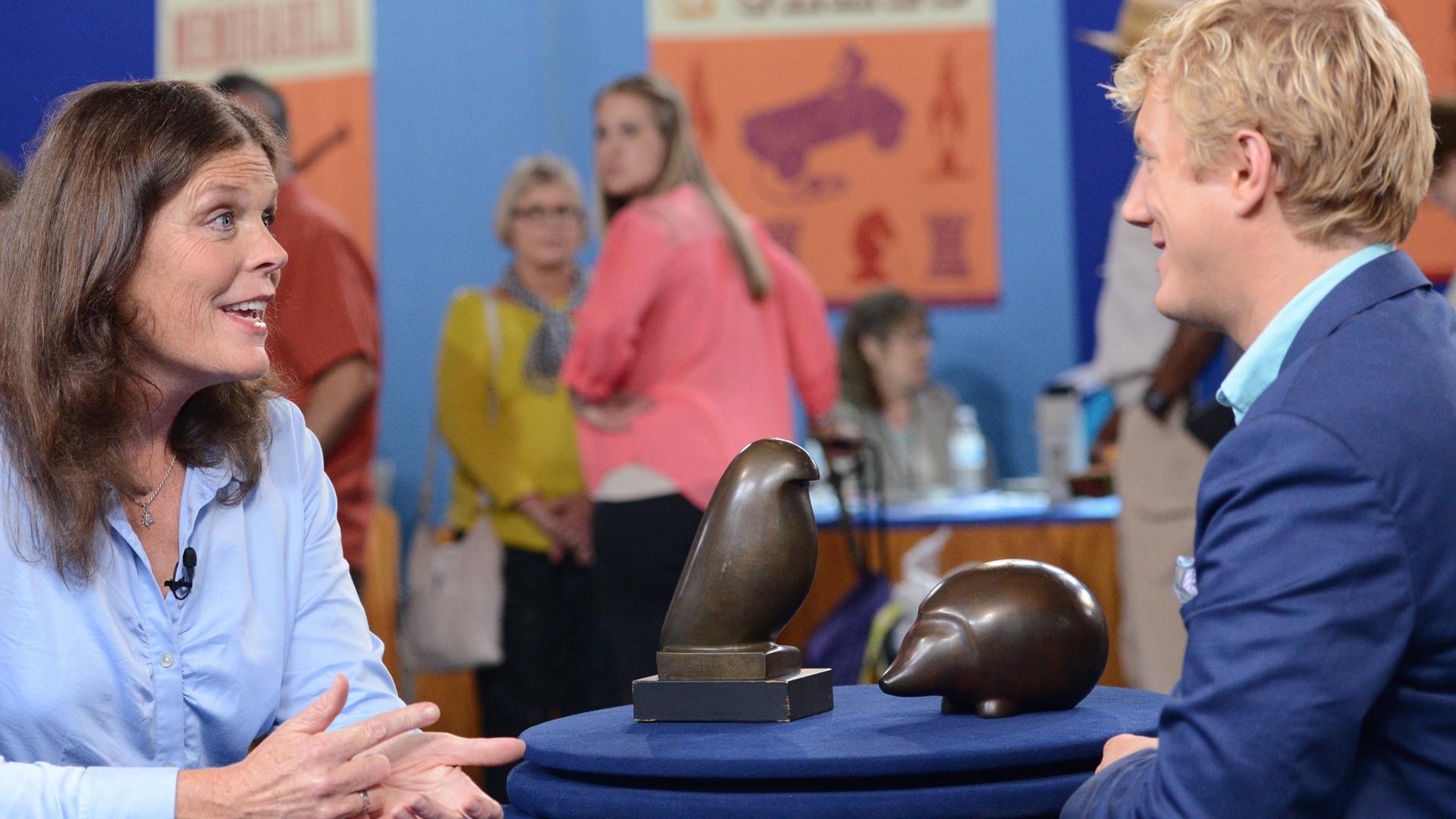
It's a teapot that I've had for about ten years, and it came from my grandmother. It was always in her house as long as I ever knew behind her favorite chair, where she always sat when we would go and visit. I know it came through my grandfather's family, but I really don't know the history of it. I'm assuming it's a teapot because it's got a spout and it's got something on top, but I mean, it doesn't look like any teapot I've ever seen before. So the first thing that you notice about this is the odd shape, isn't it? Yes. As you rightfully say, you don't remember a teapot looking like this. It doesn't look like a teapot. And that's because this shape is a peach. A peach, yeah. And this conical appendage at the top, a lotus pod, a lotus shape. So you have a peach form, the handle is in the form of a branch, with these little sprigs of leaves coming out. The same thing here with the spout. So we've got this fruit- decorated, fruit-form vessel with this lotus conical receptacle at the top which actually is where the liquid goes, and then it comes out the spout. Now, why would you have a fruit-form vessel with this big, wide body? Wow, I just don't know. In Sonoma Valley, what do y'all do here? Wine. Wine. So this is a wine vessel? It's a wine vessel. Oh, my! So not tea. Exactly. The color of the blue varies from various times in history because it is from a mineral called cobalt, which is imported into China. And the imperfections in that blue vary from one period to another as the supplies changed. Okay. The other thing that's a clue is the kind of roughness and irregularity of this conical top and the kind of eccentric and unusual form itself. So that's kind of a freedom that's evidenced in the way the potter treated this material. And then at the base, you'll notice there are these little gaps in the glaze. Yes. All those are features that are characteristics of the late Ming dynasty. Oh, wow. Which was around 1644, was when it ended, where there wasn't a lot of control over the kiln sites, so the potters got to experiment and really be expressive and do all kinds of unusual things, and that's what this is evidence of. And that continued past that date, the fall of the Ming, into the Qing dynasty, where they did not really fully exert control over the kiln sites. That wasn't a big concern. They weren't worried about pottery and porcelain. Right. They were worried about getting control of the government. So for a certain period of time in the 17th century, there was this really expressive, unusual kind of artistic flowering that took place, and that's where this dates from. Oh, wow. And we call this kind of a transitional ware, transition from the Ming to the Qing dynasty. Okay. And what do you think this is worth? I have no idea. A few hundred dollars? A few hundred dollars? Well, what if I was to say at auction, $15,000 to $25,000? (laughing) Oh, my...! Oh. You have to be kidding me. I'm not kidding. This is really $15,000 to $25,000? $15,000 to $25,000, I'm not kidding you. It's wonderful. These rugs have been in my family I believe since the 1800s. I believe they were purchased by my great-great-aunt. And I've had this one maybe ten years, and this was given to me, oh, just about a year ago, and it was a wedding present to my wife and I, who were married in October. Oh, nice. As far as I know, they have come from the Caucasus, but that was sort of loose information. I don't have any reason to believe that that's necessarily true. Well, one of them is from the Caucasus, and that's the one that's hanging with us. These were probably bought around the same time-- I'm guessing in the early 1900s. Okay. And the reason I say that is because the vintage of the one on the floor is from around 1910. 1910. And that's called a hamadan, and it's from Persia. The one that's hanging is from about 1880. Okay. So the hamadan is a Persian rug that was made for the Western market, and it was made at a time when they were already starting to use synthetic dyes, and so there are some oranges and pinks in the rug that are synthetic dyes. Ah. And from a collectible standpoint, that sort of knocks it out of contention as a collectible rug. I see. It's in good condition, but we view it as sort of a commercial decorative rug from that period. Right. The piece that's hanging is a little bit more interesting because it is from the Caucasus. It's called a talish, and it's from the southeast Caucasus, near the Caspian Sea. Okay. And these rugs were made in the 1800s and end up being very popular today because of their use of natural dyes. So they've got a beautiful, soft sort of salmon red, yellows, blues, very good geometric design. This border is the classic rosette border, which anyone that's knowledgeable about rugs, they automatically look at it and they say, "Ah, that's a talish." Now, one of the things that's interesting about the talish rugs is that their signature design is a navy blue background, completely empty with no design at all and maybe a random figure here or there. So when you see a red ground with an overall pattern, it's a little bit atypical for talish, but because you see the border the way it is, it definitely is a talish. Huh. It's in good condition, actually better condition than most for its age. The one that's on the floor, any guess at a value? Given what you've told me, I don't know, a few hundred dollars at best? I would say maybe around $300 on a retail level. And the important thing to stress here is that they were probably equal value at the time that they were sold. Right. And I've seen old advertisements that list a rug like this for about $7.50. Wow. The piece here I would say has a retail value of $12,000. That much? Yes. Wow. They've really shot up because people recognize that the art of the village weavers and the creativity is something that you just won't see again in our lifetime. Right. My husband's mom and dad bought them at a gallery in San Jose which is now no longer in business. They loved them and cherished them for many years and then decided that it was our turn to take care of them, so they gave them to us, and we love them and adore them every day. And we have since studied Bufano and learned a little bit about his history in San Francisco and all the sculptures that he created in San Francisco and around the Bay Area. So you've mentioned the artist's last name, Bufano, and it's Ben Bufano. Yes. He was an Italian immigrant to the United States. He and his family came here in about 1902. They immigrated to New York. Okay. Then he studied at the Art Students' League of New York. Oh. And there are works of his in the collection of the Metropolitan Museum of New York. Bufano worked in a number of media, including drawing, painting, terra cotta sculpture, glass mosaic, and even large-scale public mural. Okay. But possibly what he's most famous for are his large-scale sculptures located throughout the Bay Area. So what we have here today that you've brought us are two of his bronze sculptures of animals. Bufano first did a series of animal sculptures in the 1930s, and then it was a theme he revisited throughout the rest of his career. Okay. What you have I believe are from the later part of his career. Your in-laws bought them in the 1960s? We think maybe in the '60s, yeah. Bufano died in '70, and these would have been towards the last part of his career, I believe. Both sculptures are signed at the base and numbered with their limitation. Okay. When you in-laws purchased these from the gallery in San Jose, do you have any idea what they might have paid for them at that time? They didn't say. We asked them today before we came here, and they didn't remember what they paid. I would expect these at auction to bring about $10,000. Okay. Together? That's together. Okay. So if I were to price these separately, I would actually put a little bit more on the hedgehog that's near me. Yay! Is that your favorite? I love the hedgehog. Okay. I would expect him to realize right around $5,500. Okay. And then I would expect $5,000 or a little less, maybe $4,500, for the bird. Okay, great. That's great, we love them.
WOMAN
It's been hanging in our cabinet, and nobody knows anything about it because the people that did know about it are no longer with us.
APPRAISER
It's American Indian. It's Athabascan, which is above the Northwest coast around the bottom part of Alaska. It's called an octopus bag, and it dates to around 1850. This would have been part of the men's regalia and it would have had a strap on it, and they would have worn it across here and on the hip. Uh-huh. And it would have been used for keeping the fire lighting equipment. It's made out of a red stroud. It's a woolen material that they made in the northern part of England, and they exported it in the 19th century to America. These are very tiny beads, very, very delicate. The designs on the piece are really wonderful and very, very abstract. This is based on the double volute, and this is a symbol, a sign that can be found all the way from the East Coast all the way across America right to the Athabascans. And I think this probably comes from the Toltan tribe. I think conservatively, even with the damage, I think it's worth between $6,000 and $7,000. Whoa. You like that? You want to buy it? (laughs) No, no.
MAN
These are my fourth great-grandparents, and these are their wedding portraits from 1814. And I acquired them from my grandmother's estate.
APPRAISER
And how long ago was that? I acquired them about four years ago. They originated in Fitchburg, because that's where the two of them were married, but then their daughter brought them out to Crawfordsville, Indiana, in about 1840. And then from Crawfordsville, they went to Des Moines and Chicago, and then my great-great-grandmother brought them out to Pasadena in 1906. One of the things that I noticed right off the bat when you took them out of the box was that they're both handsome people, and the thing that really got me was the folky nature of the way their faces are painted and some of the characteristics. A folk painter sort of adopts a style and does things a certain way because it works for them, and people like what they paint. They sat for so long on the mantel of my great-great-grandfather's fireplace in his study and they got kind of sooty, and I looked, I couldn't find a signature, but they need to be cleaned badly, and I often have wondered if it was an itinerant painter or if it was somebody else, I don't know. Most of the portrait painting back in that time period was done by an itinerant painter. It so happens that we think the painter on this is a guy named Zedekiah Belknap. He was born in 1781, he died in the 1850s. He actually graduated from Dartmouth College, was a minister, and then became an itinerant artist I guess because the pay was better for that. The one thing he always did was he painted one side of the nose, and there's always this red outline, and the ears are usually flat and red colored, and he also did the eyes round, and they were very clearly defined. So right now, we would say they're attributed to him. They're so rare, and the reason is that it wasn't cheap to have somebody come out and do that for you. When you got these from the estate, you had to buy them, right? Yes. And how much did you have to pay? I paid $2,000 for the pair. He painted on canvas, but he also painted on board, and these are on board. Yes. I think you would be really surprised with what a light cleaning would do in terms of bringing out more details, but as is, for insurance purposes, I would put $6,000 to $8,000 on the pair. Very nice, very nice. Regardless of what their cash value is, to have something that's 200 years old from my ancestors is wonderful. In 1999, my uncle passed away, and my brothers and I inherited it, basically. I was executor, and we ended up purchasing all of the string instruments that my grandmother had, which were this Fender and a few other items along. This particular guitar she taught with, and she had her business in probably 45, 50 years of teaching string instruments. Mm-hmm. And my father and his three brothers all played, and as kids, we used to run through the parlor and listen to them all sitting around. You know, it was a great time. It's a Fender Telecaster. These are commonly called Black Guard Teles, because they made them with a black pick guard for the first few years. This one's from 1953. In late '54, they changed to the white pick guard rather than the black. The serial number is under the bridge cover. This is commonly called an ashtray because it kind of looks like an ashtray when you take it off. Uh-huh. Is this color, which I've seen others, but they're always darker in color and different types of... This was the only color they made at this time. Oh, really? Yeah, this was the original Telecaster color, that kind of see-through blond. I'll be darned. It's really rare to see the original hard shell case in this condition. This is just pressed fiber board, and if it gets any humidity at all, it just starts to fall apart. And then also, the Fender Deluxe amplifier that she probably bought around the same time. We have receipts and paperwork from her when she purchased this particular guitar and amplifier, and I believe it was $225. I guess that was quite a sum for her as far as her teaching and stuff, but she took very good care of it. Well, the early Telecasters like this are quite valuable today, and especially when they have an original hard shell case, and then the whole package with the amplifier makes it even more enticing. So the guitar alone, even if it didn't have its original case or amplifier, would probably have a retail value in a specialty shop of $25,000. Now, the case adds a lot to that. The case alone is worth $2,500 because they almost never survive. Oh, my gosh. The amplifier, if being sold separately, is probably in that $2,500 range. Excellent. $2,500 is a pretty good estimate for that. Wow, that's amazing. And then you put the guitar and the case and the amplifier together, and you probably have a package that could sell for at least $30,000 in today's market. Oh, my word. I would have never... It's definitely going to move out of the closet somewhere a little bit more important now. I know for sure it's going to move up the family line a lot. I'm shocked. I never had any clue. To just know what I've got now just makes it that much nicer. Thank you, Grandma. Never expected this. It's wonderful.
WOMAN
So these were hanging in my grandparents' dining room. I've known them to be there forever. When my grandmother passed away in 2002, they were given to me. My mom had them restored. They've been with me ever since, and now in San Francisco. And you know who they're by. Yeah, I know that they're Audubon. I'm not sure if there's other people that were involved or exactly how they were made and what they were made for. Okay, well, they're from John James Audubon's second great work, which is about the quadrupeds of North America. Everybody knows Audubon for his Birds of North America, which are very, very famous. This is his second great work, and they came out between 1842 and 1848. Now, Audubon's birds are famous because they're very, very large, the first edition. They're double elephant folio, they're all life size. Well, when he got to the quadrupeds, he did a buffalo and deer, he couldn't do them life size, so they're not life size, but they were on a very large paper. It's called an imperial folio paper. And that's what these are. He worked on it, interestingly, with his sons, John Wodehouse Audubon and Victor Audubon. And Victor did a lot of the backgrounds, and John Wodehouse did some of the images. And this was really the last project that Audubon worked on before he died, and there were 150 prints done in the series, which was done generally with three volumes. It was sort of a book, but there was really... the text was actually in a separate volume. These were really plate volumes, and they were sold separately over time as well so that they weren't all bound. Now, it's always been an overshadowed work because one thing is they're not as large as the birds. They're also not as pretty. I mean, the birds have flowers in them and they have all the colorful... And the animals are mostly brown, so they're not as pretty. Plus, of the 150 animals, an awful lot of them are rodents. You know, they're little things like weasels and voles and things, and they aren't very popular. However, there are a good number of them that are very popular, and these are two of the more popular images. People love deer. Now the fawn, for instance, is just a charming image, and the Virginia deer people love it. It's a beautiful image in the woods. Now, in terms of value, the weasels and the squirrels and things, they don't sell for a lot. They're great prints, but not many people want them hanging on their walls. So those will sell for maybe as low as $300 on up to about $600. Given that, let's say, a rodent is gonna be $300, what would you think a beautiful fawn would be? Given that I think it is more beautiful than a rodent, maybe three times that? I don't know. Actually, quite a bit more than that. Now, the fawn is a charming image. This one is a little faded, the color isn't quite as rich. If you look at the fur, I think it's been sun-bleached a little bit. Okay. So it's only worth about $8,500. Wow, that's still a lot. It's still a lot of money. If it were in better shape, it might be worth around $11,000 or $12,000. Wow. This happens to be one of the more popular prints. Interestingly, this one is by John Wodehouse, and you can see down here, it says "J.W. Audubon." That print over there says "J.J."-- John James-- "Audubon." But it's the image, it's the deer, it's a beautiful one. In a retail shop, this one can sell for as much as $28,000. Wow. Now, I have seen it offered for more than that, but I think that's a reasonable price. It's a lot of money, but it's one of the great American prints. Interesting. The painting was bought by my mother-in-law in about 1930, and when she died, it came to us. And she adored Indians. So then finally, I think when she got married, her husband and she bought this. Where did they buy it? I am not sure. Couse was an oil painter in the '30s, right? Well, he died in 1936. Ah. He was a very interesting artist. He was one of the founders of the Taos school, and he was the first president of the Taos Society of Artists. His friends Blumenschein and Sharp, who he met in Paris, where they all studied in the late 1880s, had been to Taos, and they encouraged Couse to come out to Taos and work in the summers. So by 1901, Taos was a thriving art community and Couse was there with his wife, Sharp was there with his wife, and Blumenschein was also there... Wonderful....as a summer art community. They all lived and worked most of the year in New York, but what they were all most known for was their Native American subject matter and their interest in preserving the vanishing West. Couse in particular grew up in the Midwest and lived near a Chippewa tribe, so he from a very early age was interested in Native American culture. This work we know was done after he became a National Academician because he signs it in the lower left "E.I. Couse," Eanger Irving Couse, and he inscribes it "N.A.", which means National Academician. Ah. The National Academy was an honorary organization of artists, and they elected their members. I think that it probably dates from the late 1920s to the early 1930s because of the way the work is handled. It's very competent, but there's some generalized drawing that's a little bit more of a later, more modern painting style. Couse moved permanently to Santa Fe and Taos in the 1920s, so I do believe that this painting was done in Santa Fe or Taos. Yeah. The medium of this painting is oil on board. I would say a retail replacement value would be about $75,000. Oh, good. Yeah, great! Terrific. It's a little more than I thought, and that's wonderful. Good. He's worthy. And now it's time for the Roadshow Feedback Booth. And today, we brought our mom's comic book collection. "Tarzan," ten cents in 1953, now two dollars. I don't know about you, but I would pay more than two dollars to get a glimpse of this tender moment. Today, I brought my grandmother's watch from 1900, 1910. It's worth about $100, but it's worth a million dollars to me. Today, we brought in our salesman's sample from The National Tomb Company, and a motor raises and lowers the tomb out of a vat of water. But because the motor was dead-- yah, yah, yah-- it wasn't worth as much as we thought, but we had a great time.
BOTH
Thanks, Antiques Roadshow! Today, I brought my husband's 1969 Hot Wheels car. Honey, we will not be retiring. It's worth five to ten dollars. But thank you for letting me bring it. I had a wonderful time. I thought this was baroque. It's just broke. (laughing) We got up early this morning to bring in my mom's bronze shield. We finally found out it's from Persia and it's worth about $500. I'm so happy! Good to be at Antiques Roadshow. Bye! I'm Mark Walberg, thanks for watching. See you next time on Antiques Roadshow. Look at that. It's a John Belushi samurai sword from Saturday Night Live. I wish. Captioned by Media Access Group at WGBH access.wgbh.org
Search Episodes

Donate to sign up. Activate and sign in to Passport. It's that easy to help PBS Wisconsin serve your community through media that educates, inspires, and entertains.
Make your membership gift today
Only for new users: Activate Passport using your code or email address
Already a member?
Look up my account
Need some help? Go to FAQ or visit PBS Passport Help
Need help accessing PBS Wisconsin anywhere?

Online Access | Platform & Device Access | Cable or Satellite Access | Over-The-Air Access
Visit Access Guide
Need help accessing PBS Wisconsin anywhere?
Visit Our
Live TV Access Guide
Online AccessPlatform & Device Access
Cable or Satellite Access
Over-The-Air Access
Visit Access Guide




Follow Us