








PBS Wisconsin Passport
Watch this video with
PBS Wisconsin Passport
Become a member of PBS Wisconsin, support your local community, and get extended access to PBS shows, films, and specials, like this one.
Chicago, IL, Hour 2
10/26/15 | 55m s | Rating: TV-G
Discover an eclectic array of discoveries in Chicago such as 1989 Keith Haring graffiti art, a 1910 Walter Johnson All-Star watch, and a Walt Whitman Civil War letter. Watch to learn the $50,000 find! Also: a field trip to the Chicago Civic Opera.


Copy and Paste the Following Code to Embed this Video:
Chicago, IL, Hour 2
This week, Antiques Roadshow is coming to you from Chicago, Illinois. Well, if you like bright and shiny things, this is a great thing to own, that's for sure. This one was sitting on the ground at a yard sale with some other pet stuff. He must have thought it was a dog dish. But that was only a dollar. Wow! That's amazing. Chicago's got the stuff collectors' dreams are made of, coming up right now. Welcome to Antiques Roadshow. Hi, I'm Mark Walberg in Chicago, Illinois. Robert Johnson sang about his sweet home Chicago. Frank Sinatra crooned about Chicago, that toddlin' town. Bessie Smith had the Chicago-bound blues. So many songs were inspired by this great city. Our experts are singing Chicago's praises for all the fantastic antiques we're seeing. Like Frank said in another one of his chart-toppers, Chicago is Roadshow's kind of town. Take a look.
WOMAN
My husband and I found this in a little shop in Evanston, Illinois, in 1968.
APPRAISER
Do you remember what you paid for it? I would guess it was about $150 or $200, because that was a lot for us. This is the National Republican Chart for the presidential campaign, 1860. And Lincoln was nominated in May 1860, which you can see it says right up here, and this would have come out very shortly after that. It was actually issued during the campaign. Now, it's not a campaign poster. It was actually a commercial poster, and it was done by a publisher out of New York called H.H. Lloyd. He also did one for the Democrats, so he wasn't particularly politically inclined; he was commercially inclined. Now, one of the main issues of the Republican Party was to stop the spread of slavery to the American West, and that's what makes it particularly interesting historically. You see here, you've got the slave states, up here are the free states, and you've got Oregon and California. And it was this whole area that was the issue, because in 1820, with the Missouri Compromise, Congress agreed that-- this is the southern border of Missouri across here-- said no slavery could be in this area north of there. However, in 1854, when they created Nebraska and Kansas, they had a compromise, because the Southerners didn't want it to be kept out of there, and they said that those could come in as states by voting whether they were slave or not. So all the people against the spread of slavery were horrified, and that's what created the Republican Party. And this map was showing that graphically and saying to the people against the spread of slavery, "Look, if we don't elect Lincoln," this whole area in here could become slave." What makes prints valuable is they're connected to the time. Well, you can't get any more connected than a poster issued during the campaign. If I had to guess how many of these exist in reasonable shape in the world, you're probably looking at under 100. A couple have gone at auction since about 2000, but very rare, and those were not in as good shape as this. You've had it conserved, it's in very good shape. In a retail shop, I would expect this to have a value of about $14,000. I had no idea. Yeah. Oh, that's wonderful. A lot of money for... It's as good as you get with historic prints. Oh, that's so nice, thank you so much. And especially because you fixed it up and everything, so it's stable. It's a treasure.
WOMAN
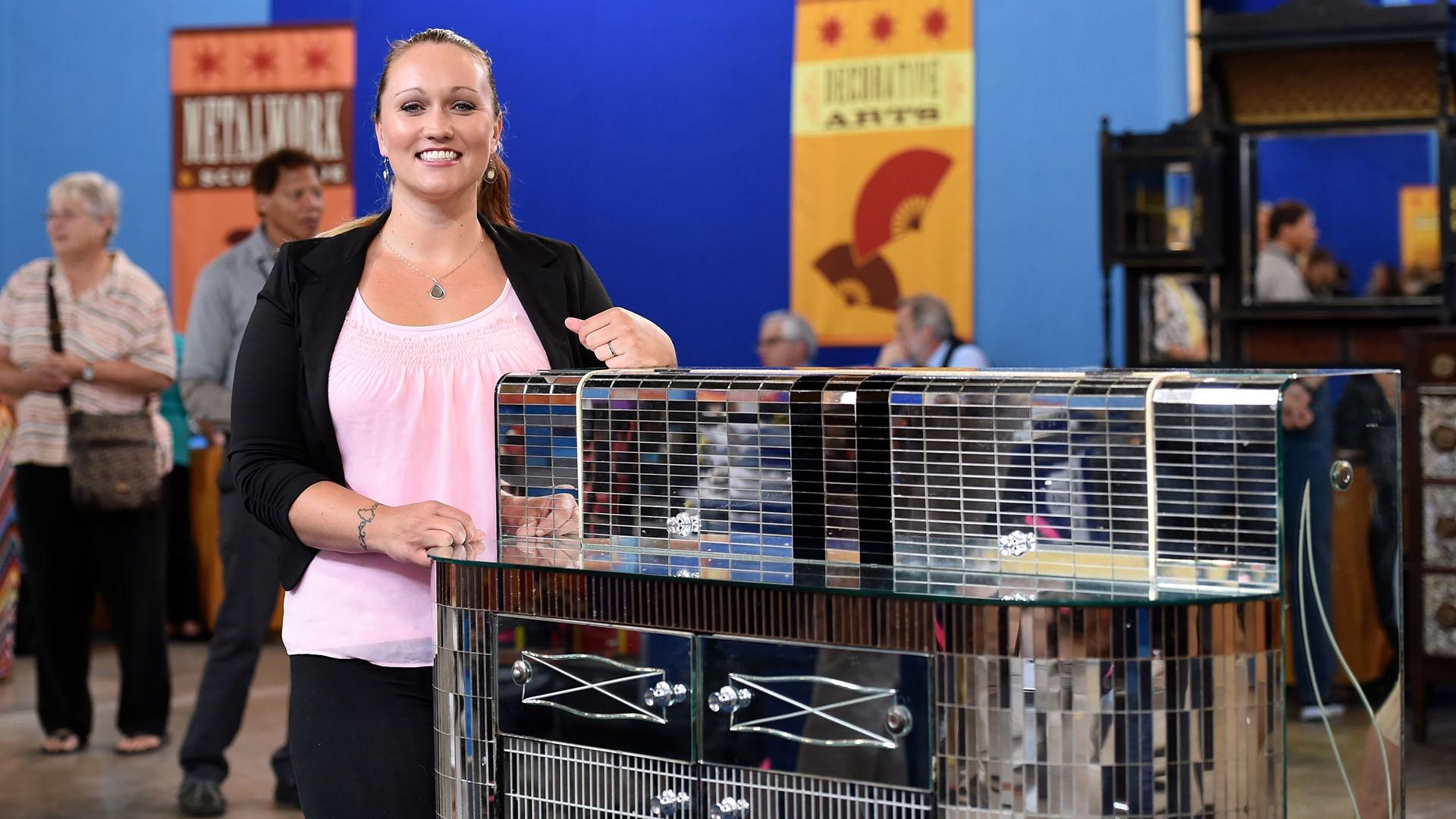
This belonged to my father. We know that he got it in Aspen, Colorado, in 2001, and there was a receipt with it, but it has no name, no company, nothing. He liked bright and shiny things, and this was his favorite thing in the world, so that's all I know about it. Well, if you like bright and shiny things, this was a great thing to own, that's for sure. Yes. This just screams Chicago to me. When I looked, I thought, "Oh, it's so fantastic." It's got everything you'd ever want. Kind of commands your attention, it really does. It's a fantastic piece. From a historical perspective, it's also very interesting. On the Roadshow, we don't do very much Art Deco furniture at all. It doesn't come in very often. And what's fascinating to me anyway, is that Art Deco's a very important component of American 20th century design, which has become very popular, especially amongst younger collectors. The French, the Germans, the Europeans in general started doing Modern about 1900, 1901. They were up and running. They were doing all kinds of interesting things. And we, the Americans, didn't come to Modern until really the late 1920s or the early 1930s. And how we discovered Modern was through Art Deco. Things with wild shapes and colors, mirrored things, things that no one would have ever thought about doing before. And I think this piece says, "Look at me." Yeah, it sat right in the sun, so it would just explode in my dad's house, because he had it right at the door. I'm sure. The Modern movement over the last 20 or 25 years of collecting has become kind of stilted. We worry about who made things. "Is this the first model, is this the second model," all these ridiculous things. With great Art Deco like this piece, you don't have to worry about any of it; you just look at it and say, "Ah, that piece is fantastic." Yeah, I like it a lot. I do too. If we open this up, it lights up, it's all mirrored. I can see myself having a martini after the show, just standing here with a couple of friends. It's perfect. We don't know who made it. I'm sure this was built in America, and just sort of an American signature style. It was probably made in the mid-part of the 20th century, probably made in the 1940s, probably after the war or right before the war. It's well built. It was certainly an expensive piece. Do you have any idea of its value? I know that he paid $3,000 for it. And he paid $3,000 in Aspen, Colorado? In Aspen in September of 2001. Right, well, one interesting thing is the Deco market has kind of declined a little bit over the years, and also I think antique buying in Aspen is probably more expensive than buying it almost anywhere else in the world. Yes, well, I thought he overpaid for it. I don't know what it was, but we'll see. He was very close. Right. At auction today, this piece would probably bring $2,500 to $4,500. Okay, cool. So there's an estate sale company out of the Northeast that seems to dabble in art, and they found a whole bunch of pop art, and this was one of the pieces they found. Didn't seem to know anything about it, but I kind of fell in love with it. It's a plywood box, and the label says... "Suicide." "Suicide." And inside, we have an image of flamingos and these wrapped scissors. Correct. Was there any signature on this? Not that we saw. I just thought it was really kitschy and neat. I mean, it just was clearly some sort of folk art and interesting, and my wife was not pleased when we brought it into the house. Well, we believe this artist is H.C. Westermann. Horace Westermann was born in L.A. in 1922. He's hard to classify. He's a folk artist, a Surrealist. He called himself an Americanist. He was a gunner in combat, and the military had a profound effect on him. He came back and went to the Art Institute of Chicago, and exhibited quite a lot here in this local area. One of his techniques, because he was originally a carpenter, was to use this kind of plywood, so that's kind of a real giveaway as to his work. He normally had a very pop culture theme to things, so the kitschy flamingos being a 1950s kind of pop icon, and possibly the scissors having some sort of military reference. Hard to say. He was often asked what does his work mean, and he would say, "Heck if I know." It's really hard to classify something like this, but certainly it would fall into the category of fine art sculpture at this point. This would be from the period in Westermann's work around 1960. It is something that would have to be checked out. The Museum of Contemporary Art here in Chicago wrote the catalogue raisonn on this artist, and the Whitney and they have had many exhibits of his work. So it would be something that, right now, we would consider sort of an attribution to him. But his work is very, very popular. Do you have any idea of what its value is, or what did you pay for it? I paid I think $150 for it. I think we assumed the value was zero, and so anything above that would be a shocker. So, if it is an homage to Westermann, I would still say it's probably got a value of around $2,000, because there's so much work and it's such an interesting thing. If this thing checks out, and I think it well should, it would be valued between $20,000 and $30,000. Wow, wow, that's unreal, unreal. And the high water mark for this gentleman is about $125,000 on the secondary market at auction. Wow.
MAN
I bought it at a New York gallery probably... 35 years ago. I've had it at home and enjoyed it ever since.
APPRAISER
So what did you pay for it? $7,500. All right, I've seen a number of these. This is the most elaborate and really one of the finest Yoruba Orisha Oko shafts and beaded sheath that I've seen. This object was done by the Yoruba, and as you know, Nigeria is in West Africa, so this is a cult, the Orisha Oko cult, within the Yoruba tribe. Orisha Oko is a deity among the Yoruba for fertility. Orisha Oko protects the home, it ensures a good crop. Orisha Oko is a male deity. When they select a keeper, it's always a woman, and it is a priestess, and she has to go through a fairly long ceremony before she's qualified, and then she's in charge with keeping this. Some of this imagery, which this is... actually represents kind of a crown, it indicates that the owner of this was an extremely important individual. These figures I've never seen before, and they could be some sort of practitioners. You see here that they're holding things that could be references to other Yoruba gods like Shango, the god of thunder and lightning, or Eshu, the trickster god. And so you have this absolutely extraordinary beaded element from top to bottom. What makes this really special is it's in unbelievable condition. Now, we're looking probably a date, conservatively, of the first quarter of the 20th century. And the iconography is superb. This is sort of a sluggish market right now. I would give you an auction estimate of $10,000 to $15,000, expecting it to go much higher. Uh-huh. I feel confident that a gallery would ask $20,000 to $30,000 for this. So, how did you do on your investment? I did okay, it's not bad.
MAN
Well, I brought three pieces of Santa dishes. This one was sitting on the ground at a yard sale with some other pet stuff. He must have thought it was a dog dish, but I was collecting Christmas things. But that was only a dollar. Okay, and what'd you pay for the other two? I don't really remember. I think he had these with other dishes, but he had more on them. He thought these were worth more than that thing, but I thought, "That's the best one." All three of these pieces are marked with the same mark, okay, which we know as a Roseville Pottery mark. Roseville. Now, the American art pottery movement really started in the late part of the 19th century, moving through the early part of the 20th century, and one of the major makers was Roseville, and they came out and they made tons of production ware pieces. They started off in the early 20th century doing custom pieces, and for the most part, the Roseville market has gone way, way down in the last four to five years. So ten years ago, all of this stuff was worth three to four times what it is today. This particular set is what's called a juvenile ware set. They made a number of them. They made the Santa, they made some with chicks, and there were a couple of other designs that they did. And the funny thing is, this pattern's really sought after and hard to find. Because of Santa? Because of Santa. If you sold this at auction today, I would expect it to have an estimate, for the whole set, between $1,000 and $1,500. Wow! And he was using it for a dog dish! And he was using it for a dog dish. Yeah, if you had a different pattern, one of the chicks or one of the other patterns, it would be worth maybe $150. Yay, Santa! This watch was presented to my grandfather in Galveston, Texas, in 1896. At that time, he was the editor of the Brotherhood of Locomotive Firemen and Enginemen, Railroad Union's monthly magazine. He later became president of that union. He was president from 1908 to 1922. And during World War I, when the railroads were nationalized as a part of the war effort, he worked very closely with the secretary of commerce, William McAdoo, to further the war effort. Well, this is nice. It's a complete set, it's a chain and a fob, which is for the Brotherhood of Locomotive Firemen and Enginemen. Railroad watches are a very interesting American invention. If you look closely at the dial, you'll see that this was made and sold by the Ball Watch Company in Cleveland, Ohio. Now, it was indeed Webb C. Ball in the 1890s who proposed the standards that made railroad watches possible, because at that time, there was no time standard that was adopted by all railroads and railroad conductors. There were a lot of accidents, trains being on the same track together when they shouldn't have been. So, he proposed a watch that was highly precise, had a dial that was very, very easy to read, large numbers. To set the hands, you had to open the watch up so that you couldn't accidentally unset the watch. And all the value of the watch for the person who purchased it was in the movement. He didn't make watches himself, he sold them. This was made by the Hamilton Watch Company. We'll open the watch and see the extensive inscription inside the watch. Open it again to see the beautiful finish of the watch. And the idea that a railroad man could buy a watch meant that they always had to be very inexpensive, and the characteristic of a railroad watch is that generally, they're found to be in gold-filled cases. A typical railroad watch to a collector today is worth perhaps $200 or $300. But yours is very special. First of all, on the dial, it's one of a very few that were made with the logo of the Brotherhood of... Locomotive Firemen and Enginemen. (laughs): Locomotive Firemen... Right, that's a tongue twister. In addition, it's in a 14-karat gold case. If we turn it over, we can see that it's beautifully engraved. A railroad watch needs to have 17 jewels for its precision. This one has 23. When you add to it the fact that very, very few of these were made, to a collector, as a group of railroad memorabilia, probably at auction, an estimate would be in the order of $12,000 to $15,000. Terrific, yeah. I got it from my grandfather through my mother. My grandfather supposedly had brought this from Sweden when he came over to this country.
APPRAISER
When was that? Well, he was born in 1877 and emigrated at age 19 to Canada, and then down to DeKalb, Illinois. Was he known as a wood carver? No, not at all. I believe he probably brought this with him. I would question whether or not it actually came from Sweden, just because it has these two American flags flying... I noticed those....broadly on that building. I wonder whether or not this is more of an allegorical story of his travel from a town in Sweden to America. And if you look along here, you can see that these buildings on the horizon here are not American buildings, but rather more of a European-looking city. You've got this great body of water, and then you get down to the scene in this town, these wonderful formal buildings, and it's relief carved, which means that this is one piece of wood, and they carve back to get this three-dimensional quality. Let's look at what this is made from, and I'm going to flip it around quickly. It's a piece of found wood, and it is probably just a piece of birch, and I believe it is the backboard of a chest of drawers. You can see there's chamfering on your side here, and chamfering on my side, but not on the tops and bottoms. So it would have fitted into the side panel, birch an American wood. And then while this is showing from this side, let's look at this other very whimsical thing that he's done by inlaying pieces of colored glass, which of course are going to show through the windows in the buildings on the other side. There's a few pieces missing here obviously, so with a light behind it, you'd get some really very lovely effects. What has happened to this side of this panel? Well, I believe my mother had an art student attempt to restore it, and they got that far. I don't think it's done professionally. Right, well, actually, I'm sort of pleased that we get to see this color coming through here, because if you check the difference between this panel, which has been cleaned clearly, and then the rest of it, you see there is a muddy quality to most of the panel because it was varnished, and that varnish oxidized and turned dark. But here, the varnish has been removed, and honestly, nine times out of ten on the Roadshow, I will say, "Don't touch things," but I think this is actually a very good job. They've taken this paint back to a dry, dry surface, which is what folk art collectors look for when they're looking for original paint. Look at how bright and lovely the color is on this side compared to... and especially in the dog. You can see his bright, bright white body, and brown ears, and on this side of the tree, as he's running through, he's a little dull on that other side. Certainly is. Well, I think for auction purposes, we would probably estimate it in the $3,000 to $5,000 range. Oh, very nice. That's very good. How did you come to know Keith Haring? Well, I was coming from the Art Academy, going to the art expo here in Chicago. I already had known about him, but I ran into him doing a mural project here in Grant Park and we stopped to talk some, and the next thing you know, we're helping out with this mural project that took place here. And in that time, you had him over for dinner? Towards the end of the week, yeah, we invited him over to dinner, there in northwest Indiana. Had tamales with my mom and dad and sisters and he met the whole family, it was cool. Nice. He was a pretty famous guy by 1989. Yes, he actually passed away in 1990, so... Right. This was probably at the climax of his career. Yes. He had AIDS. Was he very sick when he was here? When I met him, he didn't seem that sick. He was very active, you know? I didn't see him slowing down at all, you know? I didn't see it coming. So, tell me about this book. This is a black book that graffiti writers keep, keep other signatures from graffiti writers and keep some of your own pieces in. And this is a piece that he did for me in my book. Personally inscribed it to me, to "OMS ONE." That's your tag name? That's my tag name. The photograph was taken in front of the mural that was taking place at the time for the Art Against AIDS Foundation. I think it was in collaboration also with the MCA, Museum of Contemporary Art. That's myself, my brother, Keith in the middle. Then there's this very interesting object here. Yes. What is this? That's a history. Started in 1987, and in 1989 when we met him, he came to our house and placed this drawing here in the center while we had him over for dinner. What are all the other tags and... signatures? The other tags are just graffiti writers' tags from the area where I live, northwest Indiana, and some Chicago writers also. So, any time they'd visit you, you would have them sign this tabletop? Right, we sit around and congregate and plan our next hit. That's why we're called the Hit Men. Keith gave you this hoodie. Yeah, that was given to me by Keith and also signed by him. So it's signed by him, and he inscribes it "Hit Men," which was the name of your crew. Correct, that was the name of the crew at the time. "Hit Men Bombing Crew." The hat was also another item that was done by Keith Haring. It's from the Chicago Improv. Keith was raised in Kutztown, Pennsylvania. He came to New York after studying in Pittsburgh for a period of time, came to New York and studied at the School of Visual Arts. He was a little bit more commercially minded than many of the graffiti artists, and in the late 1980s, he opened his own pop shop. Right. And I would think that the hoodie came from the pop shop. The market for Keith Haring is very interesting. Because the Foundation no longer authenticates, it's really important to have an undisputed line of provenance, and nothing could be clearer than the photograph of Keith with you and your brother and crew, the inscription to you, the hoodie, the hat, and of course, this fascinating document. Right. The value for a Haring drawing in the retail market would be about $10,000. Wow. Hoodies have come on the market and sold at auction for about $1,800. Okay. The hat we have no comparables for, but I would expect that would be about $1,000 as well. Wow. And the linoleum we have absolutely no comparables for. I think you're talking about $2,000 for the linoleum. Wow. So the total value of the collection as a whole is $14,800. (laughs) That is great to hear. I like that.
WALBERG
It's always a good day to explore Chicago. This city is loaded with landmarks. And what better way to see them all than taking a trip on the historic elevated line, or the "El" as they call it here? There's the Field Museum, home of the largest T-Rex ever discovered. Millennium Park, sight of the reflective masterpiece Cloud Gate. Buckingham Fountain, Navy Pier, the Magnificent Mile. And after a busy day, there's no finer way to top it off than spending time at the opera. Roadshow visited Lyric Opera's Civic Opera House with appraiser Nicholas Lowry to gaze around this Art Deco marvel and discuss some 1920s transit posters. Nicho, first of all, I have to know that whenever I'm working with you, I will always be underdressed, but I appreciate that. But why are we looking at travel posters here at the opera? Well, it's a fair question, Mark. Samuel Insull, who was instrumental in having this theater built, also owned many of the local Chicago railway lines. And in order to sell seats on the lines of these trains that he had taken over, he started a fantastic poster campaign along the lines of many of the famous British and French advertising campaigns. And the team of Chicago artists that he assembled were among the best in America, and the posters that they have designed are extraordinary. And you have selected one for us to look at now. Tell me about this poster.
LOWRY
This piece, by one of the greater artists on that campaign, Oscar Rabe Hanson, with this sort of phenomenal beach scene, which even though the text is very Chicago specific, is something that can be enjoyed by anybody who's ever been to the seaside before. One of the beauties of this campaign was that Insull wasn't selling his trains; he was selling the places that his trains could take you, the places where you might want to take your family on a weekend, beautiful landmarks around Chicago. The University of Chicago is on one poster. The Field Museum. Here, the Civic Opera. Using the British model and the French model, he came up with the idea to make basically a branded advertising campaign whereby train riders would begin to recognize the typography, they'd begin to recognize the artistry, and sooner or later, the brands of these railways would grow in their mind. The campaigns ran through the 1920s. Sometimes, these pieces appear at auction. They're very scarce. When they do, some lesser examples can be bought in the $2,000 to $3,000 range. There's a spectacular one that's about three times the size, almost my height and my width, of Boul Mich-- Michigan Boulevard. It's a nighttime bird's-eye view over the city, absolutely fantastic, and I've heard that that sold privately for as much as $25,000. This piece, because of the combination of the artist, of the scene, of the availability of the scene to everybody in any part of the world, not just in Illinois, at auction, I'd estimate this piece between $8,000 and $12,000. Well, it's a beautiful piece, and what a slice of Chicago history, and what a great place to learn about it. Thank you so much. You're welcome. This is part of a China set that my great-great- grandfather received from the King of Prussia. And this was in 1854, because the day before, the queen's carriage had either gotten in the hands of revolutionaries or had just gotten away, and he was there at the time and got on and stopped the carriage. And these pieces are the thank-you from the King of Prussia. The next day, they showed up on his doorstep with the letter here, and they were in a wooden box which we still have today, too, as well. So we have the translation, too, of what the letter said. Let me read the translation that you've got for it. It says, "I have, "from the high magistrate of the queen's command, "the honor to bestow upon you great regard and acknowledgement of the valiant efforts given." And then the letter there has the red wax seal of the king. The porcelain is actually made in Berlin, and it's made by the Royal Berlin Porcelain factory. And let's look at the mark on the bottom. We've got a blue scepter mark there, which is the mark of that maker, which is underglazed blue, and then there's a round mark with an eagle in it, and then next to that is an orb with a cross on it, and beneath that, it says "KPM." So American collectors usually refer to this type of porcelain as KPM porcelain. And it's comparable in quality to Meissen, which is even more famous than KPM porcelain, but the quality is equally as good. Now, one thing about this set that's interesting is the interiors of the cups and the bowl next to you are painted with gold. And that's an indication of it was some of the very highest quality, most expensive porcelain made by them during that time period. Now, just the pieces themself, the teapot itself would definitely sell for over $1,000. The two pieces nearer to you would be a little less than that, and the cup and saucer would probably be at least $500 or so. So without the provenance, these pieces here would sell for between $3,000 and $5,000. However, I do believe that the provenance adds to the value. If this were being sold... and if the set would need to stay together. So the pieces here, I believe, would actually sell for between $4,000 and $6,000 or more, with the letter and all the provenance that you have. I see. What would the whole group be together? There was a platter it was all served on, and I think two more pots and another cup and saucer. Exactly, so my belief is that a retail value for the entire service, assuming it's all in good condition, with the provenance, would be somewhere between $10,000 and $15,000. That's interesting. Really a nice amount. I have an original cigar store Indian. My grandfather, I believe, paid $75 for it in 1938. He procured it from the corners of Milwaukee Avenue and, I believe, Division Street in downtown Chicago. They transported it back to their home and it has been in our family for 74 years. Wow. We know the carver's name because of its distinctive style, and it was John Cromwell. And he was one of the first early carvers in New York City. He was a ship carver-- most of them were-- and they morphed into making cigar store figures, tobacco shop figures all throughout New York, and they started shipping them throughout America. The tobacco figure became the figure of the Indian, and the reason for it is the Indians taught the settlers how to raise and plant and harvest tobacco. I see. Cromwell has a very distinctive style, and right here, this is a key to assigning a carver's name to it. It's this triangular headdress, and the way it comes to a point. The headdress has a wonderful fan shape to it that goes back to the head, flowing down the shoulders, all very distinctive styles of Cromwell, as well as the bear claw over his shoulder, and the necklace, which what is really the imagery of a peace medal that were given out by the United States government to the great chiefs throughout the Indian nations. So, we do know it's a John Cromwell. He operated in New York City, 1840, 1850, 1860. And it is indeed a rare figure. These full-bodied figures tended to be a little top-heavy, and sadly, this piece did meet that fate of toppling over, and we know that because of the fact that the face is not a John Cromwell face. The face has been at some point in its time, prior to your family's ownership, recarved. Okay. When the face was damaged, the arm snapped off. And it was probably the same day that this fell forward, arm snapped off, face was damaged. This entire arm is new. Okay. New meaning prior to 1938. Right. When you go further down, you see this wonderful skirt with feathers, but then your eye starts to look at the legs, and these legs are a tad short, and Cromwell's figures would have had legs that were about six to eight inches longer. Okay. It's a very common story for these cigar store figures that lived out on the streets. Right. The paint is old but not original, so the surface we say is pre-1938, which is good, because it was being used up to that point. In terms of valuation, prices have a very wide range, most of it tied to the rareness of the carver and the condition of the piece. So, do you have any idea approximately what your $75 in 1938 is now translating to? I would guess maybe $10,000. Okay, it's actually a pretty good guess. I think a retail price would be somewhere in the $10,000 to $15,000 range. Okay. One in original paint, beautiful carving, total integrity, can be as much as $700,000. Interesting. He's a great keepsake, and we'll continue to pass it through the family. I have a mantel clock that I purchased from a family friend. We bought about seven or eight clocks from her for approximately $400. This was one of them. I think it's the most beautiful. I know that it was made in Paris. There's a stamp on the back. But besides that, I don't have any more information on it. This clock is actually of French origin. It's really a result of a few very big companies making these circular movements, and oftentimes, the movements aren't actually signed. They're signed "Made in France," like this one is. The reality is that they were sold to people who case their own clocks or styles. It's a very unusual clock in the fact that it is a brass case that has this champlev decoration. Now, champlev is a process of enamel where they put enamel that's divided by brass. And all this little detail work here is really nicely done. And it's an up dial in that it has this wonderful floral decoration on the inside of the time ring. The standard ones are just plain white, and it makes it a little bit more interesting to have that decoration. And then the fittings on the clock would have been a little bit extra in terms of pricing the clock out originally. It has these wonderful feet, and it's not unusual for clocks to be up on feet, but the fact that these are in the form of an animal paw meant that they spent a little extra time casting it. The fact that it has fully turned columns that are decorated that are inset into the case, all little details that make it a special example. So we have a clock made about 1900, probably for a metropolitan market like Chicago or New York or St. Louis. You have any idea of what it's worth? I was hoping to at least make my money back on the clock. I was guessing maybe $500. Well, I think you'll be happy to learn that if this clock, with a little bit of cleaning up and servicing the movement, you were to find it in an antiques shop or a clock shop in Chicago, you probably would expect to spend somewhere around $2,500 to $3,000 for it. That's great. That's a pretty good buy. It's beautiful.
WOMAN
The letter belonged to my mother and it was written by Walt Whitman to my mom's great-great- great-grandfather. Walt Whitman would go around, as I understand, and would be the scribe for injured soldiers in Washington, D.C., during the Civil War, and this young man was a foster child in that family. The letter has been in my family all along. It sat in a corner of the closet for years and years, and I'd like to know more about it. And I did see that the date on it is the 12th, and the young man who it was being written for died just about ten days later, so it's kind of sad, too. The letter is dated in 1863 in Washington. A lot of soldiers either got sick, wounded, hurt, and they had to come off the battlefield and were in the hospital. Now Walt Whitman, he had a brother in the Civil War, and the brother got wounded. Not major wounded, but Walt Whitman went down to find his brother to see how he was, found him alive, fortunately, but in the trip, he saw the amputations, the wounding, he saw the destruction, and he immediately wanted to help. One of the things he did was, soldiers who were too sick to write home, he would sit there and write letters for them. They would transcribe it, give him his thoughts. Maybe he helped with the language. So when you brought me this letter first, I looked at it, and I saw that it was signed "Albion Hubbard." But when we first looked at it, the handwriting, I know that handwriting. And then of course you drop down a little, "Written by Walt Whitman, a friend." And you see, this is all in Walt Whitman's handwriting. It's not just the front, but it's a longer letter. He's talking about, "Please, family, please write to me, I miss you, write me long letters." And then, what really adds to the tragedy is he says, "My diarrhea is still somewhat troublesome, yet I feel in pretty good spirits." It didn't get better, and he died within two weeks. Walt Whitman letters are great when he's talking about literature and that, but I did a lot of checking and I didn't find hardly any letters that he wrote for the patients. Oh, really? And he obviously did a lot, but people weren't necessarily saving them because they weren't Walt Whitman letters, per se-- they were the family letter. I would say that a collector would easily pay in the $8,000 to $12,000 retail range. Oh, my gosh! That's wild. I never would have thought that. Thomas, what's the story on this little chair and this bigger chair? Well, the little chair came from an estate sale here in Chicago 15 years ago. And after I purchased the little chair, she asked me if I'd be interested in acquiring the big chair, which was directly behind me and I didn't even see it because it was covered in a blanket. They're from a period that I absolutely love, probably the 1950s, and it's post-Bauhaus, when Mies van der Rohe was working with pieces with tubular aluminum and canvas, and these very minimal pieces were being made. Just gorgeous, the construction. And then you go over to the bigger chair, and you have the same exact setup. I just think it's so cool. Right now in this state, what do you think they're worth? I couldn't tell you. What'd you pay? For the little one I paid $10, and for the big one I paid $20. $30 total. $30 investment. Okay, they have to be, just because of the quality of this and the quality of this, even if you don't figure out who it is, they got to be worth $2,000. Oh, no kidding, really? Awesome. Not bad for a day. Not bad for a day's work. So, these dresses were my great-great-aunt's dresses, and they have been passed down to all the women of the family. I know that my great-great-aunt and her sister made these dresses, and I was told that it was somewhere in the mid-1800s, even in the maybe 1880s-ish, is what had been passed down to me. First of all, I'm going to talk about this, the blue piece. Okay, awesome. It's cotton. It is probably cotton from England. It's a block print. The blue is just stunning. It's from the late 1830s. Oh, okay. So it's much earlier than you think it is. That's awesome. It's two-piece, it's the late 1830s. We know this because earlier, there would have been kind of very large, voluminous sleeves. And then as the decade progresses, very early 1840s, the sleeve starts to drop. And we have all of this hand-gathering on the edge here, which is just stunning. It's all done, both of these are done by hand with no labels. And it's in really lovely condition. The print is reminiscent of an Indian, an earlier Indian print, and it's these wonderful paisleys and exotics of Indian floral motifs. At auction, we believe that this would probably sell for between $1,500 and $2,200. Wow! The blue is just... it zaps you, doesn't it? Yeah, it's beautiful. The second piece you brought in is later, it's more mid-century. Okay. And it's made of wool challis, which is a really fine, fine soft wool. It's printed, and it has some condition issues. All of these buttons that are metal would have been covered in a... Oh... You see little remnants of the purple there, so imagine all these stunning purple plum covered buttons to pick up the purple in the stripe here. Wool moths love wool, and there are condition issues all around here that are going to affect the value as well. And it's significant when you start to have holes that obvious. So, the market for this is very different. At auction, it would probably sell for about $300. Okay. I inherited it from my grandmother. She had gotten it from her parents. Her sister had studied with Charles Curran as, I'm guessing, a young adult, and my great-grandmother decided she wanted a Curran painting, so my great-grandfather, for their 25th anniversary, got her this one, which featured silver birches, so it's just come down through the family to me. And it's always been a sentimental favorite, because it reminded my grandmother of Cragsmoor, where they used to take their summer vacations. Cragsmoor in the Hudson River Valley in New York was founded in the late 19th century as an artist colony, and was the location for many of his paintings. He was born in Kentucky, however. Oh, okay. Born in Kentucky in 1861. Lived until 1942, and for most of his painting career, he went back and forth from New York City to Cragsmoor, and he did this for decades. Hmm. And he was an artist who also had training at the Acadmie Julian in Paris, and while he painted other subjects besides beautiful women in landscapes, that was really his stock-in-trade. The painting is titled on the back, on the stretcher. Is it really? Not only is the painting titled, "Across the Valley," but it's also noted that it's by Curran, and you've got an inventory number. And as appraisers, as art historians, we're fortunate enough when we see the title. It adds information and it helps with establishing the authenticity of a picture. So, the painting of course is an oil on canvas. Right. And the condition is also very good. So, it's the original canvas and more than likely the original frame as well, although it has been repainted, the gold. Oh, okay. Do you recall how much your great-grandfather paid for this painting? I don't know. It was just part of a story that my grandmother happened to include in her memoirs. Yeah. In today's market, 2014 at auction, this painting has a value of $12,000 to $18,000. Wow. Well, what would be the insurance value? You would probably want to insure it for about $35,000. Wow! That's amazing. Thank you so much! My great-great-grandfather brought it from Europe, we think Italy or Austria, and my grandmother has had it all the years until she passed away with my mother having it, and now it's mine. It was always so special. My grandmother built a special gold cabinet. In fact, she's dancing in Heaven today with us filming this, because this was a real prize for her.
APPRAISER
A real prize, but you've never had it appraised or look at? No. Number one, it's monumental. It's 22 inches tall and about six-and-a-half inches in diameter. And this is all very heavy gilt gold, applied work with enamel flowers. You of course have seen all these flowers all the way around this piece. This is an emerald green. I'm going to refer to it as a window. And we have the emerald green windows down here so you see the light through. The interesting thing about these pieces, there's sort of three periods of this Moser or Moser-style glass. In the 1880s, you wouldn't see as much of this little tiny raised flower look. It's a flatter look. The gilt gold looks similar, and in the 1950s, they did away with a lot of the gilt gold and the flowers were just bigger, and the colors, the emerald greens are different. This one is right in between those two time periods, which we don't see very often, and so that was really exciting. So this one is circa 1910. Moser, Austria, that's correct. A similar one sold at auction in the George Klabin collection, and the Klabin collection was a major collection that came up for sale very recently at one of the major auctions. So, that even adds to the value of the piece. I would estimate this, at auction, for $3,500 to $4,500. Great! That's super. It's nice to know. That watch belonged to my great-uncle, who was Walter Johnson. It's kind of come down through the family since then. And it's an appreciation watch that was given to him after a rather strange series of ballgames between this so-called all-star team that he was pitching for and the Philadelphia Athletics in 1910. So did you know Walter Johnson himself? No, he passed away in 1946, and I was born a couple years before that, so if I met him, it's not something I remember. Let's flip it over. It says, "To Walter Johnson "of the all-star American team, 1910, "in appreciation from American Baseball Club of Philadelphia." So the Philadelphia Athletics, who of course won the pennant in 1910 and when on to annihilate the Chicago Cubs four games to one in the 1910 World Series. I believe that's correct, yeah. It's a very interesting story. People think "all-star game," they think the very first all-star game, 1933, but here we have, in 1910, this interesting occurrence. And the Philadelphia Athletics obviously wanted to stay on top of things for this week leading up to the series, they wanted to keep in shape, so they organized this all-star team of players from the Red Sox, from the White Sox, and also from the Washington Senators. And of course, on the Senators is a 22-year-old fireballer, Walter Johnson. Give him a few more years, he starts to accumulate the wins, he ends up with 417 wins, second all time. He has the most shutouts in history. And of course, he's one of the first five people inducted into the Hall of Fame. He is a legend of epic proportions. What's cool about this watch, obviously it commemorates a unique moment in history when this happened, and what's really neat is you have this beautiful enameling here of the Philadelphia Athletics logo, with the famous elephant. They still use that logo today. The Oakland Athletics now still have an elephant in certain logos they use. As a gold watch from this era, and there are a lot of them out there, the watch is probably worth about $300 to $500 without that particular engraving, without that particular enameling. You're dealing with Walter Johnson here, your relative and perhaps one of the most legendary baseball players of all time, so it really adds something special to the watch. Everything is going for it, the provenance, everything. It's a family heirloom, and I understand with family heirlooms, you want to keep them insured. I wouldn't insure this watch for anything less than $50,000. Okay! (laughs) It's a treasure. It's one of the finest pieces I've ever seen on the show. It's magnificent. Wow. Wow, that's impressive.
WALBERG
And now, it's time for the Roadshow Feedback Booth. We learned a lot today. We learned that this wine cooler may only be plated silver. But we also learned that the staff and volunteers of Antiques Roadshow have hearts of gold. And I found out that my lobby card and her chair are worth about the same amount, only mine's a lot lighter, but she let me carry them both. And I brought my great-great- grandfather's egg basket, and the appraiser said it was the sturdiest egg basket he's ever seen, so you can put all your eggs in one basket. And we didn't get the gun in because we found out it was loaded, so his Civil War rifle stayed outside. I found out that my quilt is worth about $250, so that's cool. I brought some silver spoons, and I did not know that silver could be worth so little. (laughs) We brought our ugly vase here today to find out it's really not worth very much. So ugly, only a mother could love it. And she doesn't like it very much, either. That's why we have it. I brought this painting in of my mom when she was 18. It was painted by William Edward Scott, who's a kind of famous guy in Indiana, but the appraiser said that it's worth $2,000 to $3,000 because it's a sketch and not a finished portrait. So, Mom, I got your painting on TV, and it's really... it was a great time, a lot of fun. Goodbye, Antiques Roadshow We had fun, but now we're done. Bye! I'm Mark Walberg. Thanks for watching. See you next time on Antiques Roadshow. Oh sir, how are you? Caught you off guard there, huh? Is this yours? Captioned by Media Access Group at WGBH access.wgbh.org This painting has been in our family since 1960. My parents purchased it directly from Mr. Roy when his studio was in Bombay. I've always been a great fan of Jamini Roy because he combines classical Indian training as well as folk traditions. And of course the subject matter is the beautiful eternal female. It's a great image. It's gouache on paperboard. It's a wonderful example of the artist's work, the simple, contemporary quality of it really speaking to the time that it was done in the 1960s is tremendous, and which is very popular right now. Do you remember what your family paid for it? Probably $75 to $80 for this piece. Oh, my goodness! Well, that was a great investment and it's a lovely piece. Because of the popularity of the artist and of the rising importance of Indian artwork, I would be estimating it between $7,000 and $9,000 at auction. That's very much of a surprise, but nice to hear.
WOMAN
I had an elderly friend who passed away, and her children gave me these dolls as a gift. Well, these little dolls were designed by a woman named Georgene Averill. She was an American designer, and these dolls were produced in Germany. They have deep modeling in the hair, glass eyes that sleep. Yes. They would sell, on a retail basis, for about $1,500 for the pair. Oh, my goodness, I had no idea. A doll can be that valuable? Yes. This vase belonged to my son. He passed away seven years ago, and I have a lot of his things that I'm keeping for his two children. I love the design of your silver vase. It was hand-made by a very special jeweler in Montville, New Jersey, called Schroth. It's full of design, it's very dramatic, it's got a lot of movement, it's very hard edge, and a real icon of the '60s. I think it's probably worth about $2,000 to $3,000 at auction today. Fabulous.
Search Episodes

Donate to sign up. Activate and sign in to Passport. It's that easy to help PBS Wisconsin serve your community through media that educates, inspires, and entertains.
Make your membership gift today
Only for new users: Activate Passport using your code or email address
Already a member?
Look up my account
Need some help? Go to FAQ or visit PBS Passport Help
Need help accessing PBS Wisconsin anywhere?

Online Access | Platform & Device Access | Cable or Satellite Access | Over-The-Air Access
Visit Access Guide
Need help accessing PBS Wisconsin anywhere?
Visit Our
Live TV Access Guide
Online AccessPlatform & Device Access
Cable or Satellite Access
Over-The-Air Access
Visit Access Guide




Follow Us