







PBS Wisconsin Passport
Watch this video with
PBS Wisconsin Passport
Become a member of PBS Wisconsin, support your local community, and get extended access to PBS shows, films, and specials, like this one.
Albuquerque, NM, Hour 3
10/12/15 | 53m 1s | Rating: TV-G
Albuquerque reveals classic items from the past including a 1962 sonic blue Fender Stratocaster, a 1965 Beatles-signed photo and letter, and French filigree earrings, ca. 1775. Learn which is valued at $45,000! Also: a trip to the Albuquerque Museum.


Copy and Paste the Following Code to Embed this Video:
Albuquerque, NM, Hour 3
Wait till you see what Antiques Roadshow found in Albuquerque. I have been garage sale-ing for a long time, and never really came across something that I really didn't understand.
MAN
You've got me flummoxed on that. I'm going to try to de-flummox you a little bit. (laughs) Whoa. (chuckles) Holy moly!
You won't want to miss a minute of this exciting hour of Antiques Roadshow. Stay tuned. Welcome to Antiques Roadshow. Hi, I'm Mark Walberg, this week in Albuquerque.
People come from far and wide to attend our show, and the event here in Albuquerque is no exception. We're glad you joined us too, because now we get to show you this. I was at a yard sale looking at books, and they had some poster tubes, and they were like... it was like "take your pick for five bucks," and I grabbed a tube and took it home.
So you didn't even look what was in the tube? I had no idea what was in them until I got home and I was like... I started unrolling them and I was like, "Oh, my gosh, what are these?" How long ago was that yard sale when you bought these? I've had them in the closet, it's been about two years, maybe three.
And I'm just amazed because I haven't had them completely rolled out before. They're pretty nice-looking posters. I particularly like this one here. These posters do advertise the 1964 Tokyo Olympics.
And they were all designed by the same man
Yusaku Kamekura. It's easy for me to say that Kamekura was a titan of Japanese graphic design-- a titan. He was such an important figure within the world of Japanese graphic design that all of his colleagues nicknamed him "the Boss." He was the president of the Japanese Graphic Design Association, and after he died, they named an award in his honor. So he was really top of the heap.
And when people look at these, they begin to see some of the genius that he brought. The first poster in the middle was actually designed in 1961, so it preceded the Games, trying to get the world ready for it. And when you look at it, it's kind of a simple image, and that's good. It's so simple looking, but it is such a complex design in which the rising sun is harmoniously balanced on top of the gold Olympic rings with the very neat and organized sans-serif typography below it.
Now, the middle piece Kamekura designed by himself. The other three were photographed by a famous Japanese photographer, Osamu Hayasaki, and then Kamekura incorporated the photographs into the design. They're very dramatic photographs. They put a real punch and a real athleticism into the Olympic games.
Any idea, given the five-dollar yard sale purchase price, what somebody who knew more about the graphic design history of these pieces might pay for them? You got me flummoxed on that. I mean, with the lead-in, $100 each, $500 each? Got me.
I'm going to try to de-flummox you a little bit. Lest you think I've built them up too much, let me tell you that the piece in the center, according to the Olympic Committee, 100,000 were printed. That's a lot. That's a lot of posters.
Similarly with the other posters, between 50,000 and 70,000 each were printed.
But here's the thing
not that many of them have survived. These pieces do come up at auction, and when they come up at auction fairly regularly, they are estimated between $700 and $1,000 each. Wow. And generally sell within that range.
Though I would add that one of these posters is not quite in as good condition. There's a tear. So I think that poster would be more in the $400 to $500 range. But together, the four, the set of posters at auction, an estimate of $2,500 to $3,500.
Okay. (laughs) That's not bad. They're pretty, they're beautiful, you know?
MAN
My wife and I have been garage sale-ing for a long time and never really came across something quite this unique, something that I really didn't understand. I didn't know who made it, when it was made, anything like that, but I really liked it. And where was the garage sale? In Gallup, New Mexico.
Okay, Gallup, okay. What'd you pay for it? $50. But I couldn't figure out whether this was Native American or not.
It's a remarkable piece. I took this to my colleagues at the tribal arts table and they'd never seen this either. It's clearly a piece of folk art, but the question is, who made it? Is it an American Indian piece or is it an Anglo piece?
The beads on his sleeve here are very, very tiny. Those are some of the earliest kinds of beads that became available to American Indians, particularly out on the plains. And these don't follow too far behind. These were typical beads from the 1860s.
This sort of kidney-colored bean is a little bit later. So we can start with saying that it was probably made in the 1860s or 1870s, and that fits in very well with the figure. The figure is wearing a sort of a standard Civil War or right after the war frock coat. He's an officer.
We know that because he's wearing this scarlet sash that only an officer would wear. He's standing underneath these great flags with a patriotic shield and crossed flags here. He has his folding camp chair, which is very typical for officers to have had, and then there's a small artillery piece over here.
Here's the interesting thing
when I first saw this, I said, "Oh, my gosh, here is a beaded piece of work "that was made in the Southwest because he's clearly standing on a Navajo-style weaving." The red wool yarns here are probably dyed with a substance called cochineal, which comes from ground-up insects. It produces a vivid red. It was a kind of dye that was used before aniline or chemical-based dyes were invented. So we're suggesting that there's a possibility that this wool is some really early wool.
And that's the kind of early wool that would have been used here in the Southwest in the 1850s and 1860s. So the question is, who made this thing? If it was made here in the Southwest, the Ute in southern Colorado and throughout Colorado could have done this, or the Navajo could have done this. The Navajo were doing beadwork in the early 1860s-- not very much.
But we can't say which is which because the Ute had Navajo blankets. They were trading with the Navajo. So, is it American Indian or is it an Anglo person? We don't know.
This could go either way. It could go in an Americana auction with folk art or it could sell in an auction with other American Indian art. In either case, I think that a safe sort of auction estimate for the piece would be somewhere between $5,000 and $7,000. Really?
Just made my day.
MEN
We inherited it from my mother. She grew up in Philadelphia. She received it from her dad and mother. It was used, we understand, as a fireplace shield.
She describes it as being inlaid with 88 different types of wood. We want to find out its origin. We don't know how old it is, where it's from. My mother's been gone about 40 years now, so we really don't have that history and wish I had asked her more questions at the time.
Yeah. Well, it's always nice when somebody comes in with a story that we can corroborate. We can identify this table as very distinctly Philadelphia, but not only that, I think we can identify who the maker is. Wow.
Allen & Brother was a very prominent cabinetmaker. And when we say "cabinetmaker," we're meaning one that's making custom furniture in the traditions of Philadelphia, which is historically a great center for furniture making. Allen & Brother was active from roughly around 1830 right up to around the turn of the century. And their work is distinct.
One of the things that distinguishes them is their use of ebonized detail and gilt incising. So here, we see the gilt-incised columns all on a very fine walnut base. The paw feet, again, is a Philadelphia tradition that Allen & Brother carries on through the 19th century, and it's distinct to their furniture. And as we move up the table, we find this great top.
Now, you identify this as a fireside piece, which I assume is based on the fact that this tilt top comes up. Right. I'm not sure that I would agree with that. I think the purpose of this table is to display this work of art, which it's almost like a painting.
I also think the heat would cause a problem for the table. Marquetry is a thin layer that's inlaid. These woods are dyed, but it's a very complex process that heat would definitely lift this. And as you can see, we do have some lifting problems.
That is normal with a table of this age, which would date from around 1870s. Okay. Okay, right after the Civil War, Allen & Brother is at the height of their career. They were known for having great craftsmen, expert carving.
The marquetry top is something that a lot of companies would import from Europe. This is not. This is something that would have been done in-house. The value on these is not as strong as it was ten years ago.
So the 2014 price that I would put on this is $2,000 to $4,000 at auction. Had it been ten years earlier, we would probably be looking at $4,000 to $6,000. $4,000 to $6,000. Well, thank you.
We wouldn't want to sell it anyway. I first met these guys when I was about 20 years old. They were in the apartment of my favorite Auntie Judith. She was quite a storyteller and a bon vivant and a world traveler.
She had acquired them in London in the mid-1970s and brought them back to New York with her. I don't exactly know much about them except the stories Judith liked to tell, which were, among other things, 17th century Venetian. I have no idea if that's true or not. And I inherited a few of her wonderful things, including these cheetahs.
Thank you for bringing them here. This must be no small feat. They're so terrific, and incredibly expressive. Much more aggressive-looking than perhaps new ones like this would be.
I think that decorative arts have gotten more commercial and more pretty, and these are much more raw. We all agree that these are Italian, but not necessarily Venice. They are majolica, which means they're covered in this glaze that the whole thing would be low-fired and the glazes are very bright. It is a typically Mediterranean way of making ceramics.
The fact that they're on these lovely pillows, you don't see these pillows. It would just sort of be cut and hollow and on the ground. They're in beautiful condition. There's a little flaking of some glazed spots here and there, but not many.
So these have such a strong look to them. These are often referred to as designer items. So that said, sometimes you have to rely on your gut for an estimate. We felt that easily, a retail price on this would be in the $4,000 to $6,000 range for the pair.
Mm-hmm. This is fairly conservative. Well, I didn't really care so much about the price on them because I just value them. They're cherished items, and they remind me of a person I loved very much.
One of our dogs, who's about the size of one of these guys, he puts his head down on the ceramic pillow and starts snoring. I've had this for ten years and I thought, "If the show ever comes down, I'm going to take this piece," because I just thought it was different. Okay, well, it's an interesting table, and what I want to do is, let's just bend down for a second and take a look at what we have going on down here. And this is the key to what we're looking at.
There's a gentleman by the name of Michael Thonet. He perfected a model, what's called bentwood today. Now, he signed most of his pieces, and I don't think this one is necessarily by him. In fact, we're going to put it a little bit later.
But he was the man that created this bentwood look. Now let's go back up top here. As we go through here, we see that it's been reverse-painted, so you can't... there's no paint on the surface.
Got a little pink that's lost pigment. Now, the secondaries are oak and tulip poplar, which is indicative of Germany at the time. Germany, okay, so this is a German piece. Yes, it's a Michael Thonet-style German piece that was made around 1880, 1890.
And if you sold it at auction today, I would expect it to be estimated between $1,000 and $1,500. Wow. Thank you.
WOMAN
The story is that our family was invited to a wedding in Appleton, Wisconsin, and at that wedding, there was a guest by the name of George Ornstein, who was head of United Artists in London. And the little children that were at that wedding got autographed Beatle pictures, and my little sister wasn't at the wedding, so she wrote to George Ornstein and said, "I was supposed to be at that wedding. Could I have a Beatle picture?" And so in April of '65, he sent this photo, and we always laughed because he said, "I hope this makes you happy." My sister died very young at 22. And my parents had the photo, and then when my parents passed, I inherited it, and I've treasured it because I remember so vividly how Jeannie was so thrilled to have this photo.
Now, George Ornstein worked with the Beatles. He oversaw production of A Hard Day's Night. Yes, yes. And you still have the letter, of course, that she kept.
Yes, uh-huh. Well, a couple of other things we know about the photo besides the signatures is that it was taken by Robert Whitaker. Oh, I hadn't realized. He was a renowned British photographer who took photographs of the Beatles between 1964 and 1966.
What we also know about this photo is that it was an outtake from the sessions for the Beatles '65 album cover. It's a very popular image with them holding the teacups, but something that was only published in the form of the publicity photo. And we have the personalization to your sister here, lower left. It says, "For Jean." And I always thought it was quite amusing that George Harrison wrote his signature over John Lennon's face.
Yup. We talked about it at the table, factoring in the quality of the signatures and the letter accompanying it with the great provenance, that we've placed a value on this at auction of between $10,000 and $15,000. Oh, my word. That really surprises me.
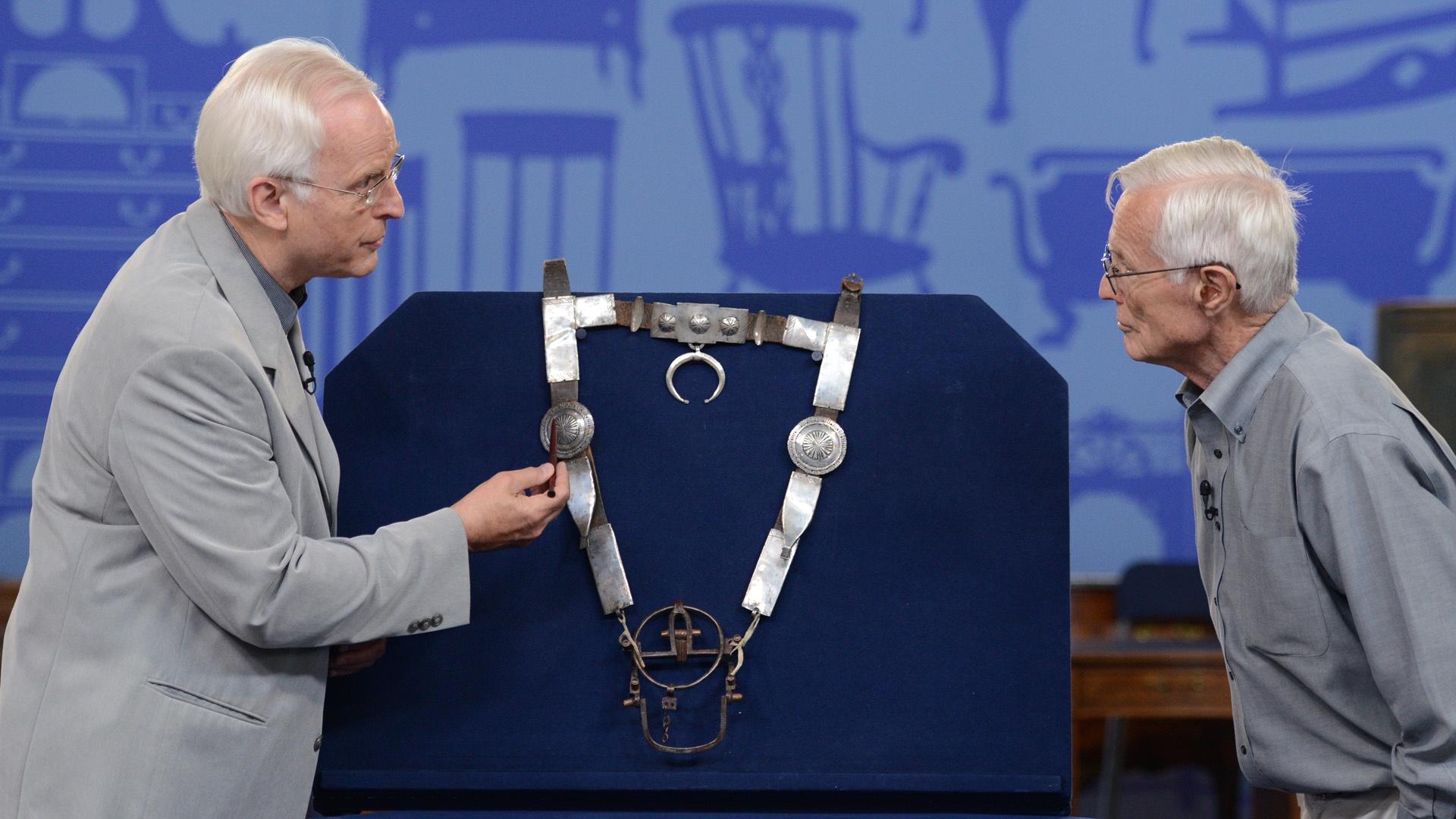
I purchased this bridle approximately 30 years ago. The person I purchased this was the granddaughter, and her grandfather had obtained the bridle. He was an Indian scout, and he had a Navajo friend who gave the grandfather the bridle. Okay, can I ask you what you paid for it at the time?
I paid $2,000. $2,000. It is in fact a Navajo bridle, and it's a nice early one. And you rarely see them this early with characteristics of the first bridles the Navajo made.
Now, they were of course influenced by the Plains Indians, the Comanche and Kiowa. And the Comanche and Kiowa would make a similar bridle that they learned from the Mexicans. Let's take it from the bottom. It's got a beautiful Mexican ring bit that probably dates to the mid- to early 19th century.
These were used on many of the Plains bridles and also the Navajo bridles. When you get up to these plaques, these silver plaques, you can notice some rocker engraving. This is the earliest characteristic of a Plains Indian bridle. They rocker-engrave the decoration.
So to see that as the detail with these different plaques means it's one of the first type bridles made like this by the Navajo. The beautiful conches are all cold-chiseled with probably the end of a file or something. Once again, a very early characteristic. This is the naja, which is actually a Moorish symbol that came over from Spain via Mexico and all the way through the Plains.
This is very early repouss work, embossing, and I particularly like these little scoops. There's early photographs of southern Cheyenne taken in the 1860s, and they're wearing rings like this. You can see these scoop rings on their fingers. So that's probably where this Navajo got the idea.
It's also got the original leather, which is really rare. So all in all, it's a fabulous early bridle, probably from the 1870 period. A real museum-caliber bridle. The material these are made out of is probably silver and possibly coin silver.
I've always loved these because they were one of the few things the Navajo made strictly for their own use. They're not collected quite like some of the other things on the market, but I think it would easily bring $10,000 to $15,000 at auction. Wow. Well, great.
Well, thank you. You by far gave me the most information I've ever received about it. You're welcome. I went to my favorite jeweler, and they were in their estate case, and of course I like shiny objects, so I asked, "Do you have any history about where they come from?" And he said, "Well, we think they belonged to a Playboy bunny "that she decided to just get rid of some of her jewelry because she was getting older, and we have them." And I bought them for about $200, and I have no clue...
I wear them for everyday.
APPRAISER
And how long ago did you purchase these? Oh, about... I would say about four... three or four years ago.
Okay, and did they give you any idea how old these were? No. I don't know anything about the jewelry. Okay, well, I saw them earlier and I fell in love with them.
They're so beautiful. So you've got the top of the earring with the bottom pendant, and all this wire work, we refer to this as filigree. Okay. A couple of countries are very well known for filigree work-- Italy, France, Spain.
The other thing that's quite unique about these is that the bottom portion, the pendants, have these raised areas that look like cameos. They're sort of emulating a cameo, but it's done in gold. Okay. Is this a female and is that a male?
Yes, it's a male and a female portraiture. So these earrings are really quite unusual because they're quite old. These earrings were made somewhere between 1760 and 1790. Oh!
(gasps) And they're what we call French provincial. They were made somewhere between southern France and Spain based on the stylization of the motifs. You look like you're awfully excited. I just...
(chuckles) (voice
breaking)
I wear them as... like junk jewelry. No, they're real. They're really nice, too, they're beautiful.
So with these type of earrings, these are called a European back, so you thread them through your ear backwards, basically. Right. And so the hallmarks are right along the edge of the wire here. They're going to just look like little tick marks on the metal, but both of the earrings have that.
Okay. And it's really very rare to find these types of earrings in the marketplace because after the Revolution, people were melting down their gold just to survive. So finding a pair of earrings that are intact and that haven't been altered is really quite unusual. Wow.
They're really wonderful. Wow. I was just so excited when I saw them because... And I love them.
They're my... I love these earrings. They're great. Now, you said you paid $200 for them, okay?
Well, I think you got probably the best deal anybody ever got on a pair of earrings because today's market, if these were in auction, these would sell for somewhere between $3,000 and $5,000. Oh, wow. Okay. Because collectors who want these items, they just never come up.
Okay. Because they're so rare. Wow. Well, I'll...
can I clean them with any...? Because I've never cleaned them. I would leave them as is. They don't need any cleaning.
They're actually in extremely good condition. Okay. I would just leave them as is and wear them and enjoy them. Wow, I will, I'll treasure them.
WALBERG
American artists have been inspired by the landscape and the people of New Mexico for over a century. Beginning in the early 1900s, the Taos Society of Artists produced several successful American painters. Roadshow appraiser Betty Krulik is on hand to talk about these remarkable artists. Tell me about the Taos Artist Colony and how it came to be.
Ernest Blumenschein was sent to the Southwest in 1896 on an illustration assignment for McClure's Magazine. He fell in love with the light and the landscape, and in 1898 convinced his friend Bert Phillips to come with him on a road trip from Denver to Mexico. Along the way, their cart got stuck in a rut, the wheel broke, they flipped a coin, and Blumenschein had to walk 20 miles to Taos to get the wheel fixed. The people were wonderful, they were warm and welcoming, so he brought his friends back to Taos every summer.
And in 1915, they established the Taos Society of Artists, and the original six were Joseph Henry Sharp, Blumenschein, Buck Dunton, Irving Couse, Bert Phillips, and Oscar Berninghaus. Let's take a closer look at Blumenschein's work.
KRULIK
This is Star Road, the young fellow that was to become the governor of the Taos Pueblo. And he is eclipsing White Sun, the elder. You see that not only in the placement in the painting, but also in their attire, Star Road wearing Western attire and White Sun in traditional. And also, we see influences that we haven't necessarily seen in paintings of the day in the Southwest where we'd see cowboys painting romantic scenes.
We have... the Taos artists are trained in Paris. Exactly. And in this painting, you see a kind of a mix of Art Nouveau and Art Deco, Deco being the strong, bold, very hard lines and beautiful shapes.
And then the sinuous lines and the rhythm of the Art Nouveau in the landscape. The market for his landscapes is generally between about $300,000 and $500,000 in the private market. A masterpiece such as this did sell for over $2 million in the private market.
WALBERG
Well, it's a beautiful representation of what was going on on the Taos Artist Colony, and thanks so much for the background. Thank you so much.
WOMAN
I was on holiday in London and I went into a shop that had all silverware and for me, this piece was the one. And it was 150. Now I don't know if it was dollars or pounds sterling. I didn't know how old it is and I still don't, but it looks like it could have been made yesterday.
It does, and how old do you think it might be? Well, I think it's from maybe the 1930s or so. It certainly has a look of the 1930s, if you like. It could pass for an Art Deco soup tureen, but it's not.
And I'm going to turn it over and we'll look at the marks on it and that'll tell you a little more about it.
You can see the name on the top of the designer
Dr. Christopher Dresser. And underneath that is the mark of the manufacturer, the initials H&H, which stand for Hukin & Heath. Hukin & Heath were a large manufacturer of silver plate, mostly it's made of silver plate, in the Midlands of England in Birmingham.
And what I love about this is it doesn't look its age. This would date to the late 1870s in most likelihood, or perhaps 1880. It's actually Victorian, and Christopher Dresser was, in many ways, the ultimate Victorian designer. He was born in 1834 and died in 1904, so his lifetime spans the Victorian era completely.
He was born in Glasgow in Scotland. As a young man he studied botany, he studied the arts, he studied the decorative arts and he studied design. He designed almost everything that you could imagine in the applied arts, as we call it, from wallpaper to ceramics, glass, some furniture and a wide range of things. In his formative years he was heavily influenced by Japanese taste.
When he was in his 40s he traveled to Japan, 1876, and brought back with him the aesthetic, if you like, of Japanese art. And the principles of Japanese art dictate that beauty can be and should be achieved through simplicity. And you can see that, I think, beautifully executed in this soup tureen. These are typically, by the way, found without the ladle.
Have you ever had it valued or do you have an idea of what it would be worth today? Well, �150, so I hope it's worth double that. It is worth quite a bit more than double that. How long ago was it you bought it?
In 1978. I would say today you wouldn't have a chance of buying this in London for less than probably �4,000 or �5,000. If it came up at auction in the United States, it'd probably be between $6,000 and $9,000. Wow.
I'm delighted. Thank you.
WOMAN
My grandmother had these pieces and she liked to collect things that had animal imagery on them. And when she passed, she passed these things along to me directly because we both shared an affinity for beautiful objects. (laughs)
APPRAISER
Do you like animals? I love animals, and I have several of them at home, but these are especially... they're a little different than the ones that I have at home. I don't have a snake or a bird, but I do enjoy the glittery quality of these.
Let's talk about this one first. This is a snake. And most people are afraid of snakes, but this snake is amazing. If you look closely you will see that his tail actually winds around and becomes the bail of the piece.
He has a large pear-shaped diamond-- it's a little over a carat-- in his head, and it's an old mine cut. And then there's single diamonds around him, around that head. He does prove to be 18-karat. The blue material, this is a large piece of lapis lazuli.
And we do think he is French, and about 1830s, 1840s. That's his... that would be the Georgian period. Okay.
Now, the bird is much more intriguing. He is also from the Georgian period, a little bit earlier. Now, the Georgian period, they had a bit of a shortage of gold, and so the jewelry that was made at the time, these jewelers learned how to stretch gold. Not literally stretch it, but they could take some gold and they would make this amazing type of work called canatille.
Okay. And canatille is very tiny filigree wires. Now, the interesting thing about this piece is on the back we have a brooch mechanism. Mm-hmm.
It's actually more of a contemporary sliding lock brooch. It has a trombone hinge. This was originally a pendant. I thought so from the little piece on the beak there.
Right. There is a tiny loop here. There is also evidence of some major restoration work right along here. This piece is extremely lightweight.
Okay. And the Georgian pieces are. So during this period, 1830s, the fashions went back to a very narrow waist and a tight bodice. And so they were wearing long chains and this bird probably was extended from a long chain and then the bird dangled from that.
That was how it originally looked. It was fabulous. Both of the pieces are unmarked. Now as to value, we decided a nice retail value on the snake is about $4,000 to $6,000.
Oh wow, okay. All right. Now on the bird, even in this condition, even though it's been what we call a marriage-- it's been changed from its original function-- in a high-end retail situation the bird is going to be $5,000 to $7,000. Wow, okay.
This is a Roerich print. Nicholas Roerich, he's a Russian artist, and philosopher and archaeologist and he traveled around the world. And we knew someone who studied with Nicholas Roerich, and then we studied with this person. So we kind of had a tie with Roerich.
And when we had an opportunity in 1977 to purchase a piece because we heard this was part of an estate sale and this was in our price range at that time. And what can you tell me about this specific piece? This piece is a sketch that was done in 1917 and the final painting was called The Call. And so I have a copy of the actual picture and it looks a little bit different than this, but it's very similar.
And of course it's in color. What were you hoping to learn from us today? Well, I'll tell you what, I took it off the wall last night and it totally... the frame fell apart and everything, and I was, like, oh, my gosh.
What I brought it here for was to find out how to preserve it. Okay, well, why don't we start with the condition, which is why you brought it in. So as you can see here along the top edge, it's particularly apparent, the work originally is done on this toned paper, and then it's glued down at some point onto this paper board, which is acidic. So we've got some discoloration from that.
And if you look all the way over here you can see it's pretty significant discoloration on this edge from what the paper started to what it is now. Also we've got some problems with these discolored spots up here and a loss right here, a small one. And all of these things certainly can be reduced in significance and can be improved. At the time, this would have been considered a perfectly fine way to take care of the drawing, but to be honest, just the simple chemistry today is so much better.
It's also framed right up against the glass, which isn't something we want. It is an old frame and something you could keep together, but I think that you'd want to have that conserved. It would significantly improve the look of the piece. In terms of value right now at auction, I would place the number conservatively at $15,000 to $25,000.
No. So how much did you say you paid for it? I think between $250 and $300. I think it was closer to $250.
It was a lot of money for us at that time. It's mind boggling. It's a wonderful piece, we love it and I appreciate you giving me this information. Whoa!
You're welcome. (laughing): Holy moly!
WOMAN
I think it's a blanket chest. My grandparents and then my dad always kept Native American rugs and things like that in it. So I'm not sure where it came from. You're not so sure?
No, it just looks sort of New Mexican. You can tell it's been used a lot. Yeah, it has been used a lot. It's very cool because it's actually locally made, as you might have surmised.
And what's cool about it is that it tells a great story. It's got Spanish colonial influences and what's now the American Southwest
was Spain's northern frontier
California, Texas, New Mexico, Arizona. And people who were actually making this stuff, the cabinetmakers, were using local wood-- ponderosa pine-- to make the furniture because the hardwoods didn't grow here that grew back East. So they used what was locally available to them, and they also decorated it with iconography that symbolized some local characteristics. It might be the physical geography of the buttes and the mesas, or the corn and the clouds and rivers and stylized fish.
That's why you have this wonderful incising and shallow carving on the raised panels. This piece strikes me as being early 19th century from the construction. But what's also interesting is that it was hard to get iron in the Southwest. So instead of using nails, which would have been prohibitively expensive, they put it together with mortise-and-tenon construction, which is essentially...
Fitted together. It's a male-female joint where the rails and the stiles come together. And then they would use pins, whittled pins or pegs to hold the joints together. What's also fascinating is that a very sparse amount of iron is used on this.
You see it for the hasp here to lock and close the chest and for the hinges or snipe hinges in the back, which is essentially two cotter pins that a blacksmith would have made that are looped together and then nailed back into the case to hold it in place. It's a great rarity. They don't turn up much in the Southwest and they certainly don't turn up much in the Northeast anymore. And if this were to come to auction today I think I would place an estimate on it of $3,000 to $5,000.
That's nice.
MAN
This painting was made by Fremont Ellis in 1929. It was given to my godmother's husband in 1969 and then my godmother gave it to me in 1985.
APPRAISER
It's a beautiful example of Fremont Ellis's work. Fremont Ellis was born in Montana and was mostly a self-taught artist. He did three months of training at the Art Students League in New York, but other than that he learned to paint on his own. That's right, the...
he was one of the original Cinco Pintores from Santa Fe when the art colonies started many, many years ago, in the '30s. And I was a personal friend of his. I went to work in a paint store in 1948 and he was a customer because we sold art supplies. In terms of technique, this is an oil on board.
It was painted probably in the late 1920s. The first date we have on the back is 1929. You have any idea of the value of this painting? No, not really.
I did know as he went on in his career a lot of his paintings were pricey. You saw them in Santa Fe, but no one had the money to buy them. Right. Well, I think this one, it's a smaller example for Fremont Ellis, but for its size I would say it should sell at auction between $10,000 and $15,000.
Wow. That's quite a... quite a figure. I never had anything like that in mind.
Well, this bank belonged to my grandfather. And it was a gift to him from his father. And his father came west from Arkansas and they lived in a place called Lake Valley, New Mexico. So we don't really know how old it is and I'm not sure if this actually belonged to his father, but it was a gift from his father to my grandfather.
My mother, of course, coveted this and when my grandfather passed away in about 1979, my mother got it. And I always wanted it so I told my mother, "I really would like to have that sometime in my life." So when she passed away I now have it. Well, you got a wonderful little bank here. Do you know what it's called?
I don't. Well, it's very easy to figure out the name. It's called "The Clown on Globe" mechanical bank. (chuckling): Makes sense.
And it was made by a company called J&E Stevens in Cromwell, Connecticut, in the 1880s, 1890s. And it was a fairly expensive toy in its day. Was it? It's cast-iron, it's a mechanical bank, it's one of the scarcer banks and one that doesn't survive very well because of the rather violent action.
What's unusual about this bank is that it does have a winding mechanism. Most banks you just put a penny in and then click a lever and it gets deposited. So after we've wound it, we release the clown so he's just sitting there like that, then we hit down this lever and he flies up in the air. Now, one of the things that makes this bank rare is there's a lot of stress points on his arms and they're often broken.
Are they? And then repaired. There are other elements that are easily broken-- the legs, the feet. But this example is really in very, very nice condition.
Thank you. It's all original, very nice paint. What really makes a bank valuable these days is the quality of the paint, and this has all original paint, very nice strong color. So I think at auction this bank would bring between $3,000 and $4,000.
(chuckling): Oh, my God. Now, if it had a slightly or much better paint, this bank has sold for as much as $16,000 to $17,000 depending on paint. (chuckling): Oh, my God. So it just shows you how important paint is.
But $3,000 to $4,000 is pretty nice for a family heirloom. That's good. Yes, thank you very much. I think I'm a lucky guy.
WOMAN
I know that it's been in my family since sometime in the 1800s and that it was my great-great-grandfather who came out to this part of the world from the East Coast. He worked for the Bureau of Indian Affairs and sent home a number of artifacts. And this one was in our living room all the time I was growing up, and then she gave it to me and we moved out here to Albuquerque, so I think it's come closer to home. I only know that nobody in the family, you know, went out and bought it last week or anything.
It did... it has been around. How far back can you trace it? Well, my aunt's letters said McKinley's administration, but I don't know.
She was not 100% sure of that. But this was a great-great-grandfather of mine and I'm 72. (chuckling): So it goes back a way. Right.
And do you have any idea what it is? Well, I call it a kachina, and I call it a wall kachina, but no, I don't. Okay. Well, you're quite right, it is a kachina, and it's very exciting to have it because it's the earliest type of kachina.
I mean most of the kachinas you see are articulated, they're standing and they're three-dimensional. They start in the middle of the 19th century, about 1850. So this one is probably around about that time. It's a Hopi kachina, made by the Hopi tribe.
The kachinas were made by males in the tribe and they were given to the young girls, who would learn about the pantheon of gods and the mythology in their society. They're made out of cottonwood. It's smoothed with a sandstone and then the irregularities are filled in with white kaolin. And the pigment is the natural mineral pigments that are around.
The headdress on the top, this is called a tableta. And this is the cloud tableta. You see the clouds here on the top. When the young ladies had finished with it, they were hung on the wall of the kiva, hence the sort of flat-backed ones.
It's exciting to have one of these early ones here. I think a good conservative figure, a retail figure for this would be about $12,000 to $15,000. I told my family I would practice my wows, but I'm not going to say wow. I am impressed, though.
MAN
This is a drawing by Seurat. It was given to me by my father. I used to be a French horn player and he thought I would like it because of the brass connection. I've had it for maybe 30 years.
Georges Seurat is one of the most important artists of the 19th century. He's known in popular culture because of Sunday in the Park with George, the musical by Stephen Sondheim. But Georges Seurat is known by painting lovers as the artist who painted "Sunday Afternoon at the Grande Jatte," the masterpiece of his career, which is in the Art Institute of Chicago, probably one of the most iconic pictures of the 19th century in France. And Seurat's importance can't really be overstated.
Now, this may look like a minor drawing. It's a very lovely little pen and ink done when he was very, very young. Seurat was born in 1859, and if we think of this as a relatively juvenile work and guess that perhaps he was about 15, he's such an important artist that these drawings of his youth are as important as many other works by greater artists in their prime. There are some very interesting inscriptions on the back of this in French, and I'm going to ask you if you could to just give us an idea of what these labels say.
Okay. The small label on the top says, in French, "Written by Flix Fnon, Seurat a l'enfant, as a child, soldier playing the bombardon." And then below that it says, "This drawing of Georges Seurat, "number 531 in the collection of Flix Fnon "came from a notebook having belonged "to the artist's brother, Emile Seurat, "and sold to Flix Fnon, who gave it to me in 1939." And then there's a signature. Okay, a drawing attributed to Seurat would require a great deal of research, particularly when it is a youthful drawing of this sort and not typical of his style. This is more typical of the style when he was being academically trained before he invented his revolutionary techniques of pointillism and other styles.
The thing that's very exciting about this is the documentation that accompanies it. Flix Fnon was perhaps the most important French art critic of the time. He was a great admirer of Seurat's and he coined the term neo-impressionism, actually, which is the term for the style of art that Seurat became known for. So Fnon is an impeccable provenance for a Seurat-related piece.
It then goes on to quote that letter from John Rewald. That's the signature at the bottom of the inscription you read, and John Rewald is perhaps the most prominent art historian of the impressionist artists. He wrote the definitive book on the history of impressionism. You combine all of those things with the Sterling and Francine Clark label on the bottom, which is a museum that has a fantastic collection of this kind of art, and what it says to me is this drawing is beyond reproach in terms of a family history, ownership by the most important people connected with this artist, and all of that contributes very, very much to the value.
But not just the financial value, but the art historical value and the interest there would be in this drawing. It's in reasonably good condition, and it's very charming in its own right. But the documentation is what it's all about with this piece, and these drawings are quite rare. Do you have any idea where your father might have obtained this drawing?
You know, I could take some guesses. He may have been given it by John Rewald. My father had quite a lot of art objects. So he might well have known him in New York?
Yes, he probably did. And that would've been New York in the... In the '40s. '40s.
I would say that an auction estimate on this drawing, I think it's easy to say $7,000 to $10,000. And I think that it's hard to predict how much this drawing might sell for at auction because while it might fall in that fairly conservative range because it's a modest drawing, it might very well make more than that because it's very rare to have all of these pieces fall into place on one object. Very nice news. That's very exciting for me to see.
Me and my daughter got tickets for the Roadshow and this is the only thing I could think of to bring. Because it's the only antique thing I've got at home, besides my wife. (laughter) So how long have you had it? About 52 years.
Really? Yes. And are you still playing it? Oh yeah, I play it every day.
No, not this one, I play my other one, but I used to play this one. I haven't played this in about eight years. I've had it stored. Uh-huh, right.
Because about eight years ago I found out it was a little... it was like an antique, so I decided not to play it. It's from late 1962. Okay.
And it's a Stratocaster, which is pretty obvious with the decal on the headstock. But what makes it unusual is the custom color. It's Sonic Blue. Sonic Blue is one of the more rare Fender custom colors.
They got their colors from automotive paint, DuPont, and this color was first used on 1956 Cadillacs. And so Fender began to use it, but it wasn't very popular so there aren't very many of them done in this color. The more popular custom colors were Olympic White, Candy Apple Red and a darker blue that was called Lake Placid Blue. Okay.
And what has really sent these kind of into the stratosphere is the fact that John Lennon and George Harrison had a pair of them, and they used that on Nowhere Man, and there's session photos of those two guys playing matching Sonic Blue Stratocasters for that recording session. Now, George Harrison later repainted his with all kinds of fancy swirls and things like that, but he continued playing that guitar until he died. The John Lennon one has been in storage for who knows how long. Uh-huh.
So it's kind of made them the mythical color for an early '60s Strat. Good. Where did you get this Fender? I got it I think in 1965 at the Wild West Pawn Shop.
I paid about $135 for it. Have you ever had a real appraisal of the guitar before? No, not really. No, just what I've been offered, but...
So what were you offered for it? I was offered $35,000 for it one time and then I refused that and they offered me $40,000, but I refused that, too. In today's market, in a specialty vintage guitar store or something like that, a guitar like this might bring $45,000 and maybe even higher. So it's definitely desirable.
And the custom color Strats have come back. They took quite a hit in the recession, but their values are coming back again, so... Well, that's good. Good to know.
's time for the Roadshow Feedback Booth. And I brought this wonderful presentation sword, which has been in my family for years, thought it was worth a fortune, it's worth $150. But I love it and I'll use it for homeland security. And I brought my Pancho Villa signature with my Pancho Villa t-shirt.
And we didn't make it on TV, but here we are. And I have a Van Briggle pottery, which I know works
because when I rubbed it I got my wish
tickets to the Antiques Roadshow. My son was visiting with his friends. His friends said, "We're taking our mother to Hawaii for her birthday." And he said, "Oh, we're taking our mother to Antiques Roadshow." I brought my beautiful Lady Godiva radio today, and they said it was worth $500 and I am just absolutely thrilled. And I loved my experience meeting Bruce Shackelford, awesome appraiser, and my Pablita is worth $12,000 to $15,000.
I impressed my husband. (laughs) Today I brought my head. It's worth a little bit, but it goes back on the wall where it can scare the heck out of me and my dog again. Thank you.
And we brought this pot, Maria Martinez pot, and we thought we were going to make a fortune, and yet she's got to keep her job. Thank you, Antiques Roadshow. Thanks, Antiques Roadshow. I'm Mark Walberg, thanks for watching.
See you next time on Antiques Roadshow. Hello there. How are you? Good, how are you?
Captioned by Media Access Group at WGBH access.wgbh.org Did you bring something to get appraised? No. No, just hung out with this guy, huh?
Search Episodes

Donate to sign up. Activate and sign in to Passport. It's that easy to help PBS Wisconsin serve your community through media that educates, inspires, and entertains.
Make your membership gift today
Only for new users: Activate Passport using your code or email address
Already a member?
Look up my account
Need some help? Go to FAQ or visit PBS Passport Help
Need help accessing PBS Wisconsin anywhere?

Online Access | Platform & Device Access | Cable or Satellite Access | Over-The-Air Access
Visit Access Guide
Need help accessing PBS Wisconsin anywhere?
Visit Our
Live TV Access Guide
Online AccessPlatform & Device Access
Cable or Satellite Access
Over-The-Air Access
Visit Access Guide




Follow Us