








PBS Wisconsin Passport
Watch this video with
PBS Wisconsin Passport
Become a member of PBS Wisconsin, support your local community, and get extended access to PBS shows, films, and specials, like this one.
Albuquerque, NM, Hour 2
10/05/15 | 53m s | Rating: TV-G
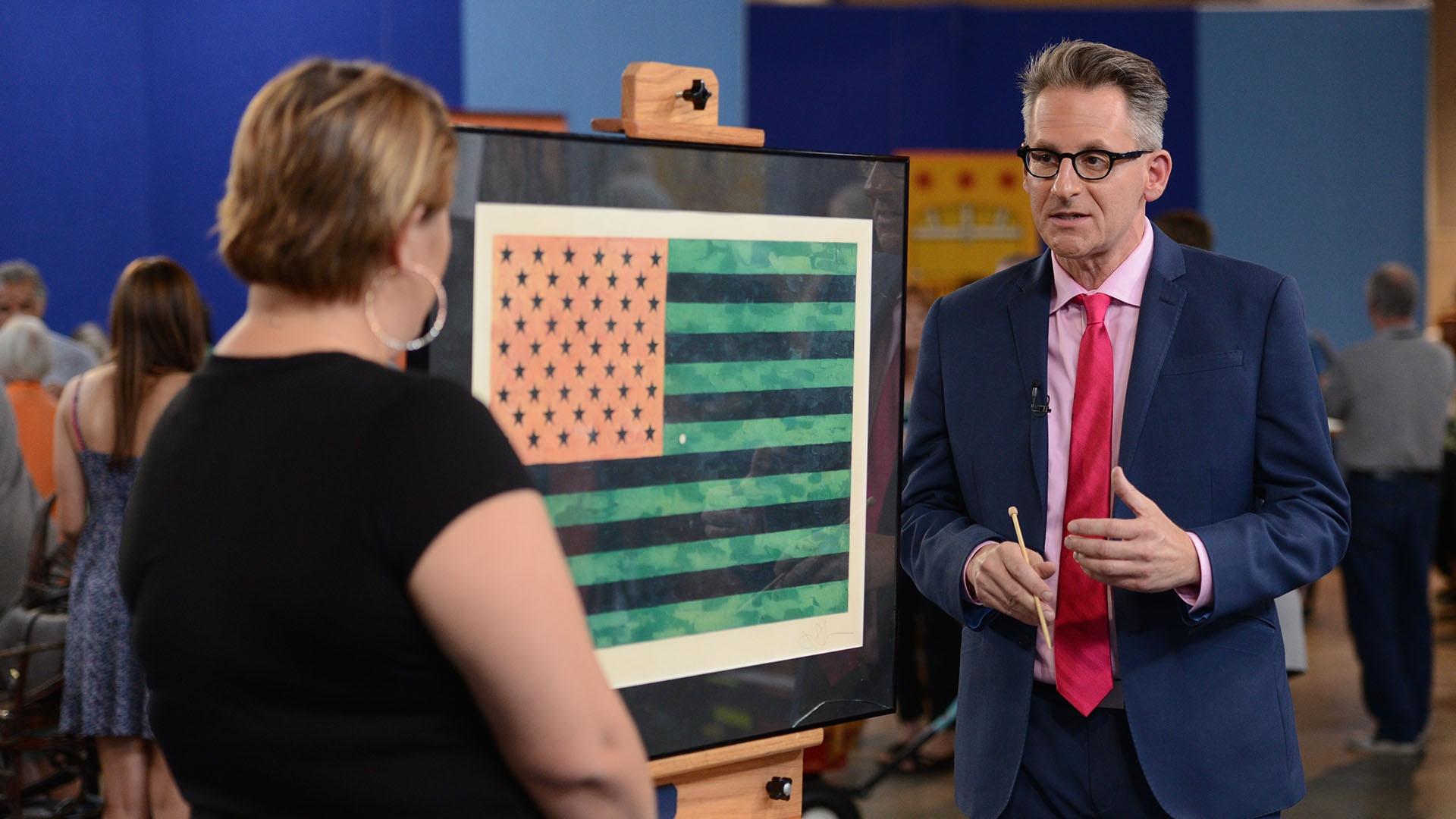
Journey to Albuquerque for finds such as a 1969 Jasper Johns flag print, a 1939 inscribed "Pinocchio" book, and an Imperial jade snuff bottle. Find out which is appraised for $50,000-$60,000! Also: a trip to the Museum of International Folk Art.


Copy and Paste the Following Code to Embed this Video:
Albuquerque, NM, Hour 2
It's another hour of Antiques Roadshow, from Albuquerque, New Mexico. Do you have impressions of seeing Jimi and his crew, you know, Jimi and The Experience? You cannot see someone like that and not be permanently changed. She was the sex symbol of her day. She was the looker. Oh, my God! Mom and Dad, great taste. Thank you! Don't miss a minute. Stay tuned. Welcome to Antiques Roadshow. Hi, I'm Mark Walberg, in Albuquerque, New Mexico. Spanish explorers hoping to find gold and riches like those of the Aztec empire called this area La Nueva Mxico-- the new Mexico-- back in the 16th century. Roadshow has made some new discoveries of old treasures here in Albuquerque. Check it out. When you brought this in, you told me that you had a choice between bringing in this or one other object. What was the other object? We had two paintings that I had inherited from my grandmothers, and this was actually going to stay in the car because it was big and clunky, so... What kind of compelled you to bring this one in instead? What do you like about it? Well, I mean, it has meaning to me. When I was growing up with it, I remember that we would look at the circle in the middle and you'd blur your eyes for a minute and then you'd look up and it would have the flag in red, white, and blue. And it hung in our home. I grew up in Florida. My parents moved to New Mexico in '91. It went in the garage, it's been there ever since. My husband and I recently bought our first home, and they gave this to us to hang in our home. You know who the artist is. I know that it's signed by Jasper Johns. And in addition to being signed by Jasper Johns, it's numbered, and we see here that it's an edition of 300. So this is a print, and it is essentially a mechanical reproduction of a painting. Flags along with targets were one of the images that was a real source of inspiration for Jasper Johns, who was a real seminal figure in 20th century American art. And the flag theme he has said to have thought of in a dream. He started doing the flags roughly in the mid-'50s. This print was done in 1969 as a real anti-war statement of what was going on in Vietnam. At the time, Jasper Johns' dealer, the famous dealer Leo Castelli, commissioned Jasper Johns to make this print in commemoration of the Moratorium, which was really a series of marches going on in the fall of 1969 across the U.S. An outfit called the Committee Against the War in Vietnam published this print in the edition of 300. There's also an edition that has typeset on the bottom that says "Moratorium," and "Flag (Moratorium)" is what this is called. Oh, wow. The orange is said to have had a connection, a statement against Agent Orange being used in the war. The green has a tie-in to the fatigues used by the soldiers. This represents a bullet hole, and that is an optical illusion. Jasper Johns was really one of the great minimalists. He was a figure who foretold what was going to be going on in pop art. And it's an interesting print. It's iconic and something that people remember from the late '60s. It's interesting to hear that story because my parents were total hippies. Oh, were they? Total hippies, and this was gifted to them in the '70s, and I didn't know the story, so it makes a lot of sense in terms of actually having that meaning. It resonates with the story. Well, he was a relatively young man when this was produced. He was born in 1930. But it's interesting that as a mechanical print, because it's signed and numbered, in today's market at auction, this print has a value of $10,000 to $15,000. What? And it's funny because my parents this morning were saying, "Don't bring it, it's worth nothing, it's damaged." I'm glad you didn't listen to them. It was going to totally stay in the car. That's crazy.
WOMAN
My husband's grandfather passed. He was about 100 years old. This was up in the attic in their house, and I told him to go get it and bring it down because I wanted it. And how long have you had it? Almost 30 years now. This vase was made by Thomas Wheatley. Thomas Wheatley was a potter from Cincinnati, Ohio, and in 1880, opened the T.J. Wheatley Company, where he made copies of a famous style of work called Limoges ware that other people in Cincinnati, Ohio, were doing. He filed a patent for the technique, eventually went out of business, and in 1903 formed another Wheatley Company, which is this one. And this company, also in Cincinnati, copied the work of Grueby Pottery in Boston, Massachusetts. So Wheatley was big into copying work that others did. And I mean, that's not necessarily a bad thing, because a lot of companies copied each other. I would date this piece, since he's copying a Grueby precedent, the Grueby precedent would have been made around 1900 to 1902, so I would date this to around 1905 or 1906.
This is almost an exact copy of a vase that Grueby made
straight-sided vase with leaves encircling the top, and then these fern fronds forming tight little handles, covered in this vegetal matte green glaze. The difference between this piece and a Grueby piece is, were this Grueby, the pot itself would be hand-thrown on a wheel. You'd see the finger marks on the inside. And then further, these leaves that we see on the outside of the vase, that thrown vase would have clay stuck to the side and the leaves would be sculpted out with a carving tool, as opposed to being part of the mold that was used to make this piece. And finally, these handles would be formed from flat pieces of clay, where they would stretch them out and roll them and apply them to the side at Grueby, rather than cast and applied as they are here. So Wheatley approximated the Grueby look in a very good way. It's a fairly honest representation, but at a much lower cost. The Grueby's green glaze is a signature. Over 100 companies copied the matte green glazes that Grueby used. When you walked up to the table, I knew this was Wheatley because this is their signature glaze. Ah. The Grueby glaze would be a little bluer in color, a little less texture, a matte crystalline surface to it. There'd be a lot more distinction to the Grueby vase. There is one issue with this pot. It's not marked, or if it's marked, the bottom is covered with a sufficient amount of glaze that we can't see it. But there's a crack running through the bottom of the piece that does come up the side, which is going to limit the value. It's a pretty good-sized body crack. I still think because it's such an extravagant example, at auction, it's still worth $1,000. Without the crack at auction, it's about a $3,000 piece. And if this were a piece of Grueby made a couple years earlier in Boston, Massachusetts, at auction, it'd be about $7,000.
WOMAN
My mother-in-law was an antique jewelry dealer. She collected these, and my husband has gifted them to me over the years.
APPRAISER
And what do you need to know about them? I mean, she was in the business. You must know so much. Actually, not much. I know she loved Art Nouveau or Art Deco, I really don't know the difference. I don't know what these pieces are, where they were made. They are Art Nouveau, not Art Deco. Art Nouveau came first. It dates probably from around 1890 to around 1910, 1915, and after World War I, that's when Art Deco became popular. Later. Later. And this is classic Art Nouveau jewelry. You have the first piece right here. This is an opal, diamond, enamel, and what you also have is a little armature that converts it into a brooch. And then you have the original chain, which has green enamel little bosses. When I turned it over-- and we always try to say, "Okay, this should be signed"-- and sure enough, we found a signature. The signature is right in here. You didn't know it was signed. No, we've looked for marks and we haven't found them. And the signature is Marcus & Company, who was an American jeweler that rivaled Tiffany, worked around the same time, and he loved Art Nouveau. He specialized in the use of opals, enamel, gold. He did some extraordinary jewelry. This is a quiet... I call it a quiet opal. It doesn't have so much coloring, but it fits into the scheme of the brooch, and certainly with the enamel. And look at how he's holding the opal. Instead of just having prongs, it sort of undulates and it's all in that theme of Art Nouveau. Now here, you have another piece which is also Art Nouveau, but this one is made in France. It's heftier, the way the gold is beautifully chased, the beautiful natural pearls, the diamonds. This also has its chain. I found a mark on the chain, and of course, it had the French hallmark, and it also had the maker's mark, but it's very hard to see. But I had to dismantle it. I know you were worried. Yeah, a little bit. I had to dismantle it to find the mark, and sure enough, it's difficult to see, right there is the hallmark. We never found it. The French, when it was great, they signed it. This one has a poinon, which is sort of a mark that has the maker's mark. It says G. and Frres. There's a specific book that we have to look through to find the G. and Frres. I'm going to give you a value for the American piece, the Marcus & Company, and I would say an auction value would be between $8,000 and $12,000. Wow. If you had to insure it, you're probably going to say $15,000 to $20,000 to insure it. Mm-hmm. The French piece, I'm going to say $12,000 to $18,000. Mmm. My goodness. If you had to insure it, you're looking at at least $20,000 to $25,000. Very difficult to find them complete with the chain, with the markings. You have great examples of American Art Nouveau and French Art Nouveau jewelry. You're very, very lucky. Wonderful. My father is from Ohio originally, and he retired out to New Mexico several years ago, and in 2004 or '05, he gave me some things, stuff. This was in the stuff. He was away until four, five months ago, I was going through some things for a garage sale and pulled it out and was like, "Oh, this is comfortable," and sat in it. And my friend, who was helping me, friend at the time, is a woodworker and does upholstery, and he says, "Wow, this is very cool. Can I have this, can I buy this?" I said, "No, I like it, I think I'll keep it." Anyway, he went back and researched it and he got online and he said, "You know, I think this may be a piece that you may want to find more about." This was made by a man named Wharton Esherick from Pennsylvania. Esherick was a craftsman who kind of bridged the gap between the Arts and Crafts period and the modern studio craftsman. He was born in the 19th century, and he was one of the first craftsmen that really started taking away classical ornament and really started focusing on pure form, so this is a very simple stool. And his work kind of almost looks like folk art, or outsider art, until you really start looking at how clever the work is. He was really interested in taking ordinary household items and giving them a sculptural quality. The top is not quite square, it's not round, and the edges are very subtly curved, like sculpture. It's very nicely marked underneath here, Wharton Esherick, "W.E., 1960." Unlike a lot of other craftsmen from the period who had large workshops and many people working for them, Wharton Esherick's work was much more intimate. He made every single piece himself. Therefore, you don't see them on the market very often. Stools like this come in various shapes and sizes, but typically they have three legs, they have this nice little peg joint on the top. This one has something spilled or stained on the top. Do you know what might have happened there? I don't know anything about it. Ten years ago, I would have said this needs to be restored, but now we think that this is part of the history of the piece. It tells a story. Someone probably put a plant there and used it as a plant stand. Once I got down here and y'all were interested, I was like, "Oh, I should have cleaned it!" It's so dirty, I haven't done anything to it. Well, now the one thing I hope everyone has learned by looking at the Roadshow all these years is... Don't clean it! Did you ever think about selling it? Well, actually, I would have sold it for maybe 30 bucks at the garage sale, but then, you know, when my fianc said, "You better not. Take a look at this..." I'm not attached to this, so yeah, I would sell it if... I would sell it. Well, in today's market, there are quite a lot of collectors who are looking for Esherick pieces, and because this one is very nicely stamped and marked, it's made out of black walnut and hickory, I think a collector would probably easily pay $2,500 at auction in today's marketplace. Wow, wow. Great, that's great, wow. So what are you going to do with it now? I'm going to sit on it. I'm going to quit not sitting on it. I'm going to sit on it.
WOMAN
I inherited this Rosa Bonheur from my mother, who inherited it from her parents.
APPRAISER
And I gather you love cows. I love this painting. Cattle... You love the painting. I love horses, but... She was famous for her anatomical drawings, and she was such a giant and such a model for women in the 19th century. Her parents believed in Saint-Simonianism, where women should be equal to men-- can you believe it?-- in the 19th century, and she started drawing early, had to dress up as a male to get into the veterinary school to do anatomical drawings. I mean, she must have been quite a power. In 1855, The Horse Fair was a great success, which is now in the Metropolitan Museum, one of the great anatomical, challenging, exciting paintings done in the 19th century. Oh, it's a fabulous painting. So with that honor and international fame, in 1856, she goes to Scotland, and these Highland cattle became her subject. What do you think this watercolor is worth of these cows, because cattle aren't really "in" these days? I really don't know. I've always had this idea that maybe it was worth $12,000. I don't know why that figure... $12,000? Yeah. I believe this would sell at auction in the range of $70,000 to $90,000 if it were to sell, because it's so beautifully preserved and so great. Oh, my God. And I think you should have it insured for no less than $100,000. It's really a masterpiece. So rare to find something of the 1850s from the Scottish trip. You may not like cows, but you sure have to love how she painted them. Oh, I do. I'm in shock.
MAN
I got these posters when I was 16 years old. My dad was stationed in Germany with the Air Force. I was going to school there, at Frankfurt High School, and all my friends and I used to go to these concerts downtown. Do you have impressions of seeing Jimi and his crew, you know, Jimi and The Experience? You cannot see someone like that, of that caliber and not be permanently changed. We went to the shows early so that we could be in front when the doors would open, and it was common practice for anybody that could get to them quickly to strip the posters off the walls and pull them down. It was considered acceptable behavior. First-come, first-served sort of behavior. We have one from The Doors and The Canned Heat, one with Jimi Hendrix and The Experience, and we have Ray Charles. Most of these posters were for concerts in Frankfurt, Germany, or in the area where you were. The poster artist's name was Gnther Kieser. Kieser was born in 1930, and during the 1950s, he created posters for jazz greats Ella Fitzgerald, Count Basie, Johnny Coltrane, all the greats. By the '60s, he moved into rock and he began to define all the rock concerts with psychedelic art. The concert promoters were Lippmann and Rau. Yes. In 1967, '68, they were working with Cream, they were working with the greatest artists. They worked with Mick Jagger of the Rolling Stones. What was your first concert you went to over there? Oh, golly, I don't remember all of them. From Derek and the Dominoes to Frank Zappa to Led Zeppelin. What I love about the German posters versus the American posters, the American ones were put out in large production. They're also graphically a little different. They weren't as pop. The German culture, for years, their factories have made the best graphics in the world. I think that these are way ahead of the American posters at the time. This is an ultra-rare 1968 Jim Morrison flypaper poster. I've never seen that in any auction catalog. I'm sure they might be out there for sale. This one with Jimi Hendrix, I've never been able to find an original. I think that this is one of the masterpieces of rock art right here. This concert is from January 16, 1969. The year before, he had been named Artist of the Year by the main entertainment magazine. And then Ray, of course. I love that they've done the whole psychedelic look with Ray. As far as the value on the three posters here before us, I'm going to say the value on the group at auction would be $4,000 to $5,000. Very good.
WOMAN
This book was given to my husband, who was an animation artist at Walt Disney. He worked on Pinocchio, and Walt Disney signed it, along with a lot of animators that were there.
APPRAISER
How long did he work for the Disney company? I don't know, a few years. He worked on Pinocchio and he worked on Fantasia. Wow, two of the Disney classics from that time period. Pinocchio, he worked on Monstro the whale. Monstro? He worked on Monstro the whale? The whale, yes. They made Pinocchio and Fantasia in 1940. It was a legendary time at the Disney studios. It's astonishing to me to see this book. Here's the title page of the book showing the 1939 publication date. On the next page......here we have an inscription to your late husband from Walt Disney himself. It's personally inscribed. Pretty special, pretty amazing. But what makes this book even more special, it has wonderful plates throughout the book, but here, we'll leave it open to this page showing Monstro the whale. This is the part of the Pinocchio film that your husband animated. Yes. And his fellow animators have signed the page. This book is chock full of autographs of Disney's animators from the golden age of Walt Disney animation. Walt Disney autographs are increasingly collectable in the market, particularly authentic autographs with excellent provenance, like yours is, in addition to some three dozen other animator autographs. It is a second printing, not a first edition, and the dust jacket is a bit tatty. But the book's worth, at retail, $10,000. Oh, I'm surprised, yes.
WOMAN
It was bequeathed to me by a friend. I believe it's a tansu, based on the design. But what I love about this chest is all its secret compartments. And I design and build contemporary furniture and contemporary tansu, and I build secret compartments into everything that I build. The card that came with it said it was a 1740s Queen Anne apothecary chest, purported to be used for nobility. So the paper said Queen Anne circa 1740. Yes. Inferring that this was made by an English cabinetmaker for use in England. One can pull out one of these and see that you've got this terrific little box, but it's really a visual pun. Yes, it is. Because most of these are not, in fact, drawers; they are other things. They're sliding doors, or they are drawers designed to look like four small drawers, but in fact, they're broken up into compartments that have all kinds of other things going on. Right. And that's because this was made for someone who was a pharmacist. What this does, it actually hinges together and forms a box, and you've got this wonderful plate here on the front, and the corners are reinforced with these metal plates that have this silvered surface. These are in a Baroque kind of Rococo design, which is a European design. We're going to just look at the whole exterior, and what do we see? The side that looks like it's one solid panel in fact slides open. You had said tansu, which is a type of furniture used in Japan and Korea. This actually is made of a wood that is not teak, not padauk. It's a wood called huanghuali. Huanghuali was a wood that was used in Chinese cabinetry work. Oh, okay. From an early period of time during the Ming dynasty and the Qing dynasty up into the 18th century. It wasn't really used by any other cultures in Asia. Okay. That and this form, this hinge box form, is a Chinese form. This was made by a Chinese cabinetmaker probably between 1720 and 1750. This was made for somebody who was a well-to-do individual. This was likely made in southern China, probably in what was then called Canton, and it was made for someone who was working there or brought it back from there to Europe. And stylistically, I think that individual is likely Dutch. Really? And I base that on the style of these mounts. What a terrific object. This is so fun. And the fact that it's miniaturized really makes it appealing because it's portable and small. Right, right. It's worth, I think, conservatively, $8,000 to $12,000 at auction. Wow. (chuckles) That's amazing. I can't believe, such a gift! If they were Chinese mounts, not these European mounts, this would be worth $50,000 to $70,000 at auction. Oh, wow.
WALBERG
The Museum of International Folk Art in Santa Fe has a trove of Spanish colonial arts and crafts. Roadshow got a behind-the-scenes peak at the furniture collection storage vault to check out some examples of traditional New Mexican furniture. Sebastian, there are some wonderful pieces of furniture here. We've seen some bancos, which are benches, trasteros, cupboards, but we're going to take a look at some beautiful cajas, which is the Spanish word for "chests." And before we do that, maybe you can give us a brief history of some of the furniture making here in New Mexico. Spain colonized this part of North America in the late 16th century, and they brought along with them cabinetmakers, or carpenteros, and this is a wonderful example of Spanish colonial furniture made in the late 18th century. We have the rosette right here, also the pomegranate, and then this lion. And these are all elements that we see in Spanish or Iberian furniture, and when I say Iberian, it's what we know today as Spain and Portugal. It's a straight line from the influences in Spain being incorporated into a piece of colonial furniture, and what's really wonderful about it is that there's some traces of the original pigment left on the borders and throughout the chest as well. If we were to find something in the marketplace in this condition-- and this would be considered extremely good condition-- I would expect an auction estimate for a comparable example to be between $3,000 and $5,000. Sebastian, this beautiful piece, brightly colored, all that pigment, tell me about this.
CLARKE
This piece dates from the mid- to late-19th century, and it really shows influence from the Pueblo Indians. You've got the natural pigments as well as the geometric designs. What's interesting about this lock is it's a very European-style lock. It's the type of lock that you would expect to see on a piece of Spanish furniture, and here we have it on a piece of Spanish colonial furniture. This actually came out of the Ranchos de Taos church. It was used as an altar, and it is attributed to the Valdez family, and it is one of 11 known examples by the Valdez family. So it's really quite unusual to have any piece of furniture, especially Spanish colonial, that you can attribute to a maker. If we were to see a similar example come up for auction with the same attributation, I would expect to see an auction estimate of $6,000 to $8,000.
WALBERG
That's really great. Thank you so much for sharing them. It's my pleasure. It's by Raymond Jonson. He was a New Mexico painter. It belonged to my parents. And when they died I got it from the estate, because I thought it was lovely and it reminded me of places where I worked as an archaeologist, and that's all that I know.
APPRAISER
Well, it's a beautiful painting. Thank you. And it's a scene of Santa Fe. Ah. It's an oil on canvas, and it's signed with his stylized signature and dated 1922. And it's fully signed on the back "Raymond Jonson" and titled Santa Fe. He received his formal training in Chicago. He studied at the Academy of Fine Arts under Nordfeldt, and then later at the Art Institute. Nordfeldt was a Modernist artist, and this is where he gained a lot of influence. It's significant because this painting was probably one of the first paintings done when he first visited Santa Fe. By 1924, he became much more abstract. He was the founder of the Transcendental Painters Group in Santa Fe, and his works became completely different from what you see here. This painting reminds me a lot of Czanne. He was influenced heavily by the French artist Paul Czanne, where the mountains and natural forms are abstracted. Do you have any idea of what the value might be? Oh, I thought maybe $5,000, $10,000. I have no idea, honestly. I just liked it. I think a painting like this at auction would bring $25,000 to $35,000, easily. Oh, my God! Mom and Dad, great taste. Thank you! Sorry. Give credit where it's due. Thank you, that's delightful. Yeah, easily. It's a wonderful painting. Well, thank you so much. Thank you so much for bringing it here. Thank you. It's delightful. Oh, what a nice surprise. Oh, that's great. It belongs to my husband, but it was carved by his great-grandfather, who was from Germany, born in 1855, and came to the United States when he was 26. And his name? Was Fred Ege, E-G-E. When he came to the United States he was in Beaver Dam, Wisconsin, and after that he moved to Colorado Springs. This traveled with him to Colorado Springs. There's also another one very similar to this that we have in our family room. We still use them. Okay. He did very large pieces. They were done mainly for famous people in Colorado Springs. He did make some incredible furniture for some very famous and very wealthy people in the late 19th century. Now, the form is a Moravian form of a plank seat with a plank back, fairly simple design, with this scrolled, Baroque-inspired base. We have these scrolls that come right out of Dutch furniture, German furniture, acanthus leaves, they go all the way up. A beautiful shaped, sort of almost balloon-shaped seat, leafage that goes up and continues almost as if it's really alive. This is oak. Oak is like carving marble, it's extremely dense. So it would've taken incredible effort to make a chair like this in oak. Oh, that's interesting. And the crispness of the leafage. If we look at the top, you can almost cut your fingers against. Oh, I see. It's just unbelievable. Now, as you know well, this says, "Columbian." This chair was exhibited in the Columbian Exposition in Chicago. Right. In 1893. So he must've been well-known enough to have been able to be included in the Chicago Exposition. And that Chicago Exposition was famous because almost 30 million people attended from over 40 countries at the time. I just love the fact you've kept the finish original. Given the fact that this is a Columbian Exposition piece and the fact that it's so rare, and the quality of the carving, I would put a range on this at auction of $2,000 to $4,000. An auction estimate. Really? (chuckles) That's wonderful!
WOMAN
I got it from my great-aunt, and I believe it's a Tiffany lamp. It has not been converted. I don't know about the shade, what the pattern is, and I would really like to learn how to work it. This is a Tiffany student lamp. This border here is referred to as a vine border, although some people refer... have referred to it over the years as the acorn pattern. Most of the time you would get just a regular blown-glass shade on this. It's very unusual that you get a leaded glass shade. This is a very early lamp, and there is a very minute little Tiffany Studios stamp here on the shade. Excellent. I couldn't find it. And this is before 1900, probably. Now, Tiffany Studios didn't have their own foundry early on, so they would sub out some of the bronze work. It has a little mark here, five-digit mark, so that indicates to me that there's a very good chance that this was a very early Tiffany Studios foundry base. Wow! Now, it's all original condition. This is just gorgeous to see. Great decoration here. It has not been electrified. These were all for... This is the kerosene compartment. If you wanted to maintain it as an oil lamp, there are clean-burning, smokeless burning oils. Because it puts off the black smoke. Yeah, and then you'd want to get a new wick here, but there's remnants of the old wick. But this would have had a glass chimney that would have come up through this hole. Your shade holder is a little askew, as you know. Now, that's something that you'd want to take to somebody very good to have it corrected. Now, if someone were to buy this, they would probably want to electrify it. If this were very competently changed over to electricity without compromising its original integrity, I don't think it would affect the value really at all. Although it might slightly increase it for a certain segment of the market, because then you have the easy-on ability to light up the shade. And then cleaning, just a light cleaning of the patinated bronze would bring up the beauty of this lamp. These early lamps in this condition don't bring the huge amount of money that the big, big shades do. Do you have any idea of what it's worth? I have no idea. I was thinking maybe $1,000, $2,000. Okay, I think easy, $8,000 to $10,000. Oh, my goodness! And maybe a little bit more. We don't see the very early lamps very often here, and it's a joy to see it. Thank you so much! I'm so excited! I brought in a British flag that was captured by my great-great-great-uncle Jimmy Hartshorn during the Civil War, the naval engagement off of Galveston. Jimmy was an ensign, and he served off the gunboat the Katahdin and did most of his service up and down that coast. Went to Galveston to try and be involved in the blockade at that time, and he came away with this flag and he wrote lots of letters home, and this is the one that refers to the flag. He did die three months after he captured this flag. Really? Very quickly from, they think, malaria. So this would've been one of the last pieces that he sent home before he died. Absolutely, yes. During the Civil War, they set up a Naval blockade of the South. And basically it was their way to shut down commerce in the South. So your ancestor was serving on one of the ships in the Union Navy, guarding to be sure that the ships didn't make it into the Confederacy. Exactly. This one's from 1863, and it talks about capturing this flag. Yes. And it's kind of cool because in the letter it says they were chasing him, and it says they were flying the English flag all the way. They ran them aground, the sailors scattered. They were going inland as the boarding party came aboard. They burned the boat, but before he did he took what he could. Yes. This flag was part of it, and he states that there was a southeaster coming, and the rain was going and when they made it aboard ship they looked more like drowned rats than they did men. The flag itself is beautifully hand sewn. It's got so much character. You can see the holes, the wear. The wear. It's beautiful. Do you know why it has the red field? No, no, I don't. They made them three different versions. The red was actually for British merchant ships. And... which goes right along with a privateer trying to get in to Galveston. Sure. Flags are one of the few things that when it's bigger it's not always better. Oh. This one's the perfect size because it's big enough that it stands out. Okay. But it's small enough you can still frame it and enjoy it. Hmm... This image is of your ancestor? Yes. It's a beautiful daguerreotype. Yeah. And what's special about it, we have the photographer studio stamp of Matthew Brady in New York. Matthew Brady was the most famous of all photographers. I missed that looking up stuff-- wow. And it's in beautiful condition. Detail is wonderful, the case is solid, it's just a nice group all the way around. Since it's an ancestor I assume you would be looking for an insurance value. Absolutely. If this were my family's flag, letter and image, I would insure it for $7,000. Oh, my goodness. We'll do it. Thank you so much! Cool. (chuckles) Very exciting.
MAN
I picked these up at a local Goodwill.
APPRAISER
They were both made by the same maker. I'm going to turn this one over, and we can see the mark. And it says clearly, "L. Megede," then underneath that it says, "Coin," telling you that it's made of coin silver. And Louis zur Megede was German, he was born in Prussia, 1821. And he was trained as a jeweler and a silversmith. In the late 1840s he moved to Missouri. Okay. And he made a number of things. Mint julep cups, which these are, are something that would have been popular. This one's engraved, mentioning Lafayette. That's Lafayette County, where he operated from at the time. People do like mint julep cups, especially when they're as old as these are. They're also made in the Southern states, and this is a relatively rare manufacturer. If you put them in auction, each one would likely bring at least $500. Oh, wow, that's amazing. Maybe as much as $600 or $700. I paid, I think, $1.99 each. (chuckles)
MAN
We lived in a building in Hollywood, and the gentleman who designed the costumes lived in the same building with us. We had a storage area in the basement, and one day there was a fire in the basement and our storage area was right next to his. He said, "I'll pay you guys $20 apiece if you'll go down and just throw it all out." And we said, "Throw it all out?" He said, "Yeah, I don't want anything down there." So we sort of went through the things that were there and found these, and I said, "Well, let's, you know, hang onto them."
APPRAISER
Well, that gentleman was George Hopkins, and George was a very famous costume designer, and one of his very first projects was working with a very famous silent film star called Theda Bara. She was the sex symbol of her day. She was the Marilyn Monroe, she was the looker. She starred in only silent films. She did not ever utter a word. Never did any talking. Never. Her nickname was "The Vamp," short for "The Vampire." And she always had this very... evocative look. These are silver gelatin prints, and we can see the photographer on them, Albert Witzel. Very famous Hollywood photographer at the time. This one is also autographed and dated by her. A lot of these on the back also show what production they're from. A good deal of them are from Du Barry, a movie that she did in 1917. This woman was paid $4,000 a week to be in films. She was one of the highest paid actresses of her day. And a very strange thing happened to the 40 films that she made. In 1937, Fox Studios had a fire and most of her films burned. These are in really pristine condition and at auction, they would bring between $750 to $1,000 each. Each? And the signed one would bring between $2,000 and $3,000. Oh, my God. So the value altogether of this would be about $6,500 to $9,000. Holy moly! That's amazing.
WOMAN
These dolls are from a collection that my great-grandmother purchased in Europe. She would go with her husband, who was buying Persian Oriental rugs for the family business in Pittsburgh, and she'd go off and buy these dolls. The one in red, she's from Scotland, and is a Bru, I believe. The little guy, the toreador, I'm sure is from Spain. And the middle one, she looks like she might be Greek or Italian? Well, you have an interesting collection here, and these three were picked as representing some wonderful costumes of the time. Ethnic dolls were done as souvenir pieces a lot of times. Right. And so your grandmother bought pieces that represented the countries that she went to. These three pieces are sort of what we would refer to as a good, a better and a best. Mm-hmm. And your good is the little matador, and he probably was around the turn of the century, a little bit more toward 1900, 1910. He does represent a Spanish matador, but he is a German doll. Oh, really? And he has more value because of his costume and having his original costume. The values would be a retail value at an antique doll show, and he's worth probably in the range of around $100. Mm-hmm. We get to Mrs. Better here, and she's a little closed-mouth German, and closed-mouth dolls tend to be a little bit more expensive. She actually has a solid dome head and she isn't marked. There are several companies that made closed-mouth, solid dome dolls, which we have referred to sometimes as Beltons. She was probably done by one of the very nice German companies. Probably Bahr & Proschild made her, possibly Simon & Halbig. The date is around 1890 to 1900. This may be a Swiss costume, it could be Italian, and I would place her at somewhere between $750 and maybe $1,000. And she is about the same value, whether she has her ethnic costume or whether she's in a good children's costume. Oh, really. Then we get to the doll that represents the best, and the date is approximately the 1880s, as late as 1888. Okay. And she's not a Bru, but she is a good doll. She's French, she is an Jumeau, a Tete Jumeau. She has a red checkmark on her that indicates that, and she has a blue label "Jumeau" on her body. She has a costume that is from Scotland. The costume does not affect her value one way or another. This is a wonderful cabinet-sized doll. They are very collectible in this size. And she would be worth approximately $3,000 to $4,000. Oh, wow. So we have a good, a better and a best. They're all wonderful. Thank you! I acquired it about 30 years ago. I was in El Paso. I paid about $325, $300 for it. Most tea tables that have a tripartite support as this does that go down to a plinth and then flair back out again are from the early 20th century. This table was made in England in the 1750s or '60s. That's great. It's a great piece of furniture. The way the stiles scroll and project beyond the molded top. Mm-hmm. The cabochon and leaf carving on the knee right as it peaks and starts to descend toward the ankle and then down into that really exaggerated scrolled foot with additional leaf carving. And finally the teeny, tiny little brass casters that are original to this piece. It makes it almost hover or float off the ground. I would say in today's market, you're probably looking at something conservatively estimated at $10,000 to $15,000. I didn't have a clue. That's fantastic! My five brothers and sisters went up and down the stairs by the clock, you know, a million times a day. My father had a dry goods store in this little town where we grew up, and he sold all kinds of weird things like farm boots, and towels and fabric, but he bought the store from two brothers, and it was a general goods store then where they had groceries. So I'm assuming that's where it came from. This clock was made by the Sessions Clock Company in Forestville, Connecticut. A very common clock, it's called a box regulator in the trade in an oak case. Or a regulator no. 2 in the Sessions clock catalogue. More commonly they were without this advertisement at the bottom. It was just a clear glass. And sometimes you would see the word "regulator" across the clear glass. It would sort of dress up the clock, it would... it's not a true regulator by any means. A true regulator would be a clock that would beat one true second with every swing of the pendulum, which would be a true meter long. So this is a little bit more rare because it has the advertising. The glass of it is exceptional, it's in perfect condition, and that's really what drives price in the ad memorabilia market is the subject matter, which is Calumet, and the condition of it. And this is really an exceptional example. It's a time-only timepiece, meaning it only keeps time, it doesn't strike, but it has a 31-day calendar, which is kind of nice with this added complication around the chapter ring. And that's what this red hand is. It indicates what the date is. It's not a compensating mechanism for like February with 28 days, so you do have to readjust it, but it's nice to have that added complication. This clock was made at a time right around the turn of the century, 1900, where everyone baked, and so this company, Calumet, would go to Sessions and say, "We would like to order all these clocks," and they would actually give these to general stores. If this clock was just a clear glass, they made thousands of them. It would be a clock that would sell in the $300 to $400 range at auction today. But in a retail situation, with this advertisement on the glass and the condition that it's in from the dial to all the reverse painting and the subject matter, it's a clock that would sell in a retail situation for $800 to $1,200. Oh, wow. Oh, wow. That's exciting. My brothers and sisters might change their mind about me owning this. (chuckles) I hope not. These were my grandfather's. In the early part of last century he did a lot of traveling in Eastern Europe and in Asia, and I think he collect... had a whole collection of snuff bottles. And what I understood from my grandmother is he kind of bartered for them, so he had about 30 of them in a little case that was over the fireplace in their house. Well, he had good taste. The one over near you is lapis lazuli. And it's 19th century and probably about 1850, 1860. Okay. Nicely carved with birds and flowers. And a good piece of lapis lazuli, very, very well-hollowed. The value on that bottle is around $400. Uh-huh. Good quality, nice work, but $400 on that one. This other bottle is another story completely. This other bottle was made by the Imperial workshops. Oh. For the empress. Oh, wow. And one of the reasons why you can tell that is this bottle is also equally very well-hollowed out, and that's an enormous waste of what was a very, very precious material in order to hollow that bottle out. Oh, I see, yeah. Because this bottle is very, very thin. And it's also beautifully carved on the side with a Foo Dog mask and foliation that's typical of that Imperial workshop. The top is a tourmaline, the little white piece is a piece of Peking glass, and then there's another jadeite piece that's there on the top. But that is great, great color. Really like an emerald green color jade and uniform, not much mottling or anything like that. This jade bottle was probably made between about 1780 and 1820. What would you think that bottle is worth? So I... I thought they're all worth a couple hundred dollars, that's... This bottle's worth between $50,000 to $60,000. (laughing): Oh, my God! Oh, my God. And $50,000 to $60,000, that would be an auction estimate and it could even go higher than that because these things are very desirable. Wow. Wow. Everybody wants a bottle like that in their collection. (laughs) So I think you picked the right bottle. I did, I'm speechless. I had... I had no idea.
WALBERG
And now it's time for the Roadshow Feedback Booth. We had the battle of the grandmothers. This was a glass... I got two glasses from my grandmother, and he got a glass from his grandmother, and we call that "The Ugly Glass," obviously. And so it was a battle to see whose was best and I won because mine was worth more. Today I brought some cameras, and the one that I thought was worth something was worth nothing, and but I found out that my other cameras that I didn't think were going to be worth anything were about 500 bucks. So I'll take it. We had a blast. This book I almost threw out turns out to be a first edition worth $2,000 to $3,000! What I thought was a sixth century Byzantine oil lamp turns out to be 19th century and from South India. And I brought a 19th century Mexican oil painting, and it's worth about $1,000. I brought a pair of my grandfather's spurs today. The family rumor was that they were probably from about 1930 and probably cost about $200. What we found out today is that they're actually from the early 1900s, and they're worth about $1,200. How awesome is that? These are our primitive tools, and they were valued at $100 each. And we can use our surprise face. (gasps) I'm Mark Walberg. Thanks for watching. See you next time on Antiques Roadshow. How's everybody doing? Good. Good, what you got, can I take a look? Captioned by Media Access Group at WGBH access.wgbh.org
Search Episodes

Donate to sign up. Activate and sign in to Passport. It's that easy to help PBS Wisconsin serve your community through media that educates, inspires, and entertains.
Make your membership gift today
Only for new users: Activate Passport using your code or email address
Already a member?
Look up my account
Need some help? Go to FAQ or visit PBS Passport Help
Need help accessing PBS Wisconsin anywhere?

Online Access | Platform & Device Access | Cable or Satellite Access | Over-The-Air Access
Visit Access Guide
Need help accessing PBS Wisconsin anywhere?
Visit Our
Live TV Access Guide
Online AccessPlatform & Device Access
Cable or Satellite Access
Over-The-Air Access
Visit Access Guide




Follow Us