

 Passport






This video will be available on Saturday, April 25, 2026.
Seafood Stew and Salmon Burgers
09/20/25 | 28m 29s | Rating: TV-G
Test cook Vallery Lomas makes host Julia Collin Davison Crab and Shrimp Stew. Equipment expert Adam Ried reviews gyuto knives. And test cook Becky Hays prepares Fresh Salmon Burgers with Sriracha Mayonnaise for host Bridget Lancaster.


Copy and Paste the Following Code to Embed this Video:
Seafood Stew and Salmon Burgers
-Today on "America's Test Kitchen," Vallery makes Julia a flavorful crab and shrimp stew, Adam reviews Gyuto knives, and Becky makes Julia fresh salmon burgers with sriracha mayonnaise.
It's all coming up right here on "America's Test Kitchen."
"America's Test Kitchen" is brought to you by the following.
-Plugr European style butter was created for all chefs, cooks, and bakers, slow-churned with 82% butterfat for a smooth texture and more pliability for flaky crusts.
Plugr -- from professional kitchens to your home.
-GreenPan Frost, the frozen treat maker that makes ice cream, sorbet, slushies, and more with a built-in chiller that goes from fresh to frozen.
GreenPan Frost.
-On an American Cruise Lines journey, travelers can experience the coastal heritage of the southeast U.S.
and the Gulf Coast.
Aboard our fleet of small cruise ships, travelers can explore the historic towns, like Charleston and Key West, while experiencing the local customs and cuisine that define the southeast coast.
American Cruise Lines, proud sponsor of "America's Test Kitchen."
-Smithey Ironware, polished for performance.
Naturally nonstick, clear of chemical coatings.
Made in America.
Made to be passed down for generations.
Smithey.
Use it well.
-Seafood stew is loved all over the world, from the French Bouillabaisse to the Brazilian Moqueca to San Francisco's own Cioppino.
But today, Vallery is going to make her own seafood stew inspired by her home state of Louisiana.
-As a Louisiana native, we make a lot of different types of seafood stews.
-Mm-hmm.
-This crab and shrimp stew, I like to make it on weeknights because it cooks pretty quickly.
-Oh, I love it.
-Yeah.
So we're going to start with a roux.
-Okay.
-I melted 4 tablespoons of unsalted butter over medium heat.
-Okay.
-And I'm going to sprinkle in a 1/4 of flour.
So when you make a roux you want equal parts of flour and fat.
-Mm-hmm.
-We're using butter.
I like how that pairs with the seafood.
And I'm just going to give this a stir.
-Okay.
-And I'm going to reduce the heat to medium low.
-Mm-hmm.
-Because if you cook a roux too quickly it can burn.
-Yep.
-You want to make sure you're cooking it evenly.
-Mm-hmm.
-So you want to scrape the sides and the bottom of your Dutch oven.
-Okay.
-A burnt roux can not be saved.
-Nope.
-You want to keep your eye on it.
If you notice it's browning too fast, you can just turn the heat down a little.
Julia, could you handle the roux for me while I prep the rest of our ingredients?
-Ooh.
That's an honor for a Louisiana woman to say, "Will you handle my roux?"
-Right.
-Ooh.
-So we're going to cook that until it's cinnamon colored.
About ten minutes.
-Mm-hmm.
-I'm going to go ahead and chop this bell pepper.
-Mm-hmm.
-So I've just removed the inner parts of my bell pepper and I'm now going to chop this fine.
Alright.
So in French cooking we have mirepoix.
-Yep.
-Right.
That's onion, celery, and carrots.
-That's right.
-In Creole cooking, we have what's called the Trinity.
And it's these three ingredients -- onion, celery, and bell pepper that are the base of Creole cuisines.
So you're going to find it in gumbos and touffes.
And you're going to find it in this crab and shrimp stew.
-Now that to me looks like cinnamon.
-This is the perfect color.
-Mm-hmm.
-I'm going to add 1 small onion that's been finely diced.
-Mm-hmm.
-So when you add to roux you don't want it to splatter.
And I've got 2 stalks of celery that have been thinly sliced.
And then our small green bell pepper that has been finely diced.
And I'm going to increase the heat to medium.
And I'm going to cook these vegetables with 1/2 a teaspoon of salt until they soften, which will take about eight minutes.
-Okay.
That smells delicious.
It smells like Louisiana in the best way.
Like, you know you're about to have a good meal.
-That's those Creole flavors.
So our vegetables have softened.
I'm going to add 4 minced garlic cloves, 2 tablespoons of tomato paste.
I've got a teaspoon of smoked paprika.
-Oh, interesting.
-And I've got a teaspoon of old bay seasoning.
-Oh.
-Now this is great for seafood, especially crab.
-Mm-hmm.
-So it's going to be perfect in our crab and shrimp stew.
-That makes sense.
-And I've got a teaspoon of dried thyme and 1/4 teaspoon of cayenne pepper.
This is just enough heat to really bring out the flavors.
But it's not going to be overwhelmed, like, too spicy that you can't handle it.
-Gotcha.
-And I've got 2 bay leaves.
-Mm-hmm.
-And I'm going to toast all of these spices and the bay leaves until they're fragrant.
-Mm-hmm.
-We want all of these flavors to come together.
It's going to take about two minutes.
-Okay.
-The spices are very fragrant.
-Mm-hmm.
-So we can add our seafood stock.
-Okay.
-So this is 4 cups of store-bought seafood stock.
-Okay.
-And I'm going to add 14 1/2 ounces of diced tomatoes with all of their juices.
-Mm-hmm.
-So we've got tomato paste.
We've got diced tomatoes giving us that robust tomato flavor with the different types.
And another 1/2 teaspoon of table salt.
We're going to bring this to a hearty simmer.
I'm going to increase the heat.
It's vigorously simmering.
-Mm-hmm.
-I'm going to turn it down.
And we're going to let this cook for about 20 minutes, so all of those flavors can marry and it can thicken slightly.
-Mmm.
-It's been about 20 minutes.
-It smells delicious in here.
-So Julia, this is the star of this stew -- lump crab meat.
-Oh, yum.
-This is a super premium product.
It's got this sweet, delicate, mild flavor.
And the lump crab is really tender.
So I'm just picking through, making sure that I've gotten all of the little bits of crab shell out of it.
Since our stew has simmered, it's thick, it's perfect, I'm going to add our lump crab.
This is 1/2 a pound of crab meat.
So there's going to be crab goodness in every bite.
I've also got some shrimp.
1/2 a pound.
This is large shrimp.
It's 26-30 count.
That means there are 26 to 30 shrimp tails per pound of shrimp.
-That's right.
-The reason we want to use large and not jumbo or something even larger is because we want a lot of shrimp in every spoonful.
So I'm going to increase the heat on this.
And once this reaches a hearty simmer, I'm going to turn the heat off and let the residual heat finish cooking it.
We don't want overcooked, rubbery shrimp.
-Mnh-mnh.
-We want everything to just be melty, delicate, beautiful, smooth.
It's been about five minutes.
-Mm-hmm.
-I'm going to take a look at our shrimp.
I mean, they look cooked through.
-That's true.
They're pink and they're curled into the perfect "C".
-So I'm going to fish out those bay leaves we added.
-Mm.
Hardest part of the whole recipe.
-[ Laughs ] -And I'm just going to finish this with 2 tablespoons of fresh chopped parsley, a tablespoon of fresh squeezed lemon juice... -Mmm.
-...and a tablespoon of Worcestershire sauce.
-Oh, wow.
-So we're adding things to really brighten the flavors that we've added so far.
-That looks delicious.
-Yeah.
It smells amazing.
Let's give it a taste... -Okay.
-...to see if we need to correct it with salt and pepper.
Mmm.
-[ Laughs ] -That is good.
Let's add a little touch of salt and a pinch of pepper as well.
Alright, let's eat.
-Alright.
I like that you have nice big bowls.
-Oh, look at that.
-Ooh, this looks delicious.
-You got to add a little hot sauce.
-[ Laughs ] -Also, lemon juice.
Whenever you have crab or shrimp, a squeeze of lemon juice goes a long way.
-Okay.
-Same thing with this stew.
And I've got some crusty French bread.
-Mmm.
-You could also serve this over rice.
-Alright, I'm gonna dive right in here.
-Listen.
-Oh, man.
-It's good.
-That is a lot of flavor.
-Right.
It does not taste like a 45-minute soup at all.
-Not at all.
It has a really hearty backbone, thanks to the roux.
-Mm-hmm.
-You taste the spices, kind of mild around the edges.
You have the backbone of the roux, but you taste the crab.
There's very few recipes where you can actually taste the crab.
And this -- it shines right through.
-It does.
And I love that addition of Worcestershire sauce and lemon juice and fresh parsley at the end.
It just brightens everything up.
So it feels both satisfying but refreshing and light.
-Mm-hmm.
-Yeah.
-Vallery, this is delicious.
Thank you for showing me how to make it.
-I had so much fun cooking with you.
-Likewise.
If you want to make Vallery's very own seafood stew, start by making a cinnamon-colored roux and saut the trinity of onion, celery, and green bell pepper.
Layer in a few spices, along with some tomatoes, and simmer for 20 minutes, then finish with crab and shrimp.
From "America's Test Kitchen," Vallery's very own Louisiana-style weeknight crab and shrimp stew.
I can't believe this came together so quickly.
-I know.
But it did.
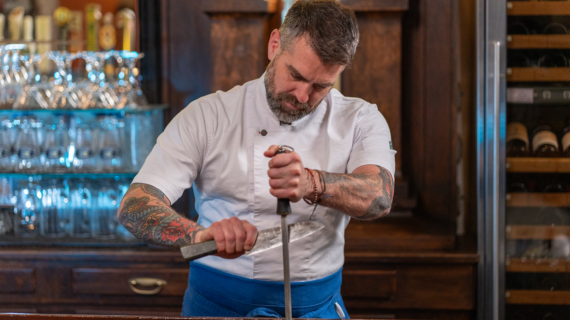
-The world of Japanese knives is really interesting because most are designed with a specific task in mind, like chopping vegetables or slicing fish.
But there is one knife, the Gyuto, that is really an all-purpose knife.
And today Adam's going to tell us more about this kind of knife and how it compares to a Western-style chef's knife.
-We were so curious about this Gyuto because it really is the closest thing you can come to, in the Japanese cutlery world, to an all-purpose knife.
We assembled this lineup of nine.
They were all about 210 millimeters, which is close to the 8-inch length that we like on a Western-style chef's knife.
And the price range was $50 to $226.
-Ooh.
That's a big difference.
-Now, you can tell they look a lot like Western-style chef's knife, but there are a couple of really important differences to keep in mind.
One is the type of blade geometry.
-Okay.
-They're both double beveled, which means they're ground on both sides of the cutting edge.
However, Western knives are symmetrical.
They're ground at the same angle on either side of the edge.
-Yeah.
-The Gyuto are asymmetrical.
-Interesting.
-One of the angles is steeper, narrower than the other one.
-Okay.
-And that is intended to keep the knife that much closer and more flush to the food that you're slicing for more precise slices, a smoother action.
Another thing to note is that the steeper angle, the narrower angle is usually on the right side of the blade.
-Huh.
-And so when you cut, that's going to direct a very subtle force to the left like that.
And that can create an issue for some lefties.
Some lefties have a hard time with this Gyuto.
Another thing to really keep in mind is the cutting edge.
You can see that the cutting edge is a lot more straight than a Western-style chef's knife.
So it's better suited to movements of push and pull, push and pull, like slicing or dicing something, as opposed to rocking it on a cutting board, which we would do to mince fresh herbs.
These blades are also thinner, and they're not quite as tall as a Western chef's knife from the cutting edge to the spine.
Generally, Gyuto are also a little bit lighter than Western chef's knives.
It actually makes a real difference for long prep sessions.
These are really easy to use for a longer time.
-Ah.
-Of course, as with any knife, the handle is a very important element.
There are basically two types.
There's the Western-style handle, which is familiar to us with chef's knives.
It's a little more molded, a little bit shorter.
Then there's the Japanese style, which is a little bit longer.
It's often made from wood.
It can be cylindrical, hexagonal, octagonal.
In our testing squad, people didn't really feel like one design was inherently better than the other.
It's all about how it feels in the hand.
One last thing to really keep in mind here is that the metal used to make the blades is harder than the metal used to make a Western chef's knife blade.
-No kidding.
-It's true.
The standard material hardness measurement is called the Rockwell scale.
The knives in our lineup had Rockwell hardness ratings of 58 to 65, whereas the last set of chef's knives we tested had Rockwell hardness ratings of 55 to 58.
-Okay.
-That's interesting because combined with the fact that the blades are a little bit thinner... -Uh-huh.
-...the hardness creates a couple of issues that you want to be cognizant of as you're using.
The blades are a little less forgiving to certain kinds of movements.
They're susceptible to damage with really hard strikes.
So you don't want to be cutting through dense foods like a butternut squash or frozen foods.
That's one of the reasons that we designed the tests the way we did.
Our tests included slicing tomatoes, slicing onions, slicing bell peppers, slicing carrots, cutting a chiffonade of greens, and slicing through steak.
And as I said before, those are all geared towards that push, pull, slicing motion more than a chopping motion.
I want you to give it a try.
See what you think.
-I'm excited.
-You got some peppers there.
-It's a nice knife.
Oh-ho-ho-ho-ho!
This is fun.
-[ Chuckles ] Nice.
-[ Inhales deeply ] Oh!
And that's a bell pepper.
It has a soft side and a rough side.
-I have to say, you are responding to these like our whole testing squad did.
People loved these knives.
-I don't want to stop.
-Now, there were three winners.
There were two that tied for the very first place.
One is this one.
This is the Hitohira FJ 210 millimeter Gyuto.
It's $210.
-May I?
-You -- Please do.
-Oh, yeah.
-It's got that Japanese-style handle which a lot of testers really liked.
-I'm not used to it, but I could get used to it.
-It's pretty light, isn't it?
-Yeah.
It's very light.
-It's easy to use for long periods of time.
-Ooh.
-If a heavier knife is more your thing... -Uh-huh.
-...another winner was the Masamoto Sohonten VG Gyuto.
-Okay.
-$226.
This one was 2 1/2 ounces heavier than the first one.
-Oh, yeah.
Oh, yeah.
-It's got a Western-style handle, if that's more your thing.
There was also a best buy.
This one is the Kanetsugu Stainless Gyuto, 210 millimeters, $50.
Less expensive than the other ones.
It's the same knife that you were using on the peppers before.
It's light.
It wasn't quite as razor sharp as the other two, but it's still plenty sharp.
And as I said, testers would recommend any of these.
-Wow.
I'm seeing myself with a new knife in my future.
-That makes two of us.
-So there you have it.
If you're in the market for a Gyuto knife, we have three great options for you.
Hey, can I try this one?
-Oh.
Please do.
-Oh, yeah.
-The United States is a burger nation.
We're mad about them.
But what happens when America's favorite food meets America's favorite fish?
Well, let's find out together, because Becky's here, and she's got a burger recipe for us.
-Now, salmon is America's most-consumed fin fish.
So we're going to mince it up, season it, shape it into patties, and make some really fantastic burgers.
-Gorgeous.
I cannot wait.
-So, of course, we're going to start with some salmon.
This is 1 1/4 pounds.
And this is a great place to use a tail piece of salmon, which is sometimes less expensive because we're going to chop it all up so it doesn't matter anway.
A lot of recipes call for mincing the fish, but that can be pretty tedious to mince it all up by hand.
-Sure.
-So we're going to use the food processor, but we're going to freeze cubes of fish first because otherwise the friction from the blade would heat up the fish and kind of melt its fat, and it would make them too gloppy to shape into patties.
So I'm going to start by cutting 3/4-inch pieces of fish here.
-And I'm assuming this is skin off.
-Skin off.
That's right.
Okay, so we're looking for 3/4-inch pieces.
I'm just going to put them on a parchment-lined baking sheet.
Spread them out a little bit.
And then I'll pop this in the freezer for 20 to 25 minutes.
I want them to get nice and firm around the edges, but still a little bit pliable.
-Before we grind it.
-That's right.
So let me pop this in the freezer.
Okay, so our salmon was in the freezer for about 25 minutes.
You can see it's pretty firm here along the edges, but it's still pliable at the center.
That's exactly what we want.
Before we mix that up in the food processor, let's do some seasonings for the burgers.
-Okay.
-So I have 3 tablespoons of panko breadcrumbs.
And these are going to soak up any extra juices that come out of the fish.
2 tablespoons of mayonnaise.
That'll act as a binder.
It's going to help hold all the little fish pieces together.
2 tablespoons of parsley, a little bit of freshness.
A tablespoon of lemon juice.
And that's really going to brighten things up.
Salmon is really rich.
It has a lot of fat in it.
So we want some flavors that are going to kind of cut through that a little bit.
-A little punchiness.
-Yeah.
Just a little bit.
A tablespoon of shallot will do the same thing.
And just a teaspoon of Dijon.
And it's a small amount, but you will taste it in the burger.
And then 1/4 teaspoon of black pepper.
I'm just going to mix that all up.
Alright.
So there's our seasonings.
-Great.
-Now we'll get the fish into the food processor.
Now 3/4 teaspoon of salt.
And we're going to process this with the fish.
This is going to help the burgers hold together.
But it's not going to make them bouncy.
-Okay.
-They're still going to have a nice tender texture.
-Nice.
-I'm going to pulse this 13 to 18 times.
I want about 1/4-inch sized pieces when I'm done pulsing.
-Okay.
-One more.
Okay.
-13.
-So that's 13.
There we go.
And you can see that's just about right.
They're about 1/4-inch size pieces, a little bit smaller.
It's just what I wanted.
-Nice.
-So now we'll add that to our seasonings.
Now I'm going to mix this up.
I don't need to be gentle with it.
I'm really going to go for it and make sure everything's nicely blended in there.
So I saved the parchment that we froze the salmon on.
And now I'm just going to divide this into 4 portions to make 4 patties.
And here's a quick way you can divide up your burger mix, whether you're making, you know, hamburgers, turkey burgers, or salmon burgers.
Just level off the mix like this.
And now I'm just gonna use my spatula to divide it into four sections.
-Very smart.
-That's a nice way to get nice even portions.
So I'm going to tidy up here.
Then we'll come back and make our patties.
-Okay.
Sounds good.
Now let's talk about burgers.
Now, when making beef burgers, we want to make sure not to mix the ground meat too much.
Otherwise, you might get a tough, chewy burger.
No good.
But with salmon burgers, we actually want to mix the fish thoroughly.
And here's why.
When beef is ground, a sticky protein called myosin starts to release out of the muscle.
Mixing the meat encourages more myosin to dissolve, forming a gel that allows the meat to easily stick together so that we can form patties.
Now, if the ground beef is overworked, it'll release too much myosin, and if you cook that mixture, you'll end up with a tough, unpleasant texture.
But the myosin in fish is much more delicate than the myosin in beef.
So when we process the salmon in the food processor, there's no fear of over mixing.
The fish's myosin gel is weaker than beef's, and it won't create a springy texture when cooked.
In fact, with salmon, that extra myosin works to our advantage, as its stickiness is essential to making the burgers more cohesive.
So with salmon, it's a good idea to mix it thoroughly, and you don't have to worry about overmixing.
-Alright, let's shape these into patties now.
-Sounds great.
-And the fish is nice and cold.
So that makes it easy to shape these into uniform patties.
I want to make them about 3 1/2 inches in diameter.
-Oh.
-You want to check me there?
-Yeah.
-See how I did.
Am I good or what?
-You nailed it.
-So good.
So we don't need to add any fat to the skillet.
There's already some on the outside, and a little bit more is going to render out when these cook.
And I'm also putting the burgers into a cold skillet because... Yep, I haven't turned the heat on yet.
You're safe.
[ Both laugh ] By bringing the patties up to temperature very slowly, most of the fat will stay inside the fish and they'll stay nice and moist.
Those look pretty good if I do say so.
-They look beautiful.
-Okay.
Thank you.
Now, if you wouldn't mind, Bridget, give me some medium high heat here.
-Okay.
-And we're going to cook these for about five minutes until the bottom third starts to turn opaque.
And that's how we'll know that it's time to flip.
They're going to get a nice brown crust on the bottom.
-Alright.
-So it's been five minutes.
And you can see that the burgers are starting to turn opaque there on the bottom third.
-Definitely.
-So let's take a peek.
See what we got.
Oh, my gosh.
-Ooh.
-Does that look good?
-Beautiful crust.
-Gorgeous crust.
-And you're right.
There is a little bit of fat that came out of the burger.
It's just enough.
It's not swimming in it, though.
-Yeah.
That's right.
-Ha, ha, ha.
-So we'll let these go another five minutes.
We want the fish to come up to 110 degrees and then we'll take them out.
-Okay, great.
-It's been five minutes.
Let's see where we're at here in terms of temperature.
We want 110 degrees.
There we go.
Nailed it.
-But that seems kind of low.
-Yeah, that is low.
We're gonna take these out of the pan.
We're going to let them rest for about five minutes.
And while they rest, the temperature will rise to 125 degrees, which is exactly where we like to eat salmon.
Going to put these on a paper towel-lined plate.
-Some blue ribbon burgers you got there.
-Pretty good, right?
-Yes.
-So while those rest, I have the world's simplest burger sauce for you.
I have 2 tablespoons of sriracha and a 1/4 of mayo.
And I'm just going to mix that all together.
Oh, you can use 1 or 2 tablespoons.
I'm going -- I'm going full tilt.
Alright.
-I love you for that.
-I didn't have to ask.
-No.
-I knew.
So this is going to add a little bit of heat which is really nice with the rich salmon.
So a nice amount on that toasted bun.
It's a good one.
I have some pickles here, too.
Do you like pickles?
-I love pickles.
-Okay.
Let's give you a couple pickles.
-I love a lot of things, evidently.
-Some nice fresh lettuce.
That freshness is really nice with the burger, too.
-You even topped my burger for me.
-I know.
Well, I'm doing it up.
Bon appetit.
-And you gave me chips.
-Oh, yeah.
We gotta have chips.
-Gotta have chips.
-Mmm.
-Incredibly tender.
Somehow impossibly tender.
You don't expect that with a burger of any kind.
But this is super tender.
It's actually kind of amazing that it's holding itself together.
-You can taste a little bit of heat from the sriracha, from the Dijon.
You get the parsley and the shallot.
-Mm-hmm.
I was a little worried because I saw you sneaking some panko in there.
-Mm-hmm.
-And often that will turn salmon into a salmon cake.
But... 3 tablespoons was it?
-Yeah.
Bridget, I got you.
You don't need to worry.
You can't even tell that there's any -- any bread at all in there.
It's just enough.
Just enough to soak up any stray juices.
-Yeah -And that's it.
-And all those juices are still in there.
-Oh, yeah.
-Becky, these are, bar none, the best blue ribbon salmon burgers I've ever had.
-Wow.
Thanks, Bridget.
-Thank you.
From one "B" to another.
Appreciate it.
-My pleasure.
-And if you'd like to make these burgers at home, it starts by using the food processor to grind par-frozen salmon.
Mix in a little mayo, mustard, and panko, and start cooking the patties in an unheated skillet to ensure juicy burgers and a super crisp crust.
So from "America's Test Kitchen," the very best fresh salmon burgers with sriracha mayonnaise.
And you can get this fabulous recipe and all the recipes from this season, along with product reviews and select episodes.
And you'll find them all on our website, americastestkitchen.com/tv.
Alright.
How do you feel about chips on your burger?
-Oh, yeah, I'm all in.
Let's do it.
-Alright.
-Let's do it.
-Visit our website where you can sign up for our free email newsletter with even more of the recipes and stories you love from all of our cast and test cooks, americastestkitchen.com/ newsletter.
-Get every recipe and product recommendation from all 26 seasons of public television's most-watched cooking show.
This year's edition includes 1,400 recipes from all 26 seasons of "America's Test Kitchen."
The cost is $29.99.
That's over 40% off the cover price of $50.
To order, head to our shop at americastestkitchen.com/tvbook.
"America's Test Kitchen" is brought to you by the following.
-Plugr European style butter was created for all chefs, cooks, and bakers, slow-churned with 82% butterfat for a smooth texture and more pliability for flaky crusts.
Plugr -- from professional kitchens to your home.
-GreenPan Frost, the frozen treat maker that makes ice cream, sorbet, slushies, and more with a built-in chiller that goes from fresh to frozen.
GreenPan Frost.
-On an American Cruise Lines journey, travelers can experience the coastal heritage of the southeast U.S.
and the Gulf Coast.
Aboard our fleet of small cruise ships, travelers can explore the historic towns, like Charleston and Key West, while experiencing the local customs and cuisine that define the southeast coast.
American Cruise Lines, proud sponsor of "America's Test Kitchen."
-Smithey Ironware, polished for performance.
Naturally nonstick, clear of chemical coatings.
Made in America.
Made to be passed down for generations.
Smithey.
Use it well.
Search Episodes
Related Stories from PBS Wisconsin's Blog





Donate to sign up. Activate and sign in to Passport. It's that easy to help PBS Wisconsin serve your community through media that educates, inspires, and entertains.
Make your membership gift today
Only for new users: Activate Passport using your code or email address
Already a member?
Look up my account
Need some help? Go to FAQ or visit PBS Passport Help
Need help accessing PBS Wisconsin anywhere?

Online Access | Platform & Device Access | Cable or Satellite Access | Over-The-Air Access
Visit Access Guide
Need help accessing PBS Wisconsin anywhere?
Visit Our
Live TV Access Guide
Online AccessPlatform & Device Access
Cable or Satellite Access
Over-The-Air Access
Visit Access Guide




Follow Us