

 Passport





Iranians in Wisconsin share worries on the Middle East war
U.S. airstrikes on Iran are continuing, and Iranians living in Wisconsin share their perspectives on worrying about their families and friends as well as their hopes for the future of their homeland.
By Steven Potter | Here & Now
March 13, 2026


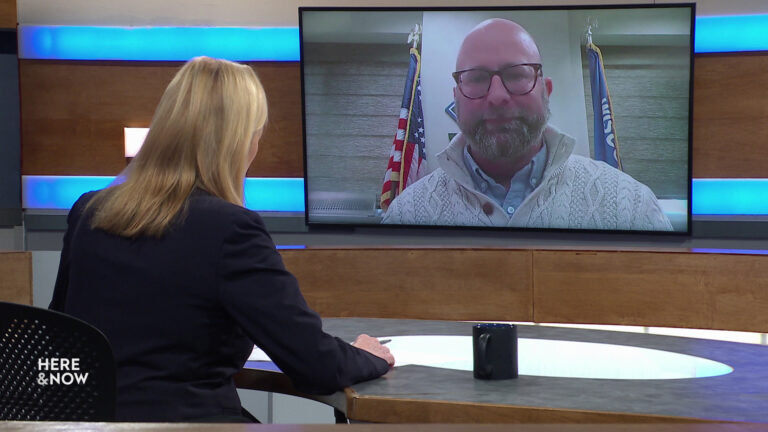
Iranians living in Wisconsin share their perspectives as U.S. airstrikes continue.
Watching and living war from afar — that’s what Iranians in Wisconsin face as they worry and wonder about family and friends there cut off from communication.
Zara Fakhri and Ali Soltani, who live in the Milwaukee area, are among those feeling disconnected from loved ones.
“It’s because of the blackout — there’s no way to call them,” Fakhri said. “They’re calling us directly by the phone lines and the quality of the call is terrible.”
Has she been in contact with friends and family in Iran?
“Yes — the internet is cut off, right? So my sister just yesterday, through landline, had called me,” Fakhri shared. “They all have moved to smaller cities, so they’re not in Tehran anymore.”
She shared more about her family’s experiences.
“Even in the small cities, a couple places where these are the garrisons and the security forces, places that have been hit. She knew about those, but Tehran is really, a lot of people hear a lot of loud noises, the bombing, and scare some people, of course,” Fakhri explained.
Fakhri and Soltani have different feelings about the United States and Israel beginning the war in Iran and removing the country’s supreme leader from power.
“It was the last option for us,” Fakhri said.
“At first we were so happy because of the intervention that we were waiting for, after that we got really happy and thrilled because of death of the Khamenei, but we all knew that it’s not just one person, it’s systematic, we cannot say that and topple that government down just by killing one person.”
Soltani described his thoughts.
“We have always opposed foreign war,” he said. “This is a very brutal regime. So some people, because they were fed up, they said, ‘Oh, United States, come and attack.’ That kind of mentality — but foreign interference will never end up well in the long run.”
Fakhri and Soltani do agree that it should be the Iranian people who decide who leads their homeland – and it should not be the leaders of other countries who chose Iran’s next government. But who should lead Iran?
“Whoever Iranian people inside Iran and Iranian people outside of Iran agreeing with,” Fakhri said.
“We want the U.S., the international community, to let the Iranians, after 120 years of fighting for freedom — we don’t want to go back to another dictatorship. Doesn’t matter how you sugarcoat it, it’s a dictatorship. We don’t to go to one man rule. We want no clergy, we want no shah, we a non-nuclear, secular democratic republic based on rule of law, that if you don’t like somebody you can vote them up, right, just like U.S., just like France, just like many democratic countries,” Soltani said.
What resolution are they hoping for in the end?
“Getting rid of Islamic regime, Iranian people doing their job to make the country free, and having a secular government. A better place and showing the world what is a real Iran, and what is real Iranian people, and how it could be a better world with peaceful country in the Middle East — that’s what we are looking for,” Fakri added.
‘We want U.S. and every other country to recognize our right to choose our own form of government,” Soltani shared. “That is what’s dear to us, and that’s what actually in the long run is for the benefit of Iran and the international community.”

Our Partners




PBS Wisconsin is a service of the Wisconsin Educational Communications Board and the University of Wisconsin-Madison. © 2026 All Rights Reserved.
Follow Us