

 Passport





A farewell toast to the beer that made Milwaukee famous
A business archive, breweriana collector and craft brewery work to preserve the memory and legacy of Schlitz, an iconic brand once among the top selling beers in America that is ceasing production.
By Murv Seymour | Here & Now
July 3, 2026


A business archive, breweriana collector and craft brewery preserve the memory of Schlitz.
It’s a bittersweet start to summer for beer lovers as Pabst Brewing taps out on production of one its most iconic brands: Schlitz.
“It is a long history that’s almost 180 years old,” said John Eastberg.
The story of Schlitz is preserved in a Milwaukee neighborhood just blocks from the beer’s earliest beginnings
“The Schlitz story actually starts without anybody named Schlitz — it was a young German immigrant, August Krug,” said Eastberg, curator of the never publicly seen Schlitz archives.
“What we have in the Schlitz archive is really an amazing collection of artifacts, advertising, photographs,” Eastberg said.
Old films, cassettes, original artwork — it’s all part of the private collection of the Uihielin family, who helped give birth to the Schlitz brand.
“It was the largest lager brewing company in the world, and definitely the largest company in the United States,” explained Eastberg, who oversees this rare collection.
“This is one of the earliest photographs taken of this neighborhood where the Schlitz Brewing Company originally started,” he shared. “This would be where the Fiserv Forum is and where the Bucks play today.”
Eastberg described how the company acquired its name.
“August Krug had hired a bookkeeper by the name of Joseph Schlitz. When Krug died in 1856, his widow Anna Krug married the bookkeeper and became Anna Krug Schlitz,” he said.
Artifacts along the walls and on the shelves of the 2,500 square-foot space chronologically piece together the story.
“This is one of my favorite pieces in our archive,” said Eastberg, pointing to a homemade, handwritten spreadsheet from 1889 made by the company’s then-bookkeeper and largest shareholder, August Uihlein, who was Anna Krug Schlitz’ nephew.
“He took two pieces of Joseph Schlitz Brewing Company letterhead, glued them together, and then detailed the output of all of his local competitors, but also his national competitors,” said Eastberg about Uihlein’s work. “He is listing all of the different breweries across America, and then Schlitz is at the very bottom.”
Just over a decade later, Schlitz would rise to the top of the list.
“Each piece is another piece to the puzzle of a company that essentially started in 1849 and has run in one way, shape or form all the way to 2026,” Eastberg said.
There are original ads used during Prohibition when beer companies were simply trying to survive. Schlitz launched its own brand of nonalcoholic beers, sodas and candies.
“Their idea was to produce high-quality chocolate, and they built a specific plant for it. They created very attractive packaging and advertising,” Eastberg shared. “Pabst went into a processed cheese product and the Uihleins created the Eline — spelled phonetically E-L-I-N-E — candy company.”
If Schlitz fans find the Uihlein’s archive sweet, there’s another remarkable collection that sits 35 miles to the west in Oconomowoc.
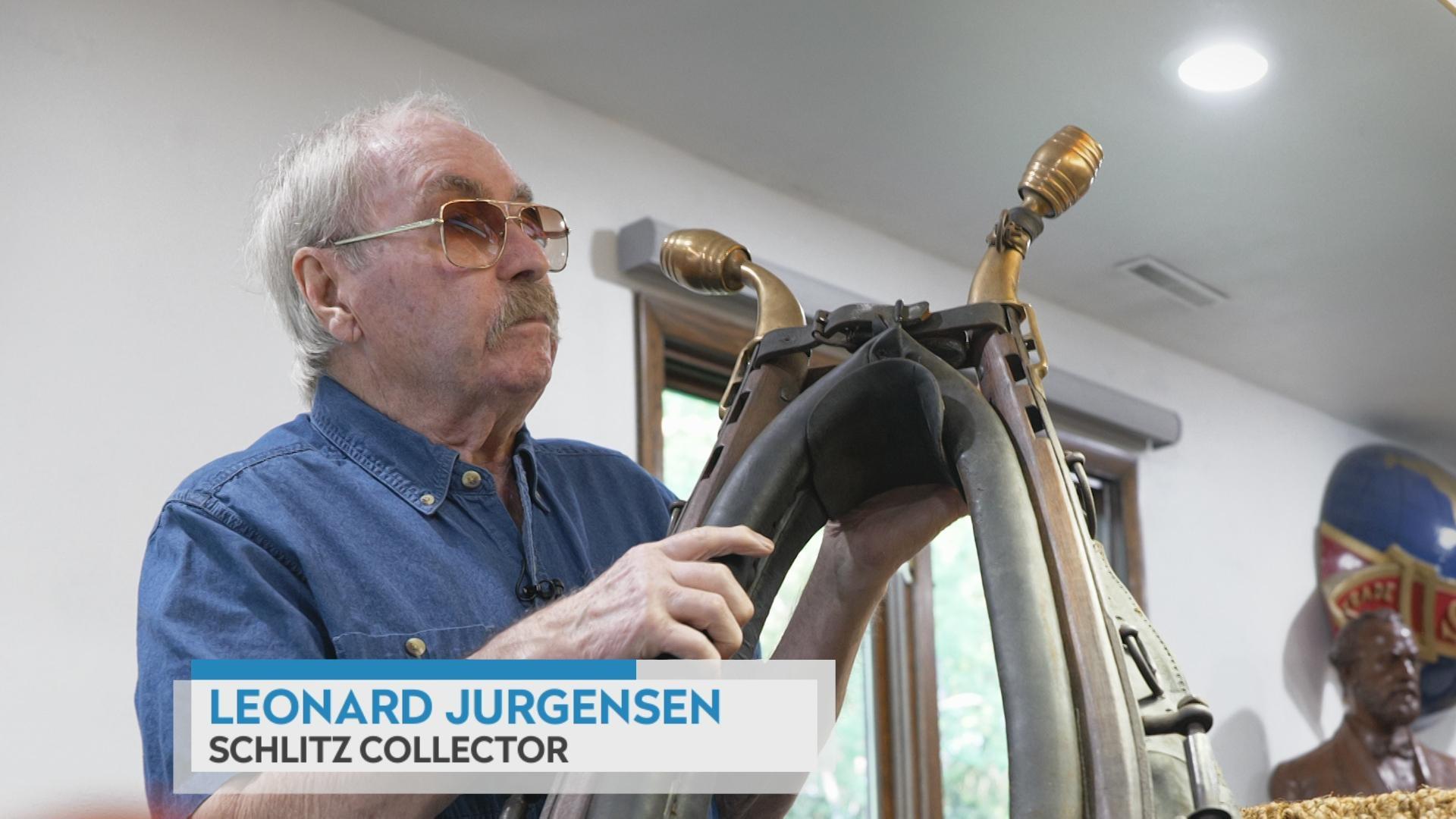
“You have to have a mission in life,” said Leonard Jurgensen. “In my case, I’m preserving the past of Schlitz.”
Jurgensen describes the vast collection of Schlitz breweriana he’s accumulated.
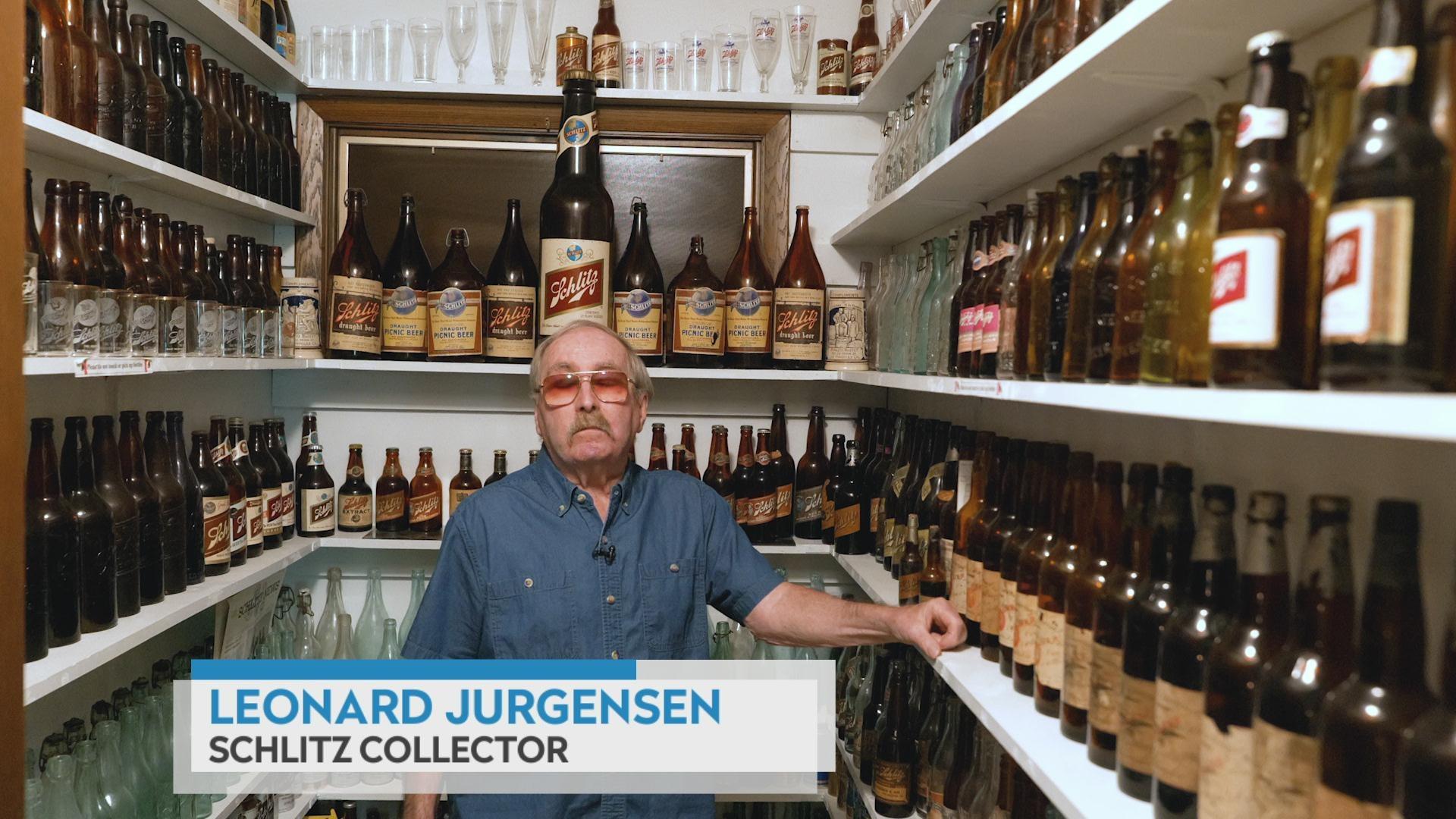
“Each one is a specific category on the history of the brewery,” he said. “I believe there’s close to a thousand bottles in this room. I don’t know of any other collection of Schlitz bottles that is this large.”
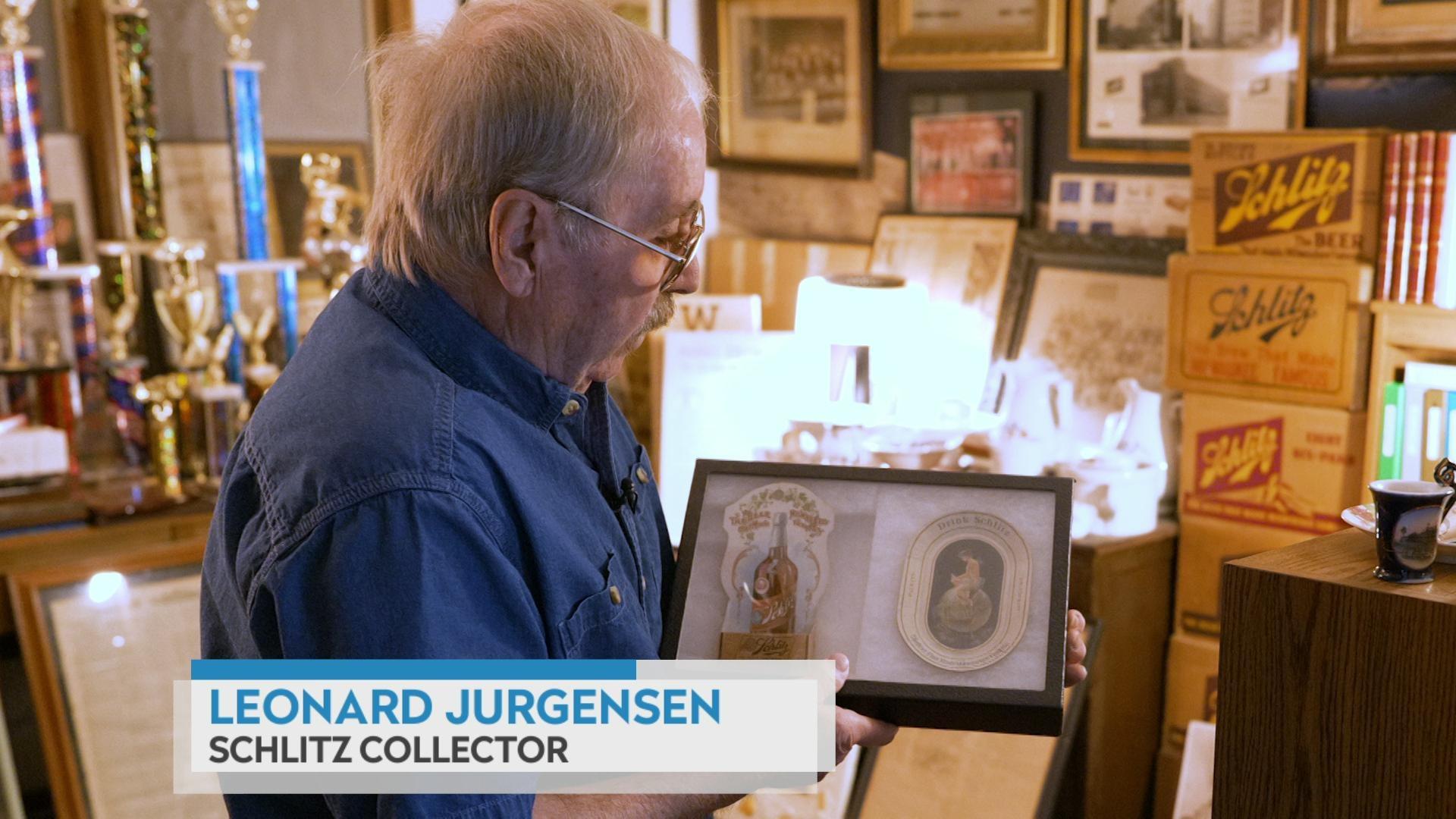
Jurgensen displays one historic framed advertisement.
“902: Schlitz became the largest brewery in the world — brewed the most beer, sold the most beer and they created this piece of advertising. This is we call a ‘Fat Man,'” he shared. “The caption is, “I Rule the World!” In other words, they control the market and the world.”
He owns one of only a few of the original ‘Fat Man’ figures.
“This is probably 1905, 1910. Best of my knowledge, there’s only three or four surviving,” he said, describing a painted statue.
At 85 years young, Jurgensen admits he has a problem.
“An outdoor saloon sign, probably 1870, 1875,” he said, pointing to one of his treasures.
“That’s a stained-glass window out of a saloon in Chicago,” he said, describing another.
“Plate glass window right out of the general offices — the front window,” he said, describing a third.
“Collecting is an addiction,” Jurgensen said. “If I’ve never seen it before, I have to have it.”
What started out as one simple piece of Schlitz memorabilia grew into thousands of items over almost 50 years and counting.
“I just started to collect out of curiosity,” he explained.
“The first known beer case of Schlitz bottled beer,” Jurgensen continued. “There’s not a piece that I have here that I can’t tell you why it was created, when it was created, and what was the reason for it.”
Jurgensen describes a room lined with shelves filled with Schlitz bottles.
“This room really demonstrates the evolution of the label, the evolution of bottles,” he said.
Bottles led to worldwide distribution, and embossed labeling prevented piracy while enhancing worldwide branding.
“All the competition had to do was remove the labels, clean the bottles, and then put their brand of beer in it. And what they soon discovered is that if you had a bottle and it’s embossed with your name on it, Blatz or Pabst or Miller could not use it,” said Jurgensen.
“Every bottle here is a container for Schlitz beer. Some of them are 1877, some of them are 1999,” he explained. “Some of them still have the beer in them.”
Jurgensen pointed to one smaller bottle.
“This is a paper label bottle from the 1893 Chicago World’s Fair,” he said. “I’m preserving the past. A lot of these things could have ended up in a dumpster in a landfill. A lot of these things I rescued.”
This history is centered on the city that became synonymous with Schlitz.
“‘The Beer That Made Milwaukee Famous.’ After it was acquired by Stroh’s Brewing Company, they dropped that famous slogan, and for years they called it ‘A Great American Beer.’ And a year later, they went back to the famous slogan,” Jurgensen explained. “The slogan was created in 1893 by Alfred von Cotzhausen, who made lithographs for them. … He shared it with them. They used it and they incorporated it in almost everything they did.”
It’s still at the heart of the beer’s brand.
“After 135 years, they still look at that slogan as key to the word Schlitz,” he added.
Inside the glass and concrete walls of Wisconsin Brewing Company in Verona, a special brew was in the works.
“This has got to be the coolest brewing day of my life,” said Kirby Nelson, its brewmaster.
“The history of Schlitz in itself is amazing,” said Mark Holzmann, a long-time Schlitz fan.
On a warm day in late June, there was standing room only inside the brewery’s tap room for a special beer release — with Nelson center stage.
“Schlitz is an amazing brand, an amazing part of Wisconsin’s heritage,” he told an assembled group of the beer’s fans, sharing basics about the brewing business and Schlitz history.
“Beer bottles — what color are they?” Nelson said. “So brown glass evolved as a way to protect beer to keep it fresher and more representative of what it’s supposed to be.”
Nelson effortlessly put on a master class in beermaking.
“The yeast can just get in there and party to their heart’s content and turn it into beer,” he explained.
Using a handwritten, detailed recipe from Schlitz logs dating back to the 1940s, and with special permission from Pabst, the owners of the brand, Nelson and the Wisconsin Brewing team used today’s brewing technology to make yesteryear’s beer.
“For me to have a chance to brew an example of the beer that made Milwaukee famous from its golden era was absolutely irresistible,” he said. “The Schlitz that we produce is based on when Schlitz was on top of the world. In 1950, these — they were selling 5 million barrels.”
For nearly a month from a tiny control room, every phase of the beermaking process was monitored. They meticulously tested and tasted until the mix was just right.
“We’re making wort, this liquid yeast food that will be fermented into that beloved liquid we know as beer,” Nelson said on day one of the brewing process.
Kriby said for him, this part of modern beermaking, it’s like watching a giant video game.
In the tap room on the day this special edition of Schlitz was released, Holzmann was sporting his rarely seen but hard to miss beer jacket.
“Oh, I’m experienced, and I like beer. In fact, if you look at it, I love beer,” he said. “It’s 25 years of collecting patches — I’ve scoured every antique shop I could find, and I looked for patches that would fit in specific places.”
Holzmann and everyone else at the release day wanted to be part of what might be the most important chapter of Schlitz history.
“I try every kind of beer I can try and every one has its own flavor,” he said.
About a month after the brew was started, and two months since Pabst announced that Schlitz would be shutting down, Wisconsin Brewing pumped out about 200 barrels of what they called a commemorative Schlitz beer. When it’s all said and done, over a 6- to 7-hour period, the brewery’s production line would spit out enough beer to make 3,000 cases, which is about 167,000 cans.
From the brewery’s warehouse, Sadie Nelson worked to update callers from all over the United States and even Canada about the status of this seeming liquid gold.
“Hi Ms. Christine, this is Sadie with Wisconsin Brewing Company. How are you?” she said on the phone.
For so many customers and those at the brewery, their journeys with making and getting a can of Schlitz was personal.
“Working for Schlitz for 20 years and surprising an 88 year old with a four-pack signed by the brewmaster, I think that there’s nothing better,” Sadie Nelson explained.
Wisconsin Brewing said those customers that were lucky enough would get at least a case of beer. But to help make sure others get a taste, they’re also offering four packs.
When asked why the Schlitz brand has faded, Kirby Nelson said it’s because its makers changed their recipe and people changed their drinking habits.
“I bet you I’ve seen 10 breweries going to auction in the last two weeks, and a lot of it has to do with there is too much,” he said. “But again, changing habits. People are really pulling back from alcohol and beer is in a downward trend right now. It’ll be back.”
But will Schlitz be back?
“I’m hopeful that a Wisconsin brewer will pick up the label and be able to brew small batches through maybe a lease option with the Pabst Brewing Company,” Eastberg said back at the Schlitz archive. “It would be a shame to let such a legacy brand kind of fade away.”
Fade away, as not just the beer that made Milwaukee famous, but the beer in Milwaukee that will never be forgotten.







Follow Us