

 Passport



Wisconsin's tribal nations assert reciprocity and resiliency
Chairwoman Nicole Boyd of the Red Cliff Band of Lake Superior Chippewa delivers the 2026 State of the Tribes Address, emphasizing how Indigenous voices can contribute to policymaking in Wisconsin.
By Erica Ayisi | Here & Now, ICT News
February 13, 2026


Chairwoman Nicole Boyd delivers the 2026 State of the Tribes Address.

This report is in collaboration with our partners at ICT, formerly Indian Country Today.
“I share with you my Anishinaabe name: Woman Who Leaves Tracks Where She Walks,” said Nicole Boyd, chairwoman of the Red Cliff Band of Lake Superior Chippewa at the start of Wisconsin’s 2026 State of the Tribes Address.
Boyd highlighted achievements and challenges of the state’s 11 federally recognized Native American tribes, focusing on tribal sovereignty and government to government partnerships.
“We are not here simply to take. Our ancestors knew this, they fought for this, and they left us the teachings of reciprocity,” she said.
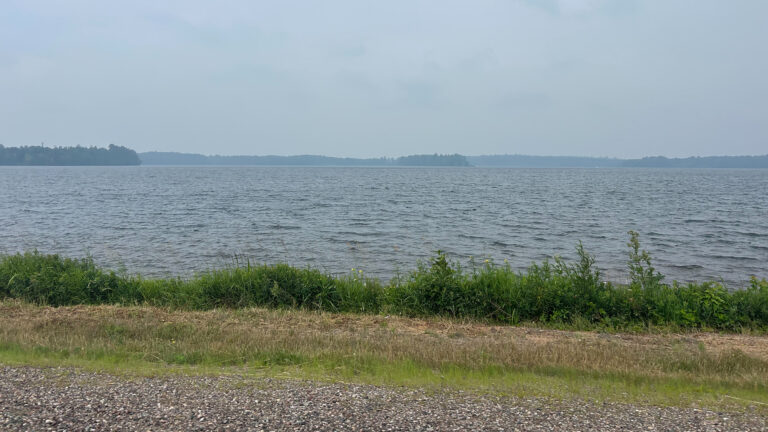
Boyd asked to work together with the state in preserving water rights on tribal lands — referencing concerns about the Enbridge Line 5 oil and gas pipeline running through and plans to reroute it around the reservation of the Bad River Band of Lake Superior Chippewa.
“Why is it wrong to expect that the feasibility of projects of this magnitude be ecologically sound and ensure the water will be protected?” she asked.
Paul Smith of the Oneida Nation said Boyd’s message to protect waterways on and around tribal lands could bring more visitors to northern Wisconsin.
“The national shoreline that she wants to protect with the Frog Bay National Park, with protections of Lake Superior and the protections around the waters through Bad River — it’s all those things are connected to tourism,” he said.
Boyd also asked for more tribal input with a bill to change the designation of Apostle Islands National Lakeshore to become a national park, which is close to the Red Cliff Band’s reservation.
“Were we wrong to request that there be meaningful due diligence as part of the decision-making promise?” Boyd asked.
Relating to Gov. Tony Evers’ Executive Order Relating to Tribal Treaty Rights and the Protection of Wild Rice, Boyd asked that manoomin — wild rice — be elevated to become the state’s official grain.
“Wild rice has seen a significant decline over the last many years, and promoting it will allow us a platform to continue our efforts to restore and protect this vitally important resource,” she said.
Sagen Lily Quale of the Red Cliff Band said Boyd’s call to make rice the official state grain has deeper cultural connections as a living relative for the tribal community.
“To be able to rely on that relative as not only medicine that connects us to place and space, but also connects us to ancestry and tradition is really beautiful,” she said.
On economic development, Boyd touted positive gains for tribal nations and the Wisconsin economy through cultural events and gaming, noting the collaboration with the 2025 NFL Draft in Green Bay with the Oneida Nation.
“This event brought in an astronomical $105 million to the state of Wisconsin,” she said.
Brian Wilson Jr. of the Oneida Nation said Boyd’s message on tribal economic contributions to the state resonates with his 100% Indigenous-owned small business.
“We are adding to our employees, and with health benefits and retirement programs,” he said.
Boyd asked for legislation for online sports betting wagered through Wisconsin’s tribes to be approved.
“The state will see increased revenue through the state gaming compacts, and consumers will have the legal protection needed to ensure they receive fair play,” she said.
In health care, Boyd pointed to an increase in wellness and treatment centers on the Lac Courte Oreilles, Bad River and Mole Lake reservations, and said drug overdose deaths are on the decline, though vaping nicotine and gun violence among youth is increasing.
Boyd added that rural tribes need more law enforcement investigative agents and emergency medical resources to save lives.
“Pretending that the northern part of the state doesn’t have this need is harmful and deadly,” she said.
To assist in opioid recovery, chronic pain and other illnesses, Boyd is asking for bipartisan support for medical cannabis in the state.
“For centuries, Indigenous people have used this plant medicine for various medical and ceremonial purposes,” she said.
Boyd also said the state task force to address Missing and Murdered Indigenous Women and Relatives needs improved policies that includes helping survivors heal.
“We must invest the resources needed to prevent violent crimes against women and children,” she said.
In tribal education, Boyd said several nations are integrating language teaching and cultural learning at every level and is requesting the University of Wisconsin-Madison’s Tribal Educational Promise Program be extended to tribal colleges in the northern part of the state.
“Including the College of Menominee Nation and the Lac Courte Oreilles Ojibwe University would also provide tribal members an opportunity to attend college close to home that strongly supports their identities,” she said.
Boyd closed the State of the Tribes Address with a message of resiliency for Wisconsin’s tribal members and partnership among state and tribal leaders.
“This is the place our ancestors fought for and are buried within,” she said, “and we will continue to exercise our treaty rights in perpetuity.”
This report is in collaboration with our partners at ICT.




Follow Us