

 Passport





Quilt With Carefree Curves - Part 1
11/11/13 | 26m 47s | Rating: TV-G
Nancy takes the stress out of piecing traditional quilt block designs such as the Drunkard’s Path, Blackbird Pie, and Mill Wheel. Learn the secret that eliminates concave and convex curves as you create easy quilt projects.


Copy and Paste the Following Code to Embed this Video:
Quilt With Carefree Curves - Part 1
Curves in any design provide movement and interest. That principle applies to quilts as well. When fabrics are cut and seamed to create curves the process can be frustrating trying to get those opposing shapes to turn out smooth. To make the process enjoyable I'll show you a carefree method of creating curves.
This Drunkard's Path design is a quilt favorite. You'll learn how the curves are created effortlessly using a rather non-traditional technique. "Quilt with Carefree Curves" that's what's next on Sewing with Nancy. Sewing with Nancy TV's longest-airing sewing and quilting program
with Nancy Zieman is made possible by
Baby Lock, a complete line of sewing, quilting and embroidery machines and sergers. Baby Lock, for the love of sewing. Madeira, specializing in embroidery, quilting and special-effect threads because creativity is never black and white. Koala Studios fine sewing furniture custom-built in America.
Clover, makers of sewing, knitting quilting and embroidery products for over 25 years. Experience the Clover difference. Amazing Designs and Klass needles. The traditional way of making a quarter-circle block as you saw in the Drunkard's Path design is to have two shapes.
I've taped my fabric to my templates just so that you can see that they have two opposing curves. These have to be seamed together. You pin them together. When you do that, you will pin them at the ends and once in the middle because it's hard to pin them together in this area.
Usually-- always, I should say the outer curve seams longer than the inner curve. So to do the sewing for this with 1/4" seam allowances you use, kind of some finger pins. First get started, and then "pin" with your fingers to get those edges to meet. You have to kind of move that around.
Remove that center pin and then go for the home stretch. This is a very traditional way of making any curved shapes. I have to say, it works. It certainly works.
If you have templates like that at home you can use them for the projects. But you know, sometimes it's hard to get that shape exactly perfect. I didn't do so bad! This is one I made yesterday.
I had a little problem, giving a bowed area on the side. You press the seam allowances there and you'd have the block. Another option, the carefree option that I'm going to share with you and this has not been completely sewn but you cut a complete square for the background. A fusible interfacing technique is used and you get a smooth curve every time.
This will later be applied into place. You can make it in many sizes. The template that I'm going to be using you can make these three sizes from four-, to six- to eight-inch blocks. You use one template.
In this program, we're going to use this template to make quarter-circle blocks and whole circles. This is a two-part series. In the second program, we're going to make a very crazy name, the Hearts and Gizzards block. It's a very traditional block but again, to get those curves, rather than sewing opposing curves together we're going to use a template that will give five sizes.
They can also make a fan shape, a circle shape or a wagon wheel shape. This is called a fan shape. You can make five difference sizes with the smoothness. The carefree technique that's what I'll be detailing now.
The quarter-circle block has so many options for design layout. You saw the Drunkard's Path. We'll see that again. But this is called Mohawk's Trail.
There's a 16-block section in the middle and on each end, I have four blocks. It's a tummy-time quilt for little kids learning how to creep and crawl. It could be on the floor. We will give you the instructions to make this specific design in the book that accompanies the program.
Behind me is the same block in a very contemporary look. It's a block in process. It's going to be a dramatic wall hanging. It's made of the quarter-circle blocks.
You can see, there's one block. They're just flipped and flopped to have the motion. To make these, I'm going to show you the details. You saw the interfacing in the sample earlier but how do you get there?
You can make it using the traditional templates. You're certainly welcome to do that. But if you'd like to make quarter-circles you can start by tracing a circle. On this template there are three different options for sizes.
On the side of the template that shows the quarter circle you just read how you should cut squares. Not circles, you're going to cut squares. You'll cut a 9" square for the circles. For this particular block, it's 6-1/2" background fabric.
I'm making a little smaller one for the sample. If you're wondering, why such a big block? Well, I'll show you in a minute but I also must mention that of the same size you cut fusible interfacing. I have the smooth side facing the right side of the fabric and then the fusible side to the underside.
You place the template on the square. You don't have to cut these perfectly square because we're going to trim this a little bit later. Then you trace in the die cut areas all the way around. Also trace the marks down the quarter areas.
We're going to be cutting this apart but we'll sew once, cut after the fact. Then mark all these areas, as I mentioned. The two layers of fabric are going to be sewn together. It's a little light to see but when I'm at the machine you'll see that I'm going to stitch around the curves, the circle.
Here I have my machine set at a "2.0" stitch and I'm just stitching that continuous circle. I've already done it on this sample. It's easier to see on the interfacing side. From this side, I have marked and there are little quarter marks on each corner because that makes it a lot easier to do the cutting.
You're going to cut this apart in vertical and horizontal. One cut-- This one, I'll just cut separately. And then two. Then some trimming takes place.
Here's my quarter-circle block, or portions of it. You could use a pinking sheers or a decorative blade and trim around the edges so it's nicely graded. Then, with a scissors, you're going to trim. Let me grab my scissors.
We're going to trim leaving about an 1" or an 1-1/2" on the inside. You may want to save this. You never know when you might need this. Now, the interfacing is going to be pressed toward the underside.
Use a bamboo creaser or a hera marker to make this curve nice and sharp to bring that edge smooth to the outer area. Then do some pressing. Roll that with your fingers a little bit. You can make these en masse.
You can just cut and press a whole slew of these quarter-circles at once. Then you get a nice shape. The block was cut 6". I'll show you that block.
You're going to place it in one of the corners. Pin it down, and then do some stitching. All of our blocks have been stitched with clear monofilament thread. You put this in the top, and matching thread in bobbin.
You stitch around the edge, a straight stitch, zigzag or blanket stitch. Here I'm using dark thread so that you can see the contrast. Stitch around these edges. You can stitch, as I mentioned numerous blocks at one time.
Clear thread is the magic element. No one can hardly see that stitching up close. That's how you make these blocks whether you make them small to large using that template or templates you have at home it's really pretty easy with this technique. Then, the layout.
That's what gives you such creativity and so many options. I have a different set of fabrics to show you how they're laid out. The Mohawk Trail is behind me. It's made with one block, not different blocks.
I'll show you a little bit later that you sometimes need an equal number with changing the background and the quarter-circle. But this is made all in one. I'm just going to lay out one-half of this for you. Honestly, when I'm doing this, I have to look at a picture.
But I think I can remember how to lay this out. I'm going to start by placing the blocks with the squares to the center. Then I'll just peek around and check this out. Let me move this down a little bit.
Then, I'll place the quarter circles so that you can see what we've got going here. I'll just continue to do the layout. I'm doing half of it and you can kind of get the idea of how this is laid out if I did it correctly. I think so.
Then, this would be flipped around. I would just continue. You can kind of see how the movement starts. This is all one color.
But as we flip this up the next design is called Fool's Puzzle. This puzzle is made with two different color combinations. Perhaps you can see that we have the same block that I just worked with, but then the reverse where the background becomes the quarter circle. So here are three of one design put together.
Let me do that. One, two, three. Then, I'll move this and grab the opposite. Sneak a peek at what you have there so you can see to make sure the design is correct.
I'm going to go like this. This gives you one-quarter of this area. This is one section that's laid out. The trickiest one is the Drunkard's Path.
The most common quarter-circle design that people like to make and see. I've made this once; I've made it twice! But to lay it out I'm just going to show you that you need equal numbers. You need eight blocks, in this instance with the background of one color and eight blocks with the back, which was red here is red in the quarter circle so that it's flipped and flopped as it goes around the quilt, so that as the design the Drunkard's Path name, really comes to be.
There are some very simple designs to create. Those are made with, many times, equal numbers of the blocks in opposing colors, opposite colors. Here we have made four blocks from one circle, pretty common, and then also four blocks from the other color. I have them stacked here somewhere.
There we go. I have two there and two there. You can make a Mill Wheel simply by changing out the opposite corners. It's pretty dramatic and fun, I mean, really fast.
You can see what fun that is just by doing that flip and flop. With this template you get three different sizes of circles. You can put a smaller circle in the corners. I did this on this sample.
We're using batik fabrics in some of these very brilliant samples. They really are dramatic. By using two different sizes of quarter circles you can place all one size together but then notice the smaller circles that appear in the corners. There's a lot of room.
Then, what if you flipped this block? That's what I'll show you next. You get a propeller type of look. The way that you can layout these blocks makes it great fun.
Notice here that you get movement again, because you have two large and two small meeting together. As you create the block you'd have more movement and more propellers. Use your imagination when laying out a quarter-circle block. Large or small circles in a quilt design can really make a statement.
Use circles alone or combine them with geometric elements for a modern look. This single circle block variation called Waxing and Waning Moon was created again, with the carefree fusible interfacing technique. You might guess that I have a quilt in process. I haven't finished it but I have some of the blocks that are going to be in a circle and geometric quilt design.
A simple circle, but almost perfectly shaped. Then we have half circles and the waxing and waning of the moon is going to be incorporated in that quilt. Maybe some day you'll see it finished! Like the quarter circle we're going to trace on squares of fabric and again use interfacing.
On this template you can buy a circle template if you'd like, or use this one or make a template out of a dinner plate. The choice is yours. On this one, we can make three different sizes of circles. It tells me for this very large one-- and I'll just read it to you.
Up here, it says that you can cut a 14-1/2" background fabric which is this big lavender square that I have. Then for the circles, it's 11-1/2". Then, add the interfacing. Cut lightweight fusible interfacing.
Kind of combine the sewing and quilting worlds. Most quilters don't use fusible interfacing but you can for this example or process. You place the template on your fabric. I'll use a white marker to trace around.
We don't have to mark the quarters because we're not going to be cutting this into fourths as I did in the last segment. Meet the two fabrics together set your machine for a shorter stitch length and sew around the circle. On the underside, I'll show you what I have here. I'll flip this around so that you can see the stitching a little bit more.
I've started to trim away the outer edges. Again, pinking shears or a decorative blade on a rotary cutter. This is a 45mm rotary cutter. Just interchange the blades.
It nicely grades and trims the fabric. Then, with your scissors just do the rest of the trimming leaving an inch or inch-and-a-half. As you can see, I've started to do this so we're just in process. Then we're going to turn this to the inside.
We can move over here because I have my iron right here. You really do need an edge, to make the edge crisp. You can see that I have a big circle. Use bamboo, a hera marker, or an edge just to kind of form that before you do the pressing.
Then, you get the idea, just form that edge. It really gets very nice and even. Don't elongate your stitch when you're doing the stitching because you want it nice and tight so that it gives a nice tight curve. I'm getting a facial as I'm doing my pressing kind of a two-for-one there!
You can see that nice edge that I've started to form. This circle has already been pressed. I'm going to position it on the square. To get it spot on, I've already folded the background 14-1/2" square in fourths and pressed the corners.
Then I'll do the same for the circle fold it once, fold it twice. Just give those corners a little press. You can press that out after a while. The main purpose of doing this is to align the quarter marks.
There we go. That's got to come up a little bit. It gets nicely centered. Again, use that monofilament thread, that very clear thread and topstitch, zigzag, or blanket stitch around the edge and you have a block.
Big or small, made in the same way. You can do some variations of the seam-- of the theme, excuse me, or the seam! You can have bias tape down the center. Or actually, I cut it apart, right down the middle.
Then cut a section of another color, 1" wide. One inch is important because if you use 1/4" seam allowances then it will exactly meet together. I'll show you what I mean by my next example. We'll stay right here you can see what's going to happen.
Make two circles, opposite fabrics. Cut it in half and make the Waxing and Waning Moon block. When I flip to the underside or the back with 1/4" seam allowances those raw edges will kiss together and you'll see that you're not going to change the shape of the circle if you use that 1/4" seam. So, half circles, waxing and waning of the moon or a full circle, and you have great options for your next quilt project.
The new buzz term in the world of fabric and thread is "modern quilting." If you're wondering what modern quilting means and what type of quilt fits into that description you're not alone. Please welcome Alissa Haight Carlton from the Modern Quilt Guild, who joins us via Skype. Alissa, good to see you via Skype. Hi, Nancy, thanks so much for having me.
I had the honor of being at the first Modern Quilt Guild or conference in Austin and I was blown away with the designs. That's when I knew I had to have you as a guest on Sewing with Nancy to tell others about what makes a modern quilt. Give us kind of a little summary of the category or what fits the description of a modern quilt. Well, modern quilting is really sort of a new aesthetic that has arisen, that has sort of developed and come out of a number of different things.
Certain things that you see specifically in modern quilting you see various traits repeatedly. You see lots of negative space. You see lots of use of solids. Asymmetry.
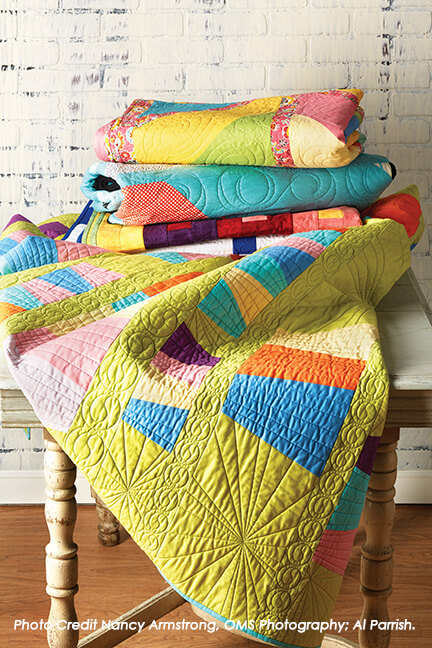
Bold color choices. Sometimes you see a traditional quilt pattern that a new twist has been taken on. We can show a traditional pattern. The Best of Show from QuiltCon was a traditional pattern but it doesn't look traditional.
Exactly, "Double Edged Love" is a beautiful, beautiful quilt made by Victoria Findlay Wolfe. Really, if you take a look at it, you can see clearly it's a traditional Double Wedding Ring pattern. But then really, lots of different play with improvisational piecing and parts of the piecing are the negative space. She really turned it into something new and interesting really her own spin on that traditional pattern.
I was able to see that quilt in person and the back is as interesting as the front a totally different look. Yeah, really gorgeous. Negative space the importance of the background being as important as the foreground is demonstrated in the deconstructed nine patch quilt from Jacquie Gering. Jacquie is such a talented artist.
I mean, really, repeatedly in her work you see amazing use of negative space. And this is something in particular that I think you really find specifically with modern in that when the quilter comes up with the design they're looking at that. They're really considering, how will I create a very graphic image with my design. And that negative space really, really shines through especially that quilt is such a perfect example of it.
I also think you rarely see borders used in modern quilting. I think that really applies to the negative space, as well. If you were to throw a border around that it would take away from sort of the edge of that negative space. The Log Pyramids quilt, again doesn't have borders.
It has bold colors. Lots of bold colors. You know, I think that quilt is a great example of very precise piecing very careful, precise, quarter-inch-- coming from what is a distinctly modern quilt yet you really see all different kinds of piecing and design choices that way in modern quilting. I have to say, when I went to the exhibit I wasn't expecting, and excuse me for saying this but for the workmanship to be so stellar.
It was topnotch, as traditional quilters it was equal that way, with the category of modern quilters. So, it doesn't matter, it's just a different design. Exactly, everyone cares about, you know, construction and workmanship and that their quilt lasts over the years especially because modern quilters really make functional quilts so they have to stay together. You know, they're going to be thrown in the wash and in the dryer.
They've got to hold up. A quilter's a quilter! Exactly. You've made this quilt called "Bias," Alissa.
Yes, I think that that quilt there's a lot of negative space in that one, as well. But it's also a really good example of alternate grid work or a non-block-based design where the design really develops by looking at the quilt as sort of one huge block rather than a number of small ones in a traditional grid. The bias flow is very appealing. There are hundreds of quilts that we could talk about but I want people to be aware of modern quilters the Modern Quilt Guild, and the events that you have.
I thank you for joining us. Thank you so much for having me. It was a real pleasure. You can find out more about the Modern Quilt Guild by going to all things Sewing with Nancy.
Go to nancyzieman.com and you can re-watch this interview or re-watch this program on "Carefree Curves." Then click on the link to the Modern Quilt Guild and find out more information. There may be a chapter in your area. This wraps up our program the first of the two-part series on "Carefree Curves." Join us next time. Thanks for joining me.
Bye for now. Nancy has designed a set of three templates and written a book that can be used to create the quilted projects featured in this program. The templates are $24.95, plus shipping and handling. The book is included free with purchase.
To order this reference material as well as notions used during the series call 1-800-336-8373 or visit our website at sewingwithnancy.com/2714. Order Item Number BK2714 "Quilt with Carefree Curves" templates and free book. To pay by check or money order call the number on the screen for details.
Visit Nancy's website at
nancyzieman.com to see additional episodes, Nancy's blog, and more. Sewing with Nancy, TV's longest airing sewing and quilting program with Nancy Zieman
has been brought to you by
Baby Lock Madeira Threads Koala Studios Clover Amazing Designs, and Klass Needles. Closed captioning funding provided by Oliso. Sewing with Nancy is a co-production of Nancy Zieman Productions and Wisconsin Public Television.
The latest from Nancy's blog
Search Sewing with Nancy Episodes

Donate to sign up. Activate and sign in to Passport. It's that easy to help PBS Wisconsin serve your community through media that educates, inspires, and entertains.
Make your membership gift today
Only for new users: Activate Passport using your code or email address
Already a member?
Look up my account
Need some help? Go to FAQ or visit PBS Passport Help
Need help accessing PBS Wisconsin anywhere?

Online Access | Platform & Device Access | Cable or Satellite Access | Over-The-Air Access
Visit Access Guide
Need help accessing PBS Wisconsin anywhere?
Visit Our
Live TV Access Guide
Online AccessPlatform & Device Access
Cable or Satellite Access
Over-The-Air Access
Visit Access Guide




Follow Us