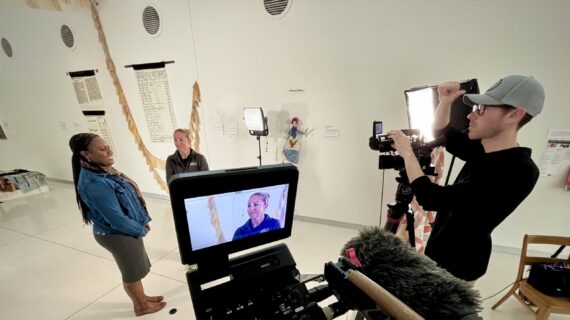
My name is Matt Welter. I'm the curator of education here at the Neville Public Museum. We're going to explore the exhibit, Who Are The Hmong. Story cloths were started by the Hmong people as a way of recording there own oral history.
They started this during the Vietnam War. They were worried and concerned that they would lose their story, so they began using thread work. In order to read this cloth what you first have to do it find the mountain. It's up here in the top, right next to the word China.
That's where the story of the Hmong begins. Originally they were mountain people who lived in China. They liked living in the mountains because in the mountain areas they could see their enemies. About 5,000 years ago the Chinese began to persecute them.
The Hmong people did not like the persecution. They said that they wanted to leave that area. That is because of something that they hold more dearly than anything else, and that is what the word 'Hmong' actually means, which is freedom. About 5,000 years ago they left from China.
They moved to the Vietnam peninsula. They moved to Laos and Thailand and Vietnam. They lived in the mountain regions. Things were good for them for about 5,000 years until helicopters and planes started showing up, or the Vietnam War.
The United States' leaders went to the Hmong leaders and said, You know, we would like to work with you. We want to have a war, but we don't want the communists to know that you're working with us. When the Hmong people became our allies the Unites States referred to the campaign using the Hmong as their soldiers, as the Secret War. This was a secret war for two reasons.
One was, obviously, they did not what the communists to know they were working with our allies, the Hmong. But there was another reason. Some of the solders that were being sent and recruited from the Hmong were actually as young as ten years old. We did not want our citizens to know this.
As one Hmong soldier told me, "When I was given my first gun as an American soldier it was as tall as me." This is a photograph of a Vietnam veteran and a Hmong veteran. The very first thing you notice about the Hmong veterans that are still here in this country is that they are all about ten years younger than our Vietnam veterans. We have a traditional Hmong rifle. This is a flintlock, much like a 16th century rifle a Hmong person would have fabricated itelf, including all the metal materials in it.
They would also be grinding their own powder, and boiling and making the metal and making their own bullets. Traditionally, this would have been used for hunting things like squirrels. During the first part of the war they were not allowing our rifles to get into their hands. At that time they were not sure how devoted the Hmong people were.
Eventually, one American soldier took pity on one of his fellow Hmong soldiers and he gave him a rifle like this one here. That soldier took it to General Vang Pao and General Vang Pao went to the Americans and said, why are you not giving us these weapons? We're putting our lives on the line every day. This was about a year and half into the war.
And he said, you're right. We do need to help you. Hmong people often consider him the George Washington of the Hmong culture. As you probably know, we did not win that war.
When the Americans did leave they took some of the Hmong with them, but many Hmong were left to flee from their country. They had to flee from Laos into Thailand. This was a very tragic time for Hmong people. Part of what they had to do was cross the Mekong River.
Imagine traveling by night across the land and running into a river as large as the Mississippi and having to cross. And growing up most of your life not even having to swim ever. I know of one person who still to this day is afraid of open water because she had to cross at a damn and people were shooting at them, and she lost a few relatives. Sometimes they would pay somebody who had a raft to take them across the river.
They paid them every bit of money they had. That person would ferry them about half way across the river, and then go back to the mainland and then turn them in to the communists for the bounty. So for many people they suffered many tragedies. When they eventually got to Thailand they were put into refugee camps.
The camps were not like concentration camps. The people were being cared for there. But they could not leave until they had a country of their own to go to. The Hmong people had to deal with new things that they had never had, such as cement or concrete floors.
They'd never seen plumbing before, and sometimes there was plumbing in these camps. They were given sandals which they had never had themselves unless they had fabricated themselves. So it was a very different life. For adults, they often worried about what their future or their fate would be.
Some children actually grew up in these camps waiting and waiting and waiting for years until they could get to their new home. Children came up with their own types of games and toys in these places. We have, for example, a checker set that's made simply out of cardboard and a little bit of ink and bottle caps. This school desk, and this can usually fit about three or four kids on it.
We have some other items that you might have found in the camps, and some of them talk about war. We have some crutches that people made themselves in case, you know, the bomb had gone off. We also have an artificial leg that's made from a bomb casing. One of the things about the Vietnam War is that in Laos we dumped a lot of bombs, big bombs like the one that's behind me.
Those would often have cluster bombs in them which would send out about 100 landmines. The Hmong people are farmers. These things look like rocks when they're in the ground, and not all of them exploded back during that time. The Hmong people living in the Laos area, and other tribes that are living there, on average can have up to 7,000 bombs per square mile that may still be undetonated.
In some areas as many as 13,000. Hmong families have just chosen to live with the bombs. When they find one in their garden they'll walk around it, they'll move away from it. They'll tell their children not to do this.
An older person who feels they're not contributing because they're too sick and they know it's soon for their time to die will actually-- A grandparent will pick up a bomb and take it to another place, like an anthill, so that their family doesn't have to deal with that bomb anymore. If it goes off then they feel that they've contributed to their family. Hmong people came to the United States. They had some trials just getting here to become our neighbors.
Getting over here they had to have sponsors. We only took a handful of Hmong people with us when the Vietnam War ended. This story cloth depicts religious things, the nativity scene. It was churches who first started helping sponsor the Hmong people coming over here.
One of the things they did was they told Hmong people that it their last name was a certain last name they would have to go to a certain city. They sorted them out like, all the Jong people, they need to go to Pittsburgh. All the Vu people, they have to go to Minneapolis, and all of the Vangs have to go to Milwaukee. It is taboo to marry anyone of your clan.
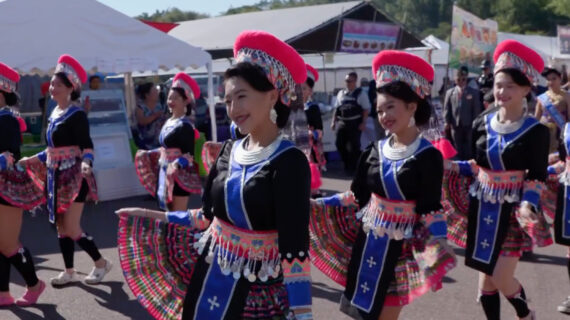
So if everybody that's Hmong that's living in Pittsburgh is named Jong no one can marry each other. In Wisconsin they especially migrated to Milwaukee, the Fox Valley area and the Wausau area. We're very fortunate to have Hmong people in our area contributing to our community.


 Passport















Follow Us