pensive, soft music
What are the defining images of Milwaukee? Some might mention a beautiful lakefront. An emerging downtown. A blue collar city. Others would say scenes of poverty. Crime. One of America's most segregated cities. Our city is literally segregated and divided, geographically, racially. Decades of division have opened a lot of wounds.
humming to herself
Tia Richardson's Band-Aid is her paint brush.
tap, tap of brush on rim of bucket
slow, thoughtful guitar music
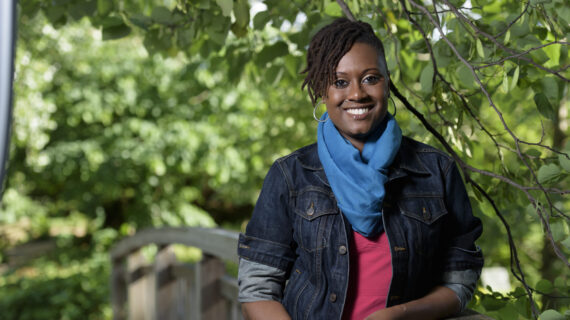
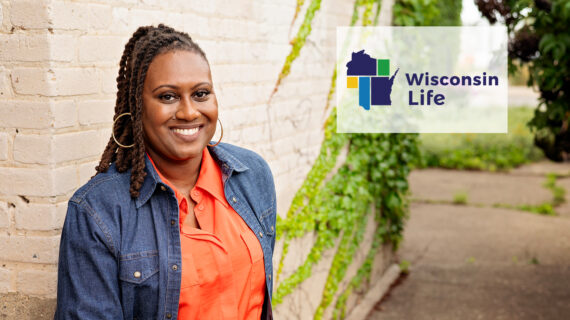
Some people feel hopeless. Some people feel like it's not gonna change. They absolutely feel like it's not gonna change. Tia is a Milwaukee artist and teacher. Her official title should be "optimist." It is the work that I do. And so as a teacher, if I were to have a sense of hopelessness in my students, that wouldn't work.
chuckles
What kind of teacher would I be? And so Milwaukee is like my classroom. She spent much of her childhood in Milwaukee. As far as friends and my social life, I didn't have a good time. It didn't help that I was shy. I was super shy. Art became her outlet. The mentors that I had, the relationships that built me up, were outside of school and they were in my community. Now she gives back to her community, working with schools and non-profit organizations to produce public art around the city. Like this mural for Black Cat Alley, an outdoor street art gallery on Milwaukee's east side. Tia sees it as an opportunity to spread her message. This mural tells a story about a unified Milwaukee. An uplifting message. It's a reminder of the net that holds us all or the web that holds us all because I feel like we feel divided. We need more cooperation. That is something I see we need in this city is cooperation.
uptempo, jazzy music
Segregation, inequity, racial tension. They're uncomfortable subjects to talk about. A big part of the problem that I see happening with the division is there's a lack of relating. We don't know how to relate to each other. So the conversations never happen. So for me the key is in transforming our relationships with each other. That is the key. How do we transform our relationships with each other? How we relate to each other? That's why she's determined to create public spaces where people from opposing backgrounds can come together and have those conversations. People ultimately are what changes systems, the person. At my reach, I have the power to influence people. And so that's what I choose to do in my work. Tia knows she can't patch Milwaukee's wounds with a single painting. It's who I am to have a vision or to be able to imagine and create beyond what we know right now. She wants to spark a different emotion simmering under the surface. Hope. I don't think that I could paint this, if I didn't already feel that the healing is happening. Yeah, 'cause then it wouldn't feel true. This is Tia Richardson's image of Milwaukee. I see hurt and I see pain and I also see people who are doing diligent, beautiful, excellent work in the community. She hopes one day it'll be everyone else's image too. I am very optimistic because I believe in people. And I believe in my city. I believe in Milwaukee. I believe in what we can do when we come together. And that's my life. That's what I eat, live, drink and breathe. So I'm pretty up close and personal with that world. And since I see that, and since I experience it, and since I am in touch with people who participate in that, then it's real for me. And that's what Milwaukee is.


 Passport














Follow Us