[in Hmong] - Duabci Crystal Vang: Nyob zoo.
Kuv lub npe yog Duabci Vang.
Kuv muaj 24 xyoo, kuv nyob lub nroog Appleton xeev Wisconsin tuaj.
Kuv niam thiab kuv txiv lub npe hu ua Sivblong Vang, Vam Yaj Lis thiab Song Yang.
- What that means is, "Hello, my name is Duabci Vang.
"I am 24 years old.
"I'm from Appleton, Wisconsin.
My parents' names are Song Yang, Sivblong Vang."
That's basically the introduction that you need to know to kind of get around and really meet people.
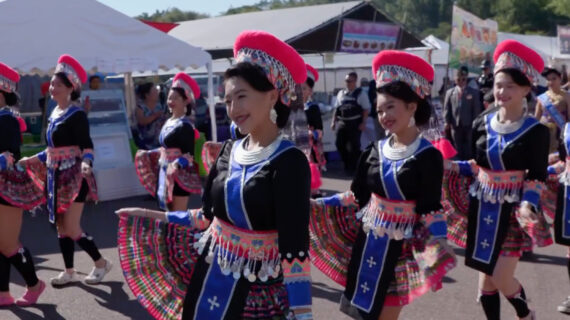
When I was four years old, I started Hmong dancing.
And I just never stopped dancing.
Or once I got off stage, then I started teaching.
["Peb Haiv Hmoob" Pajkub Tsab] Los yog Australia Nyob thiab teb suav teb Thiab los tsuas Hmong dancing is really defined by where we came from, different regions.
So, there isn't a specific type of Hmong dancing, but it was inspired by, like, Thai and Lao dancing.
So, if you notice, in traditional Hmong dancing that sometimes our hand movements are similar to Thai and Lao dancing.
But then, we also incorporated Chinese dancing because that's also where we came from, too.
Txawm yuav ruam thiab ntse Txawm yuav muaj thiab pluag Peb tsis txhob sib thuam So, like, currently right now, we're in the United States.
So now, we're trying to adapt to where we're at.
We're now more like hip-hoppy, very, like, energetic, and very sharp with our movements.
["Peb Haiv Hmoob" Pajkub Tsab] Oh... oh... One of the main people that taught me to be who I am today is definitely my dad because he was so involved in Hmong community.
And then, when I turned 13, my dad passed away.
And I remember him always telling us, like, "Hey, like remember, like these are your people, and no one's going to love you unless you love them.
You guys have to love each other."
One thing that I've learned through dance is definitely knowing the language.
[Duabci speaking in Hmong] Kuv yog ib tug ntxhais seev ce.
I think that when you Hmong dance so much, you really learn the language, and you really learn to appreciate all the small, little things that people put into music to make you be able to go and perform in those dances.
So, like, simply as when the song's talking about Hmong people, they'll tell you like, "Oh, we used to live like this."
And then, we, as the dancers reenact those movements.
So then, we can see how our parents once lived.
That helps every dancer realize what our families have gone through to get to where we are today.
[cheering] - Two, three, who -- are -- we?
Duab Ci!
[cheers] - Duabci: It is disappearing faster and faster per generation.
Even my generation doesn't know that much Hmong anymore.
And so, even me, I try to help my dancers preserve the language.
[speaking in Hmong] - Diamond Thao: Ka Vang and Fong Thao.
You get so personal with everyone.
And every dancer that goes through the doors, even though they leave, I still feel connection with every one of my dancers.
– Alivia Yang: She's been my, like, first-ever coach.
So, I feel very close with her, and I feel very comfortable around her.
I feel very safe around her.
She's just a loving, caring person.
– Aeriyanna Xiong: I love her.
She's super funny and she's a really great teacher.
She's just like a friend.
– Claire Yang: She's a little childish.
She likes to jump and dance when she's dancing.
– Ila Xiong: It doesn't matter if she messes up or stuff.
Everyone makes mistakes.
And if she tries something, try something new.
- The beginning of the year, they tell me, "Crystal, I hate what I do.
"I hate this.
Why do I have to be here?"
And I'm just like, "Well, because you're signed up.
"You have to be here, right?
You wanna learn, right?"
"No, my mom forced me to be here."
But then at the end of the year, they're the one that's like, "Crystal, when is next year gonna happen?
Oh, my gosh, I already miss everyone."
Once you get the taste of competition-- I tell all my dancers this-- is that you never wanna stop.
You just crave for it.
You just keep going, like, "Oh, my gosh, "that was so stressful, but it was so fun.
Let's do it again."
[dancers cheering and laughing]


 Passport

















Follow Us