Milele Chikasa Anana
These are some photos from the March on Washington in 1963. We came there to protest that our democracy wasn't working. I don't see myself in any of these pictures, but I'm sure that one day, I might find myself listening to him.
saxophone melody
Milele Chikasa Anana
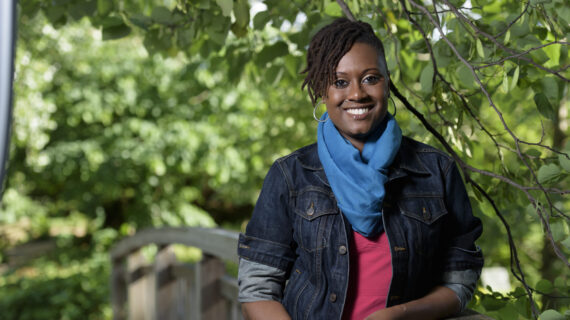
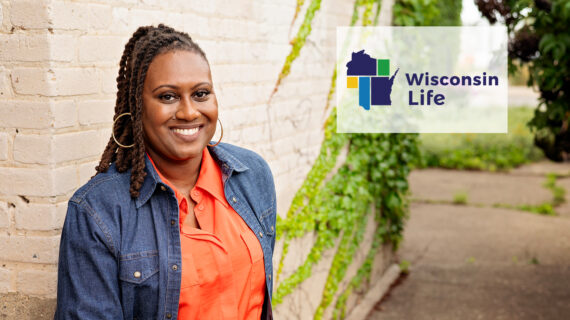
My name is Milele Chikasa Anana. I have been a publisher, an editor, a social worker, an activist, and......general Hellraiser.
saxophone playing
Milele Chikasa Anana
I came to Madison in 1968. In that era, when I would look at newspapers or the news, I saw only stereotypical images of black people, and I thought, "This story is not balanced. "There must be something more, must be something missing here."
conversation and laughter
Milele Chikasa Anana
Ms. Milele, we so appreciate the legacy that you have made with the "Umoja" magazine because it is history. My son could tell you--
Anana
We started Umoja" magazine in Madison in 1990 to portray the positive attributes of the Black culture.
jazz music
Anana
I did everything. I took photos, interviewed people, I wrote up their stories, I edited. And all the spelling mistakes were mine.
chuckles
Woman
But also, it's her power of persuasion. Well now, that might have something to do about it.
Dana Warren
She thinks it's important that people are rewarded for the good things that they do, and I think that's what she's done with "Umoja," yeah. It helped me a lot because, coming from Chicago, it did expose me to a black community here. And to really see positive news about black people, I just really appreciate that. When Milele chooses you to be a part of a story, that's a big deal 'cause she's like, "I think it's important that people know what you do."
Anana
What we found over the years is that if you feature a black person who has done something, other black people say, "Oh, I can do that too." So, that has inspired a lot of people to know that others had these dreams, but didn't know whether they could do it or not. Did you have difficulty securing artists for the covers? No,
it was exposure for them. - Woman
It was exposure.
Anana
I knew I didn't have the resources to make a cover portrait, so I decided to use black artists to portray our experience.
Jerry Jordon
The idea behind the mural, I wanted to paint something that would represent who were the people or the community that helped make Madison what it is today, and I didn't see it would be possible not having "Umoja" magazine represented in this mural.
Milele chuckles
Jerry Jordon
All right.
Jerry Jordan
I work in oil, pastel, charcoal, and I usually work with the human figure. I've painted a lot of covers for "Umoja" magazine over the years. I suspect around 12 or 13 covers. She has given a lot of artists an opportunity to get their work seen by the community.
Edith Hilliard
The artwork is absolutely beautiful! Maybe artwork that you wouldn't normally see, so that was an excellent idea for her to do that.
Jerry Jordan
I'm very proud of my partnership with Ms. Milele over the years. She would demand the best out of you, and you want to live up to it, so you always give your best.
somber music
Anana
I grew up in Tulsa, Oklahoma. It was a segregated society, and my mom said that no human being is greater than another one, no matter what they may look like. I never will forget that. I was sitting right on the edge. I think I was so close, I heard-- Somebody told Martin Luther King to tell about the dream, tell about the dream. When young people ask me why I went to the March on Washington, I look at them and say, "Because of you." We went there to make a larger impact on the world and we did that. I worked on "Umoja" magazine for 29 years. I wish that there were a "Umoja" for every community in the United States to celebrate the good things happening in the Black community. When anybody thinks of positive things that are happening in Madison, that's where they heard about it, from "Umoja," so I think that's her legacy. In the Swahili language, 'moja' means one. When you add 'u', it becomes 'together, all of us.'


 Passport















Follow Us