The University of Wisconsin-Madison has a rich cultural tradition and a history that's not so well known. All right, I need some gifts for our students. UW-Madison is extraordinarily special. Aaron Bird Bear is the Assistant Dean for Student Diversity Programs in the School of Education.
speaking in Ho-Chunk
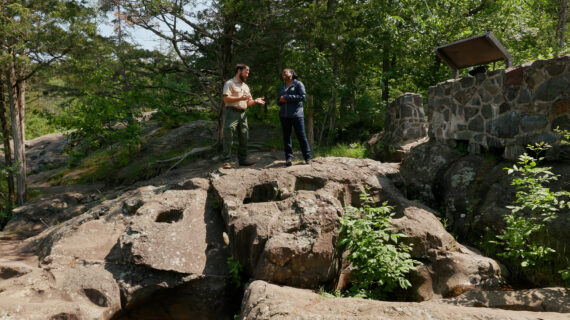
Hanicara hapi. (I am happy to be here.) Aaron Bird Bear ga hinigaire. (Aaron Bird Bear is my name.) I'm a guest here today of the Ho-Chunk Nation as we're all guests of the Ho-Chunk Nation in their home of Dejope. We call ourselves the most archaeologically-rich campus of any in the United States.
The snow kinda melts differentially around it. We can kinda see the double-tailed water spirit peeking through the snow. There has never been another one discovered like it. Walk with Aaron on his campus tour and the landscape comes to life.
We have an established archaeological record of human occupation and human activity going back 12,000 years on our lake shore. This culture kinda grew and evolved, and they started making these representational figures
on the earth
deer, bear, canines, birds, water spirits, snakes. Along the lakeshore, the signs of human activity can still be seen. Their origins date back thousands of years. These effigy mounds are only built in the western Great Lakes.
You won't find them anywhere else on planet Earth. That's what makes UW-Madison such a special place, is that we're in the very epicenter. On this day, students also discover the monuments to those that tried to vanquish that culture, that language and that way of life. All we see are these monuments to ethnic cleansers, or Indian fighters, or all sorts of people.
In 1851, a little earlier, the reservation period hasn't really begun yet. Aaron's goal is to educate people with his tour and break through that colonial veneer. And if you can crack it, you can suddenly see this incredible depth of humanity and celebrate the full 12,000 years of humanity. And not just the 1.5% of humanity that's represented by 1848.
speaks with gusto
on the earth
"Forward!" Right? Starting with one of the most iconic landmarks on Bascom Hill. There's a rubbing I did at Camp Randall, which speaks back to this period. On the 18th of December 1862, who's president again?
Tour group member
Abe.
Aaron Bird Bear
Abe! On the 18th of December 1862, the 25th Regiment came into Camp Randall from a campaign against Indians in Minnesota. He's president during that. He's committed to the ethnic cleansing of the Ho-Chunk.
He's enacting our federal policy. So he's a leader who's trying to rid the Native American presence from Wisconsin as a president. So the Ho-Chunk view him as, you know, a monster, right? Somebody committed to their destruction.
The tour provides insights into a society that thrived long before Europeans entered the picture. And there's almost no acknowledgment of the 12,000 years of human story that exist before the arrival of colonizers. This is a map of the ancestral lands of the First Nations of the Western Great Lakes. Inside the Memorial Union near the main entrance, these murals depict how Native Americans were glamorized in 1925.
But unfortunately, these are all stereotypes. They're not accurate or authentic to any one Indian culture or nation. It'd be the equivalent if I took a plane to France. So, I got my toga, I got my fur hat, I got my lederhosen.
Like, "Look, baby, I'm a European! I got it all! I got it all!" And that's what this is like. It's a mish-mash of cultures and ideas we see above us.
It's not accurate. In 1925, when the Union was being built, what kind of education are Native Americans receiving? There were 11 boarding schools in Wisconsin. One for each of the Native Nations.
And the whole idea of boarding schools was to eradicate native languages and destroy Native American culture. Aaron also sees the challenges when faced with the myths and stereotypes engrained in the building blocks of the university. Because it was designed almost exclusively for white men in its origin. If you applied to UW-Madison in 1848, you could only be a white man and be here.
Women weren't allowed. People of color weren't allowed. And so we, as an institution, have been striving to become a more inclusive community. Let's walk over to this one real quick.
The tour takes a positive turn in a place called Dejope, a Ho-Chunk word meaning "four lakes." It refers to this region that we're in today. Dejope Residence Hall is where the University of Wisconsin looks to showcase Native American history. When they designed it, they asked the Ho-Chunk, "What kind of image should we do?" And so they built it in the form of a bird. Here's a drawing, from a hundred years ago of the goose effigy.
So, this goose effigy is represented here on the floor. It's right behind us out these doors. In this place of higher learning, Aaron recognizes the university is making progress. So, I'm seeing concrete stuff happening around us that show us that there's tremendous value in the teaching and learning about the full 12,000 years of this place.
And I think we can leverage the landscape and the incredible human story of this place to advance those goals. Our students witnessed the Indian Wars as students and they wanted us to remember something about them. And so, I'm committed to giving these tours because they do advance our understanding of one another. This tour is really a story of hope and a story of incredible promise of what the relationships can become between First Nations and our university community.
So, thank you so much and welcome to the University of Wisconsin-Madison.


 Passport


















Follow Us