

 Passport





Strip-by-Strip Patchwork Quilts - Part 2
09/25/17 | 26m 47s | Rating: TV-G
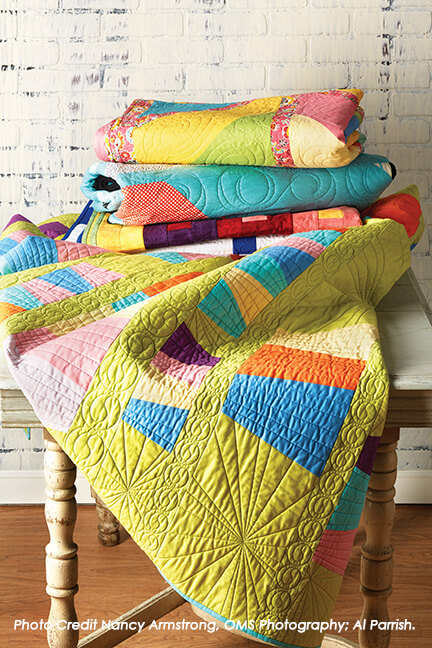
Nancy and quilt designer, Donna Fenske, explore the use of color and design to achieve a rich depth of tone and dimension by using fabric strips to construct quilt blocks. Learn how fabric and block dimension changes produce an entirely new look. Projects include Jeweled Illusion and Tumbling Leaves table runners, and the Fractured Sunlight quilt


Copy and Paste the Following Code to Embed this Video:
Strip-by-Strip Patchwork Quilts - Part 2
One of the aspects of sewing and quilting that holds my interest in this art is the use of color and design. Change a color, change a size, and, bingo, a new look. A master at giving visual interest to quilt designs is Donna Fenske, a longtime member of the Sewing with Nancy team. Donna, please share with our viewers the insights on this first design of this program.
Well, this first quilt is very colorful, and it's called Jeweled Illusions, and it's a combination of multiple ombre or gradated fabric strips with a black background. Gives this design great movement. I slightly varied the width of the strips, which provides the intrigue. "Strip-by-Strip Patchwork Quilts," that's what's coming up next on Sewing with Nancy.
gentle instrumental music
female announcer
Sewing With Nancy, TV's longest-airing sewing and quilting program with Nancy Zieman,
is made possible by
Baby Lock, a complete line of sewing, quilting, and embroidery machines and sergers.
Baby Lock
For the love of sewing. Madeira, specializing in embroidery, quilting, and special effect threads, because creativity is never black and white. Koala Studios, fine sewing furniture custom-built in America. Clover, making a difference in sewing, quilting, crafting, and needle arts for over 90 years.
Fuller Brush Vacuums, dedicated to keeping homes clean. Amazing Designs and Klass Needles. During the first program of "Strip-by-Strip Patchwork Quilts," Donna and I shared with you three different designs that were all made with just straight cuts of fabric sewn back together, cut apart, and we're continuing that philosophy. Yes, and it's just really a lot of fun with the gradated fabric set I've incorporated with the black.
Now, to give you a sense of what-- let's do it this way-- a sense of what we have here, you can see a block, and the block is, on purpose, misaligned. Right. Most of the strips are cut 1" wide, and then a few of them are cut an" and a quarter, and the reason I did that, 'cause I didn't want to match seams, and it also then added to the illusion that gave it its name. So we mentioned two sizes, 1 1/4"-- they're small-- and 1", but, wow, what drama, and you only have to make a table runner, you don't have to make a queen-size bed out of this, and the ombre or gradated fabrics work out very well.
Right, and I used only three ombres, but the ombres make you look really like you're really great at picking out color, because it has three to maybe five colors per ombre, and when you multiply that, you have basically, you know, 12 to 15 different fabrics. - Sure. Of course. So out of each ombre, I'm going to cut 1 1/4", 1", 1", and another 1", so three strips that are 1" wide and one that's 1 1/4".
All of the black fabric is cut 1 1/4". So after you have all of your strips cut, we start to pair them together. We're making a strata, or many layers of strips that are put together. We start with the 1 1/4".
Then we add the contrasting black fabric, and, Donna, you might have to hold on to that so it doesn't slide down. And then we choose another ombre color and a black strip, and you'd use the full 40" width of fabric, followed by-- let's see, we need one more color here and then another black piece, so you would have three pair, or six strips of fabric. And we're gonna sew these together but sew them together in just a little bit of a different manner, not the way-- we're not gonna meet the cut edges like you see here. Right, because what we're going to do after these pieces are sewn together, cut out triangles, and that offsetting the strips will give us more fabric in the end.
And I'll show you what we mean by offsetting-- if we look at the top of this piece of fabric, we're gonna fold it in a 45-degree angle. You can just kind of finger-press this, and then you can align the-- its mate... Yes, its black strip. - 1/4" down.
And then sew the strip, so it's gonna be offset, so all the pairs you're gonna sew together, offset, and I think I did it backwards. When I would be right-side up, it would be matched on the other side, but we're gonna offset it by the width of the fabric, and here's a close-up of chain-stitching these pairs together. You get three pairs stitched together, and then-- and here they are. Here we have one, two, three.
One, two. Now I have another one. Let's make believe we had another one, Donna. Yes.
- Here we go. We got it. - Yes, here we go. And again, I would've pressed the seam allowances, of course, towards the dark fabric, and then we're going to also repeat the process of joining the three strips by offsetting, again, the pairs.
Now, you think, why in the world are we doing this; we'll show you, because when you cut out the triangles, which we're going to do next-- do you have the ruler? You can have-- we have two variations of a cutting device here. I have just used a half-square triangle, and I put a little tape as a reference point for the width of my fabric or triangle that I'm going to cut. And so we would cut as many triangles as we can get out of each strip.
And then one strip will have the point at the dark, and one strip will have the point at the ombre section. Right. And we're just gonna kind of just show you quickly what happens, but you sew together a strip that has-- you sew together the dark and the colorful strip. Correct.
We want to create kind of like a hourglass in the center. That's what I really focus on. I want to create that hourglass look in the interior. You sew another pair together, dark and light, and then they all create a block.
So we're not really showing you the piecing so much as the opposite colors, the dark, and then you have your blocks that go together, and look at what Donna did here. She put the color next to the black, and it has that illusionary look, where if you put this together, it wouldn't work as well. You'd lose that illusion. So there's another hint that we have for you, and we're going to soon go to the sewing machine and show you about this, but putting blocks together, we also finished it with a mitered border.
We'll give you a mitered corner technique for putting on a border-- believe it or not, there's a border here-- at the sewing machine. Each element of a quilt design can contribute to the overall appearance, and that's really evident when you look at this border, because the border is continuous and it goes all the way down and up, and it helps continue that look of the illusion that the quilt block has. It's a little difficult to see, if I were to show you how to attach that border with the piece border, so we're going to use a square, cut the size of the finished-- of the block, and it's 7 1/2", and in each corner, you would mark 1/4" the seam allowance width, because this is-- these are gonna be the stopping points for your border fabric. We used border fabric with 1 1/4" black for the background, 1" cut of the color or the ombre, and then another 1 1/4", and sewn in a strata-like manner.
And then you would extend, allow at least 3" on each side of the border, and stitch from point to point, from 1/4" to 1/4". Then the next piece would be applied, again extending that border, and stitching from 1/4" all the way across to 1/4" so that the corners haven't been formed yet, but that's what Donna's gonna do for you. Here on my sample, the borders have extended, and what I'm going to do is, I'm going to fold in a miter at the corner, get it really nice, and I'm gonna give it a really good finger press. Then I will pin this top edge.
Again, we're aligning the border really flush at the top here. Yes, if you match those ends... They'll be-- - It'll just come together. And then after I pressed it, I did enhance the crease line with chalk, and I'm going to sew from the outer edge to my stopping point on the border, so I'm going to simply sew and sew to that corner.
And you can baste it first, you know, if you wanted to make sure you're right on target, and re-stitch it if you like, but sometimes I end up basting it first. And I'm-- I would do a little back tack, but for television, I'll just speed it up just a little bit, and now I have completed a miter. So after trimming and pressing and adding your final binding, you have amazing-looking quilt design. Continuing with our theme of using strips of fabric to create focal designs, it's called Tumbling Leaves.
We'll introduce you to offsetting the strips as well as cutting on the offset to create this version of strip-by-strip patchwork in fall shades or spring colors. You get to choose. It's amazing what you can do with different sewing angles of just strips of fabric, and, Donna, this abstract leaf is very attractive, and two different colors, with brown as the leaves. Right, as the veins...
- Veins, excuse me. And the stem, yes. And we're, again, going to sew strips of fabric in pairs, and the size of the strips, the brown is cut 1", and the gold and the yellow-- oh, gold and orange-- is cut 1 1/2". Correct.
Correct. And we're going to create, as you see here, two different stratas, or two different layers of fabric, but notice they're a mirror image of each other, so that one angles from the upper-right downward-- Upper-left downward. And to create this, we have to do some-- just some little different folding. We did not use the whole strip of the fabric, the whole 40", but we cut the 40" into thirds, and we did this after sewing the pair, so you just sew the 1" brown to the 1"-- or to the 1 1/2" gold and then cut it into thirds.
Correct. - And that's what we have here. Now, to create this strata, I'm going to do the gold, Donna's going to do the brown, so, Donna, I think I get the easier. You get to go first.
- Okay. Great. So you can see, like we did the last time, we fold it at a 45-degree angle, and then I have right-side up, and then I meet right sides together the next strip, starting at the fold. Notice that she's stacking the brown onto the gold.
And then you'd do the stitching 1/4" away. After pressing it open, da-da-da, you have two put together. Then you fold another 45-degree angle. You just kind of finger-press, put the next piece down, and stitch, and we're just doing some virtual sewing, but you can get the concept, how that angle is created.
Now, to get the mirror image-- Since I have the mirror image, what I'm doing is, I'm having my strip with the brown on this side and the orange on this side. I have it the wrong side facing up. That's the key. - Yes.
And then I'm now folding the 45-degree angle. Mm-hmm. And I'm going to be sliding, or attaching, the gold-- the orange to the brown, and I'm going to align from the underside at that fold mark. So let's just kind of show at an angle that it's underneath.
See, it's tucked underneath. If I sew my 1/4" seam... - Mm-hmm. I'm going to accomplish the little step, and I'm creating a mirror image of what Nancy just accomplished earlier.
So it's offset. One time, we fold with right-side up. The other time, we fold up with the wrong-side up, and then that gives the mirror image. The reason, we're gonna use a half-square triangle and cut three different shapes.
And what I did, ahead of time, is, I just used the triangle, and I want to audition this strip of fabric. Sure, and we-- So I like to draw out the triangles. And you don't have to have them straight. You know, they could be a little cattywampus.
Right. And notice that the short end of the triangles always align with what I would classify the stem of the leaf, and they're not always aligned straight because I like kind of the organic look of a leaf. Sure. See how we have a little bit of the brown showing here, and the rest is gold, so if you even cant it a little bit when you're drawing it out, it makes it very attractive.
Donna, let's take two different halves, the one cut from gold and the one cut from orange, and you can see the creativeness that we have, and you added a flange down the middle. Right, I took my 1" strip, folded it in half, and pressed it, and it's just going to add interest when I sew it together. It's going to create the center vein, or center stem, of my leaf. And it's narrow because it was an inch folded in half.
Let's look here. It's dimensional. Now we have set this into the table runner with triangles, and each of the three leaves has a slightly different shape. We're not giving you all the details.
These are pretty traditional quilting techniques. But learning this offset technique gives you another option when working with patchwork. Blues, greens, and browns are Donna's favorite shades, which is certainly evident in her Fractured Sunlight quilt. The final quilt design of our "Strip-by-Strip Patchwork Quilt" program, you'll learn yet another artistic quilting technique.
Sewing and quilting is just not process; it's color and design. And as we look at this fractured design, beautiful shades of color that we have here, and, Donna, we're gonna use almost every inch of fabric. Right, and it's going to be kind of sewed on the diagonal. But you'll sew on the straight, but you'll find the magic that happens.
Donna, you chose some-- There's a total of forty 2-1/2" strips, and I divided them into 20 kind of brown tones and 20 kind of blue to green tones. So you could raid your fabric stash; you could buy small yardage; you could swap with a friend. 2 1/2" strips. We've cut 2 1/2" strips throughout this two-part series, and then you would sew them just the way we've done throughout this second program, offsetting by the width, by a 1/4-- or excuse me, by the 45-degree angle, so all the brown-- the browns are offset, and you would have-- instead we did half strips, but you would have the full-- yeah, look.
Full. Full, full strip all sewn together. The full 40". So here we have a mini scale of the browns, the mini scale of the blues and the greens, and if we cut them into strips like this, we'd have a lot of waste of fabric, just a tremendous amount, so what, Donna, you'd like to do next, is to trim up the sides.
What I-- yes, and what I do is, I lay my ruler on it and trim off the little steps, so to speak, just get it nice and squared up on both sides. Here, we'll show you the steps that were cut off, so now we have a slide. Right. - All the way down.
So you'd trim off, so it's even, and then with both strips-- now, this is the magical part. We're gonna meet-- - Meet and create a tube. And when you do this, it's a little bit unusual. Here, when you see, when you meet the ends, you're going to offset it by a 1/4" on one end, right here, start sewing, and then you'll create a tube, and here's a close-up of how I've sewn this, and you just keep sewing until, when you finish, Donna, when you lie it flat, this is what you get.
Right, and notice that the seam that you've just sewn sort of wraps around to the other side, and when you have the, you know, the full width, you will definitely have that occur. So at this stage, I like to turn that big tube right-side out because I like to audition my fabric right-side up so I get the true visual of the colors. And I might want to add, when we say "big tube," when you have the full 40" crosswise strip and all 20 pieces, this is how big the tube gets. But it didn't fit on our table.
So we have this partially sewn just to show you what it's like. And now you're gonna do some cutting. So now we cut them into sections. And here's a ruler.
And... I'm cutting-- can you tell me, is it 5"? 5", 3", or 2". - Sorry.
Yeah. That's why you have directions, right? Thank you, Nancy.
laughs
Baby Lock
So I did a 5", and I don't cut very well upside down. Oh, that's fine. - So I apologize for that. And here on my side of the table, I have a 5", 3", and 2".
And out of the brown, you cut some 4" strips, and we're gonna put those in between. So I have 4" strips right here. They're still in this-- Tube. They're in the tube.
- In a tube. Now, what we're gonna do quickly is start cutting. I'll cut one fold, cut this, but then, so I don't have the starting point at the same spot, I'm going to travel this down, travel it to a different layer, and so, Donna, you're gonna-- I'm just gonna travel, then, into a different area, and we're cutting-- we're just aligning our fabric at the top, and again, we're cutting straight across. So we would readjust the brown so that we would have the fractured look, so they would not start and stop at the same time.
So with a variety of techniques, interesting cutting, all strips of fabric, you have a lot of creativity. Beadwork is a time-honored form of sewing. This art is about more than just the beauty. The raised beadwork has powerful and cultural historic meaning.
Please welcome two members of the Oneida Nation, Judy and Betty, and welcome to Sewing with Nancy. Thank you. - Thank you. Good to be here.
Oh, it's a pleasure to have you as our guest, and I have the honor of having in my lap some of the most beautiful beadwork I've ever seen, and, Betty, first, starting with you, you have a leather deer hide with some beading on it, and just give our viewers a little history of that. We did our beadwork using old British uniforms, so that's where we get the red velvet from. Or black velvet or blue velvet. Our men caught the deer, so we used tan deer hides, and then we traded the Europeans for the beads.
Before that, we used the shell and the stone and berries and stuff like that. Beautiful. And, Judy, you have a eagle-- eagle feather carrier and a pincushion. Right, and the pincushion is a throwback from when the Europeans first came, and I got the pattern through a lot of research with the Royal Ontario Museum in Ontario and in visiting with New York, and we traded patterns for...
from the New York Oneidas, so this is a replica of an antique pincushion, and they called them pincushions. And then the eagle feather case. Oh, lovely. - What we started-- what we started doing was making this case, because a lot of the dancers carry eagle feathers with them.
Sure. Of course. And this is a way of safeguarding their eagle feathers. Now, Judy, a lot of your-- or, Betty, I'm sorry-- a lot of your patterns have evolved over time.
As Betty-- as Judy was saying, excuse me, some of these were 1700, 1800, and this is from a regalia, collars and cuffs, and really, again, very attractive, yes. Oh. - Thank you. Thank you.
And here let me show you the belt that goes along with it. Again-- and you have dimension in all your work, as our viewers can see. Tell me about how you achieve the dimension. You take a layer of beads like here, and you put one row down, and then you bead over it, and that will keep the beads raised.
It's called Iroquois raised beadwork. It's-- The older work was flat. Like, Judy has some flat work. They're all the same stitches, but it's flatter.
So that's how they can distinguish the age. Very nice. And, Judy, you have another belt area, and that really has dimension to it. Yes.
Actually, this is a crown. Oh, I'm sorry. - Yeah. That's all right.
Yeah, this is a crown, and they were based on the royalty from England and from Germany, and a lot of the women dancers wore the crowns or the headpieces. The other piece that I have here is a sewing kit. So it's just a way of keeping-- Mm-hmm. Keeping your needles and scissors and whatever on hand-- thread.
And you also have dolls, and you do the regalia in miniature. Right. Right. And the pattern for the dolls is an old, old pattern that goes back for centuries, and it's called a rip dress, the dress portion of it, it's called a rip dress, because all of the pieces are torn, so they're all either squares or rectangles.
Oh, my. - And... and then the other regalia that goes with it, the beadwork. And, Betty and Judy, you have been kind of resurrecting the patterns from the Oneida Nation because many of your ancestors had to leave their craft behind in New York.
When we came from New York, we were forced down here, and we were forced to walk or ride on a horse, and all we had was the clothes on our back and maybe enough food for that day, so we had to hunt, and we had to take care of the babies, and we had to gather food all the way down here. When we got down here, we had to reconstruct our houses and start farming and do everything from scratch, so we didn't have time for all of our hobbies. When we finally got around to having enough time, we actually hired a guy from New York that came down and taught us for about 20 years, but he taught us all in these silver aurora borealis. Ah.
So then we discovered Rose Mary Hill, and she's the one that brought smaller beads and all the color and just went--
exhales
Baby Lock
we all went crazy. And I'm so delighted that you are keeping this art alive. You're passing it on to many generations, and you're sharing it with us, because what beautiful work, and a beautiful part of sewing. Thank you for being with us.
Thank you. Thank you. - Thank you for having us. We really appreciate you watching as well, and I hope you've enjoyed this second program of "Strip-by-Strip Patchwork Quilts." Donna and I have appreciated bringing this to you.
Go to NancyZieman.com to watch further Sewing with Nancy programs. Thanks for joining us. Bye for now. Nancy and her guest, Do nna Fenske, demonstrate easy piecing techniques to create dramatic quilts and distinctive table runners.
Get the book with instructions for six different patchwork projects, plus the DVD of highlighted tips for $19.99, plus sh ipping and handling. To order call 800-336-8373 or visit our website at se wingwithnancy.com/3107. Order item number BD3107. Credit card orders only.
announcer
Visit Nancy's website at NancyZieman.com to see additional episodes, Nancy's blog, and more. Sewing With Nancy, TV's longest-airing sewing and quilting program with Nancy Zieman,
has been brought to you by
Baby Lock, Madeira threads, Koala Studios, Clover, Fuller Brush Vacuums, Amazing Designs and Klass Needles. Closed captioning funding provided by Riley Blake Designs. Sewing With Nancy is a co-production of Nancy Zieman Productions and Wisconsin Public Television.
The latest from Nancy's blog

Search Sewing with Nancy Episodes

Donate to sign up. Activate and sign in to Passport. It's that easy to help PBS Wisconsin serve your community through media that educates, inspires, and entertains.
Make your membership gift today
Only for new users: Activate Passport using your code or email address
Already a member?
Look up my account
Need some help? Go to FAQ or visit PBS Passport Help
Need help accessing PBS Wisconsin anywhere?

Online Access | Platform & Device Access | Cable or Satellite Access | Over-The-Air Access
Visit Access Guide
Need help accessing PBS Wisconsin anywhere?
Visit Our
Live TV Access Guide
Online AccessPlatform & Device Access
Cable or Satellite Access
Over-The-Air Access
Visit Access Guide




Follow Us