









PBS Wisconsin Passport
Watch this video with
PBS Wisconsin Passport
Become a member of PBS Wisconsin, support your local community, and get extended access to PBS shows, films, and specials, like this one.
China's Bronze Kingdom
05/27/26 | 55m 15s | Rating: TV-PG
A mysterious ancient city lies hidden in the mountains of Sichuan – remnants of a kingdom consigned to oblivion for thousands of years, until the chance discovery of a jade artifact in 1986. More than 10,000 unusual items have been found at the site which experts believe may be as archaeologically important as the Terracotta Army of Xi'an. Could this be the capital of the ancient Shu kingdom?


Copy and Paste the Following Code to Embed this Video:
China's Bronze Kingdom
♪♪ ♪♪ -At the foot of the Tibetan mountains in southwest China, scientists have discovered an archaeological site of significant size.
♪♪ ♪♪ In Sanxingdui, archaeologists are unearthing vast quantities of bronze, gold, and jade artifacts, along with hundreds of elephant tusks.
The detailed quality of these artifacts suggests a sophisticated civilization about which little was known.
-These things show an extraordinary visual and philosophical creativity.
-Sanxingdui is not just remarkable -- it's also full of mystery.
There are so many objects we can't even name yet.
It's left us genuinely puzzled.
-The objects being found, thousands of them, date back to the Bronze Age, more than 3,000 years ago, making them contemporaries of Pharaoh Tutankhamun in Egypt.
And just like many of Egypt's treasures, the relics of Sanxingdui are emerging from darkness after millennia.
-The Sanxingdui civilization was a truly lost civilization.
-Archaeologists have been working for 40 years to explain this cache of artifacts.
Will they succeed in understanding this unique accumulation of objects and learn more about the sudden end of this complex society?
Will they manage to bring the legendary ancient kingdom of Shu to life?
A major international investigation begins to uncover the mysteries of... China's Bronze Kingdom.
♪♪ ♪♪ -Some mysteries in archaeology are so significant, it takes generations to solve them.
Here, under a protective dome, these eight pits have been met with fascination in China.
On telescopic platforms, researchers move with extreme care, searching for the tiniest ancient fragments.
Temperature and humidity are strictly controlled.
-[ Speaking Chinese ] -We built a large structure with special excavation units fitted with all the latest technology.
There's even a lab to treat organic remains right on site.
It's something never seen before in Chinese archaeology.
-The pits, named K1 to K8 in the order they were discovered, vary in size and hold an impressive concentration of objects, including several hundred bronze statues.
♪♪ They also contain other artifacts, like this crumpled sheet of gold.
♪♪ Expert Chinese cultural preservationists are called in to protect it.
♪♪ They'll restore the gold sheet to its original form -- the decorative layer of a bronze mask.
Until now, the study of China's ancient past had focused on the Central Plain near the Yellow River, with the Anyang and Erlitou cultures.
The discovery of Sanxingdui shows that an important civilization may also have existed during the Bronze Age, much further west.
♪♪ A single stroke of luck brought this site and its vast collection of artifacts to light.
In 1986, brick factory workers collected clay from a field and noticed some jade and bronze pieces.
The first of the eight pits had just been found.
♪♪ -Ni hao.
-Chen De'an, a recent university graduate at the time, was one of the people in charge of that first excavation.
-[ Speaking Chinese ] -Before the first pit was discovered in 1986, there was nothing here but fields.
There were no buildings at all.
At the time of the discovery, it caught us completely by surprise.
The excavation had to be carried out urgently.
We had no time to prepare.
One evening, as we were continuing the excavation, we suddenly uncovered an object of gold, about this long.
It was the golden scepter which had just appeared.
-A long staff, or scepter, covered in gold leaf, a symbol of power and prestige.
On this gold sheet, Chen De'an made out an engraving -- a fish, a bird, and an arrow.
Could this scepter be a sign that they were excavating a tomb belonging to royalty?
Soon after the archaeologists completed their investigation, the brick factory workers uncovered a second pit just a few feet away.
A large quantity of bronze objects emerged from beneath the soil -- masks, human heads, and giant statues -- but oddly, no human remains.
-[Speaking Chinese] -At first we thought we'd found tombs, but when we ruled that out, the most likely theory became the idea of sacrificial pits.
-The absence of bones, along with what seemed to be ritualistic objects, led the archaeologists to theorize these were sacrificial pits linked to some kind of religious activity.
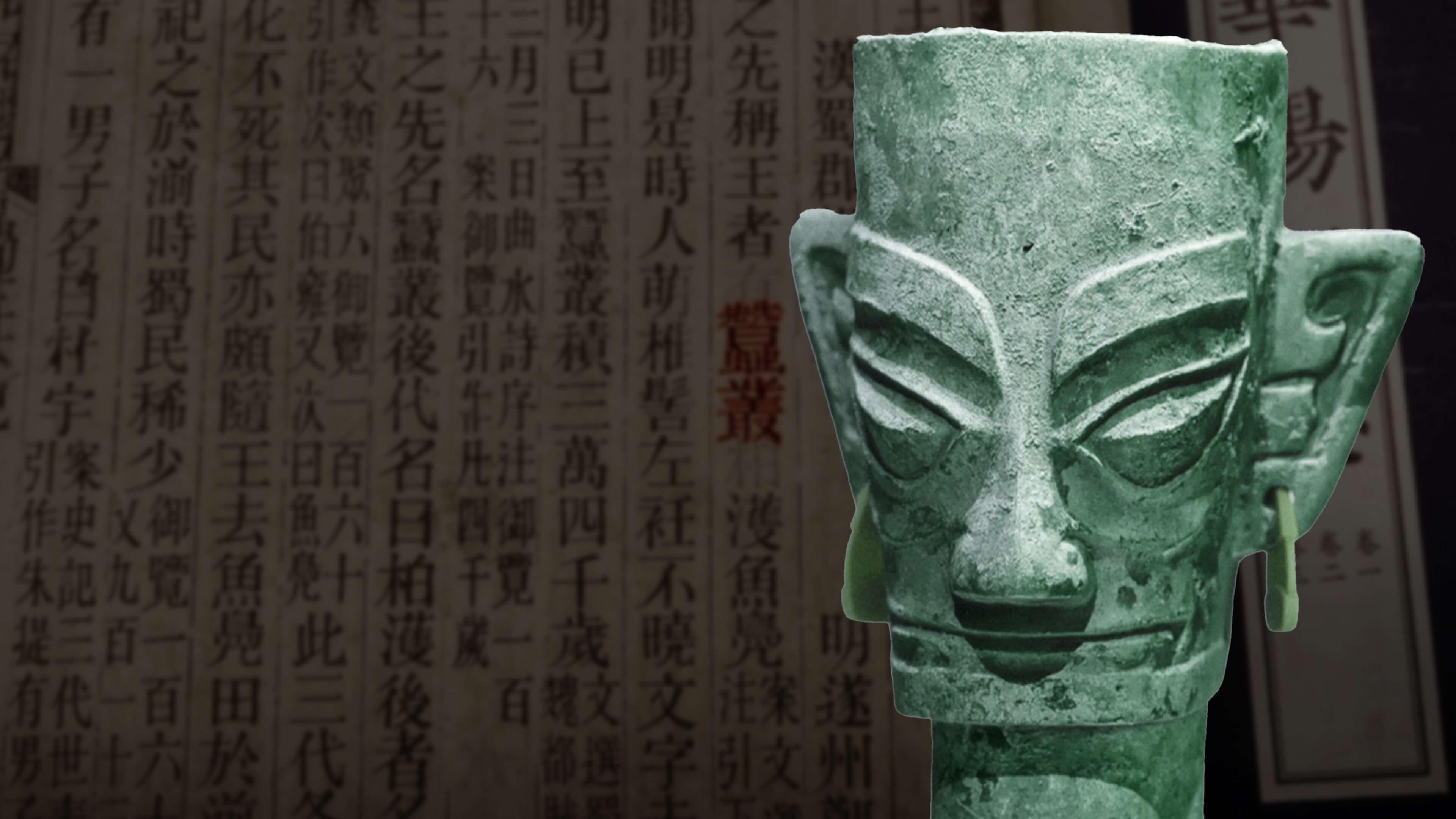
A large bronze mask with cylindrical eyes reminded the archaeologists of a leader mentioned in an ancient text.
-[ Speaking Chinese ] -When we saw them, we immediately thought of a description in the chronicles of Huayang, that of Cancong, the divine ancestor of the Shu.
-The Chronicles of Huayang were written eight centuries after the time of Sanxingdui.
More legendary than historical, the account named Cancong as the first king of the Shu kingdom, and he is described as having protruding eyes.
-There are some written documents written many, many hundreds years later than Sanxingdui mentioning the ancient history of Sichuan and that the local kingdom had the first king called Cancong.
And Cancong meaning the being that had protruding pupil.
Some of the scholars immediately said, "Hey, this is the image of Cancong."
I'm not so sure.
-Some historians believed Shu was a myth because it is barely mentioned in later chronicles, but the discovery of this mask suggests otherwise.
The Shu kingdom is believed to have developed during China's Bronze Age, sometime between the 10th and 4th centuries BCE.
It was located in the Sichuan Basin, 1,000 kilometers west of the Central Plain.
For Jessica Rawson, a scholar specializing in ancient China, The idea of a Shu kingdom in what is now Sichuan is entirely plausible.
-Sichuan is located in a deep basin with high mountains all around it.
Tibet goes right up to 4,000 meters.
It's a very important basin because it has a good climate and it's totally protected and isolated.
-With its warm subtropical climate and summer monsoons bringing heavy rains, the lands of this broad plain are very fertile -- perfect conditions for an agricultural society to flourish.
-The thing that matters in Sichuan is not the contact north or south, but the fact that it's one of the most prosperous areas in China, and it's prosperous because of the rice.
-In the archaeological layers from the Sanxingdui period, archaeologists have found rice grains that are sometimes well preserved.
3000 years ago, rice cultivation was already widespread, a key crop for the Shu kingdom.
But much remains to be discovered and understood.
The archaeologists can only envision this lost world through its relics.
♪♪ Scientists and historians want to learn more about Sanxingdui and the people who created these striking statues.
♪♪ Researchers like Ren Junfeng at the Sichuan Archaeological Institute are dedicated to learning more about the Bronze Age civilization.
He manages the new objects that come out of the pits each day.
Today, he has a typical bronze human head from Sanxingdui in front of him.
The state of preservation of this sculpture is remarkable, considering it spent 3,000 years in the ground.
-[ Speaking Chinese ] -After excavation, it appeared like this before being treated.
If you observe this bronze, you can see it is a human figure with a flat top to the head.
The top part of its head shows a hole.
Originally, this part was perfectly upright, but now it's bent.
♪♪ In the center of the eye, there's a circular layer of black paint.
This shows black paint was used for the pupils back then.
♪♪ -After carefully examining the statue's outer surface, he decides to look inside.
And his hunch pays off.
He discovers and quickly identifies this bronze fragment that was hidden within.
-[ Speaking Chinese ] -If you extended this right angle, it would create a triangular shape.
It could be half or a quarter of an eye-shaped object.
-This small piece of bronze is part of an eye that Sanxingdui craftsmen produced in large numbers.
The sheer number of eyes created is puzzling, but the holes on their edges suggest they could easily have been fixed to posts, frames, or perhaps even trees.
♪♪ Archaeologists have found more than 150 human heads like this one.
All of the heads have these striking almond-shaped eyes and pierced ears.
But on closer inspection, each one is unique.
♪♪ ♪♪ Another human head found in pit K8, which is overseen by archaeologist Zhao Hao, is especially unusual.
-[ Speaking Chinese ] -What makes this bronze head stand out is the presence of a topknot, an ornament at the back of the skull.
It was probably a type of hair decoration worn by people at the time.
One distinctive feature of Sanxingdui bronze heads is the variety of their hairstyles.
[ Camera shutter clicks ] Statues with topknots at Sanxingdui are very rare.
Probably fewer than 10 have been found.
This kind of large ornament at the back is unusual.
It may indicate that this individual held a special role, high status, or even a religious position in Sanxingdui society.
-But most of the Sanxingdui bronze heads have a different ornament -- a braid.
♪♪ Experts believe Sanxingdui's elite class was divided.
Most wore a braid, but a smaller group wore topknots.
♪♪ Chinese American Jay Xu, who studies Sanxingdui bronzes, has spent the past 40 years trying to unravel their significance.
♪♪ -Sanxingdui is extraordinary because it's overwhelmingly striking in its sculpture tradition.
That's distinguished Sanxingdui from any other cultures during ancient China.
-One of the tallest bronze relics is this standing statue, which is nearly 3 meters tall.
The two slots at the back of the head show it once wore a topknot, suggesting he was part of the elite.
-This is one and only full-length bronze figure from Sanxingdui, from ancient times in China and in the world.
-The detail of the clothing on the statue indicates this person was important in the Sanxingdui society.
-You can see those three layers very clearly on the right side of the figure.
The outermost layer of garment, which is a mantle, has four beautiful dragons.
But he is barefooted, which suggests he is standing on a piece of sacred ground.
-With such lavish clothing, this important figure was probably one of the highest-ranking religious leaders in Sanxingdui.
The position of the hand suggests an offering gesture.
Several other statues support this theory.
-Clearly, this figure represents power.
Probably the highest power of the local society.
And he here is in a very ceremonial stance, either making an offering or displaying insignia of power.
♪♪ -But these statues reveal only a fraction of Sanxingdui society.
Experts have other paths to follow in their investigations.
The best place for them to start is the six principal pits.
Strikingly, each pit is organized in the same system of layers.
And the different layers always follow the same order.
-[ Speaking Chinese ] -First, they buried the objects, especially gold, bronzes, and jade.
Next they placed elephant tusks, then scattered ashes on top.
Finally, the excavated earth was replaced and compacted.
-Three identical layers every time.
Archaeologists have never encountered this type of infilling before, and it doesn't match any ritual.
And there are more revelations to come.
The archaeologists are faced with another baffling phenomenon -- many of the objects they have found are broken in pieces.
Some even show signs of being burned.
Did something violent happen in the city's history?
A war?
A fire?
-[ Speaking Chinese ] -Almost all the objects were placed in the pits after being destroyed, burned, and broken.
It's a truly unusual, maybe even unique way of treating artifacts, and it leaves me puzzled.
-Even more surprising, archaeologists discovered that different fragments of the same object are scattered among several pits.
-One day I found a bronze dragons piece.
At the first glimpse, it's not special to us, but when I was visiting pit K3, I realized that the piece found in our -- in my pit is a part originally set on one vessel of pit K3, and it provides solid evidence that the artifacts buried in pit K3 and K8 are of the same origin.
-Here is a valuable new clue to understand how the objects were buried.
The fragments of individual objects were scattered across multiple pits at the same time.
For the archaeologists, understanding the significance of the pits and the objects inside is like putting together a puzzle with thousands of pieces.
One of the puzzles that has fascinated archaeologists over the last 40 years is a bronze tree that stands 4 meters tall.
Decorated with birds, flowers, and an incomplete dragon, it is one of the most significant pieces from Sanxingdui.
A recently discovered bronze piece is brought out from secure storage.
It might help complete the puzzle of the Divine Tree.
The restorers must feel their way forward and improvise.
♪♪ [ Camera shutter clicking ] -[ Speaking Chinese ] -Here we have an artifact discovered in pit K8.
We believe it's part of the dragon's tail.
It's notable for its double twist.
And the lower part of the dragon is missing from our Divine Tree.
We wonder if this piece might fit the tree.
♪♪ -The tree was originally found in more than 200 fragments in two pits.
But a digital reconstruction of it enables the new piece, once scanned in three dimensions, to be placed.
The tree's restoration, which has lasted nearly 40 years, isn't finished yet, even if at first glance the sculpture may seem complete.
Yu seeks the opinion of Mr.
Guo, who has worked on the puzzle since the very beginning.
-[ Speaking Chinese ] -In that case, we can proceed to look at the fitting situation with the Divine Tree.
-Here, the dragon's tail is placed on the tree.
It has virtually found its place again, fitted at the highest connecting point on the Divine Tree.
That part is easy.
But now, new missing pieces of the puzzle appear.
-[ Conversing in Chinese ] -This spot needs to be fixed here.
And here.
That's the tail.
See?
-It feels like something's missing here, right?
Here, and maybe here, too.
-Small fragments that haven't found their place yet might help finish the puzzle.
-[ Speaking Chinese ] -Yeah, exactly.
Now rotate it a bit more up.
If we align this, it fits.
There's a nice flow in the line.
Move it closer.
Bring it in a bit more.
Try fitting this section here.
Yes, exactly.
See how it together forms a really flowing line?
-But quickly, the restoration expert realizes something's off.
-[ Conversing in Chinese ] -Maybe this piece should go here.
Or maybe it fits directly there.
Yeah.
Here.
-The break seems to fit perfectly.
If that's really the case, the dragon would have a much more balanced shape.
-Yes, exactly.
This bit here, it could still be adjusted.
Maybe rotated?
Yeah.
If we put this segment here.
-[ Speaking Chinese ] -The first time we restored it, we didn't worry about these small details.
We just assembled the big pieces.
-If we could make the lines flow as we turn it, everything will look more lifelike and harmonize perfectly.
-Thanks to 3D technology, the dragon on the Divine Tree has regained its tail.
One piece has been added to the puzzle.
But thousands more still wait to be placed -- a near endless task.
The significance of the Sanxingdui pits and the way they were filled remain mysteries.
Above the layer of broken and burned artifacts lies a layer of elephant tusks, which raises even more questions.
Around 800 ivory tusks have been unearthed so far.
Why is there so much ivory?
Did it come from Sanxingdui or from somewhere else?
What role did ivory play in the Shu civilization?
Rowan Flad, an American researcher specializing in Chinese archaeology, has taken on the questions arising from this unique case.
♪♪ -The elephant tusks found in this number and concentrated in contexts like sacrificial pits, is not really discovered anywhere else in East Asia or Southeast Asia, to my knowledge.
-An engraving on a jade artifact shows a figure resembling the Sanxingdui bronzes carrying an ivory tusk on his shoulder.
This striking scene offers a glimpse into the role of ivory in the ritual ceremonies of Sanxingdui.
-The depiction that we have of ivory on the jade objects where somebody is carrying one over their shoulder is very significant because it demonstrates that the bringing in of this ivory was itself a very ritually meaningful act and a socially meaningful act.
-Though their origins remain unknown, Flad believes the elephant tusks were brought to Sanxingdui by newcomers, as an offering or sign of respect.
However, once outside the pits, these precious ivories, which have lain in a very humid environment for 3,000 years, are at risk of becoming dehydrated and quickly deteriorating.
To protect them, they are wrapped in damp cloths and placed in cold storage rooms.
Researcher Wang Chong is looking for a lasting solution to preserve these tusks.
-[ Speaking Chinese ] -In the first image, you see freshly uncovered ivory.
It's still dense with almost no visible cracks.
In the second image, taken after 10 days, a deep crack has already appeared.
After four months, it reaches a critical stage.
If the degradation continues at this rate, the ivory could completely disintegrate.
-It is an urgent problem to be solved.
Preservation is imperative if there is any chance of determining where the tusks came from.
♪♪ For several months now, Wang Chong has been experimenting with a new method.
The tusks are immersed in a liquid, which allows the water inside to be replaced with a stable compound.
The formula that could save this treasure trove of ivory may be close at hand.
And the hundreds of elephant tusks suggest Sanxingdui exerted significant economic influence in the area.
♪♪ The prolific bronze industry that developed in the capital of the Kingdom of Shu is another sign of the city's economic vitality.
Experts have wondered how bronze metallurgy, which was invented in Mesopotamia 5,000 years ago, found its way to this isolated region.
Arnaud Bertrand, a specialist in Central Asian archaeology, studies how this technology changed the world.
-[ Speaking French ] -It turns out that the archaeological discoveries over the past 20 or 30 years have let us trace the missing link between Central Asia, Mesopotamia, the steppe, and the Chinese world.
We know bronze was already common in Mesopotamia by at least the fourth millennium BCE.
We also know that Central Asia, through the Andronovo Culture, including eastern and southern Siberia, formed a bridge to northern China, what scholars call the Arc -- the Arc facing the Yellow River plain.
From the Mesopotamian origins of bronze to its mastery in China's Central Plain, it took over a thousand years, finally reaching that region around 1800 BCE.
-The Chinese developed a new method using a segmented mold to produce small vases.
♪♪ A few centuries later, this new bronze metallurgy reached Sanxingdui, where artisans there developed their own techniques.
-What is interesting is it takes something developed elsewhere and turns it into its own extraordinary production.
♪♪ -From the eight pits and the artifacts recovered, archaeologists are beginning to draw a more complex picture of Sanxingdui and its people.
Far from being isolated, the city possessed an impressive system of trade.
And the discovery of other objects just a few miles from the pits will provide more insight into this city that its existence and power had long gone unsuspected.
♪♪ ♪♪ Ran Honglin has led several excavation campaigns.
In the city's east, he supervised one of the largest projects, the excavation of the city wall.
-[ Speaking Chinese ] -Here is the east wall of the Sanxingdui site, which runs from north to south.
In front of us is the southern section.
This eastern wall is the best preserved part of Sanxingdui's fortifications.
It stretches for nearly 1 kilometer.
It is also very wide -- almost 30 meters at its top.
On the left, you have the outside of the city, while on the right, we're inside.
In this area, we found remains from several different periods.
-These imposing city walls, made of massive earthworks, were not built to repel or deter attackers, but rather to protect the city from frequent flooding.
At the wall's base, archaeologists have identified ditches designed to drain water away.
♪♪ Less than a kilometer from the sacrificial pits, archaeologists located and excavated another section of the wall.
This stretch, slightly smaller in size, is the oldest wall, and once surrounded the city's original core.
Today it is protected by a dome.
-[ Speaking Chinese ] -The construction techniques and remains of the Moon Bay City Wall allow us to date it to around 3,600 years ago.
What you see here is a cross-section revealing a structure made entirely out of earth.
-Though these walls are made of earth, their construction method is much more sophisticated than it might seem.
-[ Speaking Chinese ] -Looking at this cut, you can see a sandy layer.
Do you see?
This type of soil comes from river beds.
Just above the layer of sand, there's another, totally different one.
It's a kind of clay that's very common in the Sichuan basin.
You see one layer above the other?
It's very clear that the wall is built using different kinds of soil.
-Analysis of these soil types, as well as the methods used to ensure the wall was stable, show the technical mastery of Sanxingdui's inhabitants.
-[ Speaking Chinese ] -This combination ensured the structure's stability and solidity.
-Archaeologists estimate that the total length of Sanxingdui's city walls exceeds 9 kilometers, and that the city covers an area of 3.6 square kilometers.
Archaeologist Xu Danyang has synthesized all the research on the city's physical organization.
♪♪ -[ Speaking Chinese ] -This is a map of the Sanxingdui site based on satellite images.
We use different colors to represent the different elevations.
We chose brown for the city walls since they are relatively high.
The east, west, and Moon Bay walls are about 5 meters high.
Besides that, the highest point is the northern terrace, which was the heart of Sanxingdui.
You can see it marked here as Mound Qingyuan.
That's the location of the palatial area.
It's an artificial platform covering about 8,000 square meters.
-This part of the city, now protected from river flooding, became the center of power.
♪♪ Many building foundations have been discovered there, including what archaeologists suspect could be a vast palace.
The existence of such a palace would prove there was an elite group ruling the capital of the Shu kingdom.
Sanxingdui was organized rationally -- a zone for power, another for the population, and another for sacrificial activities.
The size and careful organization of Sanxingdui suggest that it was the capital city of the Shu kingdom.
The city possessed sophisticated sculptures and was filled with imposing buildings.
These details point to a highly developed civilization, that of the Shu kingdom, set apart from the Central Plains.
But why were these pits dug and filled with the kingdom's most precious resources?
-[ Speaking Chinese ] -These six sacrificial pits, dug at the same time, contained the most precious and important objects of the Shu state.
-After being destroyed and burned, the objects were buried so they would never be seen or used again.
In a sense, these pits became the tomb of Sanxingdui itself.
-[ Speaking Chinese ] -We can be almost certain that these six pits date from the final period, when Sanxingdui served as the ancient Shu capital.
-Dating back 3,000 years, the pits seem to mark the end of Sanxingdui.
But archaeologists aren't aware of any other civilization that buried its most precious possessions.
What happened?
Did the inhabitants abandon the city?
Were they forced out?
A discovery nearly 50 kilometers from Sanxingdui offers archaeologists new insight.
In 2001, on the outskirts of Chengdu, the capital of Sichuan, workers using a bulldozer to dig a trench saw elephant tusks and jade objects appear.
Work stopped immediately, and emergency archaeological excavations began.
The area was divided into about a hundred grid squares.
The discoveries here would prove to be the key to outlining the borders of the Shu kingdom.
Wang Fang, now deputy director of the Jinsha Museum, has been one of the archaeologists exploring the site since it was discovered.
-[ Speaking Chinese ] -We realize this city has a functional layout.
A river called Modi divides the city north and south.
The residents live on the north side.
That's the residential area as well as the palace, and there are also craft workshops.
The south side is mostly dedicated to sacrificial activities.
-At its largest, Jinsha bore a remarkable resemblance to Sanxingdui -- the same city layout, same northeast-southwest orientation.
According to scientific dating, Jinsha reached its peak just a few decades after the fall of Sanxingdui and became the capital of the Shu kingdom.
64 pits, now protected by a large building, have been discovered in Jinsha's sacrificial zone.
A golden mask dating back 3,000 years was found in one of the pits.
The mask's style, size, and craftsmanship are unmistakably reminiscent of those found at Sanxingdui.
And the discovery of an engraved gold crown illustrates the links between these two sites.
-[ Speaking Chinese ] -On a gold crown found at Jinsha, we see symbols almost identical to those found on the gold scepter at Sanxingdui -- a bird, a fish, and an arrow.
This shows that Sanxingdui and Jinsha belong to the same cultural entity.
-Among the characteristics that attest to this shared identity -- gold.
The significance of gold at Jinsha and Sanxingdui was far greater than anywhere else in China during the Bronze Age.
According to Wang Shengyu, a scholar specializing in gold, the metal was valued as highly in the Shu kingdom as it was in Egypt or Greece in the same period.
-[ Speaking Chinese ] -Nearly a thousand gold artifacts have been excavated at Sanxingdui, while Jinsha already yielded over 200.
These gold objects are often found fixed onto bronzes or, according to some theories, onto wooden objects, since they are very thin.
For instance, some Sanxingdui masks show traces of lacquer and quicklime used as adhesive to attach them to the bronze heads.
-These masks, made of extremely thin sheets of gold leaf, served as a final decorative layer fitted over bronze statues to give them an even greater brilliance.
-[ Speaking Chinese ] -At Sanxingdui, many bronze faces and gilded masks had black painted eyebrows, and their mouths were covered in red powder.
The visual effect was much more dramatic than what we see today.
-Archaeologists and historians puzzle over why the Shu people wanted to add a layer of the most precious metal over bronze pieces, which were already nearly the color of gold.
Did this choice have a special meaning?
-[ Speaking Chinese ] -The people of Sanxingdui and Jinsha understood how to associate the brightness of gold with the rays of the sun and the power of light.
-One of the objects found at Jinsha demonstrates the link between gold and the sun.
It's a solid gold disk representing the sun, symbolized by 12 rays and four birds on its edge.
A few steps from the pit where the solar disk was discovered, excavators found nine holes forming a perfectly geometric square.
These foundations are in the area where spiritual ceremonies were held.
-[ Speaking Chinese ] -Inside the holes left by these pillars, we found many objects related to sacrificial rituals.
This clearly shows this was no ordinary building.
-The only building of its kind in this ritual zone, in all likelihood, it was used for ceremonial purposes.
A study done by astronomers demonstrated how the Temple of Nine Pillars is perfectly aligned along the sun's axis at the winter solstice, an indication of how important sun worship was for the Shu kingdom.
According to archaeologists, six large, identical bronze wheels that were found in Sanxingdui pits are all symbolic representations of the sun.
And both real and mythical animals seem to have played a great part in joining people in their religious rituals.
-[ Speaking Chinese ] -We know that the dragon exists in both Chinese and Western traditions.
It's a divine animal able to rise to the heavens, and it played an essential role in sacrificial ceremonies.
-During her research on beliefs about the afterlife in ancient China, Jessica Rawson developed her own vision of ancient Chinese spirituality.
-I'm pretty sure these images represent some form of their beliefs about the world, and some people call those a cosmology, but I would call it their view of how the universe works.
They have a sense in what keeps the universe moving and how it works.
And these animals or these strange creatures are part of that.
-Complex objects like this alter evoke ritual offerings and highlight the presence of animals such as elephants, birds, or dragons at the very heart of the ceremonies.
-[ Speaking Chinese ] -At that time, images of animals were not simply decorative.
Animals possessed a degree of divinity.
Their divinity was closely associated with their role as assistants to shamanic sorcerers.
♪♪ -The discoveries at Jinsha have shed new light on the beliefs and rituals of the people of Sanxingdui.
Their spirituality centered on communication with divinities to ensure the stability of their world, with the help of numerous animals.
♪♪ But curious statues called altars were also used in the ceremonies.
Intriguingly, they often feature offering vessels filled with seashells -- cowries.
It is difficult to imagine where these shells came from.
The closest ocean is more than 1,500 kilometers away.
Professor Li Haichao is searching for the answer to that question.
-[ Speaking Chinese ] -The only thing we can say with certainty is that these shells all come from very distant tropical seas.
The obvious question is how were they transported?
By which route?
In my view, there has always been a natural corridor, a route from Sanxingdui, heading south through southwest China and on to South and Southeast Asia.
-According to Professor Li, this route was a kind of precursor to the Silk Road, linking Sanxingdui to the South China Sea and the Indian Ocean.
The capital of the Shu kingdom was a commercial hub with routes to the south, the Central Plain, the North, and the Yangtze River.
-[ Speaking Chinese ] -This was Sanxingdui's system for exchanging resources with the outside world.
It's precisely because this network was so important for its development that I think its decline may also have been linked to it.
-Of the three layers of materials and objects found in the Sanxingdui pits, the layer of ashes above the elephant tusks should provide clues about the demise of the city.
Yan Xue, an archaeobotanist at the Chengdu Institute of Archaeology, is responsible for analyzing the organic material.
She is working to identify which species of plant each of these charred fragments belonged to.
-[ Speaking Chinese ] -I'm preparing the sample to determine what species of tree it is.
You can see it's blackened, and you see a structure that looks like a cluster of flowers.
That's characteristic of bamboo sap tubes.
That's how we know this material is bamboo.
-She has analyzed more than 2,000 carbonized fragments.
-[ Speaking Chinese ] -Bamboo represents more than 86% of the total charcoal found.
Besides bamboo, we also found nanmu and Chinese pistachio.
Nanmu makes up about 7% or 8% of the ashes, while pistachio represents just over 1%.
-The ashes from the Sanxingdui pits mostly contain bamboo, but also hardwoods widely used to build prestigious buildings, which means these ashes most likely came from the burning of such a building.
And additional evidence seems to confirm this theory.
-[ Speaking Chinese ] -In pit eight, as well as in pit four, we discovered blocks of red fired clay.
Based on our findings at Sanxingdui and other archaeological sites in China, these are the remains of walls that collapsed or burned.
-Now, archaeologists are sure that a fire broke out in an important building in Sanxingdui before the ritual objects were buried in the pits.
And they believe this event marks the abandonment of Sanxingdui in favor of Jinsha.
What would cause such a sudden collapse?
Some believe it was an internal revolt.
Others say the abrupt end was due to outside forces.
-[ Speaking Chinese ] -Just after the appearance of the sacrificial pits, Sanxingdui disappeared very quickly.
This was more likely the result of an invasion by external enemies.
Where did these enemies come from?
Most likely from the Central Plains.
It could have been the Shang or the Zhou.
Probably the Zhou, since the appearance of the sacrificial pits coincides exactly with the defeat of the Shang by the Zhou.
-The mysteries of the Sanxingdui pits have occupied Professor Sun for 40 years.
He wants to understand where these statues stood before they were destroyed and buried in the pits.
And the latest discoveries have allowed him to better understand this ancient people.
He, too, is convinced that the objects were burned outside the pits.
-[ Speaking Chinese ] -My speculation is that the Sanxingdui temple, for a reason unknown to us today, caught fire.
♪♪ There are also human heads whose necks have been deformed by fire.
-All of the ritual objects from the temple destroyed in the fire, and at least some of the building's ruins, were buried in only four of the eight pits.
-[ Speaking Chinese ] -We know which pit each object came from, which makes it possible to determine their position within the temple.
-He believes the contents of pit K2 correspond to the holiest part of the temple, including representations of deities, like the great mask with bulging eyes.
There are also two vases for sacred trees, sun images, bronze human heads, and the centerpiece, the statue of the Great Man.
All these items are intimately linked to the sun cult.
-[ Speaking Chinese ] -So once the gods had been identified, the next step was to locate the most important artifacts placed before them.
-The most significant pieces from pit K3 are these complex sculptures that suggest ceremonial rituals.
The vessel at their top is intended to receive offerings for the gods.
It's possible these altars may have stood close to the statues of the divinities.
♪♪ As for pit K8, it contains items used to ensure communication between humans and the gods, and several dozen bronze human heads found there came from the temple originally.
-[ Speaking Chinese ] -We think that these differently sized heads are neither humans nor gods, but something special -- Ancestors.
The dead.
What we would call spirits.
-The archaeologists created a diagram that illustrates where the key artifacts from pits K2, 3, and 8 were located.
He Ziaoge, whose research focuses on Sanxingdui rituals, has an idea about the sacrificial ceremonies performed there.
-They may decorate the shrine to make it sacred.
And then they bring some precious objects as gifts to offer to the deities, and with the help of animals, they might enter into a trance state.
And through that state they can have some communication with the higher level of the -- another world.
And they may offer those offerings to the deities, and they may get some feedback from the deities.
♪♪ -With the burial of ritual objects and the ashes of the temple, it seems Sanxingdui ceased to be the capital of the Shu kingdom.
Bringing their beliefs and skills with them, part of Sanxingdui's population migrated to Jinsha, which then flourished.
♪♪ Today, the city's treasures are displayed in a new museum.
Tourists, mainly Chinese, visit this modern temple to discover this branch of ancient China.
♪♪ This is a source of pride for experts such as Lei Yu, who have devoted their whole lives to studying the pits of Shu's first capital.
-[ Speaking Chinese ] -After graduating from university in 1984, I was lucky enough to participate in the excavations at Sanxingdui.
It was a true honor and an amazing stroke of luck for me, because Sanxingdui occupies an absolutely unique place not only in China, but among the world's civilizations.
-More than 3,000 years ago, people built, in record time, a truly exceptional civilization.
By uncovering this lost kingdom, archaeologists have revealed just how deep the roots of Chinese history truly are.
♪♪
Search Episodes
Related Stories from PBS Wisconsin's Blog



Donate to sign up. Activate and sign in to Passport. It's that easy to help PBS Wisconsin serve your community through media that educates, inspires, and entertains.
Make your membership gift today
Only for new users: Activate Passport using your code or email address
Already a member?
Look up my account
Need some help? Go to FAQ or visit PBS Passport Help
Need help accessing PBS Wisconsin anywhere?

Online Access | Platform & Device Access | Cable or Satellite Access | Over-The-Air Access
Visit Access Guide
Need help accessing PBS Wisconsin anywhere?
Visit Our
Live TV Access Guide
Online AccessPlatform & Device Access
Cable or Satellite Access
Over-The-Air Access
Visit Access Guide




Follow Us