








PBS Wisconsin Passport
Watch this video with
PBS Wisconsin Passport
Become a member of PBS Wisconsin, support your local community, and get extended access to PBS shows, films, and specials, like this one.
Reclaiming Peru’s Glaciers
10/01/25 | 55m 8s | Rating: TV-PG
Gulnaz follows the ancient Inca and modern Catholic paths confronting the Andes’ deglaciation. These spiritual traditions unite through engineering, pilgrimages, lawsuits, and prayer to face Peru’s climate crisis.


Copy and Paste the Following Code to Embed this Video:
Reclaiming Peru’s Glaciers
Gulnaz Khan: Around the world, mountain ecosystems are under threat from climate change.
Here in the Peruvian Andes, glaciers aren't just a critical source of water for the millions who live downstream.
People's spirituality and sense of belonging are also deeply tied to the snow and ice.
Every summer, thousands of pilgrims travel to the Andean highlands to pay their respects to this life-sustaining force.
But scientists estimate that more than half of the glaciers have already melted, and ancient ways of life are disappearing as well.
[singer vocalizing on soundtrack] I'm Gulnaz Khan.
As a journalist, I'm reporting on how climate change is endangering humanity's most sacred sites and traditions, as well as how faith-based communities around the globe are tackling this humanitarian and existential crisis with innovative solutions.
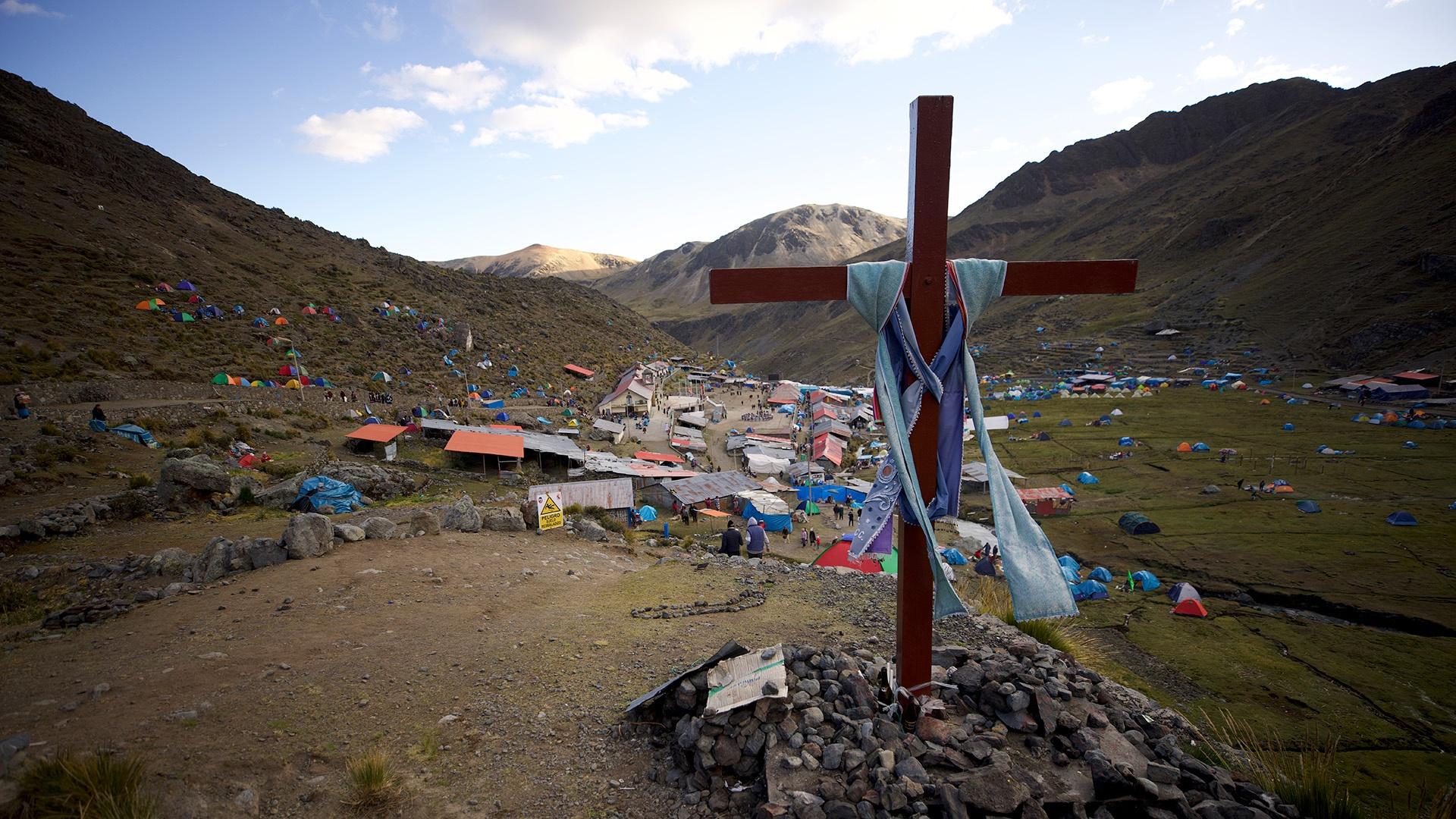
[wind blowing] Gulnaz: This is Paucartambo, Peru-- one of eight Indigenous nations that embark on a three-day pilgrimage to honor Seor de Qoyllurit'i, Lord of the Shining Snow.
This ancient tradition pays tribute to the icy mountains that have sustained these communities for generations.
Though it predates the arrival of Catholicism in South America, it's woven into the fabric of Christianity in Peru.
As the pilgrimage fast approaches, Father Mijail offers a quiet prayer, seeking guidance for the physical and spiritual trials ahead.
[Padre Mijail speaking Spanish] Taytacha Qoyllurit'i, nos preparamos para tu encuentro.
Tu conoces nuestras intenciones, tu sabes porque peregrinamos.
Acompaos y haz que en nuestro regreso volvamos bendecidos, compartiendo esa fe con nuestra familia.
Un ao ms peregrinamos, y que dicha poder hacerlo desde nuestro Paucartambo, con la nacin ms Antigua, con la nacin que tiene historia, con todos mis hermanos.
Y nuestro Taytacha nos dijo, "Yo hago nuevas todas las cosas, "transformo la tristeza en alegra, "la soledad en compaa.
Yo hago nuevas todas las cosas."
Y as all vamos.
Soy el Padre Mijail.
Fui enviado a trabajar aqu en Paucartambo, soy de Cuzco, y la Virgencita y nuestro Seor de Qoyllurit'i me trajeron para aqu.
[motorcycle engine running] Estamos ahora en la plaza, la plaza principal de Paucartambo.
Gulnaz: Why is Qoyllurit'i so important to the people of Paucartambo?
[Padre Mijail speaking Spanish] Paucartambo es la nacin ms antigua que peregrina Qoyllurit'i.
Por eso, es de que la, digamos, la importancia de Paucartambo hacia Qoyllurit'i tiene, digamos la fundamentacin de que ellos fueron los primeros que llegaron.
Y a partir de entonces, pues subieron peregrinos, danzantes, y permitieron pues que contine la tradicin 200 aos despus.
Y el color caracterstico de Paucartambo es precisamente el negro y el rojo.
[Gulnaz speaking Spanish] Por qu?
Padre Mijail: Yo he escuchado testimonios, no hay un porqu definitivo-- que se ha ido adoptandose en la figura del ukumari.
El ukumari es un oso.
Entonces el oso tiene un pelaje oscuro y all lo que representa es esta cruz que est en rojo.
Y asi se ha ido asumiendo como colores distintivos de Paucartambo el color negro y rojo... Gulnaz, voice-over: The pilgrimage takes place in the Sinakara Valley at the foot of the Colquepunco glacier.
For the pilgrims, the ice in these glacial basins is sacred.
So, not only are they the dwellings of the gods, but the ice itself is believed to have healing powers.
Going up to the glacier, cutting the ice, they would bring it back down into villages.
It was believed to cure sickness.
It could ward off bad weather, hailstorms, lightning.
It was used for all sorts of things.
But today, as glacial loss accelerates, pilgrims can no longer harvest the disappearing ice.
So, these are hundreds-of-years-old traditions that are being fundamentally altered by climate change, and this is all happening very quickly and very recently.
We're here to meet Jose Luis, a father of three and an elementary school teacher dedicated to preserving local culture and history.
He's also one of the youngest and longest serving leaders of the pablitos, an all-male religious fraternity devoted to the Lord of Qoyllurit'i.
Together with his ukumaris, or dancers, he plays a key role in maintaining order during the festival.
[Jose speaking Spanish] Ya voy a viajar ya 35 aos, viajo desde mis siete, ocho aos, pero para mi es una alegra cumplir como gua de ellos, pero tambin una tristeza que ao a ao que yo pueda viajar, ya no es igual, y es una pena para nosotros.
Gulnaz: Can you show us some photos of Qoyllurit'i and talk a little bit about how climate change has been affecting the pilgrimage?
Jose: Este es el Colquepunco, no?
Todo este nevado es el Colquepunco.
El nevado de Colquepunco, donde todos subimos a la medianoche.
Queremos ver nieve, no?
Ya hace mucho tiempo no la estamos viendo.
Y estos-- en este tiempo, mira, es el nevado.
Pero usted va a ver ahora, mire, poco a poco, la nieve ya est, con el deshielo del calentamiento global... ya est bajando ao a ao.
La inconsciencia a veces digo de la gente del mundo, por todo lo que hacemos, y vemos el calentamiento global que est afectando.
Mira ahora cmo est el nevado.
As lo hemos encontrado.
Ya no hay nieve.
Lo que ha visto usted en las primeras fotos, ya no hay, esto es lo que queda.
[continues, indistinct] Gulnaz, voice-over: I think it's very clear from seeing those photos taken over the years that climate change is having a really significant social and cultural impact.
There's so much pride in those photos, but it was also this documentation, something sacred and beloved that's slowly disappearing.
[people blowing whistles] [indistinct chatter] Gulnaz: A nearly full moon ushers in the final rehearsal for the pablitos and the ukumari of the Paucartambo nation.
[Jose speaking Spanish] Jose: Ser el caporal en una danza es tener muchas responsabilidades con el grupo.
Lo hacemos con mucha fe y devocin, que es al Seor de Qoyllurit'i.
Me siento muy orgulloso de ser el caporal de ellos a quien les conozco de muchos aos, y yo creo que si nosotros dejamos este legado a nuestros menores y que sigan transmitiendo ellos de generacion en generacion, nunca se va terminar.
Van a ser los futuros ukumaris o pablitos quienes van a guiar al ukumari, no?
[whistle blowing continues] [man singing indistinctly] [firework whooshes and explodes] [Padre Mijail speaking Spanish] Nos vamos a poner en pie, queridos hermanos, para iniciar nuestra celebracin, diciendo juntos, "en el nombre del padre, y del hijo, y del Espiritu Santo.
Amn."
Que nuestro Seor de Qoyllurit'i en esta noche nos conceda el discernimiento de ver nuestra vida, para ir preparando nuestro peregrinar, para ir preparando nuestra subida hacia el santuario.
Yo se que tenemos nuestra tradicin de peregrinar, pero que sea este ao un motivo en particular para poder llevar un propsito.
Por quien quieres peregrinar?
Para que quieres peregrinar?
Para mi, subir al Seor de Qoyllurit'i siempre es una experiencia distinta cada ao.
Es un cansancio fsico, si, pero all el sonido de la msica nos animan a dar un paso ms.
Y la experiencia del encuentro con el Seor, de escuchar los cantos, de estar en medio de la naturaleza es una experiencia integralmente gratificante.
Aprendamos e intentemos a hacer respetar la casa de nuestro Seor de Qoyllurit'i.
Un abrazo de paz.
Amn.
Si uno se adentra a conocer que significa Qoyllurit'i: Qoyur es resplandeciente, luminoso, y Rit'i es el nevado, la nieve.
Entonces cuando uno pregunta, "Quien es este Seor de Qoyllurit'i?"
Tiene que ver con esta nieve resplandeciente, es el Seor de la nieve resplandeciente.
Sin nieve, sin ese Rit'i, el Seor de que ser?
Gulnaz: We are at the beginning of the pilgrimage route up to Qoyllurit'i.
There are already tens of thousands of people up at the main camp, and over the next two days, tens of thousands of more people will come up and down this path, carrying their hopes, prayers, and dreams up to the Lord of Qoyllurit'i.
It's a 5-mile trek that climbs to over 15,000 feet in elevation, and it's sort of the great equalizer.
You're in a place where the air is thin, the road is long and narrow, and you're breathing in dust.
And you just have to persevere.
It's physically and emotionally taxing.
But through that exertion is how you come closer to the apu, or the mountain spirit, and also to God, to the creator.
[music playing] Gulnaz: We've arrived at Qoyllurit'i camp.
It's an absolute explosion of sound and color, hundreds of different communities from across the Andes have come together to express their devotion to the lord of Qoyllurit'i.
And this is nonstop.
So, 24 hours a day, the singing, the dancing, it goes on all night long.
Even when temperatures drop below freezing, people are out here celebrating and expressing their devotion to their faith.
If anyone is acutely aware of climate change, it's the people living in the Andes.
Agriculture in the region is almost wholly dependent on glacial ice and snow melt for its water supply.
But this basin, the Sinakara Valley, which was once almost covered in snow during Qoyllurit'i, is now barren, except for the ice barely clinging to its peaks.
[indistinct chatter, church bells ringing] [Juanita speaking Spanish] Mi nombre es Juanita.
Aca vine a prender la vela para pedir, para que les cuide.
Hay velas de todo.
Para amor, paz, negocio, para alma bendita, para el Seor.
Yo ms que todo pido para mis hijos, para mi salud, para que cuide toda mi familia, no?
Y ms que todo vengo a confesar mis pecados.
Cuando haces con fe, si se cumple.
Gulnaz: A majority of Latin America is Catholic.
The same is true for Peru, but they practice their faith in an entirely different kind of way.
And that's because these traditions are really informed by these old Andean rituals.
And there's a powerful tradition of syncretism here.
So, it's really an entirely different kind of Catholicism that you don't see anywhere else.
[singers vocalizing] Gulnaz: If the candlelit sanctuary represents the most Catholic aspect of the pilgrimage, the next day and night showcase its most traditional elements.
[singers vocalizing] Gulnaz: Uniquely, only the pablitos and the ukumari from Paucartambo are allowed to embark on its final and most grueling stage.
[musicians playing seashell horns] [Jose speaking Spanish] El da Lunes que llegamos al santuario, Paucartambo, cundo llega, inicia la procesin.
Si Paucartambo no llega, no inicia la procesin porque Paucartambo es la primera nacin y tiene que sacar al Seor en andas.
Caminamos durante 24 horas, el da y la noche.
[fireworks popping] Siempre se ha hecho eso.
Toda la vida se ha caminado...a la medianoche.
Siempre hemos subido, no?, demostrando siempre lo fuerte que es el oso.
Y anterior, antes antes, bajbamos con bloques de hielo, no?, porque haba bastante.
Todos los ukumaris con su hielo.
Claro, yo cargaba mi hielo, hacia todo lo que... hacian, lo que me han enseado mis ancestros.
Ahora me siento muy triste, no?
Y con mucha pena, porque ya no hay.
[indistinct chatter] [indistinct chatter] [Padre Mijail speaking Spanish] La naturaleza en s misma no es la atencin de los Andinos, o sea, quiero decir, no es nuestra atencin la tierra en s misma, sino la tierra vinculada a lo que produce, a lo que da o al espritu que tiene.
El Apu en s mismo, no es ese cerro que nosotros podemos ver, sino la fuerza que tiene ese cerro.
[Jose speaking Quechua] [Jose continues in Quechua] [Jose speaking Spanish] En la parte espiritual, creo que lo demostramos, no?
Nuestro sincero afecto a nuestro Seor que es Qoyllurit'i.
El Seor de Qoyllurit'i es todo para nosotros, y todo lo que hacemos ac es por el.
Venimos con esa fe Catlica que tenemos nosotros, somos Catlicos todos y venimos a profesar nuestra fe aca.
A rendirle un homenaje plenito a nuestro Seor de Qoyllurit'i, y es por eso que siempre cumplimos estos ritos y tradiciones en usos y costumbres, y lo vamos a seguir haciendo hasta donde nos de la fuerza, que nos de esa salud, que nos de vida.
Gulnaz: When the first rays of sun come up, they kneel towards the rising sun, like the Inca did hundreds of years ago.
And it's a moment where you can really see that syncretism at play-- the combining, the fusion of Catholicism with these age-old Andean traditions, and it's stunning.
[Jose speaking Spanish] Hermanos!
Ukumaris de la Nacin Paucartambo!
[Jose speaking Quechua] [Padre Mijail speaking Spanish] Definitivamente, la naturaleza tiene una importancia muy profunda en la festividad del Seor de Qoyllurit'i.
Se est produciendo esta desglaciacin, y eso es preocupante.
Y nos preguntamos de cada de estos ltimos aos... pero como algn Pablito dijo, "La nieve desaparecer, "el Apu all perder la nieve, "pero el Seor un dia nos llevar "a otro lugar y a ese lugar, iremos bailando."
Gulnaz: The highest and most remote mountains in the Andes have always been places of pilgrimage.
And it's not just because traditionally, they were the homes of the mountain spirits and gods, but also, it's the significance of the glaciers and the ice itself to sustaining life in these communities.
And that was true hundreds of years ago, and it's still true today.
[water splashing] Andean communities and millions of people living downstream rely on the glacial meltwater for both agriculture and clean drinking water.
It makes sense that these pilgrimages still take place up to these sources of life.
The glaciers are life.
But now these communities are struggling to cope with rising global temperatures.
500 miles northwest of Paucartambo is the city of Huaraz.
Here global warming is posing a dual threat to its 120,000 residents... a shrinking supply of freshwater and the constant risk of catastrophic flooding.
[Edson speaking Spanish] Yo me llamo Edson Amrico Ramrez Henostroza.
Soy especialista de la jefatura del Parque Nacional Huascarn, especficamente en la gestin de riesgos.
Proceso el cambio climtico, los glaciares estn perdiendo masa.
Al perder masa, ocurre lo siguiente, que la acumulacin es menor que antes, por lo tanto hay una ventaja a favor de la seguridad, que hay menos probabilidades de avalanchas de placa.
Pero al mismo tiempo en que perdemos acumulacin, es decir que comienza a salir hielo y ya no tenemos capas de nieve, sino trozos de hielo, comienzan a aparecer avalanchas de seracs.
Seracs son bloques de hielo que una vez que pierden sostenibilidad donde estan ubicados terminan cayendose abajo.
Se est dando con ms frecuencia estas avalanchas de bloques, avalanchas de seracs.
El Parque Nacional Huascarn es un rea natural protegida que enmarca, ms o menos, al 90% de la Cordillera Blanca que es la cordillera ms grande de todas las que existen en el Per.
En el Per existen 18 cordilleras nevadas, pero esta, la que est adentro del Parque Nacional Huascarn, es la ms grande, es la que tiene la mayor cantidad de montaas de 6,000 y de 5,000 metros y es la que engloba la cordillera ms alta de todo el trpico mundial.
Gulnaz: In 1941, this was ground zero for a massive block avalanche that devastated Huaraz.
[sound of rocks falling] I'm here to meet Edson Ramirez to learn more about the ongoing threat facing the city below.
[indistinct conversation] Can you tell me a little bit about where we are and what we're looking at?
Edson: A ver.
En 1941, aqu haba una laguna que ahora ya no est, que ya no existe.
Se llamaba Cochajirica y tena no mucha agua, era pequea, pero recibi el impacto de Palcacocha, que si era una laguna grande, que tenia mas o menos 5 millones metros cbicos de agua.
Al juntarse el agua de Palcacocha y de Cochajirica, rompi el dique que haba ac y todo eso fue impulsado hacia Huaraz, todo hacia Huaraz.
Y eso se podra repetir nuevamente, porque Palcacocha era pequeo hace muchos aos, pero con el proceso de cambio climtico ha ido creciendo, porque el glaciar ha ido desapareciendo.
Al ceder el espacio del glaciar, la laguna ha crecido, y ahora tiene aproximadamente 15 millones de metros cbicos de agua.
Entonces si todo esto se va hacia Huaraz por un temblor, un terremoto, una avalancha... toda el agua se va hacia Huaraz, esto significara que posiblemente entre el 20% y el 30% de la ciudad podra verse muy afectada, y eso son miles de personas.
Esa es la realidad actual de Palcacocha.
Y aqu puedes ver la... [continues, indistinct] Gulnaz: Lake Palcacocha is a glacial lake that sits above the city of Huaraz, which is a densely populated city here.
And there are multiple dangers at play.
The first is the possibility of a glacial lake flood outburst, and these outburst floods can be incredibly violent.
They can kill tens of thousands of people, wipe out entire cities in a flash.
[loud splash] So, the entire city of Huaraz is at risk.
And the risk isn't just theoretical.
The 1941 outburst caused untold damage.
Around 5,000 people died, and that's when Lake Palcacocha was only a third of the size it is now.
Today, the glacial lake hangs like the sword of Damocles over the city.
[Edson speaking Spanish] Te quiero mostrar aqu un sistema que la Unidad de Glaciologa aprob como parte de las acciones para bajar el riesgo.
Se llama sifonaje.
La idea es que estos tubos que ves aqu, aqu estamos viendo el final, vienen desde la laguna.
Lo que hacen es captar el agua, y por la propia fuerza del agua, sacarla de la laguna y llevarla hacia la parte baja del Valle, no?, de la quebrada.
Esa es la idea-- que haya menos agua lo mas rpido posible.
Esa es la solucin que se encontr por ahora y esto funciona ms o menos hace 10 aos ya.
[Gulnaz speaking Spanish] Pero no es una solucin permanente.
Edson: Exacto.
Gulnaz: Como un Band-Aid.
Edson: Asi es... es una solucin, una pequea solucin.
Una pequea solucin.
Es por eso que se necesita algo ms grande para resolver el problema, desaparecer el riesgo.
Gulnaz: Y esta es agua limpia para Huaraz, s?
Edson: S, ese es el otro tema, no?, de que el agua de Palcacocha, el agua de toda la quebrada de Cojo es agua de mucha calidad para la necesidad de la gente.
Es agua que sirve para el consumo humano, agua que sirve para la agricultura, y agua que sirve para la ganadera.
Es muy buena agua, entonces el otro problema es ese, no?
No la podemos botar.
Entonces es un doble problema, problema de seguridad pero problema tambin de necesidad de agua.
Gulnaz: So, it's amazing because Lake Palcacocha, it looks so calm and serene but it's actually this really destructive force of nature.
And I can see already here how much of the glacier has receded, how much rock is exposed.
[Edson speaking Spanish] Aqu entran las mangueras a la laguna y aqu absorban el agua.
Puedes ver que el nivel del agua est mucho menor que el diseo natural.
Esto demuestra que funciona el sistema, pero es un sistema, como te dije antes-- una pequea solucin para un gran problema.
Edson: Y yo hace tiempo que no vena, ms de un ao posiblemente, y me sorprende los cambios que estoy viendo, veo cambios muy, muy fuertes en los ltimos aos.
El Ranrapalca, la ltima vez que vine, tena un montn de nieve, y ahora lo veo totalmente rocoso y me sorprende que el cambio sea tan radical.
Quizs para ti ahora es una sola imagen, para nosotros son muchas imgenes en muchos aos, no?, muchos cambios radicales.
Gulnaz: And Huaraz isn't the only place at risk.
Across Peru's Cordillera Blanca, around 50 glacial lakes are being closely monitored.
Engineers have estimated that protecting Huaraz alone would cost 4 million dollars.
That means addressing the risks of all outburst floods would require exponentially more.
For Peru, securing this kind of funding is no easy task.
[indistinct conversations in Spanish] Gulnaz: So, one local farmer and mountain guide decided to get creative.
With the help of the NGO Germanwatch, he sued RWE, a German utilities giant whose greenhouse gas emissions have long made it a target for climate justice protests.
His legal argument?
That RWE's CO2 emissions not only contribute to global warming but also make it liable.
[Saul speaking Spanish] Mi nombre es Saul Luciano Lliuya.
Soy de Lupa, aqu de Huaraz, hijo de familia de pequeos agricultores y tambin soy guia de montaa.
Siempre crec con esa idea, con esa mentalidad de querer hacer algo de la--aventura, no?, algo parecido y crec, termine el colegio y estudi para guia de montaa.
[bird chirps] Los instructores que eran, bueno, mayores, ellos te contaban cmo era tal montaa, cuanto eran--cmo era el glaciar, cmo eran las lagunas, te contaban ah, y escuchabas, no?
Y, bueno, de ah, cuando frecuentabas ms a las montaas, cada ao que pasaba veas, pues, la diferencia, no?
Cada vez, la montaa y el glaciar iba retirndose y los que trabajabamos ah como guas, como portadores hablbamos de una pena de que est sucediendo as, a los glaciares, y conversando, no?, de que preocupaba la situacin poco a poco.
Bueno, hay que hacer algo, no?
No hay que quedarnos tampoco mirando.
Nos todos sabemos que hay responsables, los del cambio climtico, en este caso la desglaciacin, pues hay que tomar acciones.
[fire crackling] S, a veces tengo miedo, a veces tenso por la preocupacin de la demanda.
Lo difcil de esto es que cuando empezamos, hubo mucho como que criticas, no, criticas como que yo estaba haciendo algo malo.
Bueno, yo--Personalmente, mi idea, la idea estaba clara, de que yo estaba con la demanda, estaba responsabilizando a los causantes y nada ms eso era.
Gulnaz: Climate scientists from the Universities of Oxford and Washington estimate that RWE is historically responsible for 0.5% of the world's carbon emissions.
So, Saul is suing them in a German court for $20,000, or 0.5% of the $4 million needed to protect Huaraz.
Saul's lawsuit is a potentially precedent-setting case, one in which a multinational corporation may be held financially accountable for its environmental impact on a developing nation.
[Gulnaz speaking Spanish] Hola, Saul.
[Saul speaking Spanish] Hola, Gulnaz.
Buenos das.
Gulnaz: Buenos das.
Both: Cmo ests?
Saul: Bien.
Pasa.
Pasa por aqu.
Saul: Asiento.
Gulnaz: Buenos das, seora.
Es mi esposa.
Gulnaz: Mucho gusto.
Mucho gusto.
Saul: Aqu.
[cat mews] Sientate, ah est mi gato... Gulnaz: Como se llama?
Saul: Minchi.
Gulnaz: Minchi.
[Saul chuckles] Saul: Vamos a comer un poco de chirimpu.
Bueno, a ver, prueba, es una mezcla de los granos.
Gulnaz: Gracias.
[indistinct conversation in Spanish nearby] Both: Muy bien.
Mm-hmm.
So, what kinds of changes have you been seeing on the farm in the last few years?
[Saul speaking Spanish]: El futuro de la granja preocupa ms que todo porque, por las montaas que vemos cada vez menos glaciar, y pensamos que vamos a tener poca cantidad de agua y esto afecta, pues, a la agricultura.
Sabemos que a veces hay aos que llueve normal y hay aos que no llueve... hay aos que se adelanta o se atrasa, y no hay lluvia, no estamos-- el canal de regadillo, y si no hay suficiente agua en las montaas, pues, eso preocupa.
Saul: Pensamos, no?, como toda familia... piensas en tus hijos, en su futuro, que es lo que van a comer nuestros hijos, que es lo que van a tomar, que agua van a tomar, que futuro les viene.
La montaa es, pues, para nosotros, para los agricultores es como una fuente de agua para la agricultura, para tomar agua, agua fresca, agua limpia, no?
Y tambin como gua de montaa es, pues, como nuestro area de trabajo, entonces es...para mi, la montaa es, bueno, casi todo, no?
[Edson speaking Spanish] No vamos a poder recuperar los glaciares que se estn perdiendo, pero yo creo que s podemos garantizar que la gente pueda tener todavia calidad de vida y vivir bajo sus mismas costumbres.
La naturaleza es super resiliente, pero para que comience a recuperarse, tenemos que frenar el mal uso que le estamos haciendo.
Gulnaz: Everywhere in Peru, the old coexists alongside the new.
There are modern cities built right alongside 500-year-old Inca ruins.
And the Incas, they were known for being genius engineers.
And it's because they understood this really important relationship of reciprocity between humans and nature.
So, everything that they built was constructed with that in mind.
And what's really remarkable is that these structures are still being used today-- the irrigation systems, the agricultural systems that they built.
So, I think the solutions that we're actually looking for are already all around us.
They're in the past, and those are in Indigenous knowledge, in wisdom that has really withstood the test of time, solutions that work with nature instead of against it.
Man: Well, the Andes have lost over 50% of glacier cover in the last 40 years or so.
When we talk averages, like, you know, 50% or 40% of the glaciers in a particular country have been lost, that doesn't let you see the fact that many, many, tens of smaller glaciers have been lost, and, of course, the impacts that already has on people.
So, we're entering into a new phase in which people will not be able to depend as much on the water that comes during the dry season from glaciers.
I'm Jorge Recharte.
I'm an anthropologist and a member of the Mountain Institute in Peru, Instituto de Montaa.
In Latin America, the number of people that depend on glaciers, either directly or indirectly, is around 70 million to 90 million.
In Peru, the percentage of people that depends on glaciers may be around 80%.
Because most of the people are in the coast, and all the water in the dry coast comes from the mountains.
So, in Peru, it's nearly 20 million people that depend on water from the glaciers.
The loss of glaciers affects mountain communities in many ways.
The first impact: less, you know, water available in their water springs, in their rivers.
Then you also have the problem that when glaciers are lost, the rocks that sit under the glacier usually have minerals, and when they're exposed to oxygen, then they begin to produce very acid water.
There are places where they cannot use their irrigation canals anymore, and so it's very severe, the impact of losing glaciers and the quality of water.
With the loss of glaciers, their mountain communities have been rediscovering some very interesting and powerful ancient technologies for the management of water in these high-altitude areas.
These ancient, ancestral technologies hold wonderful examples about how to adapt in mountain regions of the world.
Not just the Andes, but this has implications for many other mountain regions in the planet.
One of the most wonderful and interesting places where this is happening is the community of Quispillaccta.
[woman speaking Spanish] Que es nuestro propsito mximo?
Eso de compartir, no?
O tambin de tender puentes entre el conocimiento tcnico, cientfico, y el conocimiento local, no?, de los pueblos originales... Gulnaz: Magdalena Machaca Mendieta is an engineer from the community of Quispillaccta.
And when she was younger, violence broke out in the region in the '80s and the '90s.
And her father sought permission from the community to send his daughters, including Magdalena, to school in the city.
And that was because at the time, women often stayed home.
They were tasked with taking care of the household and the land.
So, this was a big deal for him to send his daughters.
Magdalena took that education and adapted it into the context of her community.
And what they did is they studied ancient ancestral technologies, technologies that she had heard stories about from her grandfather down to the types of clay that were used hundreds of years ago in water storage systems.
And they constructed these lagoons in order to store and keep rainwater.
We're with the community of Quispillaccta to meet with Magdalena Machaca Mendieta, and she is leading a project to make these human-made lagoons which have replaced the water source because their glaciers all melted within the last 30 to 40 years.
[Magdalena speaking Spanish] Nosotros somos chacareros.
Sembramos para cosechar y comer.
Eso es lo que vamos a hacer con el agua, que es el elemento muy, muy escaso en esta poca.
La construccin de lagunas de siembra y cosecha de agua de lluvia es identificar en el territorio vasos naturales, hondonaditas en la que naturalmente, en la temporada de lluvia, aunque sea un poquito de agua, lo recepciona.
Pero esas aguas siempre se pierden, pasa la temporada de lluvia, no queda nada, no?
Pero si tiene una funcin natural, que es infiltrar el agua a las profundidades de la tierra, tcnicamente se llaman los acuferos.
Entonces la construccin de lagunas de siembra y cosecha de agua de lluvia es tapar ese dique, esa garganta de ese vaso, no?
Como lo tapamos?
Con arcilla, con piedras, pero respetando la forma que deja, o sea la huella del agua, no?
Porque el suelo, millones y millones de aos se ha formado, no?
Gulnaz: A local seaweed that hosts a diverse population of microbes and fungi is used to line the bottom of the lagoons and stabilize their ecosystems.
Fish are also introduced, which not only serve as a community food source, but whose waste products help seal the base of the lagoon.
[Magdalena speaking Spanish] Hasta ahora, en todos los distritos a la cual nosotros apoyamos, ya son mas de--ya son 205.
No solamente beneficia a la poblacin local-- miren este aporte del pueblo.
Y eso beneficia a ms de 250,000 habitantes de la poblacin Ayacuchana para consumo humano.
El otro beneficio es agricultores de la cuenca media de Cachi y cuenca baja, son mas de 9,000 usuarios agrarios que reciben 67 millones de metros cbicos de agua.
Ese es el gran aporte de este proyecto del sistema de siembra y cosecha de agua de lluvia.
Gulnaz: Magdalena and her community in Quispillaccta invited us to join a pago.
Pago is a payment to the Earth, an offering.
Magdalena, she's an engineer, but she and her entire community believes that the success of the lagoons is not only about engineering expertise, it also depends on ritual and ceremony and maintaining those things.
[Magdalena speaking Quechua] [conversations in Quechua] [Magdalena speaking Quechua] [indistinct chatter] [horns blowing] Gulnaz: Magdalena, can you explain to me what all these different pieces of the pago mean?
[Magdalena speaking Spanish] Hemos trado, para la ofrenda a Yacumama, este--apacheta.
Agua tiene pasin, pero tambin, este, tiene preferencias en frutas.
Estas son frutas del agua para que el agua siempre existe regenerando.
Eso es lo que hemos trado.
Diversas frutas, pero frutas de agua, no frutas secos, jugosas.
Tambin entendemos que esta laguna tiene su boca que es aca, y si tiene boca, estamos entendiendo de que es una persona.
No un ente vivo, sino una persona que tambin tiene preferencias.
Come, bebe.
Salud.
Desde la visin, este, de la ciencia tambin el suelo es un ente vivo, pero ese reconocimiento es que en el suelo hay microorganismos, hay una poblacin viva, no?
Pero es desde ese ngulo.
Pero desde la poblacin indigena, originaria, es vivo porque es persona.
Nosotros somos hijos de pap y mam, pero tambin somos hijos de la Madre Tierra.
[musicians blowing horns] Es autodefinirnos, quienes somos.
[Magdalena singing in Quechua] Soluciones bien concretas a un tema, en este caso, es mundial.
Y as lo hemos escalado ya a otros distritos, a otras provincias, y es una poltica pblica para Costa Rica.
Actualmente tenemos un proyecto tambien bi-nacional Per-Guatemala para escalar esta experiencia a un pueblo indgena K'iche'.
Gulnaz: In high mountain communities struggling to cope with the loss of their glaciers, Magdalena has developed a scalable life-sustaining solution.
Today, it's being adopted across the Andean region and even Central America.
For the first time in history, we are facing a future without glaciers, and glaciers are the water towers of the world.
They provide nourishment for billions of people in the surrounding communities and downstream, from the Himalayas to the Andes.
And losing the glaciers is a profound loss not only because they support basic human life-- food, water-- but also because our cultural and spiritual traditions for centuries are so deeply tied to these places.
The Peruvian Andes, these communities, their resilience, their pride, the way they honor their culture, it gives me a lot of hope that we can solve the climate crisis, and it's not necessarily about looking to modern, fancy technologies, it's about looking into the past and honoring our heritage, honoring where we came from, our relationship of reciprocity with nature.
[Padre Mijail speaking Spanish] Y quizs sea prudente en un tiempo, pero aprendan a reconocer de que juntos podemos hacer mucho.
Pues, a lo mejor no vamos a poder revertir todos los daos que hemos hecho, pero estamos a tiempo de que unidos, juntos como hermanos podemos mejorar esta casa que Dios nos ha dado.
Abran los ojos, miren lo que le rodea, y aprendan a reconocer en esa Creacin lo divino que hay.
This program is available with PBS Passport and on Amazon Prime Video
Search Episodes

Donate to sign up. Activate and sign in to Passport. It's that easy to help PBS Wisconsin serve your community through media that educates, inspires, and entertains.
Make your membership gift today
Only for new users: Activate Passport using your code or email address
Already a member?
Look up my account
Need some help? Go to FAQ or visit PBS Passport Help
Need help accessing PBS Wisconsin anywhere?

Online Access | Platform & Device Access | Cable or Satellite Access | Over-The-Air Access
Visit Access Guide
Need help accessing PBS Wisconsin anywhere?
Visit Our
Live TV Access Guide
Online AccessPlatform & Device Access
Cable or Satellite Access
Over-The-Air Access
Visit Access Guide




Follow Us