

 Passport






This video is no longer available.
Rick Steves Europe Awaits
06/03/21 | 1h 16m 34s | Rating: NR
Travel lovers are dreaming of where they'll go post-COVID. In this special, Rick Steves visits some European favorites he'd love to see when we can travel again. Rick shares a montage of travel delights: Sicily, Mykonos, Porto, the Cotswolds, Tuscany, and Romania. It's an adventure with remote beaches, gourmet food, and an English hike; Rick even drops in on an eccentric lord and a Tuscan pig farm


Copy and Paste the Following Code to Embed this Video:
Rick Steves Europe Awaits
Hey, I'm Rick Steves. And like you, I've been pretty much locked down for the last year. In fact, for the first time in 30 years I've been unable to travel to Europe to make our shows for public television. We've all been dreaming about traveling again once this pandemic is history.
To stoke those travel dreams, we've assembled an amazing journey. For the next couple hours, we'll be travel partners, you and me. We'll explore Sicily, Mykonos, England's Cotswolds, Northern Portugal, Tuscany, and the remote corners of Romania.
Our theme
Europe Awaits! We'll start in Sicily. If you like Italy, I like to say, "Go further south, it just gets better." We'll join a Capuchin monk for a coffee named after him, a cappuccino. We'll feast on Sicilian treats.
Holy cannoli! And we'll see vividly why an Italian word I learned on that island is indimenticabile-- unforgettable. Thanks so much for joining us. Now, let's go to Sicily!
Like so much of Sicily, Syracuse has ancient Greek origins. The great city-states of Greece were expansive, searching the Mediterranean for more fertile lands. Athens and Sparta dominated, but lots of other Greek cities, like Corinth, were establishing colonies as well. These new settlements created a broader Greek culture, known as Magna Graecia, or Greater Greece.
Greek culture flourished here in Syracuse. Founded in 732 BC by the Corinthians, it grew to become an even greater, more important city than Athens. In fact, Syracuse eventually defeated the Athenians in battle in this very bay. The Temple of Apollo, marking the center of old Syracuse, was the first stone Greek temple in Sicily.
It dates from 600 BC. And Syracuse nurtured the brightest minds of the ancient world, like Archimedes. The inventions of this scientist, physicist, philosopher, genius from the third century BC helped his hometown defend itself from invasions. Modern Syracuse sprawls across the mainland, but the city was born on the fortified island of Ortigia.
That's where you'll find many of the ancient sights and most of the medieval charm. With its shabby-chic vibe, delightful back lanes, and breezy sea views, old Syracuse is for me the most enjoyable urban environment anywhere in Sicily. Just a generation ago, Ortigia was a rough and unwelcoming zone, almost empty of commerce. And today, stoked by its influx of tourism, it has a bohemian energy that fills it with a joyful and relaxed ambiance.
The long and narrow side lanes are part of a street plan dating way back to ancient times. Balconies festooned with laundry are reminders that this is still a real neighborhood. I always say, "If you like Italy, you'll love Sicily," and I especially feel that in its markets.
man speaking Italian
Our theme
Each morning this street hosts a lively fish and produce market. This shop is jam-packed
for its beloved specialty
jam-packed panini. To be sure we maximize the delights of our Sicilian experience, I'm joined by my friend and fellow tour guide, Alfio Di Mauro. And Alfio is expert at connecting with the local characters.
ALFIO
Guarda, guarda, Rick.
RICK
Nice!
ALFIO
Buongiorno, Angelo!
ANGELO
Ciao! Ciao! Come stai?
ALFIO
Ti presento-- bene!--ti presento Rick.
ANGELO
Grazie! Angelo.
RICK
Piacere, piacere.
ALFIO
The swordfish... Angelo always has the best swordfish. Yeah, he just caught it. This was used until not long ago to make needles to mend the nets.
RICK
Oh, for knitting the nets together?
ALFIO
Yes. And even to do knitting needle.
RICK
This is really remarkable!
metal clanking
ALFIO
It's very resistant.
Look at that. ALFIO
Very resistant.
RICK
Ancora. Wow!
ALFIO
And when you have fresh fish like this, the meat is delicious.
RICK
Fantastic. Angelo!
ANGELO
Si?
RICK
Buon lavoro.
Grazie. RICK
Okay. Ciao.
ALFIO
Grazie, Angelo. Bravissimo, bravissimo.
ANGELO
Bye-bye! Ciao!
ALFIO
Bravissimo.
RICK
Sicily is brutally hot in the summer. I like to visit in spring or fall. And even in April, when we're here, a stop for a drink at the kiosk can be really refreshing. What's this?
ALFIO
It's a specialty. Ciao!
Buonasera. RICK
Ciao! Buonasera.
ALFIO
Due seltz limone e sale.
RICK
So, what is the name again?
ALFIO
It's a refreshing drink. It's seltzer, lemon, and salt.
RICK
Okay. Good.
ALFIO
Ideal in the summer. Molto rinfrescante, very refreshing. Then, with a spoon... salt.
Rinfrescante.
RICK
Rinfrescante.
ALFIO
Perfetto!
RICK
All right.
Grazie. RICK
Grazie. Mmm.
RICK
Nearby, the faade of the cathedral provides quite a contrast. Built in the 18th century, it was inspired by the great Baroque churches of Rome, but amped up with a Sicilian architectural razzle-dazzle. The apostles Peter and Paul greet you at street level, while Mary blesses all from above. Stepping inside, you see the church is a lot like Sicily itself, a layer cake of civilizations.
It was built into an ancient Greek temple. The temple's 2,500-year-old colonnade survives as part of the church's walls. And because a pagan temple had no transepts, neither does this church. The fine workmanship of the capitals survives from ancient times.
In Sicily, you hear the same basic story of the parade of civilizations over and over-- ancient temple, church, mosque, church. Here in Syracuse, this was originally a Greek temple built to honor Athena. Then, a thousand years later, with Byzantine rule, the temple was made into a church. Next, in the ninth century, the Arabs sweep in from just over there in North Africa.
Christians out, Muslims in, and it became a mosque. Then it's a church again as the Normans from France conquer Sicily in the 11th century. After a huge earthquake hit in 1693, the cathedral was rebuilt in today's super-charged Baroque style. Whew!
The cathedral square, or Piazza Duomo, is a mish-mash of architectural styles. It serves as a delightful stage upon which the story of this community plays out. Its graceful semi-circular design is a Baroque trick, designed to give the feeling that this is a theater for life in this community. It's the gathering place of the town, a magnet for all generations.
On one of the nearby narrow streets, Alfio is treating me to something I haven't seen since I was a kid. Puppetry is a strong tradition here in Sicily. This theater company puts on nearly nightly performances. Its young troupe of puppeteers takes their art seriously.
The marionettes are lovingly made and true to tradition.
drumming
RICK
The puppeteers skillfully bring the characters to life as the plot unfolds.
man speaking Italian
RICK
The melodrama of an old Sicilian tale fills the theater, captivating its audience as this folkloric art form has for centuries.
actor speaking Italian
RICK
The ancient Greek city of Syracuse is long gone. But wandering through its scant remains in the city's archeological park, you pick up hints of its former power. At its peak around the fifth century BC, Greek Syracuse had roughly
the same population it has today
over 100,000 people. It was the dominant military and economic power in this corner of the Greek world. With a commanding harbor view, the ancient Greek theater originally sat 15,000. While it dates from 500 BC, it's still in use today.
The terrace above the theater functioned as a grand lobby, covered by a wooden roof and decorated with fine statues. The waterfall is part of an aqueduct, a man-made underground river carved out of the rock allowing fresh water to flow 15 miles from a mountain spring into the city. The stone that built ancient Syracuse was quarried on site by enslaved prisoners of war. Today that quarry's overgrown with lush vegetation, and, while it's called the Garden of Paradise, it's filled with tragic memories.
It's easy to forget when marveling at these ancient theaters and temples that slave labor quarried and carried the stones that made it all possible. Back then, many soldiers willingly fought to the death because they knew that life as a prisoner of war or slave was even worse. The quarry was like a huge underground concentration camp, a hellish place where slaves lived out their miserable lives cutting stone. Gazing at the one tower of stone still standing, imagine that this was a pillar helping support the roof of a giant man-made cavern.
That roof collapsed with an earthquake in 1693. A surviving quarry cavern is nicknamed the Ear of Dionysus. Venturing in, you can still see the chisel lines showing how it was cut, over the generations, from the top down. A car is handy for exploring Sicily.
Once in the countryside, traffic is sparse. Autostradas are top quality and make getting around faster and less stressful than smaller roads. While most of Italy's super-freeways come with tolls, Sicily's are generally toll-free, one of many economic subsidies from the more prosperous Northern Italy. We're heading across the island, and we're breaking our journey near the south coast at an agriturismo, an upscale B&B nestled in an olive and almond orchard.
Here in Italy, working farms with rooms to rent are called agriturismos. Across Europe small farms supplement their income by renting rooms to travelers seeking a rural refuge from fast-paced urban scenes. The Mandranova estate comes with a rustic but elegant dinner, offering a great chance for travelers to share stories from the road. And we cap our day enjoying a convivial atmosphere, where, under palm trees and stars, our host enjoys sharing his olives and almonds while getting to know his guests.
Our next stop is Cefal, beautifully situated on the north coast. Cefal is Sicily'sbr/most romantic port town. With a golden crescent beach and sitting safely under its dramatic rock still capped by a fortress, Cefal cradles its past in a way that's easy to enjoy. Since the town was founded, its streets have lined up with the prevailing wind to catch the cooling breeze.
And, to this day, laundry flaps in that breeze. And for a thousand years whether ruled by Arabs, Normans, French, or Spanish, the women of the town gathered here on these very stones to scrub their laundry. In Sicily, there's history everywhere. In the 11th century, Sicily's Arab rulers were booted out by the Normans from France.
This cathedral is Norman. Built to double as a fortress, it's crenellated like a castle and it comes complete with slits for shooting arrows. Inside, columns that 2,000 years ago supported a pagan Roman temple now support Norman arches. They lead to a serene mosaic portrayal of an Orthodox Christ.
During this complicated age, it was intentionally Eastern in style to help make Norman rule easier for locals to accept. Here in Cefal, like anywhere in the Mediterranean, early evenings bring out a parade of people. It's like cruising without cars. A multi-generational scene, from families to grandparents.
Old-timers remain part of the action. And anyone's attention can be hijacked by tempting window displays. All this strolling stokes my appetite, and we're ready for some Sicilian cuisine.
ALFIO
Buonasera.
RICK
Here, surrounded by the Mediterranean, menus are rich in seafood, and courses come in waves. After the appetizers, or antipasti, the first course, or primi piatti, is generally pasta. Grazie. We're having spaghetti with clams, risotto with mussels on flat bread,
and the Sicilian favorite
pasta with sardines. The second course, secondi, is our entre, and no surprise, it's more seafood. Fresh local shrimp, calamari, and swordfish rolls. And, while I'm certainly enjoying my calamari, I'm not above a little shrimp thievery to make sure I enjoy everything Cefal br/has to offer.
One of Sicily's quirkiest charms nearby in the city of Palermo is in a crypt below its Capuchin monastery. The Capuchins, a branch of the Franciscan order, have a passion for reminding people of their mortality. Historically, when their brothers died, their bones were saved and put on display. The Capuchins of Palermo
took this tradition a step further
Rather than just saving bones, they preserved the bodies in their entirety. Back in the 16th century, the monks here found that this particular crypt preserved bodies almost miraculously. They later realized that they could actually charge wealthy parishioners for the privilege of being mummified here with their brothers. And this helped raise money to support their monastery.
This maze of corridors contains thousands of skeletons and mummies dressed in the clothing of their choice.
Each area features a different group
Monks in their brown robes, women with their favorite dresses, priests with their vestments, soldiers still in uniform, and children looking almost as if taking a long nap. The oldest body, brother Sylvester has been hanging here since 1599. One of the brothers gave me a lovely little sermon. He explained that our time on Earth is short, and what really matters is what comes next.
These bodies without souls, as they call them, are a reminder that we're all mortal. For this monk, being with all these bodies brought him great joy and peace, as it caused him to focus not on our earthly existence, but on eternity. Today the public's welcome to wander thoughtfully through these halls of haunting faces, which seem determined to tell us a truth that perhaps we've yet to learn.
steam hissing
Each area features a different group
I'm not quite ready for a Capuchin crypt, but I could go for a Capu-ccino. And I'm joined by my Capuchin friend, who, in good Franciscan style, enjoys embracing the moment as well. So, we have the same color?
BROTHER
Yes, same color. This...
Brown. BROTHER
Brown.
RICK
And the white, and the robe. So, we've got the white and the brown. Enjoy.
chuckles
RICK
A gondola carries us above Trapani, to the mountaintop fortress town of Erice. This stony town was protected by an imposing fortress, recalling a time when its strategic location was worth the climb. The stout medieval gate leads into a remarkably preserved old town. While a touristy shell today, the town is fun to explore.
The church, like everything else here, is a stony gray. But as we step inside, a late 19th-century interior dazzles visitors with the over-the-top frilliness so typical of neo-Gothic architecture. The main street leads to a humble main square. And hiding deep in Erice is the venerable pastry shop of Signora Grammatico.
Her display case tempts all who enter with its vast array of Sicilian sweets, including, of course, enticing cannoli and colorfully painted marzipan treats. But hold on. Let's not ruin our appetite. Signora Grammatico has prepared a banquet designed so we can enjoy an unforgettable education in Sicilian cuisine.
Indimenticabile. Mille grazie, Signora Grammatico.
SIGNORA
Prego.
RICK
And, complimenti.
SIGNORA
Grazie.
RICK
So beautiful. Alfio, what are we eating here? Just give me a quick tour.
ALFIO
The most beautiful things we have in Sicily. Bruschetta.
RICK
Okay.
ALFIO
With tomatoes and the good olive oil that we grow in Sicily. Rice balls--arancini, filled with meat, deep-fried, a specialty from Palermo. Tabbouleh, a reminder of the Arabs that once were here. Pomodori secchi-- sun-dried tomatoes, a local specialty.
Plenty of sun in Trapani. Stuffed red peppers with breadcrumbs, pine nuts, and pecorino and Parmesan cheese. Local tuna, fished in the islands out here. This is one of my favorites, caponata, diced and fried eggplant.
In Trapani only they put toasted almonds on it.
RICK
Okay.
ALFIO
Caprese salad, red, white, and green, the colors of the flag, a reminder we're Italians.
RICK
This is Sicily, and you even remember.
ALFIO
Even in Sicily. Sometimes we forget.
RICK
Sono molto felice.
SIGNORA
Grazie.
Manco a tutto dire
Mangia, mangia.
ALFIO
Mangia.
RICK
Enjoying this feast with Alfio is a great way to celebrate all we've experienced here in Sicily. And there's so much more with its Greek temples, boisterous markets, Roman mosaics, and glorious churches, all capped by an active volcano, Sicily richly rewards those who venture this far south. From all that tasty Sicilian culture, now we hop a cruise ship to the Greek isle of Mykonos. My crew and I jumped off the ship and filmed the island like crazy all within a one-day cruise stop before sailing on.
Join us now as we see why this many-faceted Greek isle is such a hit with cruisers.
Up next
Mykonos! Mykonos is another small island with a small port inundated by cruise ship crowds. It's so iconic and beautiful that it's included in most major cruise ship itineraries. There's a pier for only one ship, so most ships drop the hook and shuttle their people in by tender.
If visiting by cruise ship, it's smart to get an early start. We caught the first tender, beat the crowds and beat the heat. It's easy to enjoy Mykonos town with no planning, no tour, and no guide. This is a stop which lends itself to unstructured free time, just lazing on the beach, wandering, and browsing the shops.
It's the epitome of a Greek island town
a busy breakwater, fine little beach, and inviting lanes. While tourism dominates the economy, Mykonos still has a traditional charm thickly layered with white stucco, blue trim, and colorful bougainvillea. Back lanes offer tranquility away from the cruise crowds. As in many Greek island towns, centuries ago the windmills of Mykonos have harnessed the steady wind, grinding grain to feed its sailors.
Five mills still stand, perfectly positioned to catch the prevailing breeze. A tidy embankment is so pretty they call it Little Venice. Wealthy shipping merchants built this row of fine mansions with brightly painted wooden balconies that seem to rise right out of the sea. Today these mansions have been refitted as restaurants and bars for tourists enjoying fresh fish and romantic views.
Mykonos' status in the last generation was as a fashionable destination for jet-setters. And it retains a certain hip cachet. These days, tacky trinket stalls share the lanes with top-end fashion boutiques. Prices are high, and, in season, the island is crammed full of vacationers.
But, even with four ships in the harbor today, there seems to be plenty of room. I love how, in the middle of all this modern tourism, the traditional culture carries on. At the tiny church built to bless those who go to sea, a fisherman and his wife pop in for a few meditative moments among age-old icons and flickering candles. Mykonos is small; any point on the island is within a 20-minute drive.
The windy roads feel like a fairground racetrack for tourists, busy with an array of easy-to-rent vehicles. And, like most of them, we're heading for the beach. There's a range of beaches on Mykonos. The most trendy is Paradise, one of the ultimate party beaches in the Aegean.
Presided over by hotels that run bars for young beachgoers, the Paradise action is nonstop. While the beach becomes a raging dance floor after dark, the DJ is busy all day as the cruise set joins backpackers from around the world to enjoy the scene. As is standard around here, beaches rent comfortable lounge furniture with umbrellas. Just plop onto whatever appeals.
Don't worry; the drinks will come to you. If you prefer a quieter scene, the more remote beaches are a short drive farther out. While extremely arid, the stony countryside of Mykonos, complete with whitewashed churches and staggering views is a delight for a quick road trip. Agios Sostis, an old hippie beach at the north end of the island, has none of the thumping party energy of Paradise Beach.
It offers little beyond lovely sand, turquoise water, and tranquility. And, for many, it's their Greek isle dream come true. Along with its beaches, Mykonos offers a major historic attraction. It's on an uninhabited neighboring island a 30-minute shuttle boat ride away.
The island of Delos was one of the most important places in the ancient Greek world, with temples honoring the birthplace of the twin gods Apollo and Artemis. Centuries before Christ, Delos attracted pilgrims from across the Western world. Delos was important
in three different ancient eras
first as a religious site, then as the treasury of the Athenian League-- that was sort of the Fort Knox of the ancient world-- and later, during Roman times, this was one of the busiest commercial ports in the entire Mediterranean. Delos ranked right up there with Olympia, Athens, and Delphi.
Survey the remains of the ancient harbor
foundations of shops and homes, and hillsides littered with temple remains. The iconic row of sphinx-like lions still heralds the importance of the place. This was one of the Aegean world's finest cities. Imagine Delos in its heyday,
a booming center of trade
streets lined with 3,000 shops where you could buy just about anything. Dazzling mansions of wealthy merchants with colonnaded inner courtyards. There were fine mosaics, like this one of the god Dionysus riding a panther. Culture thrived here, enough to keep this theater, which could seat 6,000, busy.
Innovative cisterns collected rainwater. These round arches date from the third century BC. Plumbing ran under the streets, and water was plentiful. Local guides demonstrate still-working wells.
ANTONIS
One of the 200 wells and cisterns in the city, fresh, drinkable water from the rich aquifer underneath us, and it was enough to supply the 30,000 people at the peak of the flourish of the city.
RICK
30,000? So for more than 2,000 years, water has come out of this well.
ANTONIS
You can still drink if you want.
RICK
Very nice. About a century before Christ, Delos was devastated by a terrible war. It never recovered and was eventually abandoned. After 14 centuries of silence and darkness, it was finally excavated in the late 1800s, and today, the ruins of Delos are ours to explore.
I cap my visit by climbing to the summit of the island. My reward? One of the Mediterranean's great king-of-the-mountain thrills. As you observe the chain of islands dramatically swirling in 360 degrees, you can understand why historians believe that these Cycladic Islands got their name from the way they make a circle or a cycle around this oh-so-important little island of Delos.
From Coimbra, we drive a couple hours farther north into the mountains of the interior to explore the scenic Douro River Valley, famous as the birthplace of port wine. The Douro River's steep and twisting valleys, laboriously terraced over the centuries, are ideal for growing grapes. Unlike other great European river valleys, the Douro was never a strategic military location. So, rather than castles and palaces, you'll see farms and vineyards, almost all dedicated to the production of port, the region's beloved fortified wine.
A 50-mile stretch of prime land is home to scores of quintas, vineyards that produce port. Many quintas welcome the public, offering tours and tastings. Visiting a family like this, we enjoy a peek at local life. It's spring, and the workers are busy taming the fresh growth.
In their cellar, the sister, who runs the vineyard, explains how this is just the first stage of a very long process. Tasting the family's finest port, surrounded by their vines, I enjoy yet another chance to appreciate the pride of artisans so passionate about their traditions and craft. The Douro River begins as a trickle in Spain, runs west through Portugal, and to the city of Porto, where it spills into the Atlantic. Porto, the town that gave the country and port wine its name, is the second largest city in Portugal.
And, like second cities throughout Europe, Porto is a hardscrabble town with a rough past. It's recently emerged from a post-industrial funk to become trendy, revitalized with a fresh and creative energy. The city is full of Old World charm. Prickly church towers dot the skyline.
Houses with red-tiled roofs tumble down its hills to the riverbank. Porto's a solid city; it seems made entirely of granite. The main drag, Avenue of the Allies, is named for Portugal's World War I alliance with Britain and America. The wide boulevard, watched over by the huge city hall, is lined with monumental examples of art nouveau and art deco.
As if to counter all the heavy stonework, inviting shopping streets are ornamented with playful architectural touches. There are lots of lovely blue-tiled faades. Churches that are otherwise just more blocky granite are beautified by these fine blue ceramic tiles, called azulejos. And for a closer look, visit the old train station.
Storefronts evoke good times from the early 20th century. Delightful faades decorate venerable cafs, as Porto seems to cling to the style of an age gone by. Porto's romantic riverfront, the Ribeira district, is the city's most scenic and touristy quarter. But before tourism, this was a hard-working port.
As you stroll, imagine the busy port scene here, before this promenade was reclaimed from the river. Cargo-laden rivercraft lashed to the embankment, offloading their produce and wine directly into 14th-century cellars. The old arcades lining the promenade are filled with hole-in-the-wall restaurants and souvenir shops. Behind the arcades are skinny, colorful houses draped with laundry fluttering like flags.
The contrast of today's tourist crowds amid these vivid, authentic neighborhoods is striking. From here, a double-decker iron bridge crosses the Douro River. Inspired by Gustave Eiffel when it was built back in the 1880s, it was the biggest such bridge in the world. Recently its top deck was closed to traffic.
Now it's just people and trams. Across the river is a harbor lined with traditional boats called rabelos. Historically, these cargo boats transported kegs of wine from the inland vineyards down to Porto. The boats have flat bottoms, a big square sail, and a long rudder to help them navigate the twisty and, at times, shallow river.
Facing the riverfront is a district filled with warehouses. These port wine lodges are where the world's port wine comes to mature. Eighteen lodges compete, and most offer tours and tastings. We're visiting one to learn about the wine that put Porto on the map.
After the year-old wine is offloaded from the boats, it ages even longer here in these enormous barrels. This aging, on the cool, north-facing bank of the Douro, takes years, and even decades. And, when the refined and time-honored process is finally complete, the beloved port wine is ready to enjoy. What is the difference between port and red wine that we think of?
MAN
The difference between a port wine and a traditional wine would be the fact that the traditional wine has a complete fermentation, and a port wine is a fortified wine, so you stop the fermentation the second day by adding a really strong wine spirit, brandy, that has 77% of alcohol and kills all the yeasts.
We have mainly two different styles
rubies and tawnies. The rubies, they age in big vats, so they will have little contact with oak, little contact with oxygen. The exact same wine, if you age it in smaller barrels, it will have higher contact with oak, higher contact with oxygen, and the oxygen will change the color. The coloring of tawny is lighter, and, you start to understand, much older, and much more mature fruit.
RICK
After enjoying our tasting, a fine way to cap our Porto visit is on a lazy boat ride. Several companies offer hour-long narrated cruises along the historic waterfront. Here in a city built over the centuries upon the fruit of the vine and the hard work of its people, we ponder the impressive and salty mix that created Portugal. I hope we're stoking your travel dreams.
That last bit sure stoked mine. It took me right back to Portugal; beautiful memories. Yes, Europe awaits, and we're celebrating some of the places I'd love to travel to as soon as things open up. Up next, it's a little bit of Great Britain.
We're exploring England's epitome of quaint, the Cotswolds-- poetic hills, thatched cottages, and lots of sheep. The Cotswold Hills are dotted with enchanting villages and bucolic farmland. And it's all laced together by wonderful trails. This is the quintessential English countryside, and it's walking country.
The Cotswolds are best appreciated on foot, and that's how we'll tour the area. The region's made to order for tenderfeet. You'll encounter time-passed villages, delightful vistas, and poetic moments. You'll discover hidden stone bridges, cut across fancy front yards, and enjoy close encounters with lots of sheep.
The English love their walks and defend their age-old right to free passage. And they organize to assure that landowners respect this law, too. Any paths found blocked are unceremoniously unblocked. While landlords have plenty of fences, they provide plenty of gates as well.
You'll encounter all sorts of gates on these hikes. This one's called a kissing gate, it works better with two. Lower Slaughter is a classic example of a Cotswold village, with a babbling brook, charming gardens, and a working water mill. Just above the mill, a delightful caf overlooks the millpond.
As with many fairy-tale regions in Europe, the present-day beauty of the Cotswolds was the result of an economic disaster. Wool was a huge industry in medieval England, and Cotswold sheep grew the very best. According to a 12th-century saying, "In Europe the best wool is English. And, in England, the best wool is Cotswold." It's a story of boom and bust, and then boom again.
Because of its wool, the region prospered. Wealthy wool merchants built fine homes of the honey-colored local limestone. Thankful to God for the riches their sheep brought, they built oversized churches nicknamed wool cathedrals. But with the rise of cotton and the Industrial Revolution, the region's wool industry collapsed.
The fine Cotswold towns fell into a depressed time warp, becoming sleeping beauties. Because of that, the region has a rustic charm. And that's the basis of today's new prosperity. Its residents are catering to lots of tourists, and the Cotswolds have become a popular escape for Londoners, people who can afford thatched mansions like these.
In England, Main Street is called the high street, and in Cotswold market towns, High Street was built wide, designed to handle thousands of sheep on market days. The handsome market town of Chipping Campden has a high street that's changed little over the centuries. Everything you see was made of the same finely worked Cotswold stone, the only stone allowed today. Roofs still use the traditional stone shingles.
To make the weight easier to bear, smaller and lighter slabs are higher up. A 17th-century market hall with its original stonework from top to bottom intact marks the town center. Hikers admire the surviving medieval workmanship. You can imagine centuries of wheelings and dealings that took place under these very rafters.
Continuing our walk, we come to the quaint village of Stanton. Travel writers tend to overuse the word "quaint." I save it for here in the Cotswolds. A strict building code keeps towns looking what many locals call overly quaint. Village churches welcome walkers to pop in and enjoy a thoughtful break.
This church probably sits upon an ancient pagan site. How do we know? It's dedicated to St. Michael.
And Michael, the archangel who fought the devil, still guards the door. Inside, you get a sense that this church has comforted this community in good times and bad. Pre-Christian symbols decorate the columns, perhaps left over from those pagan days. And the list of rectors goes way back without a break to the year 1269.
This church was built with wool money. In fact, they say generations of sheepdog leashes actually wore these grooves. I guess a shepherd took his dog everywhere, even to church. Throughout this region, a few of the vast domains of England's most powerful families have survived.
The Cotswolds are dotted with elegant, Downton Abbey-type mansions. Today, with the high cost of maintenance and heavy taxes, some noble families have opened their homes to the public to help pay the bills. Stanway House, home of the Earl of Wemyss, is one such venerable manor house. The earl, whose family goes back centuries, welcomes visitors two days a week.
Walking through his house offers a surprisingly intimate glimpse into the lifestyles of England's nobility. And the gracious and likeably eccentric earl has agreed to personally show us around his ancestral home, including a peek at some touching family mementos.
EARL
Hair, cut off a member of the family.
RICK
That was the tradition?
EARL
It was, certainly in this house it was a tradition. And it's kept in this drawer here. And, for instance, this is, this says, "Papa's hair," My sister gave it me March 11, 1771."
RICK
This piece of paper from 1771?
EARL
And then that's the hair inside.
RICK
Oh, my goodness!
EARL
Which is just as fresh as the day it was cut off.
RICK
Whoa!
EARL
And that's his hair. Cut off on the day his wife died of pneumonia.
RICK
So this is a huge table!
EARL
It is; it's 23 feet long.
RICK
And what's the game?
EARL
It's called shuffleboard, or shovelboard. It was known in Henry VIII's time. Um, this one was built, we think, in 1625, just at the beginning of the reign of Charles I. And you use these 10 pieces, um, and you try and...
RICK
Let's try a game!
EARL
...shovel them up to the far end. That's a nice one.
RICK
It may be a game for English aristocrats, but this Yankee commoner is gonna give it a try.
EARL
Very good, very good. One point. Very good. Very nice, but two foot short.
RICK
Another interesting artifact is what was called a chamber horse, a sprung exercise chair from the 1750s.
EARL
And you did that, you bounce up and down, and your liver gets shaken.
RICK
For a hundred years, fine ladies would sit on here and get their liver done.
EARL
Yeah. And fine gentlemen, too.
RICK
Fine gentlemen, too. Yep. A chamber horse. I guess that makes sense, doesn't it?
EARL
It's just like going to the gym nowadays.
RICK
Lord Wemyss has rebuilt the old fountain in his backyard and today, as one of the highest gravity-fed fountains in the world rockets 300 feet into the sky, it's the talk of the Cotswolds. For commoners, the lord's sprawling parkland backyard makes for a jolly good day out.
children laughing
RICK
While not quite in a noble mansion, we're sleeping plenty comfortably just down the road in the village of Stow-on-the-Wold. Stow mixes medieval charm with a workaday reality. A selection of traditional pubs, cute shops, and inviting cafs ring its busy square. For centuries the square hosted a huge wool market.
The historic Market Cross stood tall, reminding all Christian merchants to trade fairly under the sight of God. And stocks like these were handy when a scoundrel deserved a little public ridicule. People came from as far away as Italy to buy the prized Cotswold wool fleeces. You can imagine, with 20,000 sheep sold on a single day, it was a thriving scene.
The sheep would be paraded into the market down narrow fleece alleys like this. They were built really narrow 'cause it forced the sheep to go single file, so they could count them as they entered the market. And ever since those medieval market days, pubs have been the place to gather, enjoy a meal, and a pint of beer. Tonight we're checking out a gastropub-- that's a pub known for its fine food.
While many things that pubs provide, like the cozy ambience and community living room vibe haven't changed, other things, like the quality of the food, certainly have. This isn't your grandmother's pub grub. Pubs are putting more effort into their offerings. Creative chefs are shaking up England's reputation for food, and you won't find mushy peas anywhere on this menu.
We're enjoying guinea fowl and artfully prepared fish with fresh vegetables. In Tuscany it's still possible to find your own sleepy fortified village. While tourists pack the more famous places, little offbeat gems like this remain overlooked, and are great places for enjoying the traditional culture. Hamlets like these originated as communities of farmers who banded together on easily defensible hilltops overlooking their farmland.
With today's tourism and relative affluence, it's easy to forget the fact that, until the last generation, this region was quite poor. Today, while the poverty's gone, the traditions survive. Many rural families still preserve their own meats and enjoy firing up their wood-burning ovens on special occasions. And here in rural Tuscany, you feel an enthusiasm for tradition.
Gazing at these content sheep, you can almost taste the pecorino cheese, which seems to be a part of every meal. At this farm, walls are stacked with rounds of pecorino, made from the unpasteurized, and therefore tastier, milk of the farm's sheep. Making cheese this way is labor-intensive and takes lots of patience. But, for these folks, it's well worth the trouble.
To be sure we get the most out of our visit, we're joined by my friend and fellow tour guide Roberto Bechi. We're visiting the noble farm of the Zanda family, where Nicola raises a couple hundred pigs. These pigs are a rare breed brought back from the edge of extinction by people who care about traditional agriculture, people who really love their ham. So,
it's Italian justice
We feed them, they feed us.
NICOLA
Yeah.
RICK
Now, like the pigs all eventually do, we move on to the prosciutto part of the farm. Nicola artfully cures every part of the pig. The hind legs are destined to become fine prosciutto. He brushes on a coat of garlic and vinegar with a sprig of rosemary, sprinkles it with pepper, and finally cakes it in salt.
Top-grade prosciutto is cured by hanging in a cool room for about a year. During the slow curing process, Nicola checks the progress, employing a wooden needle and an expert nose. And, like any proud farmer, he invites us into his home, not your everyday farmhouse, for a memorable taste. From the farm to the table, with only a little bit of travel.
200 meters!
NICOLA
200 meters, but a lot of work.
RICK
How many months?
NICOLA
About, uh... 15 months.
RICK
And then the ham is waiting?
NICOLA
The ham is waiting about 12 months.
RICK
Oh, so more than two years.
ROBERTO
Yeah.
RICK
Nicola, three different meats. Can you give me a little tour?
NICOLA
This is ham, prosciutto; we have soppressata-- it's done with the heads of the pigs-- and we have the salami here.
RICK
You like this?
NICOLA
Oh, I love it.
RICK
This is from the head of the beautiful pigs I was just feeding. Is it good? You eat it, Nicola?
It's fantastic. RICK
Yeah?
ROBERTO
Try it! Try it!
NICOLA
It's the best part.
ROBERTO
I think he likes it.
RICK
Hmm, yeah! It's like prosciutto for beginners, and this is for the expert.
For the expert. RICK
The connoisseur.
ROBERTO
Perfect.
RICK
With some good wine.
ROBERTO
Always with good wine.
RICK
Nearby is the vecchio mulino, or old mill. While this swan thinks this pool's made for him, it's actually a reservoir used to power the mill. This mill, with its ancient grindstones, has been producing flour for generations. Until the 1960s, neighboring farmers brought their grain here, while locals know stone-ground corn makes the tastiest polenta.
Cornmeal.
MAN
Polenta.
ANGELO
Mills like these are a tough fit in our fast-paced world. Aristocratic countryside elegance survives in Tuscany. But for these venerable manor houses to stay viable, many augment their farming income by renting rooms to travelers. We're stayingbr/in a B&B run by Signora Sylvia Gori.
And, like so much of what she serves, the limoncello comes from her farm. Signora Gori rents a few rooms in her centuries-old farmhouse. As is typical of agriturismos, as working farms renting rooms are called here, the furnishings are rustic, but comfortable. To merit the title agriturismo, the farm must still be in business, and the Gori family makes wine.
The son, Nicol, runs the show now, mixing traditional techniques with the latest technology in a very competitive field. Signora Gori is proud to show us her home. As her family has for centuries, she lives in the manor house.
And the family tree makes it clear
the Gori family has deep roots and goes back over 600 years. So it says, "Famiglia Gori"--
SYLVIA GORI
Gori family.
RICK
All the way back to--
SYLVIA
Millequattrocento. Okay.
RICK
Millequattro--1400.
SYLVIA
1400.
RICK
Incredibile. The family room, the oldest in the house, is welcoming in an aristocratic sort of way. Under its historic vault, Grandpa nurtures the latest generation of Goris as the rural nobility of Italy carries on. Upstairs is the vast billiards room.
For generations, evenings ended here, beneath musty portraits, another reminder of the family's long and noble lineage. And grandma passes down the requisite skills to the latest generation. If that was bowling, it would be very good.
laughs
RICK
The kitchen, with its wood-burning stove and fine copper ware, has cooked up countless meals. Signora Gori, happy to share the local bounty, invites us for lunch. Three generations gather on this Sunday afternoon with no hurry at all. The prosciutto and pecorino cheese provides a fine starting course, beautifully matched with the family's wine.
Pasta comes next, and the children prefer theirs bianco, with only olive oil. And the little one? She's still mastering the fine art of eating spaghetti. Food is particularly tasty when eaten in the community that produced it with a family that's lived right here for six centuries.
It's memories like these that you take home that really are the very best souvenir. They call this a zero-kilometer meal. Everything was produced locally.
It's a classic Tuscan table
simplicity, a sense of harmony, and no rush, enjoyed with an elegant and welcoming noble family. Tuscany is one of those regions where it just makes sense to sleep outside the city. And our farmhouse B&B provides a great springboard for a world of side trips. A short and scenic drive south takes us through some of Italy's finest wine country.
This is the land of two beloved local wines
Brunello di Montalcino and Vino Nobile di Montepulciano. The vineyards here produce some of the very best wines in the world. And travelers who call in advance are welcome to visit and tour the wineries. Beautifully tended vines soak up the spring sun as hardworking vintners hope that this year's vintage will be one to remember.
And overlooking it all is the hill town of Montepulciano. The town's sleepy main piazza is surrounded by a grab bag of architectural sights. The medieval town hall resembles nearby Florence's Palazzo Vecchio, a reminder that about 500 years ago, Montepulciano allied itself with Florence. The crenellations along the roof were never intended to hide soldiers; they just symbolize power.
But the big central tower makes it clear that the city's keeping an eye out in all directions.
drums pounding
This is the land of two beloved local wines
For centuries this town has celebrated its independent spirit. And today these young people carry on that tradition and entertain their visitors with a colorful ritual.
drumming
drumming
audience applauds
This is the land of two beloved local wines
Being a wine-producing capital, Montepulciano is built upon a honeycomb of wine cellars. Palazzo Ricci sits atop a particularly impressive series of cellars.
ENRICO
Oh, Roberto, ciao!
RICK
Joining a vintner, we descend a long staircase. Heading deep down into the hill that Montepulciano is built upon, the temperature noticeably drops, and eventually we end up at street level of the lower town. Climbing even further down, we reach gigantic barrels under even more gigantic vaults and a chance to learn about the wine that's aging here. These are very big barrels.
ENRICO
Yeah, of course. It's a very big barrel. 10,000 liter. It's made of wood, the Slavonian wood.
RICK
10,000 liters. How many bottles?
ENRICO
13,000.
RICK
For this wine, it's the artful combination of aging in large, medium, and small oak barrels that gets the tannin levels just right. Enrico, when was the first barrel of wine here in this cellar?
ENRICO
From 1337.
RICK
700 years.
ENRICO
Of course. Sure.
RICK
My goodness. And, for our last stop, a chance to taste some of the wine as it's aging. And I'm forever the attentive student. So how old would this wine be here?
ROBERTO
Ah, one year.
One year. ROBERTO
Basically.
RICK
So this is baby Nobile di Montepulciano.
ROBERTO
Baby Vino Nobile. Born now.
RICK
Born now. It's a little tiny baby! And when, it's finished how long, how old will the wine be?
ROBERTO
Ah, three years old.
RICK
Three years. And is this good? Can you tell when you taste?
ROBERTO
For me, the wine is how my son is. Very, very nice.
RICK
You love the wine like your son?
ROBERTO
Yeah.
RICK
You love your son like the wine!
laughs
ROBERTO
Same. Same!
RICK
The same! Good! The people of Montepulciano seem to enjoy their red meat as much as their red wine. And this osteria is a carnivore's dream come true.
Its long, narrow room, jammed with shared tables, leads to a busy kitchen with an open fire. Giulio, his wife Chiara, and their staff serve their hungry crowd like a well-choreographed meat-eaters' ballet. Weight and price is agreed upon at the table. You know what?
That's good. Bene! Then, it's leave it to cleaver. The meat is seared over embers for a just few minutes before being cut from the bone.
I can smell it already. Oh, look at that! Nice! And in Tuscany, the correct way to enjoy a steak is rare.
Chiara speaking Italian
RICK
Mille grazie to all who are supporting public television. Thank you so much. Tuscany. It's so many people's favorite.
And now, to Romania, perhaps Europe's biggest secret. For our "Europe Awaits" destinations,
I wanted to share a big surprise
and that's certainly Romania! Such a rich culture, endearing people, people who can wear a hat like this and make it look good. My vote for the most vibrant and traditional folk life anywhere in Europe is coming up next. Again, as you watch this, consider the value of this station to bring you so vividly and so thoughtfully to places you might never appreciate.
It's quality programming you'll find only here on public television. Heading north for the Carpathian Mountains, we leave Bucharest. Stunning fields of poppies are irresistible. And this quick roadside stop is just too joyful to pass up.
Our next stop is Peles Castle, the summer residence of Romania's first king, Carol. Carol chose a mountainous and forested setting that reminded him of his German homeland. And he imported German architects to create this fanciful hunting lodge. Prickly with over-the-top spires, Peles ranks among Europe's finest Romantic age palaces.
And it boasts one of the most dazzling late 19th-century interiors anywhere. The Hall of Honor, with its red carpets, grand staircase, and venerable portraits, sets the tone. The woodwork is exquisite. The rest of the rooms
have a grand yet somehow cozy elegance
glittering crystal chandeliers, thoughtful touches. King Carol ruled for 48 years. When summering at the palace, he took care of matters of state in his study. For over 30 years, the king dined with guests here.
His impressive collection of weapons and armor stoked conversation. The library showed off the king's passion for education. And today, more than a century later, tourists from around the world still marvel at King Carol's castle. Just over the Carpathian Mountains, we cross into the fabled region of Transylvania.
Trans-sylvania
It means across the forest, and that's literally where we've gone. We're spending the night in the handy home base town of Brasov, which fills a scenic mountain valley. Most of the city's people live in boxy communist-era apartment blocks, many of which have been spiffed up. But the historic Old Town is much more charming.
It's packed with locals enjoying a balmy evening. Thriving and appealing, Brasov offers a glimpse into a midsize Romanian city that has its act together. Among other things, Transylvania is well known for its rustic and wild countryside and a medieval history with a surprising German twist. In the 12th century, Transylvania's Hungarian overlords needed help taming this wild frontier.
So they imported skilled merchants and hardworking settlers from the German lands. For that reason, you'll find German-speaking enclaves and delightful German towns in this part of Romania. One of Transylvania's seven original German towns is Sighisoara, perhaps the most popular tourist town in all of Romania. The old center is entirely contained within its fortified hilltop.
Several of Sighisoara's watchtowers still survive, and its historic centerpiece is its clock tower, proudly trumpeting the town's special status in the Middle Ages. Within the town's protective walls, visitors explore cobbled lanes, enjoy pastel German-style faades, and sip beers on the main square. Nearby, a statue honors the town's tenuous connection with an infamous Romanian prince, Vlad Tepes. In the 15th century, he ruthlessly fought the Turkish Ottomans.
Much later, he became better known as the inspiration for a vampire.
Vlad had two nicknames
Vlad the Impaler and Dracula-- that means "son of the devil." Vlad the Impaler was brutal in his defense of his homeland. While he didn't drink anyone's blood, he was sadistic, famously impaling his victims. The popular Dracula myth came much later. Dracula, in the myth, is a fictitious vampire created centuries later by the Victorian novelist Bram Stoker.
He wrote his famous novel "Dracula" after being inspired by the tales of this bloodthirsty prince and other local legends. Vlad the Impaler? Important prince. Dracula the vampire?
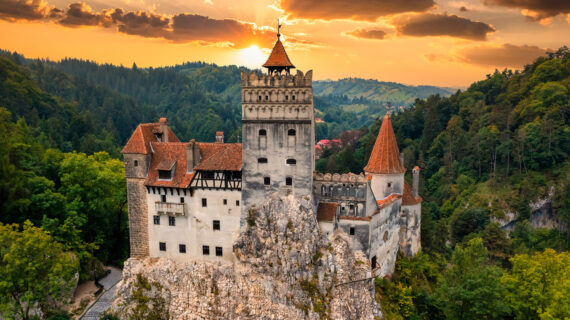
Just a scary fairy tale. Nevertheless, Dracula is big business for local tourism. For many, when in Transylvania, a stop at Bran Castle is considered a must. While people call it Dracula's Castle, it has virtually nothing to do with Vlad the Impaler.
But that doesn't stop the tourists from coming or locals from selling their vampire kitsch. Past the tacky souvenir gauntlet, a cobbled path curls up to the castle entrance. Despite the fanciful legends, Bran is actually a fine example of an authentic medieval fortress, dating from the 14th century. Some of Romania's most memorable fortresses aren't castles at all; they're actually churches.
bell tolls
Vlad had two nicknames
While big towns were well fortified, smaller German villages were vulnerable to invaders. So what did the industrious settlers do? They fortified their churches. Dozens of fortified German churches, mostly built in the 13th and 14th centuries, are scattered across Transylvania.
Like other medieval fortresses, they have beefy bastions, stout lookout towers, and narrow slits for archers. Entire communities could take refuge inside within these wraparound defensive galleries. This fortified church had a room for each family and, when under attack, each family had a defensive responsibility. Stepping inside these churches feels like stepping into medieval Germany.
Decoration was humble, pews were simple benches, Bible quotes are in German, and to this day, the services are Lutheran. Today most of Romania's ethnic Germans are gone, having emigrated in the late 19th century or fled to Germany after World War II. Those who remain speak a time-warp German and work hard to keep their unique cultural heritage alive. And the cultural heritage of Romania is many-faceted.
Appreciating the diversity of the 20 million people who make up this country enriches your experience. The faces, as varied and beautiful as the land itself tell the story. Of Romania's many people, one group in particular
has struggled to fit in
the Roma. Also known as Gypsies, the Roma originated in India. They were nomads who migrated over the centuries throughout Eastern Europe and gained a reputation as musicians, thieves, and metalworkers. Romania has Europe's largest Roma population.
They've had to abandon their nomadic ways and face the challenge of settling down. The classic Roma image is poor people in shantytowns. But most Roma live side by side with their Romanian neighbors, more or less fitting in to mainstream society. And many Roma carry on the traditional craft of metalworking.
We've been invited in to learn more. So how many years has your family been making copper?
EMIL
450 years ago.
RICK
Many generations!
EMIL
Yeah, many generations. Six, maybe seven generations.
Six or seven-- EMIL
And this job is--
RICK
Your father, his father--
EMIL
Yeah, my grandfather, my grand-grandfather...
RICK
Right here?
EMIL
Yeah.
RICK
I love your hat! Can I see your hat?
EMIL
Yeah, sure!
RICK
So, this is a Roma hat?
EMIL
Yeah, it's Roma hat.
RICK
Do you like to be called Roma or Gypsy?
EMIL
Uh, Roma.
RICK
Roma. What is important to the Roma people?
EMIL
For Roma people it's important, uh,
it's important
family, respect life, my people, art, music, language, pure language.
RICK
So you speak a Roma language.
EMIL
Yeah. Yeah.
RICK
So, today, for the Roma community, what's the challenge?
EMIL
Living modern times, but at the same time, like, keep traditions.
RICK
Pondering the challenges of maintaining traditions in an aggressively modern world, we leave Transylvania, and drive north. At the fringe of the country, tucked next to the Ukrainian border,
is Romania's most isolated region
Maramures. Maramures is fiercely traditional. Its centuries-old ways endure. Horse carts are commonplace.
The men wear distinctive straw hats. The women are tough as the land. People work the fields as they have for generations. Village roads are lined with ornate wooden gateways.
These gateways are intentionally elaborate, designed to show off the family's wealth.
The gates protect family compounds
along with the home, you'll find a barn, a garden, and an old-time dipping well. And, if you've never tried one of these, locals are happy to demonstrate. Can you show me the well?
WOMAN
Yeah.
RICK
Yeah? What do we have?
dog barking
water sloshing
RICK
Yeah? Like this. Okay. Nice.
Okay, so, into the horses. There we go. We're stayingbr/at a farmhouse B&B. Our host ritualistically closes the gate behind us.
People here are superstitious, especially after dark. It's dinnertime, but first we're getting a little tour. Traditional Romanians collect their nicest belongings into one room designed to impress their guests. Heirloom dowries are lovingly displayed.
These are bridal gifts going back generations. Tonight we're being treated to a farmer's feast. The food is typical of the region, rustic, delicious, and farm fresh. Our host, Ana, is determined to feed us well.
Hearty salads, cabbage rolls. Polenta is a daily treat around here, and pork is big. In Romania, like everywhere else, food is especially tasty when it's local and fresh. And everything goes better with the local firewater.
MAN
Noroc.
RICK
All right. Maramures.
violin playing
RICK
After dinner, the evening continues in the music room, where Ana's husband gets out his violin and shares some rousing folk music.
singing in Romanian
singing in Romanian
MAN
Yeow!
clapping
MAN
In this traditional community, many homes are busy with small-scale crafts and industry. Just up the lane, we meet a family who welcomes us into their cozy yet busy world. The daughter, using a technique that goes back to ancient times, gracefully spins raw wool into yarn. Inside, her mother weaves the yarn into bolts of cloth, which will eventually be made into heavy woolens for the winter.
Next door, a watermill does the same work it's done since medieval times. With the flip of a giant lever, George, the miller, sets things in motion. All of this powers his fulling mill, which takes the neighbor's woven wool to the next stage. Wooden hammers relentlessly pummel the fabric.
With the help of hot water, the wool is pounded into a dense felt. The finished product is heavy and warm, ideal for the frigid Romanian winter. The water wheel also powers grinding stones. To this day, villagers drop off their grain to be ground into everything from animal feed to polenta.
And George also has his own still for making the local brandy, horinca. He stokes the fire and patiently stirs his heated plum mash to keep it from burning. After its steamy journey through his low-tech water cooler, George's beloved firewater trickles into his bucket. And you can't visit George's distillery without tasting the final product.
Oh, yeah. Good? Maramures has some of the finest wooden churches in Europe. Their graceful spires punctuate the countryside.
Soaring skyward, they seem to connect earth with heaven. The exteriors show off the quality craftsmanship of local woodworkers through the centuries. And our guide, Teo, shows us how beautifully decorated the interiors are. Teo, this is remarkable.
And how old is this church?
TEO
17th century.
RICK
And how old are all these beautiful paintings?
TEO
18th century.
RICK
You know, they look more simple, like what you would see 14th century in France or Germany.
TEO
Yeah, it was a kind of a delay, or a very long-lasting tradition.
RICK
And the carpets! I've never seen a church with carpets everywhere.
TEO
They are gifts from donators, from parishioners, from the ladies.
RICK
So the ladies want to show their devotion, they bring a carpet?
TEO
Yes, it's a kind of devotion, a kind of sacrifice, let's say it.
RICK
And these beautiful embroideries, are these gifts also from parishioners?
TEO
Yes. For example, here you can see it bears even the donator's name, Jurca Palaguta.
RICK
Oh, that's the name of the woman who embroidered this! Even modern churches are still built in the traditional wooden style. Dating from 1995, this one towers 250 feet, with artistic shingle work cascading from peak to eaves. Again, the technical mastery of the woodworkers is on display.
Chunky timbers, precisely dovetailed, keep massive walls firmly in place. Just up the road is another unforgettable church, this one with an unusually joyful cemetery. In 1935, a local woodcarver, reviving an old tradition, began adorning what's known as the Merry Cemetery with a forest of vivid memorials. Each one comes with a whimsical poem and a painting of the departed in the moment of death or doing something they loved.
Even if you can't read the poems,
the images speak volumes
from a lifetime commitment to a traditional trade, like weaving, baking, or woodworking, a more modern one like television repair, or to a passion for bicycles, a sad early end by a lightning strike, or a humorous memorial to a lifetime spent enduring a nagging mother-in-law. It's a poignant and good-natured celebration of each individual's life, as well as a chronicle of village history. And it's all painted in cheery blue to match the heavens, where these souls are headed. Traveling through Romania, I feel about as far from home as I've ever been while still in Europe.
Sure, it's got some rough edges. But you'll enjoy amazing sights, endearing people, and rich memories. Thanks for joining us. I'm Rick Steves.
Until next time, keep on travelin'. Ta. Ta, ta!
bell jingling
the images speak volumes
Search Episodes
Related Stories from PBS Wisconsin's Blog






Donate to sign up. Activate and sign in to Passport. It's that easy to help PBS Wisconsin serve your community through media that educates, inspires, and entertains.
Make your membership gift today
Only for new users: Activate Passport using your code or email address
Already a member?
Look up my account
Need some help? Go to FAQ or visit PBS Passport Help
Need help accessing PBS Wisconsin anywhere?

Online Access | Platform & Device Access | Cable or Satellite Access | Over-The-Air Access
Visit Access Guide
Need help accessing PBS Wisconsin anywhere?
Visit Our
Live TV Access Guide
Online AccessPlatform & Device Access
Cable or Satellite Access
Over-The-Air Access
Visit Access Guide




Follow Us