








PBS Wisconsin Passport
Watch this video with
PBS Wisconsin Passport
Become a member of PBS Wisconsin, support your local community, and get extended access to PBS shows, films, and specials, like this one.
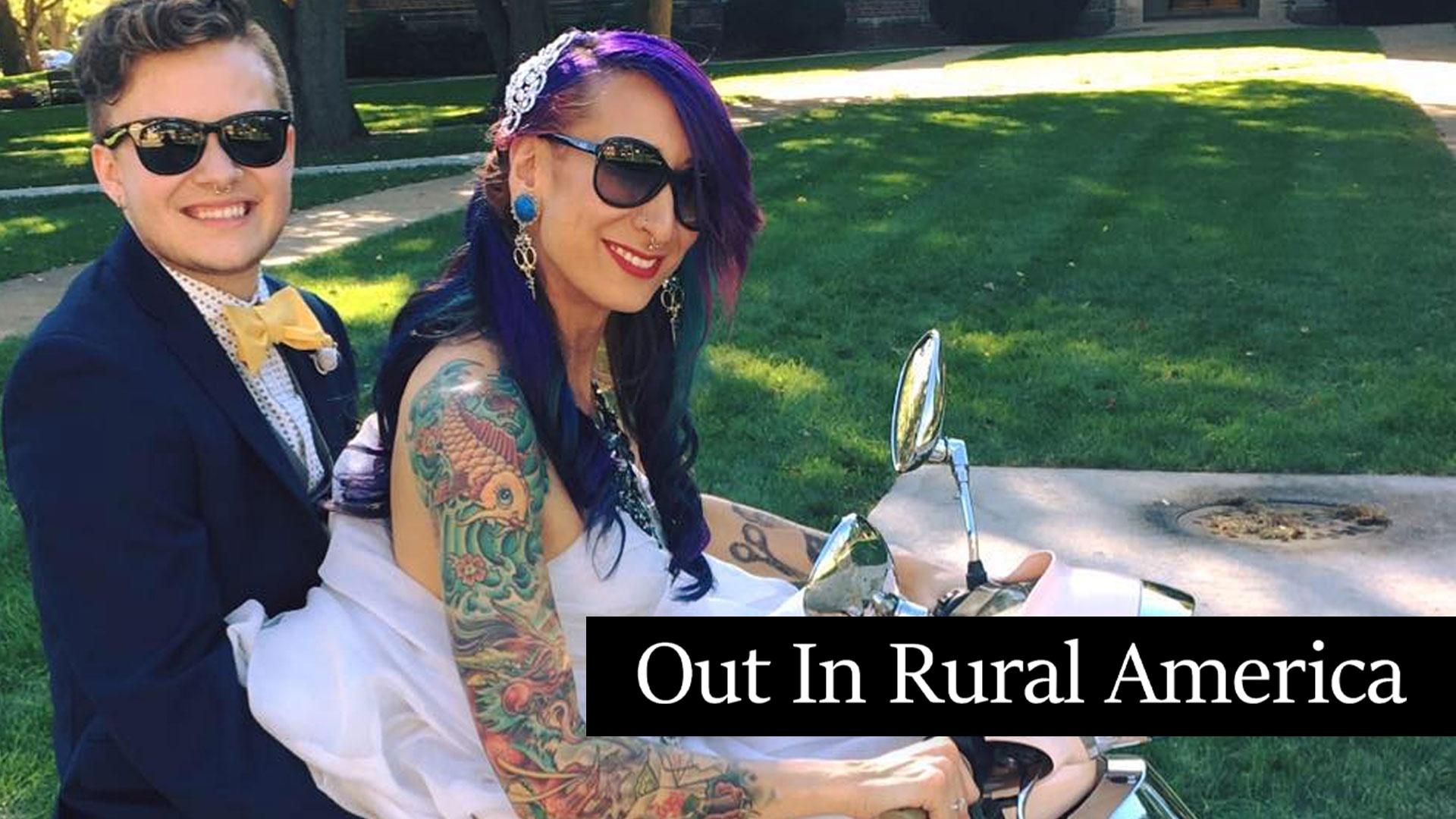
Out in Rural America
05/27/21 | 56m 46s | Rating: TV-14
Out in Rural America explores the struggles and joys of being lesbian, gay, bi-sexual, transgender and gender queer in rural America. Following five stories from the LGBTQ+ community over a six-year period, the film explores the issues of self-doubt, discrimination, acceptance and small-town and Midwestern LGBTQ+ life from a cultural, social, familial and religious perspective.


Copy and Paste the Following Code to Embed this Video:
Out in Rural America
It's hard when you feel like you're an illegal person because the state is telling you that you're not, you're not worthy. You're not enough. Just because we got marriage equality doesn't mean our fight's over. Our fight's just starting. (dramatic piano music) We live in a world where we're taught to fear. We're taught to fear our neighbors. We're taught to fear other countries. We're taught to fear each other. So somewhere in that equation, and I believe it starts in the home, if we continue to hurt each other because of fear, hurt people will hurt people. At some point, that has to stop. This is a terrifying place to be gay. There's no hate crime protection for gay people. If you beat somebody to death, yelling, "(beep)(beep)(beep)(beep)(beep)" it's not a hate crime. (orchestral decrescendo) (reflective piano music) I went to college in Casper, Wyoming, and that was right after Matthew Shepard had died. So in that, it was still very fresh for me, and I knew that it might not have been safe for me to come out. I fell in love with a woman, and I came out that year. It was 2004. Much to my mother's chagrin. She wasn't real thrilled, but she learned to accept it. She loves me. My father was more accepting. I dated a lot of folks in my 20s, kind of all over the spectrum. And then after a very hard breakup, I ended up dating a cis man, and we ended up getting married; however, that marriage was very rushed. We sprinted down the aisle, he and I, and then went through a very long and painful divorce. (uplifting piano music) After that, I met my partner, who is amazing, and fits me wholly and completely, fully understanding, and he understands my queerness because he's also queer, so I don't have to hide that part of myself or shield myself. Growing up trans was a hiding game, quite literally. I hid my body in blue jeans and sweatshirts. I hid my gender so deep in my head that even I couldn't find it most of the time. I hid my depression and anxiety in liquor. I hid my tears in the shower. For 19 years, I hid. And, to be honest with you, this isn't the kind of hiding that I'm ashamed of. This isn't the kind of hiding that I chose or ever would have chosen on my own. This is the kind of hiding that felt necessary for me in small-town Kansas. This is the kind of hiding that kept me from being beaten up in bathrooms. It kept me from being kicked off the swim team or from losing friends. In other words, this, with exception to the alcohol, this was the kind of hiding that kept me safe. My name is Brett, and I'm a writer, son, brother, lover, Christian, and recovering alcoholic. Woo! (audience applauding) Thank you. (chuckles) Thank you. Transitioning, asking what transitioning means is a really hard question because it means something completely different to pretty much everyone. For me, transitioning means that I've been on hormone replacement therapy for a while, so I take testosterone shots every week, and that top surgery, which is essentially a double mastectomy. I dress in a masculine sort of fashion. When we talk about transitioning, we sort of wanna think about the medical stuff right away, when, in reality, what's something that comes later for a lot of people or not at all for a lot of people too if there's really a cost barrier on that, and not everybody wants that. Like, for example, a lot of people think that you need to have bottom surgery to be sort of fully transitioned or to be fully trans or whatever, and I don't. There's no such thing as trans enough to me. I haven't had bottom surgery, I don't want bottom surgery, I don't ever plan on having bottom surgery, and that doesn't make me any less of a trans person than someone who has had it or someone who hasn't had any sort of medical intervention whatsoever. And it really, it came at a rough time in my life, when I sort of figured this out. The summer prior, I had actually attempted suicide, and I was sort of just coming out of that. And I realized that if I didn't move forward as Brett, I just wasn't really gonna live anymore. And I didn't know if that was sort of an active thing on my part, like I wasn't going to let myself live or if like moving through every day as I was just wasn't really living, and I knew that. (somber piano music) From kindergarten to about second grade, I got called a girl, and from second grade on, the word "gay" started getting thrown around. I know at that age, none of us knew what gay was; we just knew that it was a bad thing. When Joe was a teenager, he started to become more reserved, quiet, still had an opinion about everything, and he talked about how hard it was at school because of the harassment he received. He was at some point suicidal, but he was also a very loving, caring young man. As a gay kid, you spend your days terrified that your parents are gonna find out and that they're gonna not love you after that, even if they're the most supportive parent in the world. I had spent months trying to decide how to tell my mom. And, finally, we're just driving around one day, and I'm getting up the courage, and finally, I just go, "Mom, I need to tell you something." And she goes, "Yeah, what's up?" And I said, "Mom, I'm gay." And there wasn't even a pause or a thought. She goes, "Joe, I've known since you were two." I think I was eight years old when I heard about Matthew Shepard. And it scared me 'cause it was a state away from me. And I didn't know what gay was at the time, but I told myself at eight years old that if I was ever gay, I wasn't gonna tell anybody because I didn't want that to happen to me. Well, he came out to me first. He was 18. He was a freshman in college. He called me. We were living in Saudi Arabia at the time. (reflective orchestral music) I answered the phone, and he said, "Mom there's something I need to tell you. I am gay." And I said, "What took you so long to tell me?" And there was this pause at the other end. And he said, "I don't get it. How did you know before I knew?" And I said, "They tell me it's a mom thing." He's still my son. Nothing changed. But I think, "No grandkids." And I realized, "How selfish. You still have your sons. Both of them." Look at how many families have lost a child to car accidents or military service or health issues. They're gone. And I can still make memories with Matt. All we knew was Matt was our son, and we were there to support him, encourage him, and do whatever we could to make him have a happy, successful life without knowing all the issues and all the lack of equality and all the discrimination and everything else and the fear and the brutality towards the gay community by everybody. We didn't know anything about that. We're just old country bumpkins. What made me mad about the whole thing was I caught him smoking. I was so mad about him being a smoker. I couldn't care if he was gay or straight or a martian, I don't care. But he was smoking! That really upset me. We'll never really know what happened that night, how they got Matt to leave with them. We're only going by what their statements, confessions said. (somber orchestral music) So, yeah, he left with them in Aaron McKinney's father's pickup. Russell Henderson was driving. Aaron was on the passenger side, and Matt was in the middle. And they had left the bar and immediately robbed him, and he immediately handed over his wallet, which they said in their statements is what happened. But Aaron continued to attack Matt, hitting him with his fists, and then he hit him with the butt of a gun several times while they were still in the truck. So they drove down this road and pulled Matt out of the car. Aaron told Russell to get this, actually was clothesline rope, more like string twine, and tie Matt to this buck and rail fence. And they tied him to the bottom part of the fence, and they continued to beat Matt, Aaron did, swinging this.357 Magnum like a baseball bat, holding onto the barrel and hitting Matt with the butt, the handle grip. And he hit Matt along the head, between 18 and 20 times the coroner said, fracturing his skull four times. And the final blow came behind his right ear, right here. They took Matt shoes and his bank card and left Matt tied to the fence. (somber orchestral music) Matt was found by a mountain biker who was the next day riding his bike through the hills where Matt had been left. -
Dennis
Took a different route than he normally took. Yeah, he did. And he fell in this one place. And when he looked up, he saw Matt tied to the fence. If he'd fallen in any other place, he would not have seen that. The emergency room doctor said he'd never seen injuries like that on another human being except in a tremendously horrific automobile crash. We asked the doctor, "Well, what can we do?" And he said, "The one thing you can do is not take your anxiety into his room." So we tried not to. Matt's music was there, and we played his favorite music, and I had a bottle of perfume of mine that he liked. So we wanted him (inhales deeply) to know that we were there. Then we talked to him, and we touched him, and held his hands and stroked his arm. And they told us that we needed to start thinking. We need to start thinking about making a decision. On whether or not to disconnect all his life support. And we gathered everybody around us that was there, family and friends, and we surrounded his bed, and we're holding on to him, thinking that we're just not ready to let go. But he made that decision for us, so he was gone. (reflective piano music) I knew I was different from the time I was a little kid. I heard the term "queer." I heard the term "homo." I heard the term "gay." I heard the term "lezzy." And I heard the term "it." I didn't really understand those terms when I looked them up in the dictionary, and I didn't like the definitions of 'em in the dictionary that was in the high school at that time, so I told myself I wasn't like that because all the definitions contained the word pervert, and, to me, pervert was associated with somebody that did bad things to little kids, and I wasn't that. "Crewing up," in the area I grew up in, it's just not a term that anybody heard. In fact, I didn't even know there were gay people. I didn't know any gay people. I didn't know any lesbians, anybody that was different in high school. They were called those names, and then those people would leave, and we never saw 'em again. And it just never occurred to me that a girl could date a girl because, I mean, in my mind, I thought, well... Because I didn't talk about it to anybody, the way I thought about it was I just figured all girls like girls. They just dated boys and got married to have kids and have a family. That's what I thought. That's truly what I thought. I thought all girls felt that way, the way I did, and just dated boys because that's what girls are supposed to do, is eventually get married and have kids and help on the farm. That was my experience. Pretty narrow experience. (clears throat) Well, when I came out to my parents, I did it stages. Yeah, came out to my mom on the way to the mother-daughter banquet at church. My mom said, "Well, I kinda suspected," and we kinda left it at that. When I came out to my dad, and Mom also has asked me, "Please don't tell your father or Lake or Tim." Well, I wanna live my life honestly, and I couldn't have one parent knowing and the other not knowing, so I told my dad. We went hunting together. I used to hunt quite a bit with my dad and my grandfather. It was just me and my dad, that night, at that time. And we're on the way back from our hunt, and I said, "Dad, I need to tell you something." And he says, "Okay." And I said, I said, "I'm pretty sure I'm gay." He said, "Yeah." He says, "I wanted to sit down with you and your mother when you were in high school and talk about that, but your mother didn't want to." And I was like, (scoffs) I spent all this time and energy worrying about getting kicked out, getting disowned, getting whatever ramifications that people who come out their parents make it. And I've had friends that were disowned by their families when they came out to them, and I had friends who were told never to come back. (reflective piano music) Yeah, one time I was, been deer hunting or whatever, and was going down the highway in the pickup. She says, "Hey, Daddy, I'm gay," and I says... Lesbian, whatever. And I said, "Well, I knew that." I mean, no big surprise. I mean, but she told me outright, but I had it figured out. You're much more astute than I am, Carroll. The hormones weren't kicking in at a normal thing for little girls and little boys when they reached 12, 13, 14 year old age, just weren't kicking in the right direction. Right direction? Well. (chuckles) - The expected direction. The wrong direction, right direction, middle-of-the-road direction, whatever, whatever happens, whatever the body tells you to be. We didn't care if we had grandchildren or not. We just wanted our children to succeed at something, you know? Be happy. And where you can grow up, provide a living for yourself, and living a comfortable lifestyle. And be a responsible citizen. That's, yeah, that was probably our greatest dreams for the kids. (nostalgic piano music) I met a guy when I was a sophomore in high school. You know, back in those days, the script women were given is you went through high school, you graduated high school, you got married, you had 2.5 kids, and you live together until Social Security, and then you traveled. And that was the ideal script you were given. So a lot of us didn't get to questioning at that time. And so I met him when I was a sophomore in high school, and got married a year after I graduated. I was born in Alexandria, Louisiana. I lived there until I got out of high school. It was a small town. I had wanted to do some things, so different colleges, but my dad wouldn't go for it. So I met somebody, married him, moved away, and that's pretty simple. (chuckling) I knew from the time that I got married, when we moved to New York, that I had made the biggest mistake of my life, and I lived that mistake for 19 years. We've been together for 27 years, and we didn't really talk about marriage until recently. Well, in September of 2013, Edie Windsor won at the Supreme Court level, and it knocked down the Defense of Marriage Act, which opened up the federal protections for people who got married in a state where it was legal. We still didn't know how that was gonna apply to us because we live in South Dakota. So in February, President Obama came out with an executive order that said if you get married in a state where it's legal, you get to carry those federal protections with you back to the state you live in. So that solved that half of marriage for us, the federal level. (contemplative piano music) So one day I called up Nancy Rosenbrahn, who is a dear friend, one of the bravest human beings I've ever met. And I called Nancy up and I said, "Nancy, I wanna ask you a favor." And she goes, "Oh, no." (laughing) And I said, "Nancy, we've gotta sue for marriage equality." She said, "Oh, no." (laughing) I said, "Nancy, I think it needs to be you and Jennie," and she said, "I was wondering how long it was gonna take you take you to figure that out." She knew. She knew I was gonna call her and ask her that. Other couples have to consider before they step out in a lawsuit like this because South Dakota has no protections for employment, nor do they have protections for housing. And so if a couple of joins this suit, they are truly out of the closet. They are truly, we truly became public figures. When we sat down and made the final decision, both of us felt that not doing it would be wrong. You see families with grandchildren, families with no kids, families with one newborn, just getting started together. What you see before you is a true cross section of the state of South Dakota. And these families have stood up to represent us.
They've stood up to fight for all of us
gay, straight, queer, cis, trans, all of us, because whenever some suffer inequality, all suffer from inequality. (reflective piano music) We set the date for the wedding. It was done at the Community of Christ Church in Minneapolis. The mayor, Betsy Hodges, from Minneapolis, married us. (guests cheering) We celebrate your love, we celebrate your lives, we celebrate the stand you took, and together we say your marriages count. Yes! - And they count in South Dakota- Yes! - And they count for us. And they count in the history of the United States! And thank you! And we love you. (guests cheering) (guests clapping) (uplifting piano music) (guests chattering) (guests cheering) (contemplative piano music) I do wanna say this. I do wanna add this. I think a person's sexuality has no place in our government. But, no, they get so involved in things that do not have a relationship to the- To the rest of humanity. - Traditional welfare of the public, I mean. - Yes, yes. You lose track of what the elected officials are supposed to be doing. Here's the thing, I don't care what anybody does behind the bedroom door. I don't what you and your husband do behind your bedroom door, what we do behind our bedroom door. That's your business. I mean, just get a grip on yourself, you know? You're not gonna control everything, and you're not gonna control people's sex lives. (somber piano music) -
Producer
They've stood up to fight for all of us
To legislators listening, what would you say to them? It was supposed to work for the betterment of your community, your state, and your country, and you're not doing it. Any kind of legislation that would legalize discrimination hurts this country. It divides the country. Anything that would engender or encourage any kind of hate, any kind of discrimination based on hate, is not why we are here. It's not why we are here. How can we be examples for the world if we can't be examples for our own kids and grandkids and our own citizens to have basic, basic equal rights? If you wanna talk about the turning point in the South Dakota movement, it's SB-128. Essentially the essence of the bill was that folks could discriminate on the basis of sexuality. It also declared that South Dakota is a sovereign state, and the Feds can't do anything. I mean, it was a fundamentally unconstitutional bill. It showed a basic misunderstanding of eighth-grade civics, not to mention a basic misunderstanding of civil rights in this country. SB-128, that rolled through here, really just lit a fire under the entire movement. They were trying to take away not just our adoption rights but our rights just to exist. It was gonna go back down to Jim Crow laws. You know, like, "You cannot have a sandwich here. You cannot buy a cake here. You can't sit here. We don't serve your kind." Like where a store could put that in the window. It made no sense to me. Like, I just, like, we've come too far for this, y'all. We've come way too far. How is this happening? So we had a little rally. (uplifting piano music) (Brett chuckling) We did a little protesting. We marched up here, and that bill was killed relatively quickly, so it didn't make it out of committee. I have friends whose parents- Which is great. - Kicked them out of their house. And it was, you know, go all in or go home. It was time to fight. They picked the fight. They poked the sleeping dragon. And so we did. We fought, and we won that one. And then we started, and then we realized that there was no going back. South Dakota has never been a state that hates people. I've never seen that. So to just see this crazy legislation come out of nowhere? Just fear. It's fear-mongering. (upbeat piano music) I decided to run for office because I wanna try to bring some unification. I'm tired of the division that I see happening in our country and the division I see happening in our state. That's not what South Dakotans are about, and it's not what Americans are about. My biggest challenge in the last year and a half is still me and how I perceive myself at times, and this running for office has been a challenge. It forces me to be really outside of my comfort zone. It forces me to talk with people that I normally probably wouldn't talk with. It forces me to listen to other ideas daily. Since losing my... Since my dad died, there's a bit of a challenge in there regarding grief. But I think, I think he'd be proud of me for stepping it up and at least getting into the ring, so to speak. I think he'd be shocked a little bit too. (chuckles) I work in Sturgis. I live in Sturgis. I've been there about seven years. And what I've learned living in Northeast Nebraska, in Western South Dakota, is I'm a little bit too liberal to be a great conservative. So either way, puts me in the middle, and I believe that if we all sit down together, regardless of party affiliation, and we start looking at what we have in common, we can do really good things for everyone. So thank you again for being here today. Thank you for this opportunity. (contemplative piano music) Nobody knew who we were with the media. So prior to Matt's services, we had a PR event. The intention was to go out there and thank the media for basically leaving us alone so we could take care of Matt, and then we could get with family and friends and mourn him. We had the press conference, and then we go over to the church to go in. And everybody who had tickets had to go in through the alley, the back door, into the church, through the kitchen, because you couldn't get in the front door because there were protesters. Fred Phelps and his merry band from Westboro Baptist Church out in Topeka were there, and they had a fence around them. And then there are protestors against them, facing them. And it was a media circus. That was the first time I protested against Fred Phelps. He had come to Casper to try and erect a life-size monument of Matthew Shepard that said "Matthew Shepard burn in hell this day for crimes against God" in front of Judy and Dennis's church. So we all fought that that day, and of course it did not happen, but it was a rough day to watch these children, six, seven years old, holding terrible signs that say "God Hates Fags" or "(beep) You, Dyke." I wasn't even out, but I was already experiencing hatred from people that didn't know me. Matthew Shepherd was my biggest turning point for fear because seeing that beautiful young man die in such a horrible way because that he was gay, I couldn't understand that, how anybody could do that to somebody. And my fear was because we live in a small town, that it could happen to Joe. And that was my biggest fear. I didn't want anybody to harm my son. Fast forward to high school, we did a production of "The Laramie Project," which is the story of the town of Laramie during and after the trial of Matthew Shepard's killers. And we sat down after one of the productions with the audience and a member from the Matthew Shepard Foundation, and we were just telling our stories. And it came to my turn, and I started talking about the bullying, and all of a sudden, the next thing I realized, my face is in my hands and I'm crying and half the audience had gotten up to come and give me a hug because I had come out without realizing it. And it was weird because it was a full circle that Matthew Shepherd, the situation there, put me into the closet, but it's what also brought me out of it, telling his story. (contemplative piano music) I spent a lot of years trying to pray away the gay. A lot of years. A lot of years praying for God to make me quote, unquote, "normal." When I realized that God probably wasn't gonna make me normal, in the sense of heterosexual, kinda I really turned my back to religion. I kinda turned my back to God. I didn't believe that God was for me because if I was gonna go to hell, then I just, well, I wasn't just gonna go to hell for doing what God wanted. And I really started drinking heavily about that time because I thought, "Well, if I'm gonna go to hell, I just will earn my way there," you know? (chuckles) So I spent a lot of years using alcohol. Couple years ago I decided that enough was enough, and I started going, I started going to a 12-step program, and I haven't had to use alcohol now for a couple years, and I'm really grateful for that. Yeah, religion was a huge deal in my family. My grandpa's a United Methodist pastor, so I grew up in the church from the very beginning. And not even just because my family just kind of naturally took me there, but I loved it there. I'm in the process of becoming a licensed local pastor in the United Methodist Church. You have to remain on the side of justice, on the side of God or our higher power, on the side of life and love. We have to speak that truth now. So people always ask me if I feel like I'm challenging God's plan simply by existing as a trans person. And so, for me, when I think about being trans, I think about the fact that transitioning is what has given me life, and I know that my God is a God of life and love. And if being and presenting in this masculine way is what gives me that life, then I know that it's something of God. And so, no, I don't think I'm challenging God's plan. I think that I am living into the fullness of it. I know there are people out there that don't want to have someone like me walking around on the Earth. I know that. I pray that and I trust that their creator has them wrapped in love just as much as my creator has me wrapped in love. I just really feel that there's enough fear and anger in the world, and it's time for more love, compassion, and empathy. So I'm not asking you to give up your religion. I'm not asking you to stop being Catholic or Mormon or Baptist or evangelical or non-denominational or whoever it is that you think you are. I'm not asking you to give up your Bible. What I am asking you to give up is the power of the state to enforce your religion. I'm asking you to actually believe in that First Amendment that you like to wave around so much. I'm asking you to actually understand what the constitution means and stand behind it. That's what I want. To the queer people who have lost their church either because they've been thrown out or because they felt that they needed to leave, I would just remind them that the church, that organized religion is not God. And whether you have a place in a building or not, it doesn't change the fact that every single one of us has a place with God, and that God is always arms open wide, ready to love us and to welcome us in. (upbeat piano music) The last 15 or 20 years, have just been remarkable for the various trans communities around the country in terms of visibility, in terms of building political power, in terms of getting policy changed. But ultimately the questions are still the same. They're about acceptance. They're about public safety. They're about access to health care. And they're about economic marginalization, ways in which trans people are pushed to the margins of society and discriminated against in employment and housing and really across the board. Small towns are for some people and they're not for other people, but there's a lot of really great people in small towns who just want to live with other good people. And if you don't have state legislators making stuff up about trans people, calling trans children predators, they'll be okay. Once that has happened, word gets out that people are supposed to be concerned about these trans people who didn't do anything, have never caused a problem, but now suddenly people are afraid that there's a problem. That's sad and it's unfair, but it is a debate that is now engaged all over America, and we're gonna come out of it having educated people with that. One of the most telling things that happened in my life regarding HB2, I was actually flying to South Dakota. I was in Minneapolis at the airport, and I went to the bathroom. And in the bathroom, there were these two other guys who came in, and they came in talking about HB2 and how they were glad that it was a thing because if they caught any trans people in the bathroom with them, they, you know, they list off all these horrible things that they would do. And they said hi to me. And they did, you know, and I did my business and I left, and I'm like, "These people have no idea (chuckles) that I'm one of those people," and I'm hearing all of these terrible things. The reason people have not been accepting of transgender people is because they haven't known about transgender people. They haven't known transgender people. As we've been able to build community, as we've been able to come out more, as we've been able to stand up, introduce ourselves to our families, to the people we go to church with, to the people who we work with, they're learning about us, and they're accepting us more. For them to say, "Hey, I know a transgender person named Mara," and, "She's not so bad," and, "She's pretty typical." And I said "typical" on purpose. I think this is an interesting thing. I'm on panel sometimes with other trans people, and somebody always says we're ordinary people like everybody else. And I get what they mean, right? I have to pay my rent. I have to go to work. I have to walk my dog several times a day. But ordinary people don't really look at who they are and then go about being that, knowing that they could lose their health, they could lose their family, they could lose their job, they could lose their life. That is an extraordinary person. And all of the thousands of transgender people I've met since I've been out, it is a remarkable, extraordinary bunch of people who are strong and resilient and full of integrity. (upbeat piano music) Tomorrow we leave from Sioux Falls to head to Des Moines to get married next weekend. Yeah. My family was really kinda, I don't know if surprise is the right word, but was just really happy. When I came out as trans to them, they had a lot of fears that I would never be able to find someone who loved me and all of me and that the trans status wasn't going to be an issue for. And so they were just overjoyed that there was someone, that there was someone as great as Pam and that there was someone, period. So they were very, they were really happy. They were quick to celebrate with us. No, I didn't have any trepidations about his trans status. I had dated another trans man prior. So I'm very queer. It's just, it's all about hearts and not parts for me, so I can generally be attracted to most people depending on what's going on between their ears or in their chest. (heartwarming piano music) (upbeat piano music) I've come to learn that I wouldn't be who I am without this part of me. I wouldn't be as strong of a person. I wouldn't be as compassionate. I wouldn't be as loving without this part of me because going through all those struggles, you learn how to show love rather than hate because that's all you've got. Hate doesn't win out against hate. Showing someone love even though they're hating you is how to fight against that hate, and that's what I've learned to do, being who I am. I currently do not have a partner. I have been actually single for nine years. I'm moving to New York. I have decided to make that move because, for one, I've got job offers for when I graduate, but it's also because I've always been drawn to the big city life. And, I hate to admit it, but a lot of it has to do with being gay. My photography is a big driving force in that, and I just feel that I can be more open about who I am there. Even though I am open and out, it's gonna be something I don't feel like I have to be afraid to tell people every time I meet a new person or something like that. (soft orchestral music) You want the positive ruling. You want the ruling in your favor, but in the back of your minds, I think you know that it could go the other way, especially South Dakota. And so when the word came through, it was like, "Oh, my God. Wow." Wow. - (chuckles) Wow is right. Speechless. - Wow is right. (bar patrons chattering) (glasses clinking) -
Bar Patron
They've stood up to fight for all of us
To getting married, woo hoo! Yes! - Woo hoo! Here's to Greg! - We know how to do it! (soft orchestral music) And so you asked me, "Does marriage move the needle?" Yes, it does. And here's why. If people can get married, the state has to recognize them. They have rights. I have a couple who've been together for 12 years in the movement. They told me they have never once held hands in public until that rally for SB-128. Two men who've been together for 12 or 15 years never held hands in public until we started doing this. Marriage makes a difference because it makes them into families. Marriage moves the needle also because it invites the conversations. In a place like South Dakota, marriages moves the needle, but it's not the end of the game. (contemplative piano music) -
Chief Justice Roberts
They've stood up to fight for all of us
And there, again, if you look at the basic definition, it is between a man and a woman. Scalia. - It does not always say It's Scalia. - between a man and a woman in which the woman is subordinate in legal respects. - That's Judge Scalia. -
Chief Justice Roberts
They've stood up to fight for all of us
So I'm not sure it's still, again, fair analogy to your situation. (soft orchestral music) -
Person
They've stood up to fight for all of us
Los Alamos. What do I have to bring in? - No. Rehearse again. - All right. Who's that? - Uh oh. (people chattering) The food guy. So nice to finally meet you. Oh, my God, I'm so glad to meet you. (people chattering) It says generations of men and women, oh, dear. (guests chuckling) Okay, I got it. Okay. Generations of men and women risked their safety and their livelihoods, dedicated their labor and their honor, sacrificed their privacy and their peace of mind to achieve this victory. In one of the most consequential rulings on equality and liberty in decades, the court has reaffirmed that the Constitution is a living document that must respond to the real experiences of ordinary people who seek to participate in its great promises. Today, lesbian, gay, bisexual, and transgendered Americans are included in those promises. At long last, the equal dignity of our relationships under the Constitution is settled law. (soft orchestral music) (uplifting orchestral music) And as we turn to the east, we are reminded that today is the dawning of a new day, the continuance of a promise that was made to all of us. With this ring, I thee wed. In giving it, I give you all my life, all that I am, all that I have, and all of that I will become. With all who are assembled here today and by the authority vested in me by the state of South Dakota, it is with great joy and humbled admiration that I now pronounce you united, legally married, (attendees clapping) and spouses for life! Would you please kiss your spouse. (attendees cheering) (attendees clapping) (soft piano music) What I love the most about New York is the fact that anything is possible here, that I can do or be whoever I wanna be here. And it's with my photography, that's with my love life, that's with any innumerable things. I've seen couples on the subway showing affection to each other, but my favorite thing I've seen has been two fathers together with their children because that's something that I want Hello. - probably more than anything, is to have a family and kids. And to watch that just be a normal thing, just them on the subway together with their children, I actually couldn't stop smiling. I think they may have thought I was crazy 'cause I was smiling at them, but it was something that when I was South Dakota, it was not really ever an option. Even, I mean, now that the ruling has happen, yeah, it's an option, but growing up, I never thought I'd have a family. I never thought I'd get married. I'd never thought that any of that would be possible. I just thought, yeah, maybe I'll date somebody, and that'll be the end of it. But being here and with the marriage ruling, the desire to be a father and the realization that it could happen and probably will is (reflective piano music) something that I never thought I'd experience, and I am excited to see where that goes. (heartwarming piano music) (guests chattering) When it comes to being out, especially in a place like South Dakota, we've made that calculated decision. We've counted the risk, and we've counted the reward, and we've decided that the reward is greater, and our kid didn't get that choice. Our kid has out parents, and that's just the way that it is from the very beginning. And so I think that my biggest fear is that that will create a harder life for them. Not because us being queer is a bad thing, but just because of some of the ignorance and hate that still exists and the way people respond to, to queer and trans people. I don't want what has been life-giving for us to be harmful to them. The world that I'd like to see our baby grow up in is one of just love, and one of acceptance, one in which she could be her very own person and become exactly who she is supposed to be without judgment or fear. (heartwarming piano music) All right, so this is Matthew. We met five years ago on a dating app, and we have been officially a couple for a year now as of December 27th. I know when I first did my first interview, I mentioned what I want out of life and all the normalcy, the dinners, the putting dishes away (chuckles), yelling at each other (chuckles). And when we first interviewed, I didn't have any of that, and in the last year, all of those things kind of have come true. We want a place to call home. Honestly. We want a place that's ours. And what we want is what anybody really wants, is a family, to be able to have the security of those around us, and to honestly find our happiness within each other and from ourselves. -
Joe
They've stood up to fight for all of us
Just the normal life. We want the family, the kids, the house, the stable jobs. That's our gay agenda. (Matt and Joe chuckling) (heartwarming piano music) (soft orchestral music) This is Jade, and here I am. I think this is better. I think I'm out of the shadows. You can see some traffic in the background here. It is Election Day, November the 6th, 2018, here in South Dakota. Voters going to the polls today. Some have already voted early. How do I feel today? I am frickin' nervous. And I'm excited too. Yeah, I'm nervous. So here we go. The voters will decide. Yup, the voters decide today. The people decide today. The people's voices will be heard today. And if they want something different, they'll vote for something different.
It's about 4
30 Mountain time here in Sturgis, South Dakota. About 2 1/2 hours now before the polls close. Honestly, I'm still a little anxious about this. I know things will be as they're supposed to be. Just got out of the bathtub. Thought maybe I would take a peek at the, oh, the Secretary of State's website. On there, it does look like I have procured 14% of the vote. I will not in all likelihood be representing District 29 here in the state of South Dakota, and that's to be expected. I knew it was a long shot to win. Let's put it that way. So I took a chance, and if nothing else, people heard a different message for a little bit. (soft piano music) Maybe that stays. Maybe somewhere a seed is planted. I do believe that everything, everything is the way it's supposed to be, and I believe there's a bigger plan. And I don't know what that plan is, but I still have hope that we can make a better future for future generations. So that is all. Good night. (reflective piano music) (bells chiming) (bright tonal music) (bright horn music)
Search Episodes

Donate to sign up. Activate and sign in to Passport. It's that easy to help PBS Wisconsin serve your community through media that educates, inspires, and entertains.
Make your membership gift today
Only for new users: Activate Passport using your code or email address
Already a member?
Look up my account
Need some help? Go to FAQ or visit PBS Passport Help
Need help accessing PBS Wisconsin anywhere?

Online Access | Platform & Device Access | Cable or Satellite Access | Over-The-Air Access
Visit Access Guide
Need help accessing PBS Wisconsin anywhere?
Visit Our
Live TV Access Guide
Online AccessPlatform & Device Access
Cable or Satellite Access
Over-The-Air Access
Visit Access Guide




Follow Us