JUDY WOODRUFF
Everyone would agree this past year has been tragic in so many ways. It's also been strange. But something is about to happen to make it even stranger. The bugs are coming, billions of bugs.
The periodic cicada invasion is just days away in many states. And we are so pleased that one of our own, John Yang, has gone and learned what you need to know to cope with the coming brood. MICHAEL RAUPP,
University of Maryland
Let's see if we can find somebody under here maybe.
JOHN YANG
Entomologist Mike Raupp, A.K.A The Bug Guy, and I are hunting cicada in his neighbor's backyard in Columbia, Maryland.
MICHAEL RAUPP
Oh, boy, there we go. Look at that. Oh, yes.
JOHN YANG
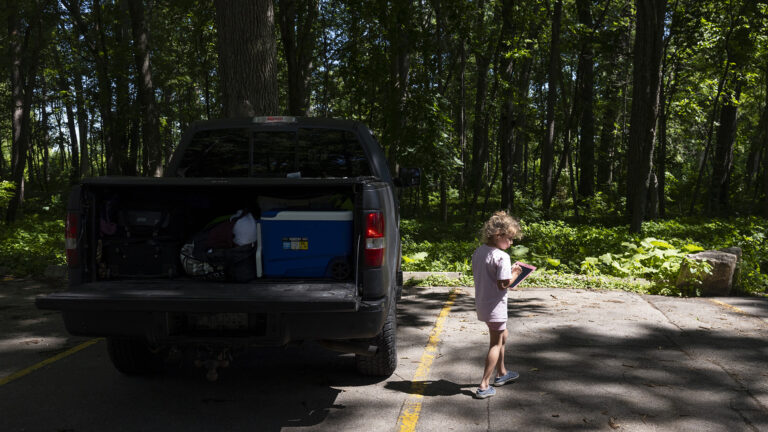
Specifically, Raupp, his neighbor Tim Hughes and I -- by the way, all of us are fully vaccinated -- along with Hughes' 3-year-old granddaughter, Emily, were looking for Brood X cicadas. What do you think?
MICHAEL RAUPP
Pretty good?
JOHN YANG
Good?
GIRL
Yes.
MICHAEL RAUPP
He's pretty cute, isn't he? (LAUGHTER)
JOHN YANG
We dug up the cicadas and then put them back. But, soon, we won't have to look very hard for them. They will climb out from holes in the ground after 17 years below the surface. And there will be a lot of them.
MICHAEL RAUPP
Twelve, 13, 14 holes, that's probably going to translate in an acre to several hundred thousand cicadas per acre.
JOHN YANG
Wow. Just in this backyard.
MICHAEL RAUPP
It is going to be crazy. There are literally going to be billions, if not trillions of periodical cicadas emerging in 15 states from Georgia to New York City, and then West to the Mississippi River, Ohio, Indiana, and Illinois.
JOHN YANG
Northern American periodical cicadas emerge together in groups called broods in distinct geographic areas after spending 13 or 17 years underground. Brood X is one of the biggest and will come out when the soil reaches 64 degrees.
MICHAEL RAUPP
These guys have been underground for 17 years, sucking on the sap of tree roots. They're going to make a jailbreak just at nightfall. Their skin is going to split open on the back. They're going to pop out of there.
Then they're going to move to the safety of the treetops. Then, within a span of about maybe a week or 10 days, it's going to be a big boy band, because only the males sing.
JOHN YANG
And they are loud, up to 100 decibels. That's as noisy as a lawn mower.
MICHAEL RAUPP
John, it's going to be all about romance at that time. Remember, these are teenagers. They're 17 years old. They have been underground.
It's been dismal. Once they're up in the treetops, he's going to do his very best to convince that special someone that she should be the mother of his nymphs. If she likes it, she's going to flick her wings. They're going to hook up.
They're going to mate. It's just going to be wonderful.
JOHN YANG
The females lay their eggs in small tree branches and then the grownups die. After the eggs hatch, the nymphs fall to the ground, burrow into the soil, and start the cycle all over again.
MICHAEL RAUPP
These are the very parents of the class of 2021.
JOHN YANG
Raupp saved some cicadas from the last emergence in 2004.
MICHAEL RAUPP
We have two different species in the box right now. These are called the septendecims, where these little guys right here, those are my favorites. Those are called the cassinis.
JOHN YANG
Chris Hughes remembers feeling overwhelmed 17 years ago. TIM HUGHES,
Maryland
It's just dramatic, how many there were. Literally, the entire yard was moving. In fact, it was moving so much that we got up, and you know how you feel when you get off a boat, you're a little woozy? That's exactly how we felt.
JOHN YANG
Instead of sea legs, you had cicada legs.
TIM HUGHES
Cicada legs, yes. CHRIS SIMON,
University of Connecticut
These are from Long Island.
JOHN YANG
Evolutionary biologist Chris Simon says there's a reason for their abundance.
CHRIS SIMON
When they come up, everything eats them. They have this sort of safety in numbers strategy. Eventually, predators get tired of eating them, and enough are left that they can survive and reproduce. And so they will all come out at exactly the same time.
JOHN YANG
Cicadas have even become cultural icons. Simon showed us souvenirs like this jade cicada.
CHRIS SIMON
They have traditionally been put in the mouths of dead people in Asia to carry their spirits into the next world. This is a bumper sticker from Nashville. This one says "Sing. Mate.
Die." Cicadas are also really well-loved in Japan. This can transform into a robot. It's called Cicadacon.
JOHN YANG
But periodical cicadas may be transforming in real life. Simon is studying whether climate change is spurring them to mature faster.
CHRIS SIMON
We have seen many more cicadas coming out four years early, and not only coming out four years early, but coming out four years early in larger numbers. And they mate and lay eggs. And the eggs hatch. In previous years, we have seen them come out four years early, but there weren't as many.
They don't establish a self-reproducing population. So, we used to think it was an evolutionary dead end.
JOHN YANG
But not anymore. In 2017, Simon tracked Brood X cicadas that emerged four years early and estimates there were millions of them.
CHRIS SIMON
With climate change, there's warming. And the warming provides longer growing seasons for the trees and for the cicadas. And so, as the feeding season gets longer, the cicadas can grow faster.
JOHN YANG
The Brood X emergence will give Simon a chance to collect new data. But for those who may fear the appearance of billions of bugs?
MICHAEL RAUPP
They're not going to bite. They're not going to sting. They're not going to grab dogs and small children like the monkeys in "The Wizard of Oz" and fly away with them. These are harmless creatures.
JOHN YANG
Raupp cannot wait for the cicada-palooza.
MICHAEL RAUPP
This is like having a National Geographic special right in your own backyard. It's going to have birth. It's going to have death. It's going to have romance in the treetops.
It's going to have cicadas battling predators. It's going to be better than an episode of "Game of Thrones."
JOHN YANG
So, sit back and enjoy the show. For the "PBS NewsHour," I'm John Yang.
JUDY WOODRUFF
But who's to say enough of them couldn't pick someone up and take them away? We will see. I know they're harmless, but they're grossing us all out.


 Passport

























Follow Us