They're our planet's first builders, nature's architects and engineers, crafting homes of spectacular design in every corner of the globe. Some are elegantly simple, others, surprisingly complex. So, it looks like a teenager's bedroom, from the outside, but if you were to cut this right down the middle and look inside -- Whether they were made by beaks or paws,
these homes have a universal purpose
to keep their owners safe from a dangerous world as they give birth and raise a family. It makes it a perfect bear home. It's secure; it's dry. Our story starts with the most prolific of builders. A bird's nest is no simple matter. Each one must match its maker, large or small, whether from course red clay or the finest silken threads. This is where the home life of wildlife begins.
MORGAN
From nature's most mundane materials, birds weave wonds... Delicate circles of grass and twigs... elaborately woven baskets of vines, imposing castles of wood and mud. These are works of art so skillful, so beautiful, it's hard to believe they were fashioned by beaks, instead of hands. I'm Chris Morgan and all around me are examples of animal art and architecture. These bird nests are from Yale's Peabody Museum of Natural History. It's a collection that started over 100 years ago and every one of these fantastic creations tells a story. Look at this. This is the luxury end of the market. It looks like a big Russian hat. This is built by North America's largest duck species, the eider duck,
and talk about resourceful
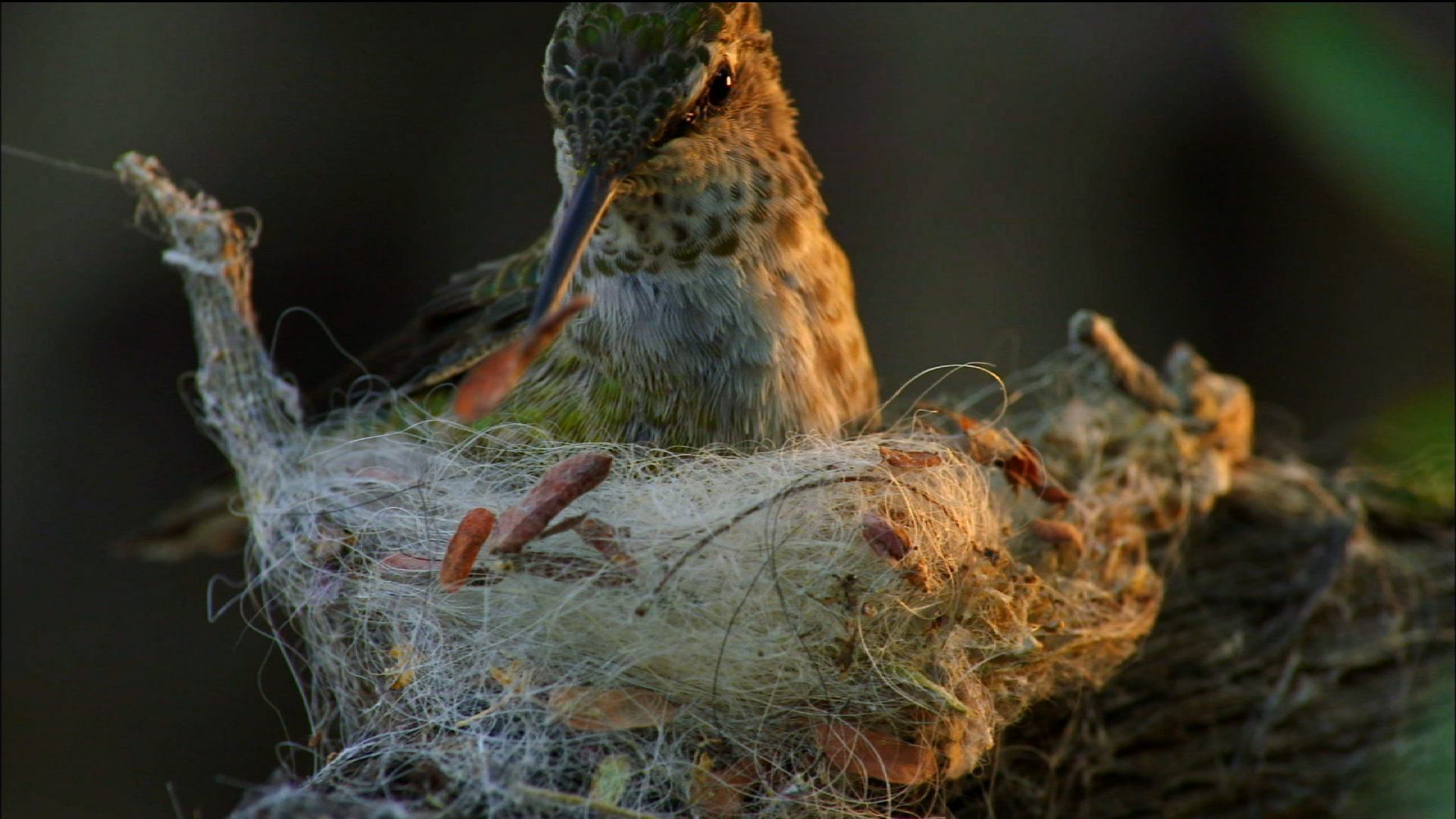
the female sits there and plucks down from her own breast, creating this big blanket. And, sometimes, when she leaves the nest, she'll even pull this blanket over the eggs, to keep them warm. Really important, when you're from a place like Alaska. This is really the minimalist approach to a nest. Just a dip in the ground, a small wall to help prevent the eggs from rolling out. It's the nest of the Arctic tern, from the wild coast of Nova Scotia. These eggs have these beautiful cryptic markings on them, so they're really, really difficult for predators to see. I've never been this close to one of these nests 'cause, by the time you usually get this close, the adults are dive-bombing you from the sky. This one's my favorite. Look at the size of that. It's built by a firewood-gatherer. What a perfect name. The entrance is in the roof here. There are spines all over these branches. It's the perfect fortress, really. And I love this finishing touch here. There's a snakeskin. It's almost like "Look what happened to the last guy." From the most basic... a classic bluebird nest. To the fairytale. Look at this. It's even got a rain awning. From elaborate construction -- It's made of 5,000 beakfuls of mud. To extreme resourcefulness -- Here's a boot that was found in 1899. These nests are just a small sample of the work birds do every year. Even the smallest of all builds a beautiful home. A female Anna's hummingbird plays the roles of surveyor, architect, and builder. She begins her nest with a platform of soft, fluffy fibers plucked from nearby plants. She's chosen a small tree branch that offers a bit of scaffolding to anchor her construction. Working in a circle, she uses her own small frame to shape the cup. Now, she needs a special thread to tie it all together. It's made by another skillful architect and, fortunately,
she can find it almost anywhere
spider silk. As the nest grows around her, she works the inside of the bowl with her feet, compressing the resilient fibers into a thick wool. With her needlework and footwork almost done, she begins to shingle the outside wall with lichen, seeds, and moss. And, suddenly... it's perfect, a finished little home for the tiny hummingbirds to come. There are some 10,000 bird species in the world today and each of their nests is a custom-made cradle of life. Millions of creatures enter the world from these remarkable structures and the nest will remain the center of gravity for the rest of their lives. All the colorful courting and competition, the dazzling feats of navigation, the marathon migrations,
they all come down to this
a parent's obligation to the next generation. An osprey has just arrived home for the nesting season, to a secluded cove on the Connecticut coast. He's flown some 3,000 miles, all the way from South America, to reclaim a nest he built here 4 years ago. We can only imagine his surprise to find it completely gone.
Peeping
they all come down to this
Like many homes along the shores of the Northeast, his nest fell victim to an October superstorm. But he's one tough bird, determined to rebuild. It's only March, but time is ticking and it will take him at leasteeks to build a nest that will work this season. The good news is there are plenty of building supplies strewn around on the beach -- maybe even some from his old nest. Some mud and a little seaweed provide a dab of mortar. He could use some help. He and his mate of several years rendezvous here in the spring. She should've arrived by now, but she hasn't returned. His efforts have caught the attention of a new female, who's looking for a mate. To impress her, he turns his back in a possessive stance, crouching low and flexing his wings. Though younger, she's slightly bigger, as is usual with birds of prey. Now that he's gotten her attention, he has to work around her. This is probably her first nesting season, and she has no idea what to do. She retreats, to observe his progress from a bird's-eye view. Gradually, the nest begins to take shape. The young female is starting to get the hang of things, and brings in a bit of nest lining.
Splash
they all come down to this
One by one, trip by trip, hundreds of sticks pile up. It's an extraordinary effort. He's a bird weighing all of 3 or 4 pounds, yet his nest will weigh in at 400 or more. And, when he takes a break from the construction, he courts his new mate by bringing her a fresh fish. It's not just a nest these two osprey are building. By working together and sharing meals, they are building a bond that may last them for years. Their nest is now quite an achievement. In fact, it's developed into a property worth stealing.
Foreboding music plays
Tweet
they all come down to this
A trespasser has flown into their territory.
Chirping
they all come down to this
This is something our male cannot allow. It's another male and, if he can unseat our hero, he can take his nest and his female.
Chirping
Flurry of chirping
they all come down to this
Our male takes to the air in combat. The female stands her ground. She fends off a direct attack, then regains the nest.
Chirping
they all come down to this
The invader has been vanquished and our male returns home to a worthy reward. Gently, he balances on the female's back and, folding his talons, so as not to hurt her, they mate. Soon, the female will lay eggs in the home they have built and defended and then, this nest and all they've invested in it will begin to pay off. While ospreys are woodworkers, red ovenbirds are sculptors of mud and clay. On a fencepost of a sheep pasture in Uruguay sits the ruins of an old nest dome -- an ovenbird home from generations ago, now worn down to just the barest foundation. It's a secure perch with a commanding view of the open meadow.
Chirping
they all come down to this
The female flutters and calls in excitement and her mate comes to inspect the property. They're eager to close on the site and begin building here. All they need is a slight assist, from the weather.
Thunder rumbles
they all come down to this
Rain is essential for builders who work with mud. The wet red clay can now be mixed with vegetation and turned into custom-blended adobe they are skilled at shaping. Facing more than a month of construction, the couple gets to work. They keep a close watch on how big the internal space must be. It needs to accommodate a clutch of 2 to 4 eggs and an adult to incubate them. As the home takes shape, lots of other birds begin showing an interest in it. A saffron finch and a kiskadee flycatcher will mark the location. One of them might use the place next year, when the ovenbirds have moved on. But it's the shiny cowbirds that are getting too close. The glossy black ones are males, but it's the dull-colored females that seem most fascinated with the structure. The ovenbirds now spend almost as much effort defending the little house as they do building it. At last, the dome is almost finished. Only a large front opening remains when the ovenbirds suddenly begin working on an intriguing internal structure. Inside the simple dome, the birds are crafting a remarkable foyer -- a curved wall that will seal off the main section of the interior. But they leave an opening at the top of the wall that gives them access to the roomy inner chamber. The home now has an elaborate 2-part entrance -- a security measure that makes it easy to defend. It's a tight squeeze in and out, even for the owners. Both parents come and go. For the next 2 weeks or so, they will take turns incubating the eggs, shouldering the duties together, just as they have from the very moment they began to build. Building with adobe is an age-old practice. We humans have been using it for some 10,000 years. But imagine a much older architecture, structures older than dinosaurs. On the floor of a dark tropical forest in Australia, there are modern creatures that have revived the art of these ancient nests. This is an Australian brush-turkey. With his dramatic yellow wattle and bright-red head, he's a colorful character, but, despite his looks, he's not a close relative of the turkey, at all. He's from an entirely different family -- the megapodes, the original bigfoot. He's using those big feet to kick up leaf litter into an enormous pile that can reach 13 feet across and 4 feet high. This is one gigantic nest, and it belongs to this brush-turkey, alone. As a territorial male, he will build the mound and tend it for the entire nesting season. A female, with her more demure yellow collar, has been observing on the sidelines and now jumps in to do a little excavation of her own, in anticipation of egg-laying. Not all megapodes build mounds, but the brush-turkey specializes in it. Sometime in the distant past, they departed from their ancestors' tradition of sitting on eggs to incubate them. They turned to another source of warmth. As this giant pile of sticks and leaves decays, it heats up. Brush-turkeys can tell, to the very degree, whether it's warm enough to incubate their eggs and she takes the mound's temperature with her sensitive beak. It's a go. This is what the male has been waiting and working for. But he's so anxious and excited, he can't leave well enough alone. She's in no hurry, laying one large, white egg with each visit. She may contribute several eggs to this nest before moving on to another, and the eggs may not even be his. As soon as she's up, she tries to bury the egg deeper, but the male insists on doing it himself. Every egg is carefully distributed. The mound may contain as many as 50 eggs, that come from several females, placed less than a foot apart and arrayed in a circle 2 feet below the surface. Now, the mound acts like a giant compost heap, generating so much heat that the eggs incubate in place without ever being touched by a parent. But the temperature is all-important. It must be kept precisely between 9 and 9 for the embryos to develop. Outside, the male monitors the mound, constantly checking its internal temperature, adjusting the decaying vegetation to keep it just right. Each egg must incubate for about 50 days, until, deep in the mound, a brand-new dinosaur-like foot appears. Once out of the egg, the chick must struggle to the surface all on his own. There will be no parents to greet him. The incubating mound freed them of all further parental duties. One by one, the little brush-turkeys set out on their own, foraging in the leaf litter for insects to eat... instinctively using the footwork they will need to build their own mounds in the future. Now, this mound may look like it belongs to a brush-turkey, but it's for a slightly different construction project. Okay. Everything a nest-builder could need, right here. My production team has gathered all sorts of materials -- Oh, this looks good. And challenged me to build a nest. Yep. I've never actually done this before, believe it or not.
Chuckle
they all come down to this
Birds, of course, have to do all the collecting for themselves. And, while I'm crashing around in this brush, they are very selective about what they choose. After all, they have to carry every bit of material back to the site themselves. Let's see what we can do here. How hard can this be? A little foundational framework of sticks. Hmm. No, that's not going to work. I'm struggling to get something going, here, and I've got two hands and opposable thumbs. I can't believe they do this with just a beak and their feet. They make this look so easy. The truth is, they, too, have to practice. It can take a young bird several seasons to get it right. I'm understanding that completely. Third time's the charm? Here we go, some slightly smaller pieces. Kind of interlace it as I go. Not quite sure how to deal with the floor of the nest. That could be an option. This is an afternoon's work for me, but birds can spend weeks on a project like this. Oh, ivy. Yes, ivy, to bind it all together. Let's do a weaver-bird number. Oh, yeah. Oh, yeah. Look at that. Once the outer structure is fairly complete, birds shape and weave a soft inner cup to cradle the fragile eggs. It's starting to look very cozy. I'd make a hummingbird proud. And, as some nests are part of the courtship ritual, there's often a bit of decoration, an original touch. This will bring in the ladies. All right. I'm feeling pretty good about my little nest. I'd love to know what a bird would make of it, but the next-best thing may be Professor Corey O'Hern of Yale University. He's a structural engineer who's finding out some surprising things about how birds build. -So, this one's a modern artist. I brought some nests for Corey to put through the lab's nest-testing machine. It's a crusher that measures structural stress -- that's how much force it takes to distort and, ultimately, destroy a structure. The same principles apply to bridges and skyscrapers. Here's a traditional robin's nest. This particular nest has a lot of weaving. The small fibers are taken around the nest in a circular fashion and they're going in and out of the other fibers. Even though each fiber is very flimsy, if you mat them together, if you weave them together, it can be very strong. -And beneath the weaving is an inner cup of dried, packed mud that gives the nest walls a lot of additional strength. How about this guy? Ha. It's the not-very-imposing nest of a catbird, but it's got some surprises. I mean, one thing that strikes me about this is just how featherlight that is, you know? You can see, again, the key feature is that the fibers are interwoven, so, one thing that's important is the numbers of entanglements and crossings. -Weaving is the secret to a nest's success. It's all the ways that strands cross back and forth and lock together that give nests such impressive structural integrity, from the giant sticks of ospreys to the spider-silk thimbles of hummingbirds. One thing that I do is I do computer modeling. I can't create in the computers, yet, structures that rival these, in terms of strength. So, even though we call them "bird brains," they have some innate knowledge of building that we can't master. -Yeah, it's really fascinating. I'm dying to get them under the machine, to see how they compare. Time to put a nest to the test. Oh, it's going. Wow. And... we squash it. -Okay, so this nest can sustain about 12 Newtons before it breaks. -That's about 2.7 pounds of force. That's still fairly impressive. Before it was put in -- -But the surprise is that the whole structure, dry and brittle as it is, just seemed to bounce right back into shape. It was resilient. -There's a lot of spring to this. Now, the robin's nest. Oh, wow! -So, I think it's broken. There was a peak stress of around 40 Newtons. -That's engineering-speak for being nearly 3 times as strong as the catbird nest. But this one cracked completely. You know, the mud casing broke. Now, you see some of the internal structure of the nest. Here's the ball, where the bird sits, but, now, you can clearly see the mud packing. -Right, and that's where that additional strength over the other one is coming. And, now, my masterpiece. -Oh! It looks like a Christmas wreath. Okay, here we go. It's lowering. It's made contact. We're at the previous levels. We're at 25. -Wow!
Snap
they all come down to this
-Oh! That didn't sound good. But it seems to have withstood quite a good deal of pressure. What did it get up to on...? -It was around 70. Was it really? -Yes. Not bad. That's about 15.7 pounds of force. Well, what's your assessment of my nest, then? -Um, I think you cheated, in several ways. Let's analyze this nest. So, first, you're using very long, almost branches.
The key issue is
what can the robin, what can the catbird use? They can only use a small fraction of the weight of themselves, and so they're using fibers and twigs. Another thing that I notice is that you're using ivy to wind, presumably, with your fingers -- -No one said I couldn't do that. Around these large twigs, whereas a bird, all it has is its beak, and so you should've made this nest with your mouth and no hands. -To be fair. Okay.
That's the brilliant thing about birds' nests
the materials are light and weak, and yet, when crafted by a well-practiced beak, they hold up to all manner of wind and rain, sometimes for years. It's late May at the osprey cove on the Connecticut coast. For 8 long weeks, the female has been confined to the nest, incubating this year's clutch of two eggs. She turns them, while keeping her sharp talons carefully away, and settles back down. Until... a baby osprey emerges from beneath her. But it's not the first chick in the nest this season. House sparrows have moved in, tucking their own nests deep inside the osprey's stack of sticks. They can have from two to four clutches a year. So, the once solitary house high on the pilings has become a lively residential complex with little sparrows chirping constantly and darting in and out. Sometimes building a nest is just the beginning of a complicated life with the neighbors. The adobe dome of the ovenbirds is being tested by the elements.
Thunder rumbles
That's the brilliant thing about birds' nests
You might imagine that a mud home would melt into quite a mess in the frequent spring rains, but, once dried in its finished shape, it's almost as hard as concrete. As the weather clears, the ovenbirds drop their guard, and both come out to feast on insects and invertebrates that emerge after a downpour. It's just the opportunity a cowbird needs. Cowbirds have been hanging around the adobe homestead like a dark cloud, despite the ovenbirds' efforts to shoo them away. And, with both parents out of the house, a cowbird female darts in. It's not what you think -- she's no predatory egg thief. She doesn't want to raid the nest. She wants to add to it. Cowbirds make no nests of their own and must use someone else's. She's back out in a flash, having just laid an egg next to those of the ovenbirds'. Her plan is to have the diligent couple raise her chick, incubating it in their cozy home, both working hard to see it fledge. It's a strategy that often works for the cowbird. But not always. Once back in the nest, the ovenbird senses something's up. She's detected the strange egg. It's just a bit smaller than the ones she laid. She hesitates for a moment. And then evicts it. The home invasion has backfired. The ovenbirds' nest is still secure. The cowbirds must turn elsewhere. And, just across the border in Argentina, chalk-browed mockingbirds are high on their list of likely foster parents. Their sturdy bowls of tightly packed twigs are tucked in all through the thorny scrub that dots the open grassland. The female can lay up to 4 lovely speckled eggs, one per day. She'll incubate them for 2 weeks, taking brief breaks to find food. The deeper the nest is in the brush, the harder it is for predators to find, but the cowbirds have been keeping a close eye on their comings and goings. A mockingbird nest would be the perfect place to leave their eggs, if they can just get past the vigilant homeowners. In the darkness just before dawn, the cowbirds make their move. With infrared cameras, we can see the mockingbirds are already up, agitated, ready to fend off the assault. As a mockingbird chases one invader away, another seizes the moment. In seconds, the cowbird slips in and out, laying a small, round egg right next to the mockingbird's larger, oval one. And, in nest after nest, other cowbirds do the same. A mockingbird returns just seconds too late. She hesitates for a moment, then turns the egg, as though it were her own. But timing is everything. If the cowbird is caught, there's hell to pay. The mockingbird is furious.
Squawking
That's the brilliant thing about birds' nests
Yet, intent on her purpose, the cowbird still manages to lay her egg.
Suspenseful music plays
That's the brilliant thing about birds' nests
But, having witnessed the crime, the mockingbird won't stand for it, and she removes the offending egg immediately. And so it goes in the thorn thickets as dawn approaches, the cowbirds sneaking into nests... the mockingbirds, screaming their objections.
Squawking
That's the brilliant thing about birds' nests
Until one actually picks up the invading egg-layer and throws her out of the house. Here's that again. As day dawns, the mockingbirds settle in on their eggs, turning them and keeping them warm. But, in nest after nest, there are eggs that are just a bit different. In the daylight, we see they're all speckled, but some are a little smaller and not quite the same color and, ingeniously, these are the eggs that hatch first. From the smaller egg, a little cowbird has emerged to get a head start over the other chicks. It's utterly dependent on its mockingbird parents. And, as their other eggs begin to hatch, they set about hunting for them all. The gaping pink mouths belong to the baby cowbirds. The yellow mouths are little mockingbirds. It's an intense time. In 13 to 14 days, all the chicks will fledge. Throughout the thorn brush, mockingbird parents work hard to fill the hungry mouths, but that leaves many chicks home alone, waiting for the telltale sound of a returning parent. Their only defense is to lie low and keep quiet, but sometimes, nests meant to provide safety and security can just as easily become a deathtrap.
Flurry of chirping
That's the brilliant thing about birds' nests
The liophis snake makes off with the bigger mockingbird chick, leaving only the terrified young cowbird for this mother to raise. Even after the chicks have fledged, the mockingbirds provide for them for another week or two. Mockingbird parents and their cowbird chicks perch together in the brush, neither noticing what an odd little family they make. Yet, the chicks will take up the battle finesse and furious combat when it comes time to lay eggs of their own. The osprey nest has produced two healthy chicks this year and, by the end of July, they're as big as their parents. But their bright-orange eyes have yet to turn the pale yellow of an adult's... and their feathers are still trimmed with white, marking them as juveniles. Though they've already been taking short flights to the dock and up to the branches all around their cove, learning how to master their almost-6-foot wings will take a lot of practice. Not all their flights look entirely on purpose... and they're still tied to the nest, crying like babies for their father to bring them fish. As always, he answers their calls. It will be another month before they can truly fish for themselves, and so the nest remains the center of the young ospreys' security and support. Their mother perches nearby, watching over them. But her long ordeal at the nest is over until next year. Now, the youngsters must build the muscles to power their mighty wings. That will take a few more weeks, yet. But, then, they will finally leave the only home they've ever known. It's now the end of February on the Connecticut coast. In a week or two, birds will start arriving from wintering grounds far away. Our osprey may already be on the wing. And this is where they'll come back to, this very nest. After all, they're coming home. An osprey can live for 25 years, so our male will come back here and have many more families over the summers to come. And, three or four years from now, his chicks will come back and try their hand in the same territory, so, in some ways, they never leave home; this becomes the family cove. Home. What powerful feelings that evokes. And a nest is a place of such ancient origin, such promise for the future. It has a hold, even on us. And it's no wonder. Deep in our primate past, we, too, once lived in trees. Like so many birds, we found food there. Perhaps the figs were fruiting, and we followed the ripening feast from tree to tree and it's here we began to build. In the shelter of the upper branches, beyond the reach of lions and leopards, we made nests, our first rustic homes. They may have served us for just a night, a comfy hammock, suspended in safety, so we could sleep. And, all these eons later, there is still nothing better, at the end of the day, than jumping into our very own beds and feeling safe and secure at home. They're nature's architects is available on DVD.s prm To order, visit... or call... To learn more about what you've seen on this "Nature" program, visit pbs.org.









 Passport

















Follow Us