Lights in the valley outshine the sun Lights in the valley outshine the sun Lights in the valley outshine the sun Way beyond the blue Way beyond the blue, one more time And it's way beyond the blue An old friend lay on his dying bed Held my hand to his bony breast And he whispered low as I bent my head Oh, they're calling me home They're calling me home (Melancholy accordion) The time has come to sail away I know you'd love for me to stay But I miss my friends Of yesterday Oh, they're calling me home They're calling me home I know you'll remember me when I'm gone Remember my stories Remember my songs I'll leave them on earth Sweet traces of gold Oh, they're calling me home They're calling me home (Melancholy instrumental) So friends, gather 'round And bid me goodbye My body's bound, but my soul will fly My little light shining from the sky Oh, they're calling me home They're calling me home The time has come to sail away I know you'd love for me to stay But I miss my friends of yesterday Oh, they're calling me home They're calling me home - So, it was 2014 when I first came across the Carolina Chocolate Drops.
- I didn't know that.
- I was in Italy.
I was a student of--nerdy student of-- jazz history, and I came across an article talking about the Carolina Chocolate Drops, and talking about the black band.
And I was like, the black string band?
Oh my God, I never heard about this!
'Cause nobody talked about it.
And for me, it was almost this idea of the missing link in the history of jazz, right?
'Cause nobody talks about strings.
Everybody's obsessed with the-- - I know, it's always the horns, and the jazz band, yeah.
- The brasses, and all that kind of stuff.
And it was only, I think, a year later that I discovered that you were living in Ireland, where I was living at that stage.
I started brewing in my head this idea of Mediterranean sounds, which is the stuff that I've been exploring, connecting Southern Italy to North Africa, to the Middle East.
And I wanted to hear those sounds connected to early American music, and early African American music, which is the stuff that I heard you doing.
So that's when I took the courage and wrote you an email, like, a cold email, like, "You don't know me but I have this idea.
Would you like to get together and try to play some music?
" And you didn't answer the email.
But you know, I just said, okay, I'll give it a couple of weeks.
I'll try, you know, she's busy, and if she doesn't answer, then I'm not gonna be a stalker.
But I tried a second time and you said yes, that's totally what I'm interested in.
You know, let's try to get together.
So we got together, and we had a jam one afternoon in Dublin in 2015, and I recorded the music, and I listened back to the next day, and I was like, oh my God, we're onto something here.
This is super cool.
Let's try to get together and play.
And I tried to arrange some gigs, but it just never worked out.
- Well, at that point the Chocolate Drops were, you know, we were kind of at a crossroads.
But then I had the opportunity to make a record with T-Bone Burnett.
A solo record.
- What was the trigger for you though, to go from this idea of the string band, into "I'm a solo artist"?
- Well, it was really hard because, you know, I was like 36, I guess, at that point.
And I had just been really committed to the string band for like 10 years.
You know, I'd been committed to black string band music, to Joe Thompson, the story, and kind of actively resisted being sort of pushed out into the front, which... that was always the temptation, because I was the woman, and pretty, and the singer.
And you know, there's always a temptation to sort of pull that person out in front of a band.
And so I really resisted that for the whole time I was in the Drops, you know?
And so the idea of kind of stepping forward as my own thing was really kind of weird.
You know?
It was one of those moments that... you look at the crossroads, and you're like...there was...
If this hadn't happened, but there was the direction that I ended up taking because it did happen.
And that was when T-Bone Burnett, who was, like, a massive producer and a huge figure in Americana, you know, just American music, asked me to do a solo record.
And so, and as he puts it, he was basically taking the bushel off of my head.
I'd been kind of doing this a little bit, kind of hiding in the band.
- So two years went by between that first meeting... - I had done the first record.
- A lot of stuff happened, right?
- "Tomorrow's My Turn".
And that kind of, you know, that did really well.
And then I did...
I was in the process of doing "Freedom Highway," I think?
- What's "Freedom Highway"?
How is it different from your first record?
- "Freedom Highway" is an album that was very tied into the history of African American culture.
And it was...I guess you'd call it an activist album.
And it was really very engaged with themes of slavery, civil rights.
- It's also a much more, maybe "rootsy" album, isn't it?
Like more acoustic?
- Yeah, I think so-- - The way it's recorded.
- Yeah, it was kind of a live feel.
You know, we went down to-- - Doesn't have the big studio feel that maybe the first record has more of.
- Yeah.
I mean, when I did the record with T-Bone, it was like, you know, here's these famous people that I work with, and I was like, oh my God!
And then with "Freedom Highway", I really wanted to do my thing with my people that I had been playing with and kind of working with.
- 'Cause that was your band?
- It was my band, yeah.
So instead of sort of studio musicians, which is a totally legit way of going, I wanted to do something totally different and play with my group that I... you know, that's kind of what I do.
- So when we connected, you were in the middle of touring that album, and I remember literally the second day of our conversation, you asked me if I wanted to co-write a ballet with you!
You know, and I was like, lemme check my diary.
Yes, I'm free.
I actually wasn't free at the beginning-- - You weren't free, yeah.
- But we made it work.
And I think that's kind of the beginning of our collaboration, because we had only played once together, and we kind of knew that it worked, but not really.
- Yeah.
- We could imagine that it would work, because all the genres, the music, (again, we hate genres) but the idea that we played and we studied kind of rubbed shoulders against each other, but they don't overlap at all.
So there's no given that this was ever gonna work, right?
- For me, this was the first moment of... you know, I'd been pretty firmly ensconced in the commercial music world, the folk world, Americana, country.
And I hadn't really done much...
I've done the occasional orchestra show, you know?
Because of course my, you know, degree is in performance, vocal performance, so, opera, and art song, and classical music.
- So that's the comical thing, right?
I'm the Italian guy who studied jazz piano at conservatory, and she's the American woman who sang Italian opera at conservatory.
And we ended up like swapping paths.
I was like, okay.
- But I hadn't really had much opportunity to touch foot in that other world of opera, ballet, and classical music very much until this opportunity came.
Nashville Ballet, Paul Vasterling asking me, and Caroline Randall Williams, the folks who made this ballet, asking me if I wanted to contribute.
You know, we had just started talking again.
And it was immediate to me.
I was like, here's the connection.
Like, this is instantaneous.
- I think it was an amazing excuse to just put on the table everything that we both had.
Because when you first asked me, and you told me this is a story about Shakespeare.
So I've studied baroque music as well as jazz, which is already a bit of an odd combination, and you know, there is folk music in it.
It just had everything that I'm interested in.
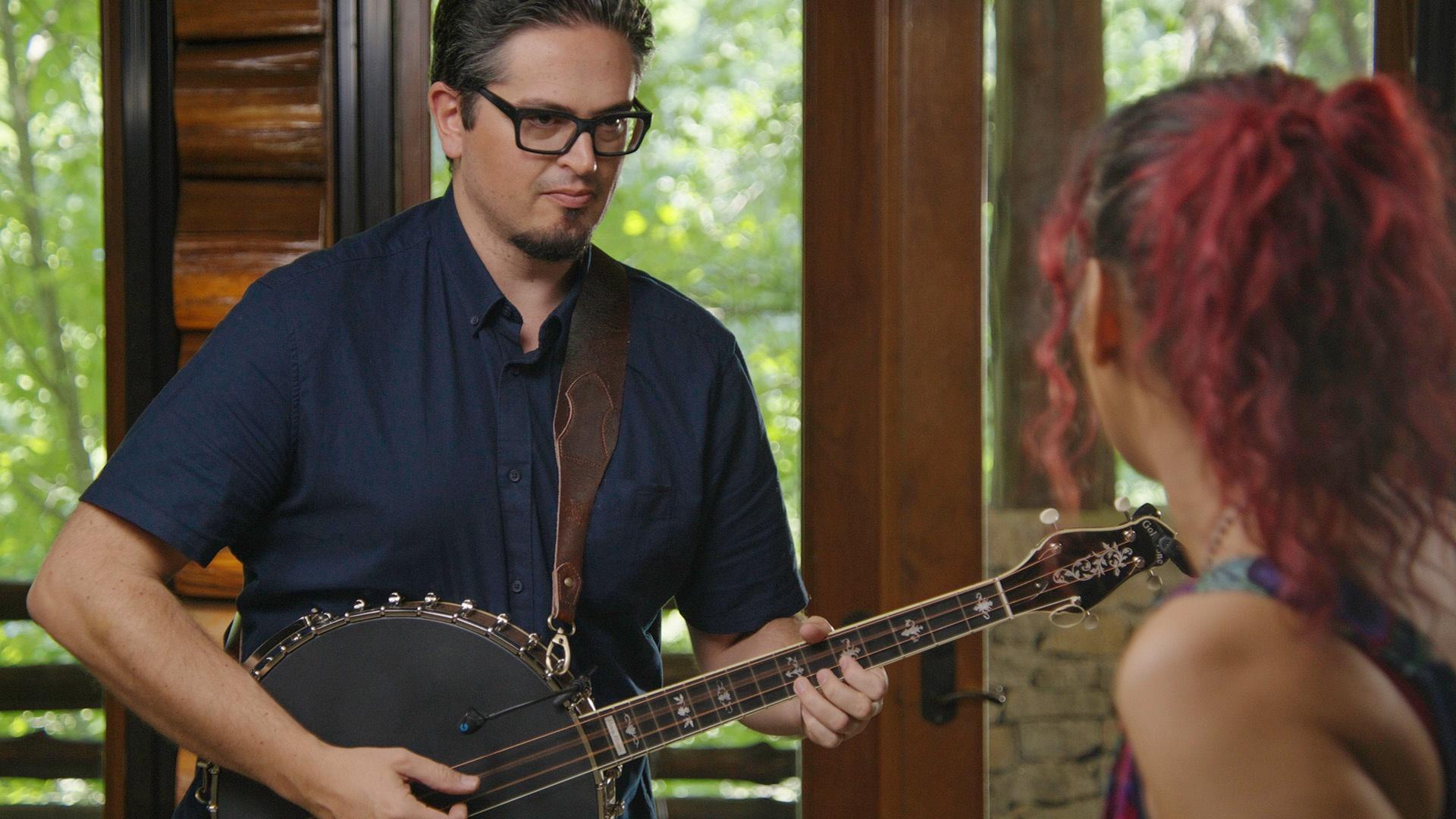
- And that's where, when you visited me to work on the ballet, that's where you picked up for the first time an instrument that you now use a lot.
The cello banjo.
- That instrument for me really represents who we are and what we're doing, because I'm not a banjo player, so I don't play five string banjo, but that one has four strings.
So it relates more to the guitar, which I played in the past.
But to me, the amazing thing was that it sounded like a lute.
For that ballet, it was perfect.
A lot of pieces were written on that instrument.
- And now you've been stretching out and doing blues.
- Now I just feel like it's the instrument I wanna work on, you know, and I found my own tuning, and I love it.
It's a very, very interesting sound.
And it's bye bye, pretty baby Baby, bye bye And it's bye bye, pretty baby Baby, bye bye Well, if I never see you anymore May God bless you wherever you go And it's bye bye, pretty baby Baby, bye bye Well I'm leaving, sweet baby But I can't carry you Yes, I'm leaving Sweet baby Don't you wanna go?
Well, if I never see you any more May God bless you wherever you go And it's bye bye, pretty baby Baby, bye bye (Rhiannon's voice imitates a muted trumpet) (bass break) Well, I tried to tell my sweet papa But he didn't understand Well, I tried to tell my sweet papa But he didn't understand Well, I tried to tell my sweet papa But he just did not understand And now he'll realize the trouble Now that I've found another man Oh Well it's bye bye, pretty baby Baby, bye bye Yeah Well it's bye bye, pretty baby Baby, bye bye Well, if I never see you anymore May God bless you wherever you go And it's bye bye, pretty baby Baby, bye bye I said it's bye bye, pretty baby Baby, bye bye I said it's bye bye, pretty baby Baby, bye bye - I studied jazz in conservatory in Holland, and Baroque music, but I also did a lot of research in Italian traditional music, Southern Italian traditional music.
And for me, a big focus of my research has been trying to find the connections between Southern Italy, North Africa, the Middle East, and the Mediterranean.
All these places are very, very deeply connected, you know?
And heavily connected.
And how the histories around where things came into Europe have been erased.
- I think it's one of the reasons why what we do works so well, because we're both telling the same story.
You know, when people talk about American musical history, they like to separate things out, but the reality of it is that it's much more mixed.
The reality of it is that African American contributions are much more strong and varied than people think.
People like to go, oh, it's just blues and jazz.
And it's like, well first of all, jazz isn't a monolithic black creation either, right?
Because there's all of the stuff that went into the making of jazz, and that's changing now.
People are educating about that, and learning more.
But when you look at just kind of how things have been taught and talked about, that's kind of the situation.
And it's a very similar way where people just kind of ignore how much came to Europe through... from the Middle East.
- Pretty much every instrument we play came with the Moors into Europe, you know?
Or was developed from something that they brought over.
Like, I always say as a joke, pasta was brought to Italy by the Moors, you know?
Italians are definitely not ready to hear that story.
It was great for me to discover that it was actually Italians and Italian Americans who introduced the piano accordion to the United States, and that they were superstars in the twenties and in the thirties in the vaudeville circuit, that now most people associate only with polka really?
- Yeah.
And a joke, you know?
Like it's kind of a jokey instrument, the way that the banjo has has been for a long time.
And it's amazing when you think about the 180 degree change on that, because when you look at the banjo, the banjo was everywhere.
Like, when you look and you start getting into the late 1800's, turn of the century.
Like, banjos were all over the world.
Like, every English colony, every English speaking country, banjos were--and ones that didn't-- you know, also other countries, the banjo was so popular.
There were so many being sold.
It was in all different kinds of music.
And then it just kind of has this turn.
It's so interesting how fast it could happen, 'cause a generation is like, what, 18 or 20 years?
And, you know, you can have a complete shift in that time of what the expectation of the instrument is.
- So with all this in mind, it was I think 2018 when we went into a studio to finally start recording together.
Yes, and it was interesting, 'cause I didn't know what we were gonna do.
I just brought a carload of instruments, 'cause I own a lot of instruments.
And it was like, so what songs are we doing?
It was like, I'm not sure.
Bring everything.
- You're a good sport.
It could have broken up another couple!
You know, we started touring with Jason Sypher, our beautiful friend and bassist.
And it was, it was kind of going back to that string band, that kind of tight feeling of just sort of being with two other people, or three other people, and sort of creating this world rather than having somebody on the drum kit and electric guitars, and this sort of big feeling of texture, and electric sounds and things.
And this was more like-- - Acoustic kind of intimate music.
During the pandemic, obviously one of the themes behind the feeling of lockdowns was not to be able to go home, and us trying to recreate things that we missed the most from our homes.
So I obviously brought some music, I think, to the table, but this in particular, this song "Quante stelle nel cielo con la luna" we started doing during those pre-records and live streams.
And it's a song, it's a beautiful love song that I learned from Lucilla Galeazzi, who is an incredible traditional singer who I've been working with in the past a lot.
I call her my aunt, "Zia Lucilla".
(laughs) And we, I brought it in, and you loved that song right from the start.
- Oh yeah.
I was kind of like, you brought it to me, but then I kind of sat with it, and I was like--and then I came and I was like, "Let's do this song"-- - Yeah, I think you decided to learn it and to do it.
Yes.
- Yeah, 'cause it's so beautiful.
I love it so much.
And it's kind of like one of those things, it's like, you know, when we're doing a blues, like, that's, you know, or a jazz song, that's something that you learned in school.
And then when we're doing something like the Italian song, I learned how to pronounce Italian in conservatory.
And I use a little bit more of my classical voice for that song, because it kind of needs it So again, we're kind of crossing over.
(laughs) - Yes.
- You know?
- And we also use the cello banjo.
It definitely doesn't belong to Italian traditional music.
- It's all mixed up.
- That's what we do.
Quante stelle nel cielo con la luna Sono luci che accendono no amanti E pi brillanti sono e pi penso che Quelle stelle brillano per me e per te Amore, amore Amore a perdifiato Quante volte di notte t'ho sognato E t'ho cercato dal mare fino al monte Come assetato cerca la sua fonte E quando lo trovavo Come un vento di primavera Sfiorava la mia mano Poi di nuovo lontano era Amore, amore che inganni Profumi d'aria di maggio Ti tocco, ti credo vero Svanisci come un miraggio Amore che viene e che vai Come una cosa leggera Ah Ah Non andare via Amore, amore per te ho messo un fiore Nel mio giardino s' sparso l'odore E giorno e notte io l'ho ben curato E questa volta il fiore non s' seccato E l'ho curato con l'acqua di fonte Io l'ho difeso dal vento del monte E l'ho nutrito a tutte quante l'ore Amore, amore Amore, amore Amore E quando lo trovavo Come un vento di primavera Sfiorava la mia mano Poi di nuovo lontano era Amore, amore che inganni Profumi d'aria di maggio Ti tocco, ti credo vero Svanisci come un miraggio Amore che viene e che vai Come una cosa leggera Ah Ah Non andare via Ooh... (logo boings) (logo whooshes)








 Passport








Follow Us