










PBS Wisconsin Passport
Watch this video with
PBS Wisconsin Passport
Become a member of PBS Wisconsin, support your local community, and get extended access to PBS shows, films, and specials, like this one.
Robert Bly: A Thousand Years of Joy
10/19/20 | 58m 55s | Rating: NR
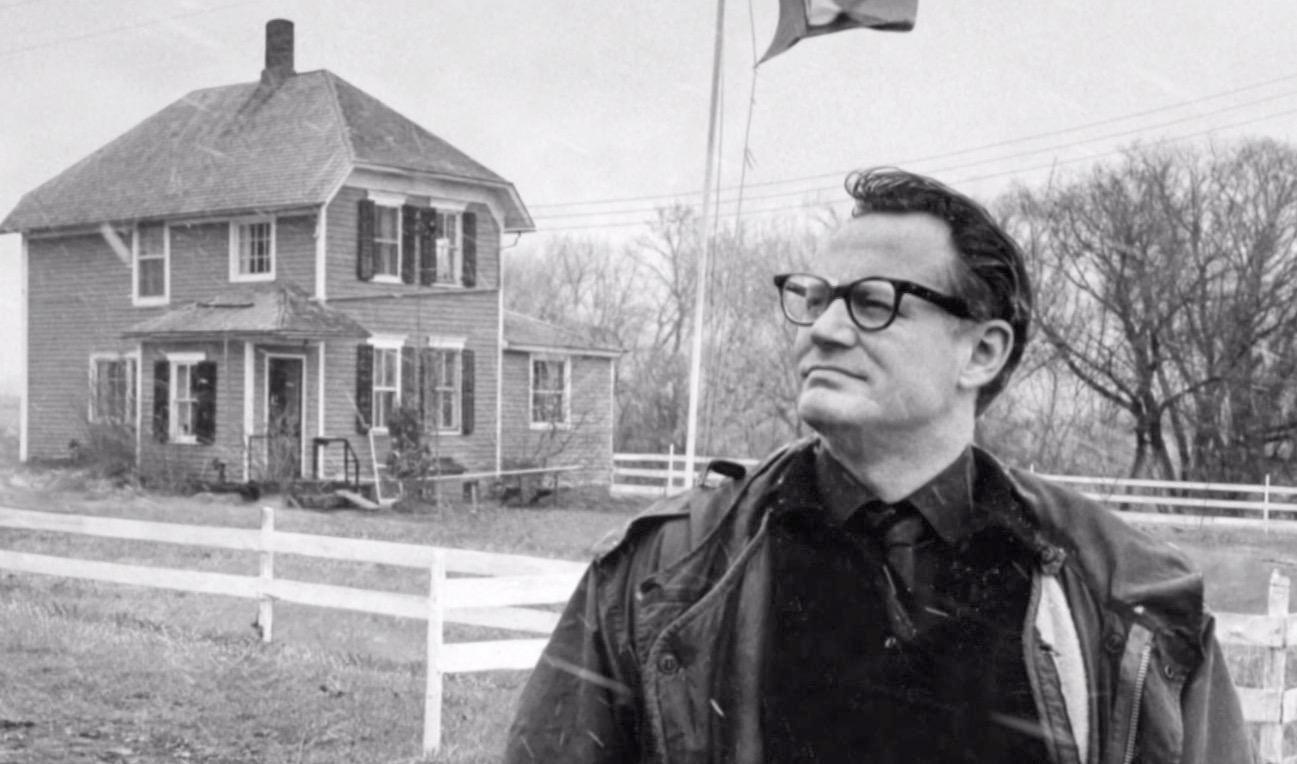
A moving portrait of one of America's most celebrated and revolutionary poets of the last half-century. The film showcases Bly's development as a writer with an unswerving belief in the importance of poetry both to his own life and to American culture in general.


Copy and Paste the Following Code to Embed this Video:
Robert Bly: A Thousand Years of Joy
(gentle music) -
Narrator
Funding for this program is provided in part by the Minnesota Arts and Cultural Heritage Fund and the friends of Minnesota Experience. ♪♪♪ Who is out there at six a.m.? The man Throwing newspapers onto the porch, And the roaming souls suddenly Drawn down into their sleeping bodies. Robert Bly -- he is, without question, one of the most influential poets in American history.
I have daughters and I have sons. When one of them lays a hand On my shoulder, shining fish Turn suddenly in the deep sea. Robert was a father figure to a lot of us. We really saw him as a threat to the feminist movement.
Perhaps our life is made of struts And paper, like those early Wright Brothers planes. Neighbors Run along holding the wing-tips. Spiritual reverence and political activism operate together in his work. It's part of what makes him such a contradictory character.
No one quite has a handle on Robert. I do love Yeats's fierceness As he jumped into a poem, And that lovely calm in my father's Hands, as he buttoned his coat. ♪♪♪
Explosions
1968, the deadliest year for U.S. forces in Vietnam. More than 16,000 Americans are killed in action. Back home, opposition to the war grows more public and more confrontational than ever before.
On March 6th, 41-year-old Robert Bly steps in front of an audience of black ties and sequined gowns to accept the National Book Award in Poetry for his collection "The Light Around the Body." This is what he said at the ceremony. These are the first lines. "I am uneasy at a ceremony emphasizing our current high state of culture. Cultural events, traditionally, put writers to sleep, and even the public.
But we don't want to be asleep any more. Something has happened to me lately. Every time I've glanced at a bookcase in the last few weeks, the books on the killing of Indians leap out into my hand." This is an amazing speech to make at an awards ceremony because it says, "Look, our culture is complicit, and we can't go on pretending that we're just having literary, cultural events which are separate somehow, in some way, from our actual American history." But what Bly had planned next would be his grand statement of the night. And I went to the resistance people, and I said, "I know how you can get $1,000." They said, "How?" And I said, "Well, they're gonna give me a check tomorrow night, and I'm gonna turn it over to you guys, so I need you to come up when I call you on the stage.
You have to wear a suit." One of them said, "I know someone who has a suit." It was at a time when the Chicago Seven were all threatened with jail, Dr. Spock, for being against the war. It was for publicly supporting young men who did not want to fight. At the ceremony, Bly and the other recipients had been forewarned that FBI agents would be in attendance.
He called up a young man from the audience, gave him the check, and said, "I advise you now to resist this horrible war." That was a direct invitation -- "Arrest me." People were cheering. They were standing up -- not everybody but most everybody. We became aware that about 10 men in black suits rose up and walked out. Robert Bly was not arrested -- not that night.
If you ask yourself why Robert never became the poet laureate, you might as well ask why it doesn't snow in July in Fresno. I mean, that question is foolish. They'd pick a guy who's supposed to advance poetry, not advance politics. Robert does not see the two separate.
He can't see the two separate. For him, as an American poet, it's always been very important to mind two sides of the self -- a politically engaged, responsible citizen and an interior mystic.
Birds chirping
Engine starts
♪♪♪ I remember I was a high-school kid, and, you know, I was a farmer's son, and I found the "Rubaiyat of Omar Khayyam." ♪♪♪ I was plowing in a long field and would memorize one quatrain of Omar Khayyam every time I came. ♪♪♪ One time I got so fascinated by what was in it that I kept going and drove into the ditch and turned the tractor over.
Chuckles
Then my brother and my father had to come and humiliate me, you know, by pulling up the tractor, but that was my first inkling event, and I responded by turning the tractor over. That wasn't bad. That was all right. ♪♪♪ The poetry of an 11th-century Persian philosopher was an exotic and enticing contrast to the Norwegian Lutheran community in which Robert Elwood Bly grew up.
Born two days before Christmas 1926, his mother, Alice, took care of him and older brother James while his father, Jacob, worked the family farms outside of Madison, Minnesota. ♪♪♪ Everyone knew everyone else. There was a certain friendliness, a certain family feeling, in that town. I still can close my eyes and see Robert and his brother, James, standing beside my desk.
He looked like the all-American boy of the '40s. I remember there being a number of very fine students. But he was always at the top. ♪♪♪ He would write beautifully.
He had a great command of the English language. A growing talent nurtured at home by his mother, Alice. I think that he and my grandmother were very close. You know, he had a sense that she cared for him a lot and protected him and that he was
Chuckles
different in a sense that he was always interested in literature. The young Bly spent his time reading Wordsworth and Longfellow while working his father's crop fields with his brother, James. What was the farm like? It was heaven for boys, especially threshing time, when five or six farmers would get together, and there you were, moving from one farm to the other.
You could see all of those. And you were associating with older men, and you tried to work well so one of them would admire you. And, uh... it was terrible to have to leave that and go to school.
♪♪♪ There is a time. Things end. The fields are clean. The belts are put away.
And the horses go home. What is left endures In the minds of boys Who wanted this joy Never to end. The splashing of hands,
Jokes and oats
It was a music Touching and fervent. The Bible was right. Presences come and go. Wash in cold water.
The fire has moved. Robert is, in one sense, a life struggling against the America that he found himself growing up in, with its limitations and its strictures and its allowances, particularly for men -- what you were allowed to feel and say. ♪♪♪ James Hillman said, "You know, every father comes into the world with a certain way that he wants to father. And every son comes into the world with a certain way that he wants to be fathered.
And what if they don't match? I was out in the field. As a farm kid, I was waiting with a pickup, and I was listening to some music, pop music. And so I suddenly realized that if I didn't do anything, I'd be listening to this pop music for the rest of my life.
I went and enlisted in the navy the next day. Bly had to lie about his age. He was only 17 when he graduated high school. After training for two years as a naval radar technician, Bly was honorably discharged in 1946, a year after World War II ended.
I was in the Second World War, like a lot of the men in my generation. When we got out of that war, we wanted to do something important or serious. In 1947, 21-year-old Robert Bly was admitted as a sophomore to Harvard University. I had thought I might become a doctor, but I didn't know.
And then I met some people who had intended to be poets since they were 15 years old... and thought of poetry as a profession. This group of young poets at Harvard -- Frank O'Hara, Kenneth Koch, John Ashberry -- they're all there at the same time. And Bly is their equal.
The Minnesota farm boy finally found peers among the prep-schoolers in the Ivy League. I first met Robert Bly in February of 1948. Actually, I call him "Bob," and I think I'm the last person allowed to call him "Bob." I found out he was a poet, and we started showing each other everything that we wrote and rewriting each other. But there was no humor, nothing flamboyant.
He was very conservative. He wore a 3-piece suit, and he hardly opened his mouth. He would talk like this. He was very solemn.
Jung says it very well. We have a persona first. And a persona is your personality that your parents like in you. It's what your teachers like in you.
And this is why, in college, we come out of college with this extremely heavy persona. It's a shell around us. American poetry in the 1950s was extremely rationalistic. The mood was that poetry was not being heard and that what poetry was there, uh...
was excessively intellectual, dominated by the East Coast academics. An approach Bly had grown dissatisfied with. What we had to learn is that you forget about the future. You're writing for the people who are alive at your time, and you try to move them as much as you can.
But in the universities, they don't think of it that way. They have an insane idea that the poet actually writes for posterity, and they keep urging us to write universal poems and so on. ♪♪♪ In 1950, Bly graduated with honors. Harvard offered the promising poet a scholarship to graduate school.
He turned it down. So I decided not to go to graduate school... on the grounds that I was already too intellectual and told enough lies. You see, if you lie, you're really in your head, 'cause you got to make up the lies in there.
You understand what I'm saying? If you really try to tell a truth -- like, if I try to tell a truth about what's going on in my family -- it would have been, "Aaaaaaaah!" It would have been something coming out of my head. The problem I had when I got out of college and I wanted to write poetry -- I had to get from here down to here. ♪♪♪ From the head to the heart, a quest that led Bly to New York City, where he worked menial jobs by day and struggled with his writing at night.
I go to New York, and I live alone. My friends go off to Oxford or somewhere like that. From their point of view, I don't do anything. From my mother's point of view, I don't do anything.
From my father's point of view, I'm a flop. Robert, I think -- You find somebody who was very hungry young and spent some times in isolation and spiritual poverty looking for what would feed him. ♪♪♪ In 1955, Bly married Carol McLean, a young writer whom he had met on a blind date back in college. They would have four children together, living on one of his family's farms back in Minnesota.
He and Carol lived in Madison at the beginning... and lived without running water or without a toilet. They were living on next to nothing. A half-mile down the road from his successful father.
Robert and his father -- in our culture, that's a naturally fraught relationship, fathers and sons. It's a beautiful thing and a very moving thing, but it's fraught, and Robert's clearly was fraught. His father, of course, was an alcoholic. That was a very distancing fact.
I do not want Or need to be shamed By him any longer. The general of shame Has discharged Him, and left him In this small provincial Egyptian town. If I do not wish To shame him --" You understand? He wasn't a college person, and every time I came home and talked to him about D.H.
Lawrence and Hardy, I would shame him. Is that clear? That's how I got back on him. "If I do not wish To shame him, then Why not love him?
His long hands --" He was a farmer. "His long hands, Large, veined, Capable, can still Retain hold of what He wanted." He wanted eight farms, hmm? "His long hands, Large, veined, Capable, can still Retain hold of what He wanted...But Is that what he Desired?" Some great river of desire keeps on flowing through him. He never phrased what he desired.
He never put into language what he desired, and I am his son. ♪♪♪ While Bly's older brother works to carry on the family legacy, Bly returned to reflect on his stalled literary career. That's good.
Speaks indistinctly
Jokes and oats
I don't know. Maybe I should take the tractor out of here. In college, I was told if you want to be a poet, you have to be very ambitious and send poems to The New Yorker every two weeks. You read the Buddhists, and they say, "If you want to be a poet, you got to give up ambition, period." So, I had been reading that, and I wrote one, "Watering the Horse." How strange to think of giving up all ambition!
Suddenly I see with such clear eyes The white flake of snow That has just fallen in the horse's mane! ♪♪♪ It turned out that I knew certain words. One of them was "snow." I knew the meaning of the word "snow." I knew the meaning of the word "dust." Those words were still connected with the original childhood experiences. So, for me, going back to the place where I was born was tremendously helpful to me in getting ahold of words that were genuine and real to me.
He's not in New York, not in San Francisco. He's not part of the scene. He's just hanging out with horses in Minnesota, at a sort of crossroads in his life, thinking about, "Should I stay, or should I go?" In 1956, Bly traveled to Oslo on a Fulbright scholarship to translate Norwegian poetry into English. The trip would hold a crucial discovery.
He discovered in an Oslo library an anthology of poems, and what amazed him is he knew he had never heard of these people, nor had he heard this kind of voice. What Bly had been seeking since Harvard he finally found in the imagery of European expressionists and the playfulness of South American surrealists like Pablo Neruda. I'll never forget the first line of Neruda that I saw. Happened to be it went something like this -- "Young girls with hands on their hearts, dreaming of pirates." And it's lovely, both in the willingness to understand young girls and to talk about that and bringing in pirates.
It made a wonderful world. There's a wonderful enthusiasm for women and for life and for images and all of those things. That's what I found. These people ended up changing his view of the world, changing his voice, and he brought those voices back.
I started a magazine sheerly out of my surprise over what was in Pablo Neruda. The Fifties, a poetry journal of translations, new works, biting satire, and critical essays, was put together at the kitchen table with his wife, Carol, friends Bill and Christina Duffy, and a clear agenda. They sent their first issue to, like, all the poets around America. Caused a tremendous stir.
One of the nice things that Robert would do was to take the work of poets who he admired and who were friends of his and critique them as if they were briefly his enemies. The rejection slips were famous, and people got outraged, which was what they were supposed to do. When you're beginning to write, your persona will give you lines, and your inward being will give you lines. You understand that?
And since you don't know the difference, the poem is mixed. He began to speak about "a wrong turn in American poetry." He brought another kind of energy into American poetry on behalf of the unconscious, the irrational, an image-centered poetry, a different kind of poetry. The Bly farm became a magnet for young writers, including James Wright, who wrote Bly, praising him for The Fifties. Bly enlisted Wright to help translate South American and German poets for the magazine.
It was a dear friendship, and Jim's work changed entirely. Wright went on to win the Pulitzer Prize for his next book, which was influenced by all that time together. If I had gotten only one gift from the whole labor of the magazine, James's friendship would have been enough. Perhaps a close second would be the ongoing correspondence with a poet who admired the ambitions of his publication -- Pablo Neruda.
Bly would receive his great mentor's blessing to publish English translations of his work. I think Bly's work as a translator has changed not only how we live as readers but definitely how we live as writers, or American writers, of poetry. This is a poem by Basho, the Buddhist poet. He says this.
He said, "We are late into fall. I wonder how the man next door lives." Another translation -- "We are far into fall. The man next door -- I wonder what he lives by." You understand that? When you go into fall and you begin to realize you're gonna die and your winter's coming and the persona weakens in the fall and the man begins to face his own death and so on, and it's very interesting that at this very moment, Basho suddenly, for the first time in the whole year, wonders what the next guy, the guy next door -- what does he live by?
How does he avoid despair and all those things? How does he keep alive? ♪♪♪ Bly's coming up at the same time as the New York School poets -- Frank O'Hara, James Schuyler, Kenneth Koch, John Ashberry. He's not part of that.
He comes up at the same time -- a little bit later, but more or less, associated with the same time -- as the Beats -- Allen Ginsberg, Gary Snyder, Jack Kerouac. Not part of that. I viewed Robert as a fellow traveler and fellow worker laboring in the same vineyards but, you know, the vineyard over the next hill. They're not so far apart.
They were both reacting to the stodgy, dead academicism of mainstream 1950s poetry. The Beats just went one way with it, and Robert an Galway Kinnell and Don Hall went another way. Takes great pleasure in presenting Robert Bly, one of the most refreshing voices in the American literary scene. Poem called "Driving to Town Late to Mail a Letter." "It is a cold and snowy night.
The main street is deserted. The only things moving are swirls of snow. As I lift the mailbox door, I feel its cold iron. There is a privacy I love in this snowy night.
Driving around, I will waste more time." Bly received widespread acclaim for his first collection of poems, "Silence in the Snowy Fields." I have a crush on that book. I love it. I know that, for me, to go back to it and look at it again is a kind of inflowing of gratitude and pleasure. Oh on an early morning I think I shall live forever!
I am wrapped in my joyful flesh As the grass is wrapped in its clouds of green. Rising from a bed where I dreamt Of long rides past castles and hot coals The sun lies happily on my knees; I have suffered and survived the night Bathed in dark water like any blade of grass. The strong leaves of the box-elder trees Plunging in the wind call us to disappear Into the wilds of the universe Where we shall sit at the foot of a plant And live forever like the dust. The discovery of that poetry is the discovery of an image-centered poetry -- pastoral poetry, really -- in the landscape he loved in Minnesota.
I thought of him then as a kind of Midwestern Thoreau with a dark side. Think about that -- 1962. It's a pivotal year. It's interesting that the book is called "Silence in the Snowy Fields" because it comes just before the thaw and it comes just before the noise of the '60s.
Last week's Indochina casualty figures are out today -- 2 more Americans killed in the war, 6 lost, either dead, missing, or captured. Another 24 were lost -- missing, captured, or perhaps dead. 13 were wounded. Let's count the bodies over again.
If we could only make the bodies smaller The size of skulls We could make a whole plain white with skulls in the moonlight! If we could only make the bodies smaller Maybe we could get A whole year's kill in front of us on a desk! If we could only make the bodies smaller We could fit A body into a finger-ring for a keepsake forever. I'm not a pacifist.
I was in the Second World War, and I thought that war was a just war. Maybe we were wrong, but I still think it was. But I notice that we didn't count up the bodies of the Germans. We simply said, "There are heavy casualties on the German front." It's in this war, for the first time, that we've had this disgusting business of counting up every little small Vietnamese body we can find and counting the hands and arms and adding them up into something.
Clearly, something else was going on in this war.
Explosions
Jokes and oats
Then diving, the green earth swinging, cheeks hanging back, red pins blossoming ahead of us, 20-millimeter cannon fire, rice fields shooting past like telephone poles, the hut roofs loom up, huge as landing fields, slugs going in, half the huts on fire, small figures running, palm trees burning, shooting past, up again... blue sky... cloud mountains... This is what it's like to have a gross national product.
My own sense is that the Vietnam War and the opposition to the war galvanized Bly, and in "The Light Around the Body," he began to write these poems against the Vietnam War. Poetry was married to politics for him, and I think it always has been ever since then. Bly co-founded American Writers Against the Vietnam War. He began organizing readings and rallies on college campuses across the country.
I think of Robert Bly in the same image as I hold Daniel Berrigan and other people -- men who went through the war years and realized that America had to take responsibility now in a way it had never taken before. Most of the poets are not themselves in the war, are not there, and Robert Bly's sitting at home, attacking the war. Right. I've been asked many times in these readings in which we'd be reading in 1968 or '69 or '67, and there would be a veteran in the audience.
And he'd say, "Who are you to make these remarks? You've never been to Vietnam. What do you know what it's about?" And I remember one of these guys -- he had a tie and a shirt and everything on. So I said, "What do you do?" And he said, "I'm an English teacher here." And I said, "What do you teach?" And he said, "I teach Chaucer and Medieval Times." So I said, "Well, were you ever in London in the 13th century?
If not, what right have you got to talk about it?" You know, it's the truth. Evidently, Chaucer lived. We believe he did. And every day that the Vietnam War goes on, the people are murdered.
You don't have to go there. That's my answer to you for that. ♪♪♪ Seeing the ropes of seaweed lying in the sand, suddenly, I rise into the dream. I am in a submarine.
I'm rolling, whale-like, beneath an immense rock sheet of the whole world. And I'm not fighting. After many public years opposing the Vietnam War, Bly moved his family for a year to a small town on the Pacific coast, seeking to nurture "the string of words unborn inside us." I am the female tiger running, my wife, a heavier male tiger, following.
Laughter
Jokes and oats
I hear the love roar...
Roars
Laughter
Jokes and oats
...as she starts after me, for my footpaths fell there to call her. Then once on the other side, she patted my hair, and we were human again.
Laughter, applause
Jokes and oats
He was always good at knowing what it was he needed for this next part of his own soul education. What was it his soul needed? The way he knew the image next would come.
Clicks tongue
Jokes and oats
To feed his growing interest in the spiritual self, Bly began translating the works of the 14th-century Sufi poet Kabir and others in the ecstatic tradition. He also turned to Freud, Carl Jung, and ancient myths and fairy tales. Once upon a time, there was a king, and the king had a daughter. And he liked his daughter very much.
He liked her a lot. The stories always began "Once upon a time." They teach you not to think literally. They're ways that have been used to teach children to think metaphorically from the beginning of time. Robert knew that it's very difficult for modern man to think metaphorically because we're so embedded in our daily concerns.
And fairy tales talk about psychological truths that are always true now, not in the past, not in the future. So, that's what he wanted us to tap in. First established in 1975, Bly's annual Great Mother Conference brought together a diverse group of storytellers, psychologists, and mythologists, including Joseph Campbell. Joe was talking about image.
He was talking about symbol. He was talking about this comparative mythology. So, of course our hearts were open to it. You realize the terror as well as the wisdom and charm of this world.
Joe was talking about it being there in many cultures, in many places, among many people, and that's exactly -- Robert understood that in terms of poetry. I was just amazed that Robert actually knew Joseph Campbell, that we were gonna actually use myth in events, not just tell a story but use mythic ideas to bring the myth present. We were so in tune. There was something very in tune, but we were different disciplines, but very together on the idea of soul and spirit and the idea of the oral tradition.
That was the big thing. While many saw the Great Mother Conference as a success in a spiritual sense, the events didn't pay the bills back home. Bly traveled for paid readings and engagements... while Carol and their four children remained back at the farm in Madison, Minnesota.
There was a period of time where she was really taking care of us, and her own literary career kind of went on hold. I wanted the mail to bring some praise for my ego to eat, and was disappointed. I added up my bank balance, and found only $65, when I need over a thousand to pay the bills for this month alone. So this is how my life is passing before the grave?" Robert and Carol Bly divorced in 1979.
Those great sweeps of snow that stop suddenly six feet from the house... The boy gets out of high school and reads no more books. The son stops calling home. The mother puts down her rolling pin and makes no more bread.
And the wife looks at her husband one night at a party, and loves him no more. The energy leaves the wine, and the priest falls leaving the church. It will not come closer -- The one inside moves back, and the hands touch nothing and are safe. And the father grieves for his son, and will not leave the room where the coffin stands.
He turns away from his wife, and she sleeps alone. And the sea lifts and falls all night, and the moon goes on through the unattached heavens alone. The toe of the shoe pivots in the dust... And the man in the black coat turns, and goes back down the hill.
No one knows why he came, or why he turned away, and did not climb the hill. In 1980, Bly married Ruth Ray. The couple moved to Moose Lake, Minnesota, allowing Bly to be close to his children. I think at different times I did feel jealous of all these people who won his attention and how they saw him as this revered figure, maybe father figure.
He was my actual dad, which is a more complicated relationship. On the other hand, I felt proud of him. Will the children let us move forward? Yes, as soon as you say, "I was an idiot.
I'm sorry. I'm really sorry for what I did and I said to you." Friends of mine are doing that with their children, and, oftentimes, they begin to weep right away, and so do the children begin to weep.
Voice breaking
Jokes and oats
You say, "I'm sorry for that. I'm really sorry."
Breathing heavily
Jokes and oats
One of Robert's great contributions is the absolute necessity to focus on grief and to not skip over it. I remember once talking to Robert, and he said, "I've only lived 50% of the artistic life I expected to live, but the other 50%, around the family, with bills and the pressures and the stresses of being a simple human being, is the stuff that's given resonance and weight to the artistic life I have pursued. I realized I didn't know what I wanted to pass on. Am I gonna pass on everything I got from my father?
Are you kidding? If not, what? And what is eccentric and what isn't eccentric? Hmm?
So, therefore, the good way to learn something is to start to teach it. Robert Bly was scheduled to do a reading at Macalester. We'd heard a lot of rumors about him trying to get man back to their kind of more macho roots, and so a number of us from the feminist collective said, "We need to go and see what this guy is all about." We focused on a few tidbits of his life -- that he had recently separated from his wife. I remember us thinking, "You know, he must have left her in a lurch." You know, we had a whole story about him that may or may not have had anything to do with who he was.
And when he got up to read, people stood up and they said, "Aren't you against a woman's right to an abortion? Aren't you against women's equality?" People were very vocal. But he just stood there, and he said, "No, I'm actually not against any of those things." But then he did launch into a talk about how men had lost a sense of who they were and that he was trying to get men back in touch with their inner selves, which didn't persuade us one bit. The men's work came out of the Great Mother Conference that Robert and others were involved with and that Robert noticed after a while that the women were doing rather well.
But at the end of those weekends, when the men turned up, they were a mess. In 1982, Bly held the first Conference for Men in Mendocino, California. It would grow into an annual event. We were getting together all across the country on our own.
We didn't know what we were doing, but we had hints. We were trying to connect and figure this out. So by the time "Iron John" hit, bam! ♪♪♪ Four years ago, a most unlikely book hit the bestseller list and stayed there for more than a year.
"Iron John," a self-described "book about men," made heady use of fairy tale, myth, poetry, and psychology to describe the embattled state of the American male. The book was immediately christened the Bible of what became known as the Men's Movement, and its author, National Book Award-winning poet Robert Bly, became an overnight celebrity. ♪♪♪ The commercial success of "Iron John" surprised Robert perhaps more than it surprised anybody else. As soon as something like that gets put out in mainstream media, it's gonna get misunderstood, mis-taken, and also probably mistreated.
The mass media had a field day with the concept, which even gave birth to a hit sitcom, "Home Improvement." Inevitably, a backlash set in, especially from some feminists. They thought, "What?! More power for men? I mean, men have been subjugating women since the Neolithic.
We can't have any more of that." But, of course, that's not what "Iron John" was about. "Iron John" tells the story of an old wise wild man of the forest who becomes a mentor to the young boy and leads and guides him through the various stages of masculine psychic development. Using a Grimms' fairy tale, Bly's book examines that it is to be a man in the modern era. The psychology that is in "Iron John," of which there is plenty, is suffused with the mythological.
And when you bring the mythological in, it is as if the elevator goes 'round to the very, very bottom floor. Robert realized that some of the problem lay in the lack of ritual, especially initiatory ritual, for young men and young people in American society. Whether you call it "fathering" or "mentoring," it's that vertical plane where wisdom gets transmitted and channeled from one generation to the other. A lot of the women misunderstood that and were very, you know, hostile to the men getting together at all.
But the most hostile were really not the women but the corporation men because they've got a lot invested in this driving, power-ridden, "let's get all this before we're 30 years old," "don't talk to me about any depth, don't talk to me about my father, don't talk to me about women, don't talk to me about any of that." ♪♪♪ He was a figure in American life at that point who could be easily parodied. It appears to me that Robert Bly was in the way of trying to deconstruct whiteness for himself and certainly white maleness. I think he ran afoul of the establishment of which he would have been seen as a part. So, if you're a white man and you exist in this position of power in your world, what are you deconstructing that for?
You know what I mean? Like, leave that alone, dawg. Like, what are you doing? Sometimes we'll have 150 men for a whole week in the forest, and mainly to get them away from their telephone...
Yeah....not because we want to run around naked in the woods. I mean, that's insane. I live in Minnesota, man. We don't do that.
Laughs
Jokes and oats
My wife swears by the fact that when I came back from one of those weekends, that I was a more loving husband, a more loving partner. My sense of everything Robert has ever done is that it is work he has done first on himself. And "Iron John" was part of that. It was part of his own connection to his own feeling self and his own work with his father.
I wanted a really companionable father. I wanted a funny father -- an Irish father, in a way.
Laughter
Jokes and oats
But what I got was a father who was a serious, determined, and taught that there were certain bounds one couldn't go across, period. And I simply never mentioned him in poems at all. I didn't even want to go into that disappointment. Finally, he gets to be 80 years old, he's in an old-people's home, and I decided I must go into it now or it's never gonna happen.
♪♪♪ Your head is still Restless, rolling East and west -- That body in you Insisting on living Is the old hawk For whom the world Darkens. If I Am not with you When you die, Then that is just. It's all right. That part Of you cleaned My bones more Than once.
But I Will meet you In the young hawk Whom I see Inside both You and me. He will guide you...to The Lord of Night, Who will give you The tenderness You wanted here. ♪♪♪ "Iron John" would stay on the New York Times bestseller list for 62 weeks and be translated into over 20 languages. Bly had hit the big time.
"Iron John" helped characterize him as a self-help author, and I think that did him no favors in the poetry world in America, because a lot of American poets are very sophisticated and do not want their work to be seen as self-help, per se. I remember hearing Bly's name and having terms like "spiritual" or "touchy-feely," that sense that says, "This is not academic. This is obedient to something other than pure rigor." This is something by Diane Wakoski. "Robert Bly has a fascinating mind, and his ideas are intriguing, even when he is dead wrong, as he often is."
Both laugh
Jokes and oats
That's right. I sometimes say ideas just to see how they sound when they come out of my mouth.
Chuckles
Jokes and oats
Sure. Robert likes to make trouble. Let's face it. He didn't have to make all this trouble.
He must have enjoyed it. I know when I do it, I enjoy it, and I'm having a hard enough time, and I'm not the firebrand that Robert is. I always thought as part of his Viking heritage that he's gonna break new territory in whatever the area might be. To follow up "Iron John," Bly widened his critical lens to focus on the culture at large with "The Sibling Society," a critical look at adulthood in modern America.
Is it possible that all the adults are becoming children? Is it possible that the adult adult is gone and we got only childish adults and adultlike children? I mean, is this possible? So, I'm still working with that.
♪♪♪ The book failed to find an audience. One reviewer called it "the most important book I can't get anyone to read." Well, I don't think he was surprised by that reaction. Robert was enough of a realist at that time that I don't think he was surprised by it and I don't think he was particularly daunted by it, either. It's good to stay in bed a while, and hear The ay slyly hidden in sequacious, Scent in the phrase summer world the two ers.
I especially like the in hidden in woodbins.
Chuckles
Jokes and oats
Am I like the hog snuffling for truffles, Followed by skimpy lords in oversized furs? For this gaiety do I need forgiveness? Does the lark need forgiveness for its blue eggs? So it's a bird-like thing then this hiding And warming of sounds.
They are the little low Heavens in the nest; now my chest feathers Widen, now I'm an old hen, now I am satisfied.
Both chuckle
Jokes and oats
Released a year after "The Sibling Society," "Morning Poems" was a collection of work inspired by friend and fellow poet William Stafford, who wrote a poem at the start of every day. They were the poems of an older man. They were mature. That's the word -- more mature poems.
He seemed to have found the wisdom where he didn't think it was, you know? It wasn't Rumi and it wasn't Zen. It wasn't that. It was out of his own experience.
And those poems were very touching. Bly would continue to explore and experiment with poetic form throughout his career. Sometimes when you've been sleeping all night in a warm bed, You notice a punky fragrance in your pajamas.
Laughter
Jokes and oats
It's a bit lowlife, but satisfying.
Laughter
Jokes and oats
It is some sort of a companionable warmth That your balls created during the night. It's not hard to see, with a poem like "Morning Pajamas," why Robert Bly's work is divisive.
Laughs
Jokes and oats
'Cause it's both spiritual and earthy in a way that could rub someone the wrong way. ♪♪♪ Robert was such an optimist and has always believed that if you just said it well enough, we could feel one another's presence on this earth. Please tell me why we don't lift our voices these days And cry over what is happening. Have you noticed The plans are made for Iraq and the ice cap is melting?
I say to myself
"Go on, cry. What is the sense Of being an adult and having no voice? Cry out! See who will answer!
This is Call and Answer!" Thank you.
Applause
I say to myself
Robert has felt all the injustices and things of the world and tried to figure out, how can one do with it? I think Robert understood that it was through his poetry and through his teaching as best he could. I went to see Robert Bly in the Bronx. I remember thinking that this 70-something-year-old man should not be asked to follow a musician who is clearly gonna tear the house down.
And, as advertised, the musician tore the house down. When Bly came out, he launched first into telling us that what musicians have notes for, poets have vowels. And in prose, you pay attention to the meaning and not so much the sound. In poetry, it's sound.
I remember us saying, "Oh." Like, it was so obvious, right? Like, "Oh, wow. Of course." And then he launches into a performance of a poem by Yeats, in Yeats' accent.
Irish accent
I say to myself
"Naked I lay, The grass my bed; Naked and hidden away, That black day."
Normal voice
I say to myself
Now Yeats is gonna go to "ays" here. And all minds were blown.
Irish accent
I say to myself
"Take the sour If you take me For I can scoff and lour And scold for an hour." And then he got to the end and said that he did it in Yeats' accent so that we can know why Yeats made the choices he did. "Love is all" -- It should be, "Love is all." Go ahead. Do this. Robert is a guy that is in love with undoing damaged language.
That's what he's done for a lot of us. He's made language beautiful, enticing, challenging again. He's reintroduced the notion that language is wealth. ♪♪♪
Indistinct conversation
Normal voice
I say to myself
The ancient world thought beauty was an unbelievable thing. One of the things that has happened in pop culture is you lose all of the connection with the past and the great heroes of the past, so it's always helpful for a poem to bring them in. Ahh. It's strange that our love of Beauty should lead us to hell.
I caught one glimpse of you, and a moment later My house and books were all thrown into the fire. Plato wrote by the light from sharks' teeth. There is always terror near the Quiet garden. If we've come to a bad end, let's blame Beauty.
The horses of sorrow are always restless, breaking Out of fences, trampling the neighbors' garden. The best odes are written by pirates in the moonlight. When Monet glimpsed the haystack shining in fall dawn, Knowing that despair and reason live in the same house,
He cried out
"I have loved God!" and he had. I walked down the aisles of the grocery weeping. Gleams of light came off my hair when I saw you And I found myself instantly under the horses' hooves. My improvidence was to have been too hopeful.
My improvidence was not to see the fall. I apologize to those in hell for my disturbances. ♪♪♪
Applause
He cried out
I'm just so pleased -- I don't have a script or anything. I'm just so terribly pleased that when the state of Minnesota decided to name a poet laureate for the first time in our state's 150-year history, they went right to the top. When my good friend here was named poet laureate, everybody in Minnesota cheered -- Mr. Robert Bly!
Cheers and applause
He cried out
It's lovely to stand up here and have Garrison say something about me. We've known each other for years and years. I'm going to read four poems. The first one is about all the old English poets, called "Loving the Old Ones." Have you given any thanks to the old poets lately?
The ones who built vowel-houses in England -- Cynewulf out in the cow stall singing, Swift... ♪♪♪
Indistinct conversations
He cried out
Poetry has a place to play in reminding us that attentiveness is the natural prayer of the soul, that we have souls, that we have interior lives, and they're worth paying attention to. ♪♪♪ He taught us to respect and understand and to work hard at understanding what's inside ourselves, as well, so that we don't end up, at the end of the day, with all this stuff but an empty life.
Birds chirping
He cried out
"Stealing Sugar from the Castle." We are poor students who stay after school to study joy. Right? We are like those birds in the India mountains. Is that right?
I am a widow whose child is her only joy. The only thing I hold in my ant-like head Is the builder's plan of the castle of sugar. Just to steal one grain of sugar is a joy! Isn't that right?
Like a bird, we fly out of darkness into the hall, Which is lit with singing, then fly out again. Being shut out of the warm hall is also a joy. I am a laggard, a loafer, and an idiot. But I do love To read about those who caught one glimpse Of the Face, and died twenty years later in joy.
♪♪♪ I don't mind your saying I will die soon. Even in the sound of the word soon, I hear The word you which begins every sentence of joy. "You're a thief!" the judge said. "Let's see Your hands!" I showed my callused hands in court.
My sentence was a thousand years of joy. ♪♪♪ (inspiring music) Funding for this program is provided in part by, the Minnesota Arts and Cultural Heritage Fund. The Katherine B. Andersen Fund of the Saint Paul & Minnesota Foundation, Darby and Geri Nelson, and other Friends of Minnesota Experience.
Search Episodes

Donate to sign up. Activate and sign in to Passport. It's that easy to help PBS Wisconsin serve your community through media that educates, inspires, and entertains.
Make your membership gift today
Only for new users: Activate Passport using your code or email address
Already a member?
Look up my account
Need some help? Go to FAQ or visit PBS Passport Help
Need help accessing PBS Wisconsin anywhere?

Online Access | Platform & Device Access | Cable or Satellite Access | Over-The-Air Access
Visit Access Guide
Need help accessing PBS Wisconsin anywhere?
Visit Our
Live TV Access Guide
Online AccessPlatform & Device Access
Cable or Satellite Access
Over-The-Air Access
Visit Access Guide




Follow Us