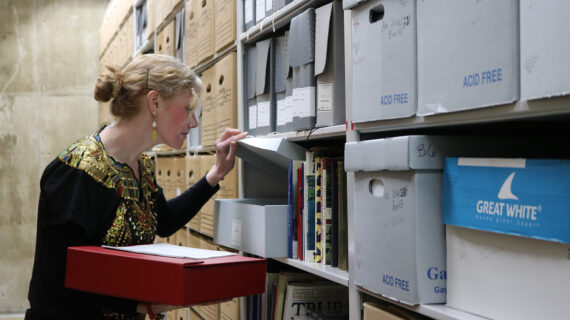
In the county of Suffolk, in a temperature-controlled vault are some of Europe's rarest medieval manuscripts. They're the court rolls of a small Suffolk village called Walsham le Willows. I do know my way to the Suffolk Archives, cause I've been there before, but the stuff I normally look at is much later than this. These court rolls cover the period before, during, and after the Black Death struck England in 1348. What can they tell me about the peasantry and the impact of the pandemic on their lives? Oh, wow, look, they're all out on the table for me already. Oh, aren't they fantastic? So, we're looking at lots and lots of very neat Latin here. It's so neat it's got a, sort of, Excel spreadsheet quality to it, but I know that buried underneath that are real human beings, even if they're treated here as units of taxation, almost. Now, I know that this set of documents is so important because it's so comprehensive, it goes on for years and years and years in the same village, and you don't normally get that, sort of, longitudinal view into the life of a community, because one bit might survive, another bit not. So, this is just remarkable, this- the completeness of this record for 14th century Walsham. The rolls are written in medieval Latin. Fortunately for me, there's an English translation. Mm, I did study medieval Latin, but a long time ago, and not very seriously, so I'm having to rely on my translation here. The population of Walsham prior to the Black Death was around 1,200. Plague strikes the village in June 1349. The court session for that month shows a huge spike in death tax being paid. And it was a very busy court session, because basically 103 people have all died. So, that's in the last three weeks. In this particular sitting of the court, they had to deal with the business of 103 deaths. It's extraordinary. And you can see that the clerk has run out of room. He's gone down the first piece, he's had to attach another one to keep going. And what's kind of chilling is that he doesn't care that these people have died, what he cares about is that there's business to be done, cause every time you die, when you are a serf, your family has to pay a tax to the landlord, and that tax is called a heriot. And in some cases the heriot is a horse, and in other cases it's a ewe. So, basically, when your father dies, you have to give the landlord one of your animals. There's clearly good money to be made. But these 103 deaths listed in this court session are just the heads of families. Younger men, women, and children, a good 80% of the community, aren't recorded. They're not economically relevant to the records. Factor them in, and the deaths must number close to 600. So, that's half of the village dying of plague, matching estimates for the whole country. These rolls are a microstudy for all of Britain during the pandemic.


 Passport






















Follow Us