What you're looking at right here is essentially what we call our war room.
400 acres, several thousand sprinkler heads on two golf courses.
Wow.
So it's pretty massive.
How do you decide what gets watered when?
So up here, 358,000 gallons of water ran last night.
Where is all this water coming from?
Because we're basically in the middle of a desert.
The grass may always be greener on the other sidebut that grass aint staying green on its own.
Humans will move heaven and earth to create an artificial oasis, even in places youd never expect.
How - and why - does grass thrive almost everywhere we live?
And in a world facing more record-setting droughts than ever, is there a better way?
Im Shane Campbell-Staton, and this is Human Footprint.
Here in Palm Springs, to walk the walk, youve gotta dress the part.
Lined up there Perfect, looks good.
Yeah.
Bam!
Yeah.
You got it!
I did not.
Alright.
Nope, it's still there.
Okay, let's see what we can do.
Boom.
I was feeling real good about myself until just now.
Turf grass It covers more of the U.S. than almost any other plant.
And there's nowhere grass is more pampered than the golf courses of Palm Springs, California.
Good golf requires good grass, in your opinion.
I would think so, yes.
Okay, and good grass requires you.
Well, I like to think so.
Jonas takes care of some of the world's most prestigious golf courses.
And it's not just a profession, it's a love affair.
I look at parks, football stadiums, soccer fields, and golf courses.
I love it all.
Youve literally created an oasis, there's not a whole lot of people that can say that.
Yeah Turns out, grass isn't just grass.
You got your Bermudas, your fescues, your rye... And each species plays a different role.
A good Bermuda grass is going to be your base for probably most of the golf courses here in the valley, just because the temperatures in the summer get so warm.
Andthat's the only grass that really will be able to thrive and survive through that.
Not only can Bermuda grass resist extreme heat, it also doesn't require a ton of water andit tolerates a wide range of pH levels.
Thatswhy we grow it in places like Palm Springs.
But theres a darker sideBermuda Grass is also considered an invasive weed: it can outcompete native species, and controlling it requires powerful herbicides.
Okay.
Alright, lets see it.
Just take it back, and go.
Oh, that was heartbreaking.
Oh, a littlepiece of my soul died just now.
Humans go to ridiculous lengths to make turf happy.
We have a set of mowers that will mow down to 8 hundredths of an inch.
We have large mowers.
We have a greens roller to firm up the surface and make it faster.
The lower the height of the cut, the different trickier things that you can do to the greens.
We're fortunate we have some pretty balanced and good soils here.
We try to maintaineverything at a certain percentage of moisture.
I think ours is in the 20 to 25% range.
Little bit, little more.
Not that much.
Right there.
Back and straight through.
Bingo.
Yeah!
Hello, youre going pro!
I mean if you're just measuring success and impact, if grass was playing golf, it definitely got the hole in one.
Underneath this thin veneer of green lies a massive engineered life-support system.
And without it, this desert oasis would turn to dust.
So this is putting out a lot of like, 300,000 some odd gallons of water, every single day.
Yep, on this course.
Then you have this golf course which would be very similar to it.
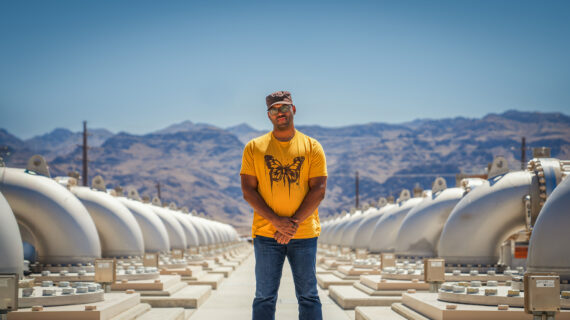
Here on this property, we're fortunate to be a part of the Mid Valley pipeline, which is where they connect water to the Colorado River, so it comes from a long way away.
To keep these courses green, millions ofgallons of water travel hundreds of miles to be sprayed out of thousands of sprinklers.
If that sounds like a lot, thats because it is.
But golf courses are just the beginning.
There are more than 40 million acres of turf in the US.
Each year they consume 80 millionpounds of fertilizer and trillions of gallons of water.
While legions of people andmachines keep them manicured and green.
Its the most resource-intensive plant in the country.
Yet the vast majority of it grows, not on a farm, but in neat squares around our homes little patches of paradise, perfect for a drink with a friend.
This is Marc Norman.
Hes an urban planner.
For Marc, building a great city or neighborhood is kind of like making a great cocktail.
You need to know all the ingredients and predict how theyll interact once mixed together.
Thank you.
Cheers.
Cheers.
Oh, that is a tasty beverage.
As a biologist, it's kind of weird to me.
It's like wherever you go in whatever environment, humans settle down and then there's grass.
Yeah, every place that we inhabit is artificial in some way.
Although this isa pretty nice situation.
It is.
I'm not going to lie.
This is some good living.
I'm going to blame the Brits because...
Okay, I'm okay with that.
Yeah.
This notion of the sort of manor, of the estate.
You mix that with the kindof individualism of the U.S. and you havenow people with quarter acre lots.
That's their castle surrounded by this space.
So it's status, is what you're saying.
It signals that I own this territory, and also that I maintain it.
I think baked into theway we expanded as a country, where we had toomuch land.
People needed to populate that.
Like manifest destiny.
Manifest destiny, exactly.
If you farmed it, or ranched it, or timbered it, for five years, then that land was yours.
I mean, if you were white and male.
Yeah of course.
But that sets a precedent.
Right, that you cant just sit on land.
You have to prove that youre cultivating it.
But grass isn't just baked into American psychology, it forms the economic foundation of American home ownership.
Lets say youre driving around a neighborhood in suburban Boston or Tulsa or Northern California.
They look relatively similar and thats because these standards had to be met in order for those homebuyers to get a 30 year mortgage.
They had covenants saying you had to have grass, and you had to cut it once a week.
Wow, okay.
That is very specific.
Right, and we have homeowners associations that enforce that.
Like legally enforce that?
Legally enforce that.
Okay.
Are the same rules applied to the back, like you have to mow your backyard the same way?
The regulations might not go to the back of the house.
This is like the suburban mullet.
It's like business in the front, and party in the back kind of thing going on.
Exactly.
Okay.
Here in California, our days of keeping up with the Joneses at least where grass is concerned may not last much longer.
In just the past four decades, Californias annual precipitation has dropped to half its historical average.
Today's California is no country for green lawns.
Luckily, theres a way to ditch the old-school lawn and do it sustainably.
Many conservationists believe the answer lies in native plants.
Because native plants have already adapted to the environments youre planting them in, they require less upkeep and also support local wildlife, such as birds and insects.
They can help bring back the biodiversity that existed here in the first place.
So, maybe we can redefine that image that popsinto into our heads when we think of patches of paradise."
Because theres a simple alternativethat spruces up our green spaces while making wildlife happy, too.
Driving around Palm Springs, you can see just how deeply grass is rooted in the American psyche.
In a country where we talk about productivity, it's so unproductive, is I think the irony of it all.
Grass is a signal.
Just having it tells the world, and ourselves, that were part of the community.
People think this is freedom of choice, but if they ever wanted to make different choices, they're forbidden to.
It takes a whole slew of federal state regulatory frameworks to make this happen.
No matter what was there before We dig it up, chop it down, irrigate, fertilize, and replace it with - you guessed it - grass.
Honestly, I can't even tell if thats real grass or not.
I think it's real grass.
Thats incredibly uniform.
But what's interesting is that So many damn cul de sacs!
Literally everything is a cul de sac.
Everything is a cul de sac.
Everywhere we go, humans reshape the landscape not just to suit our needs, but to match our ideas of what we want it to be.
The good news is, we also have the power to decide what we want our little patches of paradise to look like.
Thanks for watching!
If you want more Human Footprint, you can tune in to the full length series on the PBS App or on your local PBS station.


 Passport














Follow Us