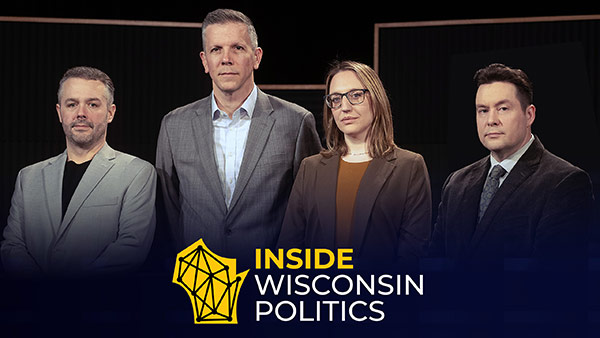
Inside Wisconsin Politics: 2026 Governor's Debate Highlights
Frederica Freyberg:
For undecided voters who watched this week’s debate between the candidates running for governor, the details from Republican Tom Tiffany and Democrat David Crowley were lacking. Our colleagues at “Inside Wisconsin Politics” looked at why that was the case along with a few more moments.
Anya van Wagtendonk:
I’m taking notes during this debate, and I just kept waiting for like specific numbers to come in, specific details, and they just weren’t coming. So one of my big takeaways from the debate was just all of the sort of talking around the specifics and there are reasons for this. There’s normal reasons around campaigning. There’s the open question of who’s going to win the Legislature that actually does make hammering down certain details kind of difficult. But there was just a lot of non-answers as you mentioned, and we’re also — early voting has already started. We are two weeks out, less than two weeks out from the election. And so for this to be coming so late and for there to still be kind of these big, unanswered questions that really stood out to me.
Shawn Johnson:
Yeah, big unanswered questions for sure. If David Crowley has a Democratic Legislature, it’s going to be a lot different priorities for him than if he has a divided or Republican Legislature and vice versa for Tom Tiffany. But it sort of like gave them a pass to answer question after question in this thing. They did get into some specifics, though, sort of, when it came to the budget. It was nice to hear them talk about that for quite a while. So let’s get into some of that. They spent a while talking about taxes and school spending. Tom Tiffany talked about a 10% income tax cut for families who earn under $150,000, but he didn’t say exactly how he’d be able to do that and still fund education. Here’s Tom Tiffany’s exchange with WISN-12 moderator Matt Smith.
Tom Tiffany:
We’re going to put more money into people’s pockets. We’re not going to raise taxes on the good people.
Matt Smith:
That’s a lot of income not coming into the state then. Do you make cuts in your first budget proposal to offset that?
Tom Tiffany:
We are going to have sufficient money in this budget to be able to fund the things that are important to Wisconsinites: education, transportation and infrastructure, health care.
Shawn Johnson:
And then on the flip side of that, you had David Crowley talking about funding education, in part, by taxing billionaires. He was asked a few times about the details. Here’s David Crowley.
David Crowley:
We need a long-term solution, not just quick fixes.
Matt Smith:
I’ll give you one more chance. You don’t have a threshold, though, for where taxes will go up, what that income level is?
David Crowley:
This is about making sure that we’re working with the Legislature. They’re the ones who have the power of the purse. And so as I’m crafting my budget, I look forward to working with them.
Matt Smith:
Do voters deserve to know that ahead of the election?
David Crowley:
I think voters want to make sure that they have somebody who’s going to work for them.
Shawn Johnson:
Alright Zac. I mean I know that these candidates are not the first candidates for governor to kind of dodge what they’re going to do when it comes to the budget. But boy, if you tuned in hoping to hear how they’re going to achieve their priorities without hurting other priorities, you might be disappointed.
Zac Schultz:
This is why we don’t have three debates anymore and why we really aren’t missing that much by not having as many debates as used to happen. In this era of campaigning, where there’s hundreds of millions of dollars for these candidates to push their message every which way, exactly as how they want it phrased and crafted, they don’t need to rely on a debate to reach the average voter the way they used to. And that’s exactly what we heard last night was a whole lot of “Don’t worry about it. I’ve got a plan.” We can dig into their history, as we did in last week’s episode. We talked a little bit about their legislative achievements to give some sense. Tom Tiffany was on joint finance during the Scott Walker era, so we would expect him to run government in a similar fashion. That’s how he crafted those budgets when he was there. David Crowley runs the largest county in Wisconsin. We have a very good insight as to how he runs those counties. So their evidence really comes from what they’ve done, not necessarily what they said last night.
Shawn Johnson:
Yeah. Anya, I feel like you were tough but fair with these candidates in your story. Some awkward moments was, I believe, the phrase you used. Let’s play one of those. This is where Tom Tiffany was asked by WISN-12 about why he wanted to overturn the results of the 2020 election. He referenced private election grants from Facebook founder Mark Zuckerberg, sometimes called Zuckerbucks.
Tom Tiffany:
That’s why I objected, because the people of the state of Wisconsin, they did not want that. And by the way, the people of the state of Wisconsin have voted to enshrine photo ID into our Constitution.
Matt Smith:
That’s the why you joined efforts to disqualify hundreds of thousands of absentee ballots in Milwaukee and Dane Counties was Zuckerbucks.
Tom Tiffany:
Yes, because of what happened there when there was money coming in privately that should not have been.
Shawn Johnson:
I want to mention I took moderators four questions to get to that point and that fifth question, they heard about Zuckerbucks was the final question on that topic with a little awkward pause I think it’s fair to say. Before the election, it was explicitly legal to do what Mark Zuckerberg’s group did with those private election grants. I was just looking back last night after Tom Tiffany mentioned that. Zac, you know, he — as Rich mentioned, he did not talk about Zuckerbucks in that initial objection. The press release where he talks about how he wants to object to Wisconsin’s vote in 2021, is still sitting on his website. A little bit of a rewriting of history on this one it seems like.
Zac Schultz:
Well, there’s been a lot of coverage about election denialism. It’s still strong within the Republican Party. And this you might be able to parse between Tom Tiffany having to serve a couple different audiences. Trying to find things that most people did object to. And there was a constitutional referendum to eliminate Zuckerbucks from coming back around.
Shawn Johnson:
Which passed.
Zac Schultz:
But of course, that was years afterwards. They were not illegal at the time. Things that Republicans didn’t even bring up before the election. They only brought up afterwards, which is part of the reasoning the conservative majority on the Wisconsin Supreme Court denied an attempt to overturn the results of that 2020 election.
Shawn Johnson:
So let’s move on to an awkward topic here for David Crowley. He had a tough primary, remember, against democratic socialist Francesca Hong. He wants her supporters to vote for him. So he was asked whether he supports the Democratic Socialists of America platform. Here’s what David Crowley had to say.
David Crowley:
And I’m glad to have the support of those who believe in the same things that I believe in, because that’s what’s going to move the state of Wisconsin. That’s what’s going to show these individuals that I’m going to be a governor for them, not for those who are funding my campaign.
Matt Smith:
Do you support any of the platform?
David Crowley:
Which part of the platform are we talking about? The one thing I’m not — I’m not familiar with the DSA platform to be answering that question.
Shawn Johnson:
Anya, as he says, I’m not familiar with the DSA platform. He ran against Francesca Hong for how many months, and he doesn’t know what’s in that platform. What’s going on there?
Anya van Wagtendonk:
To quote the great Mariah Carey, I do not know her, right? He’s just sort of removing himself from that whole kind of situation entirely, in part because once you do start, you know, I don’t know, parsing out, okay, yes, I want to keep the Senate and I do believe in Thanksgiving, you kind of just end up in a message that is not necessarily yours. So his part of his response was, you know, sure, socialists could vote for me and Republicans should vote for me, right? He, like kind of, used it to just say, as always, I, David Crowley will reach across all aisles and appeal to all people. And he kind of was able to pivot it back to his message a little bit. And then, of course, Tom Tiffany was able to then say, but you also said, you know, when you say you want to invite Francesca Hong supporters into your big tent, you sound like a socialist. And so we did kind of end up with a little bit of them trying to define one another against this candidate, this primary candidate who’s no longer in the race.


 Passport








Follow Us