





PBS Wisconsin Passport
Watch this video with
PBS Wisconsin Passport
Become a member of PBS Wisconsin, support your local community, and get extended access to PBS shows, films, and specials, like this one.
A Bridge Over Troubled Waters: Tulsa to Albuquerque
07/12/22 | 52m 25s | Rating: TV-PG
Mona Haydar and Sebastian Robins learn why many African Americans converted to Islam, how Muslims excelled in modern jazz and why Catholics and Muslims revere the Virgin Mary. The couple celebrate their ninth anniversary on a mountaintop.


Copy and Paste the Following Code to Embed this Video:
A Bridge Over Troubled Waters: Tulsa to Albuquerque
MONA: "All he needed was a wheel in his hand and four on the road."
SEBASTIAN: I dont know, it sounds pretty good to me.
[Mona laughing] I mean, I also need you.
MONA: Aww.
SEBASTIAN: Yeah.
MONA: Im Mona Haydar.
SEBASTIAN: Woo, Mona, where you going?
MONA: And this is my husband, Sebastian Robins.
Hey Babe.
SEBASTIAN: Hey, here we come.
MONA: Were on the road for three weeks.
Hey, you think of Route 66 you think heartland.
Taking time out of our busy lives as parents, educators... Were taking back the narrative... And managing my music career.
JOURNALIST: Bonjour Mona Haydar!
To follow the Muslim thread woven through the fabric of our country.
EDWARD: Muslims have always been part of America since the colonial era.
MONA: And were reconnecting with each other along the way.
SEBASTIAN: What a miracle it was to meet you and to start our life together.
What should I do?
Kiss you and hug you?
[Mona laughing] MONA: Youre so awkward.
[Sebastian laughing] MONA: Were taking The Great Muslim American Road Trip.
You just put a little fire in my belly.
On this episode... Lets go!
Midpoint!
What-what!
SEBASTIAN: Oh, midpoint!
LEON: A lot of people think that "Well, Muslims dont like music."
Well, thats far from the truth.
KENNY: There is a legendary Muslim here.
My, my oh my I know it American history, doesnt teach this in any curriculum whatsoever.
No matter what it takes SEBASTIAN: Happy Anniversary.
Im gonna keep on going [whoosh] [fly buzzing] MONA: Open your window, theres a fly.
[fly buzzing] Yeah.
Oh, came right back in.
[fly buzzing] Go outside little fly.
Stay outside.
[engine starts] [road noises] You dont know me, darling You dont know it yet One day you and me, darling Gonna catch the wind and fly Catch the wind and fly Catch the wind and fly Catch the wind and fly Turn the car around Weve been driving on the wrong side of the road This is gonna be a story For the kids when we turn old You dont know me, darling You dont know it yet One day you and me, darling Gonna catch the wind and fly Catch the wind and fly Catch the wind and fly Catch the wind and fly Catch the wind and [wind blows] [whooshing sounds] [clicking sounds] MONA: After a week, were just in Tulsa.
SEBASTIAN: Right?
MONA: Thats... slow.
[car drives by] SEBASTIAN: On the drive to Tulsa I had time to think back to the conversations we had in Springfield and St. Louis about the Black Muslim experience.
Would it be fair to say the first Muslims in America were enslaved Africans who came here in the early 17th century?
KAMAU: Probably so.
And it may have even actually been earlier than the 17th century.
SEBASTIAN: What happened to their faith?
KAMAU: People were uprooted and they were sold or traded five or six times before getting on a slave ship.
They were separated from family, from kin, from any of the religious leaders in the community.
They were completely traumatized, even more so perhaps, than refugees were.
Cause refugees usually have somebody else with them.
SEBASTIAN: Mm-mm.
KAMAU: Its more of a group experience.
SEBASTIAN: Right KAMAU: They get on a slave ship where they are dehumanized.
Theyre put in chains, theyre watching people die next to them.
Anywhere from 15 to 40 percent of the people on the ships in the Middle Passage died.
SEBASTIAN: Right, right.
KAMAU: And of course, no family, SEBASTIAN: Mm.
KAMAU: No kin.
SEBASTIAN: Mm.
They had lost touch with anyone who mightve actually done some of the kind of training in religion.
SEBASTIAN: Right.
KAMAU: Its about recovering some of those roots.
The Black Wall Street was in Tulsa so it was, it was a site of business before the Tulsa riots.
SEBASTIAN: Right.
[water splashing] MONA: We are in Oklahoma at the Reconciliation Park.
This is the location of where the Black Wall Street was, where the massacre happened.
And its- its been wonderful to have the opportunity to learn from people who live here, who are on the ground doing that beautiful work of healing.
C.J.
: "Black Wall Street" was actually a phrase that was coined by Booker T. Washington, who believed that all you had to do was go to work every day, build a business and you were to be accepted.
[indistinct chatter] We have the Greenwood District where you have folks that are barbers and doctors and lawyers, and they are business owners and beginning to build up things in an era of Jim Crow which was basically designed to have an economic discourse MONA: Mm.
C.J.
: For the Black community that was negative.
Black Wall Street is something that completely takes that and turns it on its head.
The morning of May 31st, 1921, you have a man and a woman that are in a elevator.
The man is Black, the woman is white.
Theres a scream and hes arrested.
Word begins spreading all over the city of Tulsa that this Black man has accosted this white woman.
And the stories begin to expand and get worse and worse as theyre being told.
This mob begins to gather.
Black business owners, family men, just whoever was there, go down to the courthouse cause they want to make sure that nothings gonna happen.
[indistinct chatter] And immediately theres a conflict.
A scuffle ensues, a shot rings out.
Black residents retreat.
The next morning, June 1st, white residents begin to come into the Greenwood area and basically the massacre ensues.
[gun shots firing] [people shouting and screaming] [indistinct chatter] Hundreds of African Americans that were here in the Greenwood District are killed.
MONA: This isnt the first time this tragedy has surfaced on our trip.
Back in St. Louis, we saw how it spurred many African American conversions to Islam in the 1920s.
EDWARD: In order to understand why African Americans became Muslim, you have to understand what happened in cities like Tulsa.
SEBASTIAN: Uh-huh.
EDWARD: And all along Route 66.
SEBASTIAN: Right, right.
African Americans identified in Islam a religion of political liberation and psychological liberation.
SEBASTIAN: Mm-mm.
EDWARD: From the kinds of racism that they experienced on a day-to-day basis.
Some people decide on giving up on this middle class, white notion of America.
They decide to establish their own communities, with their own strengths and Islam was one of the religious resources that Black people used in the 1920s to begin to chart their own course.
KAMAU: There was a pull to it as an ancient African religion, because there were Black people from Africa who were still practicing Islam.
There were people who were leaders in the Islamic faith.
And as we explored African history and started to recover a lot of African history, Islamic names came out, people who practiced Islam.
REPORTER: Why do you insist on being called "Muhammad Ali" now?
MUHAMMAD: Thats my original name, thats a Black-man name.
"Cassius Clay" was my slave name, Im no longer a slave.
KAMAU: Then you have the Nation of the Islam also, that has a specific goal of working with the oppressed, SEBASTIAN: Right.
KAMAU: Working with prisoners and addressing some of the political issues too.
MALCOLM X: Who taught you to hate the texture of your hair?
Who taught you to hate the color of your skin, to such extent that you bleach to get like the white man?
Who taught you to hate the shape of your nose and the shape of your lips?
Who taught you to hate yourself, from the top of your head to the soles of your feet?
[indistinct chatter] Who taught you to hate your own kind?
Who taught you to hate the race that you belong to, so much so that you dont wanna be around each other?
No, before you come asking Mr. Mohammed does he teach hate, you should ask who- yourself who taught you to hate being what God gave you.
[audience applauding] EDWARD: But we make a big mistake if we see it only as political, because Black people converted to Islam not just for political reasons MONA: Mm.
EDWARD: But also for spiritual reasons.
SEBASTIAN: Yeah, thats important.
EDWARD: For some people, the Quran was a text that unlocked the secrets to understanding the nature of God.
MONA: Mm.
[whoosh] C.J.
: I believe that the Quran talks about, you must first accept responsibility for the things that have happened.
The obelisk that you see right there basically depicts the things that were taking place all the way up to the point of, where were hoping to be at is reconciliation.
It doesnt seem like it now and its hard to go through but in the end, SEBASTIAN: Yeah.
C.J.
: We know that justice is gonna prevail.
SEBASTIAN: Yeah.
Hope so.
MONA: Yeah.
Theres too much suffering for us not to believe that.
I think Aliyes here, so... SEBASTIAN: Oh!
MONA: Before getting to Tulsa we were introduced to Aliye Shimi.
She is the first Muslim Executive Director of an important Tulsa interfaith organization that is doing the hard work of reconciliation that C.J.
had talked about.
[water flowing] And I just want to say how truly inspired I am by all the work youre doing here in Tulsa.
ALIYE: Thank you, I really, truly appreciate it.
Im truly humbled.
Um, I cant do this work by myself, you know, were a team and we get to do this work together.
MONA: Id love to hear more about what you all are doing.
I- Ive heard little tidbits.
ALIYE: So, as you know, we have a very dicey history in Tulsa with race relations.
We still have very fragile relations in Tulsa.
Im born and bred, Im a Tulsa native.
The first time I heard anything about the Tulsa race riot or the Tulsa race massacre, was in my college class, in my history class.
MONA: Oh wow.
ALIYE: And literally, it was a 10-minute snippet.
And so I didnt think anything of it, you know, graduated and started doing this nonprofit work.
And little by little started hearing, as we became partners with some of our African American community.
So, you know, we started trying to figure out what we can do to bring awareness.
So, because we are an interfaith organization, we thought of it from a faith perspective.
So, our pastors, our imams, our rabbis, they said, okay, well do 100 houses of worship at $1,000 dollars a piece, well raise $100,000 and a portion of that money we want to give to our survivors, our three lone survivors that we have.
And then the rest of that money, well grant 0% loans to our Black entrepreneurs to revitalize Greenwood.
C.J.
: So I think that what youre doing is very admirable.
We talk about tenets of faith, right?
What it is that makes me who I am, what is it that makes me believe what I believe and I think that actions like that are just an example of that.
SEBASTIAN: Im just so struck by the two of you.
That here you are, youre born in Oklahoma, youre a Muslim and you focus your efforts on social justice for this Black community.
Here you are, born Christian, who has chosen to learn something about Islam.
MONA: Faith without action is empty and yall are really living it and doing it.
Its so beautiful.
ALIYE: Absolutely.
MONA: You can talk about history, but you can feel a lot of whats left unsaid in a peoples music.
We had another unexpected meet up with someone whos been making music here in Tulsa for half a century.
LEON: And your name is?
SEBASTIAN: Sebastian.
LEON: And yours?
MONA: Im Mona.
LEON: All right, Im glad youre in Tulsa.
SEBASTIAN: We actually spent this morning in Reconciliation Park.
LEON: Mm.
Its really amazing, the further you get away from Tulsa, the more you know about the massacre.
MONA: Mm.
SEBASTIAN: Huh.
LEON: The closer you get to Tulsa, the smaller amount of information is about the massacre.
I went through all the grades, 12th grade, and not a word.
Except from my parents.
My parents were part of the massacre.
I was born and raised on Greenwood.
Thats where the massacre happened.
We had three businesses and a hotel on that street.
Music was a very big thing, a part of Greenwood.
Before the massacre, there were tons of places, clubs, churches.
Praise, children Pray oh my Lord But not only that, there were parades that went up and down Greenwood.
After the massacre, of course, all of that was wiped out.
SEBASTIAN: Mm.
LEON: There was nothing.
People had to come back and rebuild.
And you wonder, how in the world do you come back and rebuild after the slaughter happened?
How do you do that?
But, slowly but surely it did.
Some say stronger than it was before.
MONA: And did music help?
Yeah.
LEON: Music always helps, yes.
If- if youre at dinner, music helps, if youre on the elevator, it smooths the ride, ya know.
[Mona and Sebastian laughing] SEBASTIAN: Mona actually also is a musician and shes a hip-hop artist.
LEON: "A hip-hop artist."
MONA: Yes, sir.
LEON: A musician and a hip-hop artist.
MONA: I wouldnt call myself a musician.
I actually, you know, growing up, I didnt study music.
I dont know how to write or read music.
But I always thought in terms of melodies and sounds and you know, I consider myself a lyricist.
LEON: Id like for you to go to the tribes, the Indian tribes, North American tribes, the African tribes and say the same thing, they dont read music.
MONA: Yes.
LEON: They go by the feeling of whats going on.
MONA: Yes.
LEON: And what someone did before MONA: Yeah.
LEON: And then they implement that, they modify that, and they put it back out.
MONA: [laughs] I love that so much, thats amazing.
Did you ever play with any Muslim artists?
LEON: Oh yeah.
Ive had a lot of Muslim musicians in my band.
A lot of people think that, "Well, Muslims dont like music."
Well, thats far from the truth.
There are a lot of famous people, who are also Muslims.
Let me give you an example, Art Blakey.
Art Blakeys a drummer.
[drumming] He had a group called the Jazz Messengers.
At first it was called the Messengers.
And what he wanted to do was to bring the culture of the Muslim world and influence it into his jazz music.
He went to Africa to find some spirituality that he was looking for.
SEBASTIAN: Hmm.
LEON: To find something that youre needing.
Sort of like a lotta people will go to church to find that gospel thing that you wanna incorporate into your music.
And so, he went to Africa, the way its told and he didnt go there to learn how to play the drums, he was already a famous drummer.
He went there to learn the culture, to learn the- the- the spirit.
The spirituality.
SEBASTIAN: Right.
LEON: What Im trying to say is that, in the jazz arena, which blues is a sister to jazz.
MONA: Mm-hmm.
LEON: And soul is a brother to jazz and gospel is a mother of jazz.
SEBASTIAN: Mm.
LEON: So, when you incorporate gospel into jazz, theres something that happens.
SEBASTIAN: Mm-mm.
LEON: Something takes over the situation.
And thats the same thing when youre dealing with, lets say, the- the Muslim community.
So, a lot of famous artists have mixed in with the Muslim influence and that has made a big difference in music.
And so, when you incorporate that, as so many people have done, such as Yusef Lateef... Love chant Love chant Great saxophone player.
MONA: Yes.
LEON: One of the most awesome saxophone players around.
And John Coltrane.
It takes you into another dimension.
MONA: Yeah.
LEON: And I can name you other people, the list is very long.
When you incorporate that spirituality, MONA: Mm.
LEON: Into your music, its awesome.
SEBASTIAN: Mm.
LEON: But tell me about you.
MONA: Yeah, I mean, I grew up in Flint, Michigan and, you know, poetry, spoken word was a way for us to learn how to express ourselves in positive ways.
And it really was beautiful Black women in the city of Flint who taught me how to use my voice as a tool, I would say, for liberation, for expression.
And also, to heal that otherness I felt about growing up not Black, not white, you know just like somebody else right there having this American experience.
Music in general has always been this thing that, deeply profound, in its healing, in its remedy... LEON: Yeah.
MONA: For my soul.
It was super cool to hang out a little bit with Leon.
[road noises] He said, "You know, hip-hop is made from struggle."
He was like, "I already knew that about you.
"I knew that if you did this, and you got that far, that that means that it came from struggle."
Put me on a pedestal Wait and watch me fall Nobody is perfect We all have perfect flaws I can lift you I know the world seems crazy Ill be down for you baby Ill be right here, right here Part of your pain You know, to have somebody like Leon look at me and say like, "Yeah.
If youre doing this, like, youve been through it."
To feel seen in that way and to share that sort of camaraderie, that was awesome.
Lets get lifted When the world falls down And theres no one else around Ill be right here You know, Im right here Take the pain away If you let me, if you let me So lets get lifted Lifted, lifted, lifted, lifted [whooshing sounds] MONA: With a newfound respect for the history of Tulsa, were back on the road for a long stretch down to Amarillo, Texas.
[car drives by] [car drives by] SEBASTIAN: Amaree-lo.
MONA: Are we there?
SEBASTIAN: No, no, no, Amarillos 4 hours away.
[Mona sighs] MONA: Long drive.
SEBASTIAN: This many.
MONA: Its a long drive.
Hello, hello.
[Sebastian laughs] [road noises] [traffic noises] MONA: Im so glad I wore comfy clothes today.
SEBASTIAN: Im so glad Im wearing matching comfy clothes.
[Mona chuckles] MONA: I cant believe you did that.
Was it like, the shirt that was on top or did you dig for it?
SEBASTIAN: No comment.
[Mona laughs] [road noises] Well, if you ever plan to motor west SEBASTIAN: Weve got sunflowers, weve got windmills.
Yeah, take my way Its the highway, thats the best Get your kicks on Route 66 Well, it winds from Chicago to L.A. MONA: [laughs] Your pants actually match their fur.
More than 2,000 miles all the way Get your kicks on Route 66 Well, it goes from St. Louis Joplin, Missouri, Oklahoma City looks ooh so pretty Youll see Amarillo Gallup, New Mexico, Flagstaff, Arizona MONA: Your phone... SEBASTIAN: I know its goofy in that, it works once you hit it.
MONA: There we go, oh.
[Sebastian laughs] MONA: Hello, iPhone?
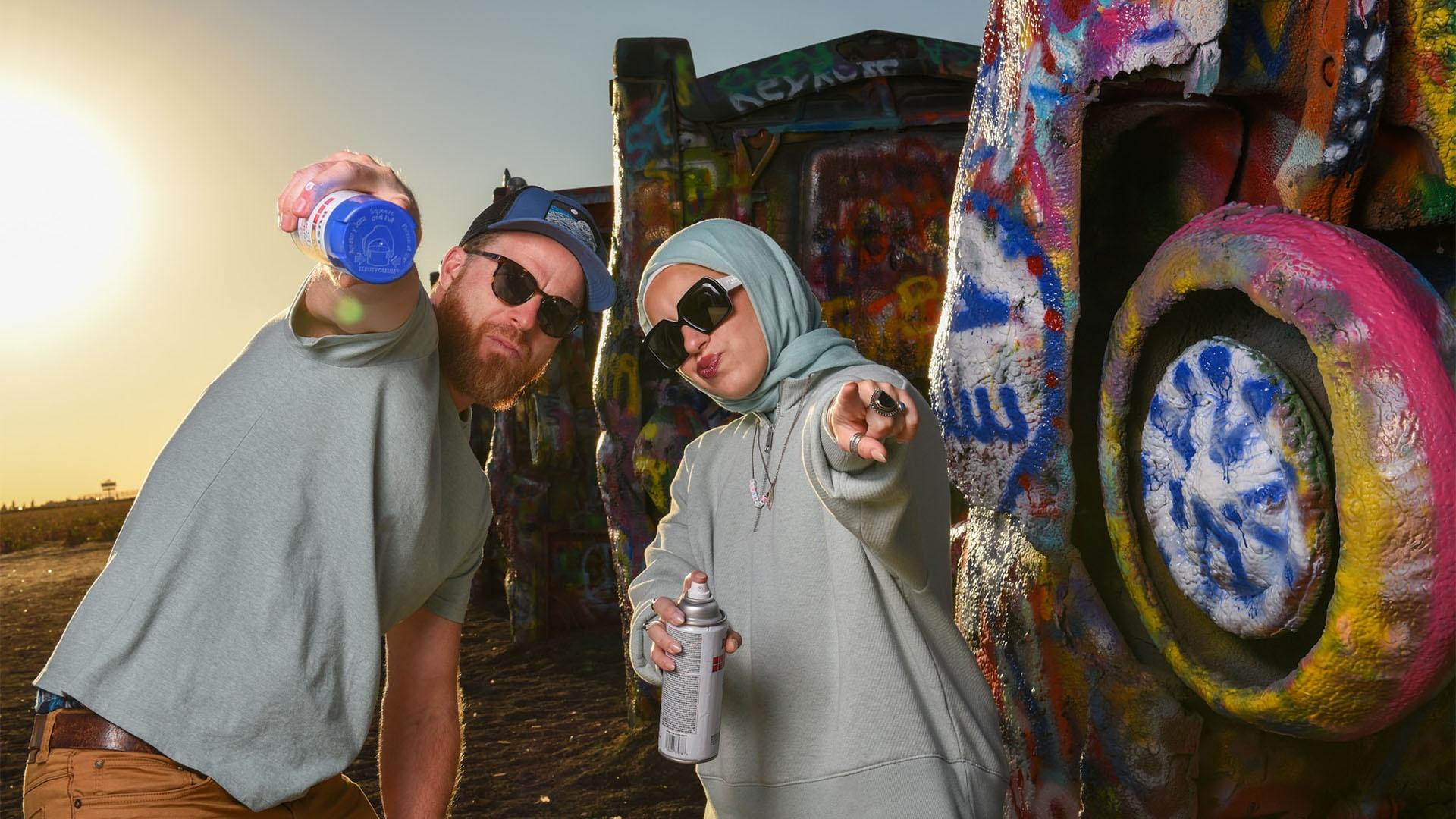
Get your kicks on Route 66 Were at the Cadillacs!
SEBASTIAN: Yup.
[spraying] MONA: You went over mine!
SEBASTIAN: [laughs] That was yours?
MONA: Dude.
SEBASTIAN: [singing] Here we are at the end of the day.
Cadillac Ranch in Amarillo, Texas.
[whooshing sounds] MONA: Amarillo has a lot more going on than just cars sticking out of the ground.
So here we are, Amarillo, Texas.
There are Afghan communities arriving here and there are beautiful people here at Catholic Charities helping these people resettle.
I actually found out that theres a really large Burmese Muslim population here in Amarillo.
Theres refugees from Burma, Ethiopia and Somalia and so many other places and you just wouldnt expect it coming to Amarillo, Texas.
SEBASTIAN: Youre from?
LOKAMAN: Im Burmese.
SEBASTIAN: And youre Muslim, right?
LOKAMAN: Muslim, yes.
SEBASTIAN: Ah, Hamdulillah.
LOKAMAN: Most Burmese Muslims are descended from like, western part of Asia.
And because of the military coup, ethnic cleansing, all of that, they flee from over there.
We came to United States in 2007.
We first lived in San Diego for a year and it was a big city, they dont speak English, it was hard to find a job.
And no transportations.
So they moved to here in 2008 and then my dad worked in beef production here.
And hes been working there since then until now.
After 2009, more and more refugees are coming.
I work with Catholic Charities since 2019.
I was a translator for like, couple months.
Then later I got promoted, became a case manager.
MONA: So what countries have people been coming from that youve worked with?
LOKAMAN: Were expecting Afghanis to come.
About 25 cases and each case it has, like, 5 to 6 family members in them.
And Ill be the first one theyll be meeting at the airport.
SEBASTIAN: Wow.
LOKAMAN: You know, Im excited for them to come, you know... MONA: Yeah.
LOKAMAN: Because Ive been in their shoes, so I know what its like.
HASEN: I come to America with my wife.
There was a war between Somalia and Ethiopia.
And we got asylum... SEBASTIAN: Mm.
HASEN: To the United States.
We flew from Africa direct to Amarillo.
MONA: Wow.
HASEN: I start looking for a job.
Walked all over Amarillo and I walked all the way out of the city where there was a truck stop and I went in there and asked for a job.
MONA: Wow.
HASEN: The guy said, "Yeah, I can give you a job."
[Mona laughs] Then I applied for West Texas University and I was accepted.
SEBASTIAN: Mm.
MONA: Mm.
HASEN: And immediately we found out my wife was pregnant.
MONA: Yeah.
HASEN: So, I dropped everything.
SEBASTIAN: Mm.
HASEN: And it is not me, SEBASTIAN: Mm.
HASEN: My children will go to school.
MONA: Mm.
HASEN: We have two boys and we saved money to send our children to school.
My older son got bachelors in mechanical engineering.
My younger son, he got his PhD in finance.
MONA: Wow.
We talked a little bit to Lokaman and Hasen, different people who just have these beautiful, brilliant stories of coming here with, you know, very little and coming from their situations that are difficult.
And how they just get a little help and how that makes all the difference.
I always feel good around people who are serving.
I was just raised with that ethos central to my life and how we have to be serving as Muslims.
How its our obligation, our responsibility and so, whenever I see any people doing it, Muslim or otherwise, I just feel like, I hope to be able to be like these people who are helping and serving and being of service to humanity.
Its just been such a beautiful day.
Well, it goes through St. Louis, Joplin, Missouri Oklahoma City looks ooh so pretty, youll see MONA: Midpoint, what, what.
SEBASTIAN: Oh!
Midpoint!
MONA: Oh snap!
SEBASTIAN: 1,139 miles to Chicago.
1,139 miles to L.A. MONA: Holy moly.
SEBASTIAN: We are officially halfway done.
MONA: All right, lets go.
I can take that California trip Get your kicks on Route 66 Get your kicks on Route 66 SEBASTIAN: Oh!
MONA: Heh, heh, oh!
SEBASTIAN: Theres Elvis.
Get your kicks on Route 66 Get your kicks on Route 66 [whooshing sounds] [clicking sounds] MONA: Santa Fe, here we come!
SEBASTIAN: You excited?
MONA: Yeah, Ive always wanted to see the Basilica of Saint Francis.
We studied Saint Francis of Assisi in a lot of my classes.
I like him.
This must be one of the oldest churches in North America.
It was first built in 1626.
And its home to a Spanish statue of the Virgin Mary thats even older, from the 1400s.
Muslims dont make art of religious figures.
But what many people dont know is that Mary is very important in Islam.
SEBASTIAN: So tell me a little bit about the trip you took.
STANLEY: So I was in Turkey during the Muslim holiday of Eid to see Marys house.
There were just hundreds and hundreds of people up there.
I wondered how come all these Muslims would come on their holiday.
SEBASTIAN: Mm.
STANLEY: And then I started to read more about how in the Quran, Mary is looked at as one of the purest women.
[page turns] [page turns] MONA: Its funny, you know, as a Muslim, people often will ask me what my relationship is to Jesus or Mary and I just feel such a deep and devoted connection to them both, in their relationship.
FATHER TIM: Mm-hmm.
Oh yes.
MONA: You know like, Mary as mother, and Jesus as her- her son, and how, you know, shes this woman in the Quran who is often talked about as just devout and righteous and blessed!
FATHER TIM: Mm-hmm.
MONA: I just feel like she is such an inspiration to me in the way she was tender and loving and devout to God, so much so that she could raise a child that could change the entire world.
FATHER TIM: Mm-hmm.
My favorite story is Jesus is at the wedding in Cana.
And he goes to this wedding with his apostles and Mary comes to him and she says, "Theyve run out of wine!"
And there was a long time when I didnt understand why that would be a concern for her.
MONA: Hmm.
FATHER TIM: And it wasnt until somebody explained to me that hospitality was so important in Jesuss time that if you got a reputation for being inhospitable, MONA: Mm-hmm.
FATHER TIM: They were gonna kick you outta town.
MONA: Mm.
FATHER TIM: And so Mary was coming out of concern for the couple, this young couple just getting married, this young couple who was running the risk of starting life in a tragedy.
And, you described her as that tender woman.
Yes, oh God, yes.
What love drives people to do that?
MONA: Mm.
FATHER TIM: I wanna be that kind of person.
MONA: He had a really beautiful sense of humor SEBASTIAN: Mm.
Mm.
MONA: And kind of giggled when he talked.
And not taking anything too seriously and, but also very like, reverential SEBASTIAN: Mm.
MONA: And devoted and very beautiful and, you know?
He was a great storyteller.
SEBASTIAN: Jesus is like, this huge part of Islam, huge part of the Quran.
MONA: And, you know the birth story is so powerful.
SEBASTIAN: Yeah, yeah.
MONA: Its this thing that connects women across all cultures.
It doesnt matter who you are or where you are, if youve experienced birth, you have a story to tell that can connect you immediately to someone else.
So that chapter of the Quran for me is so moving.
That her labor and her labor pains and her pain and her crying out to God is sacred.
SEBASTIAN: Mm.
MONA: And so sacred that it made it into the scripture, you know.
[whooshing sounds] [clicking sounds] MONA: Good morning from New Mexico.
I have a very soft spot in my heart for this part of the world.
Well see yall in Albuquerque.
ABBAS: Mona and Sebastian, thank you for coming to Albuquerque... MONA and SEBASTIAN: Thanks for having us.
ABBAS: And stopping by our masjid.
Now what Im going to show you is, about 6 years ago we realized that our children were just doing religious studies in Sunday school and they were kind of losing interest.
So to keep them engaged, we introduced a technology piece to it.
It started small, they started writing apps.
But then it grew into this amazing robotics program.
And these are very sophisticated robots.
SEBASTIAN: Wow.
ABBAS: Theyre all AI.
Theyre actually hand-built, to do a specific task.
SEBASTIAN: Ah.
ABBAS: So, this year, we dont know what the task is going to be, but they did one last year where the robot had to pick up a piece and throw it into a target 20 feet away.
SEBASTIAN: Oh my gosh.
ABBAS: And it has to do it all on its own, theres no remote control.
MONA and SEBASTIAN: Wow.
ABBAS: So lets go in here, and lets see what theyre doing.
SEBASTIAN: Okay, wonderful.
RAKIM: Oh my gosh.
[laughs] TIM: Theres gonna be hundreds of nuts and bolts and screws.
Batteries, battery chargers, its a lotta stuff!
[indistinct chatter] ABBAS: So hey guys, this is Mona and Sebastian.
[indistinct greetings] Theyre coming down from Chicago.
Theyre traveling down Route 66 and theyre stopped in Albuquerque to meet you all.
RAKIN: Oh, thats awesome!
Nice to meet you all!
SEBASTIAN: Thanks for letting us visit.
We know nothing about robotics, so-- MONA: This much, zero.
[laughs] SEBASTIAN: So we- what- what should we know, what are you guys doing?
RAKIN: So our team started in about 2016, I believe.
[overlapping chatter] MONA: And you guys have been a team since then?
ALL: Yes.
RAKIN: Were known as The Marvels.
MONA: So its like a mix of engineering and coding?
OHAFI: Yeah.
MONA: Oh wow.
SHAJEE: Theres also like, hard skills and technical software skills.
But also like, presenting skills and like, how to talk to people and how to present your ideas to other people.
And also about outreach and community service and volunteering and things like that.
MONA: Wow.
SEBASTIAN: You all won an award last year?
RAKIN: Yes.
That was the year we made it into the world championship, which was really exciting.
SEBASTIAN: Mashaallah, thats amazing.
ANNOUNCER: The winner of the Inspire Award is team number 14571, "The Marvels."
[team cheering] [applause] SEBASTIAN: And you guys just opened this box, and so whats, whats the challenge?
What do you guys have to do?
TIM: Well... this is a robot!
[all laughing] RAKIN: I was the team captain since we started up.
And then now since Im 18, I actually cant technically compete, but I am mentoring them.
Right now our captain of the team is Shajee Jiwadi.
SEBASTIAN: Salaam.
How long would it take us to build a robot?
Like- we have no math or engineering skills between us.
MONA: I- I really cant do any... SEBASTIAN: How long?
RAKIN: A couple months.
[all laughing] SEBASTIAN: Like, 10, 20 years, maybe.
SHAJEE: It might take you a little bit.
[all laughing] MONA: How does your Muslim identity fit into all this?
SHAJEE: Oh yeah.
So a big part of our team is our Muslim identity.
RAKIN: Yeah, thats one of our main aspects for our team.
This past season, we connected to Muslim communities all around the world.
Kids from Algeria, Egypt, Libya, Tokyo.
They were in their classrooms on a Zoom meeting with us.
And so we were able to show them all the work that weve done and Inshallah, theyll be starting up soon too.
ABBAS: You know, when we talk about the Golden Age of Islam, it was a combination of technology, science and religion.
And somehow, over a period of time, weve separated them.
And what this program does in our- in our minds was to bring it back together.
So we combined the religious part of it, along with technology.
SEBASTIAN: Mm.
ABBAS: And I think that is really important because thats when Islam progresses.
OHAFI: Kind of adding on to, like, what he said about the Golden Age of Islam, right?
Where science and technology and religion were all kinda combined.
Thats like one of the biggest pushes for our team, right?
Like, back in the day, they invented the first like, algebra, the first automaton.
They designed, like, a heliocentric model of the Earth.
And so I think its really important that we combine our science and technology with our religion.
And um, push to inspire STEM.
MONA: Mm.
And I think doing STEM probably in like a mosque environment, is just cementing your identity as Muslims while, also like, preparing you for the world ahead, you know?
Like you can be Muslim and do all of this other stuff too.
SEBASTIAN: Right.
I wanna start here.
Can you tell me, like youre the Marvels, right?
So whos your Marvel hero, whos your guy?
SHAJEE: Groot.
[chuckles] NEHAN: Uhh, definitely Black Panther.
MOHAMMED: Rocket the Raccoon.
RAKIN: Captain Marvel.
SEBASTIAN: Nice.
MONA: These are seriously awesome.
I want this for my car.
[Abbas laughing] OHAFI: In the center of the robot, wed also have like another pair of these, so that when the center wheels would rotate because of the rollers, it could move side to side.
SEBASTIAN: Side to side.
MONA: Thats dope, man.
SEBASTIAN: Muslims, interesting Muslim communities along the way.
Yeah so like, in Chicago, Mona met Muhammad Alis daughter, Maryum Ali.
SHAJEE: Oh wow.
SEBASTIAN: Who is like this big-time activist and prison reformer.
Holy smokes!
MONA: I know.
SEBASTIAN: What an amazing group of kids.
[road noises] Cant stop thinking about those kids on the robotics team.
MONA: Those kids were so inspiring.
SEBASTIAN: It just reminds me of what Randy was telling us in Chicago about Fazlur Khan.
RANDY: Fazlur Khan was a Bangladeshi-American.
Who was the design lead and structural engineer lead on the tower when it was built.
That was a really big deal because this building from 1973 to 1998 was the worlds tallest building.
I think the most remarkable thing about Fazlur Khan was, he didnt see his first high-rise or skyscraper until he was 21 years old.
SEBASTIAN: Wow.
And he came out of the University of Illinois and just a few years later, he came up with the concept of the building.
MONA: "Fazlur Rahman Khan initiated "important structural systems for skyscrapers.
"Considered the father "of tubular designs for high-rises, "he has been called the Einstein of structural engineering."
SEBASTIAN: What?
MONA: What do you want to do?
OHAFI: Ive kind of found a passion for building and engineering, so I wanna get into that field.
And just like, innovate the next generation of science and technology.
RAKIN: My intended career path is psychotherapy.
MOHAMMED: Id like to work on things like helping with eyesight, with technology, maybe even extending to blind people.
SHAYAN: People have been making things like, you know, very small computers and stuff that can fix problems on your body.
ABBAS: There might be a time when we actually introduce nanoparticles in your blood which will then circulate in your body and diagnose what you have.
MONA: Wow.
ABBAS: Maybe one of these guys will do that.
[kids laughing] [whooshing sounds] [clicking sounds] MONA: I love this view.
Blue skies, sagebrush, chamisa.
I met Sebastian here.
We had our first baby here.
[road noises] Its gonna be a beautiful sunset here on the mountain.
Are you excited?
SEBASTIAN: Yeah.
MONA: This drive always reminds me of my first trip up to Lama.
SEBASTIAN: Yeah.
How many years?
Eight?
MONA: Eight.
Yikes.
Well, nine since we met.
SEBASTIAN: When you first came to Lama, what did you expect?
MONA: [sighs] I mean, its hard to remember now, like, what I expected.
I wasnt happy with my life and I needed a change.
I was really struggling and, you know, I remember feeling like, "I just wanna go far away to a mountain somewhere."
I had seen a little bit online about Lama Foundation.
You know, and so I booked a ticket and May 18th, the shuttle came and drove me up the mountain.
SEBASTIAN: I remember you getting off the bus and I think I said, "Hi" first.
MONA: I dont, no you didnt.
You said, "Hey, do you want help with those bags?"
[Sebastian laughs] And, of course, I said, "No, no thank you."
SEBASTIAN: I mean when I first saw you, I thought, "Thats too many bags."
[Mona laughs] MONA: Which is something you still say to me regularly.
[Sebastian laughs] I had never been camping before!
SEBASTIAN: Yeah, a lot of bags.
And I was excited to meet you but I dont remember having any, like, feelings.
MONA: Sebastian... SEBASTIAN: What?
Alright, Mona.
MONA: Youre not telling the truth.
[Sebastian laughs] You always say... SEBASTIAN: In addition- in addition to... MONA: That you knew right away that you were gonna marry me.
SEBASTIAN: Alright, I will confess that there were some feelings.
[Mona laughing] MONA: You were just, like, genuine and vulnerable and I think our conversations were, right off the bat, interesting and compelling and dynamic, you know.
SEBASTIAN: I just had this instant feeling of familiarity with you and friendship and ease.
MONA: The banter.
SEBASTIAN: Mm.
MONA: The banter was so easy, SEBASTIAN: Mm.
MONA: You know, and fun.
Aw, Zoomby.
SEBASTIAN: Oh my god.
MONA: Hi, Zoomby.
SEBASTIAN: Its our old friend.
MONA: Hi, Zoomby.
SEBASTIAN: I remember you.
MONA: Hi, bugaboo.
SEBASTIAN: Thats so funny.
MONA: I missed you too.
[Sebastian chuckles] Missed you so much, Zoomby.
SEBASTIAN: Mmmm.
MONA: You were just so easy to talk to that when, you know, I did start to feel like, "Wow, maybe," you know, "this could be more than a friendship," it didnt scare me.
SEBASTIAN: Mm.
SEBASTIAN: Happy Anniversary.
MONA: This is kinda where you asked me to marry you.
SEBASTIAN: Mm-hmm.
So many memories.
Whyd we leave again?
MONA: I know right?
Black hole hips She looks like some sort of insect Buzzing cross the floor toward me I cant think when shes looking at me With those green eyes Shining on me like floodlights Way in the back of New York City Something about her Reminds me of the United States Sprawling across the West in all their glory And imagination Some lady wrote America the Beautiful Sitting on top of Pikes Peak up there Looking way, way down Way, way down And I hear a voice whisper in my ear saying Dont turn your back on love No dont turn your back on love You idiot You fool [whooshing sounds] [road noises] MONA: After our side trip down memory lane, were back on Route 66.
Theres a huge mosque right off the road in Gallup, New Mexico.
And now were headed to the land of the Pueblo people.
We dont usually associate Native American history with Muslims but we learned differently earlier in our trip.
EDWARD: Youre going into the territory of Mustafa Azemmouri, also known as Estevanico, Estevan the Moor.
The person we generally recognize as the very first Muslim to set forth in North America.
He is from North Africa, he was enslaved, he was brought by the Spanish as a scout and he searched for gold.
MONA: What?
EDWARD: And he ended up interacting with Native Americans.
He learned Native American languages.
MONA: And where is this at?
EDWARD: This is all in the American Southwest.
KENNY: Estevanico was a Muslim from West Morocco.
He was picked up by Spanish conquistadors and now traded off and sold as a slave.
And basically, he was bought and sold here and there.
Finally, hes owned by the Spanish conquistador who embarked upon this expedition to Mexico to confirm Christopher Columbuss allegations of villages of gold in Mexico City.
En route to Mexico City, their vessel capsized.
[ocean sounds] The entire fleet perished and drowned.
Except for four individuals.
One of them was Estevanico.
They would be held for about four years as slaves to this indigenous tribe of Texas.
But they would actually escape and begin a dire-straits expedition on foot, no real weapons, no food.
And now hes placed as a guide, hes a scout.
On the way, they met Native American tribes and would learn the formalities of language.
I personally call him the innovator of language SEBASTIAN: Mm-hmm.
KENNY: Because he knew a lot of languages.
He would proclaim he was from a family of Moors.
Now as these four individuals came through what is New Mexico territory, our people told Estevanico that, "This is probably where you will find what youre looking for."
Estevanico declared that the Seven Cities of Gold are here in Zuni, not in Mexico City like Christopher Columbus had alleged.
Estevanico is the one that almost created America.
He comes in, he designates this to be uncharted territory and then he confirms these allegations of villages of gold.
Literally opening those gateways for the rest of the world to now filter into what is now North America.
SEBASTIAN: This is amazing history that very few of us have heard about.
One of the first people to come in was this enslaved African Muslim.
So, my question is, youve really been part of resurrecting his story and his memory, whats your motivation for doing that?
Why is that work so important to you?
KENNY: My family originates from the very village that Estevanico came to.
I knew a little bit about it when I was growing up cause my grandparents told me.
But as I really engaged in research and- and- and- and archaeology, I realized that, "Wait a minute, there is a legendary Muslim here in Zuni."
And this is the very reason why I became an archaeologist.
American history doesnt teach this in any curriculum whatsoever.
MONA: Mm.
KENNY: And we should make him an American icon.
And Zuni is about the only place where you can come and find what is the true American history.
I am honored for you guys to come.
And especially giving me this opportunity to bring out this history of what the United States doesnt even know.
MONA: [laughs] Yeah.
KENNY: And- and how a Muslim man created all of this.
They dont want to see me as American See me on the TV as a terrorist All I want to do is have some fun By the beach, man But here come I.C.E.
and that travel ban They dont want to see me as American The only ones whove been here Are my Native friends All I want to do is have some fun By the beach, man But here come I.C.E.
and that travel ban Why they gotta treat me like Im an alien Why they acting like Im not American MONA: To order The Great Muslim American Road Trip on DVD, visit shopPBS.org or call 1-800-PLAY-PBS.
This program is also available on Amazon Prime Video.
Search Episodes

Donate to sign up. Activate and sign in to Passport. It's that easy to help PBS Wisconsin serve your community through media that educates, inspires, and entertains.
Make your membership gift today
Only for new users: Activate Passport using your code or email address
Already a member?
Look up my account
Need some help? Go to FAQ or visit PBS Passport Help
Need help accessing PBS Wisconsin anywhere?

Online Access | Platform & Device Access | Cable or Satellite Access | Over-The-Air Access
Visit Access Guide
Need help accessing PBS Wisconsin anywhere?
Visit Our
Live TV Access Guide
Online AccessPlatform & Device Access
Cable or Satellite Access
Over-The-Air Access
Visit Access Guide




Follow Us