








PBS Wisconsin Passport
Watch this video with
PBS Wisconsin Passport
Become a member of PBS Wisconsin, support your local community, and get extended access to PBS shows, films, and specials, like this one.
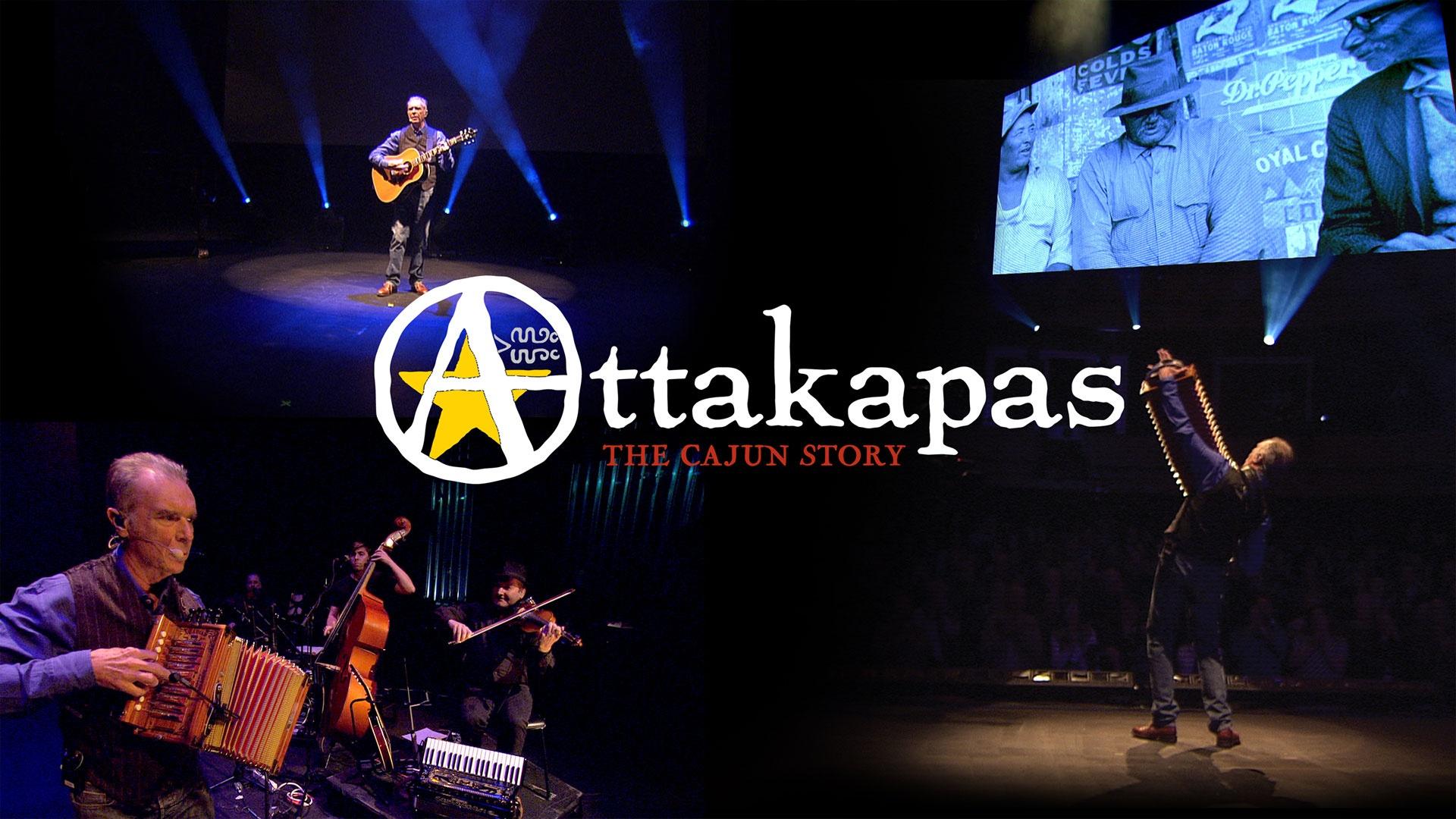
Attakapas: The Cajun Story
02/04/18 | 56m 47s | Rating: TV-G
Explore the music of Louisiana singer-songwriter Zachary Richard and his oral history of the Cajun people. This exclusive performance, taped live at the Manship Theatre in Baton Rouge, presents Richard’s original songs in an immersive, multi-media stage show. Along with performance footage, archival photography traces the lineage of one of America’s most influential immigrant populations.


Copy and Paste the Following Code to Embed this Video:
Attakapas: The Cajun Story
>> Major production funding for "Attakapas: The Cajun Story" is provided by the Louisiana Office of Tourism.
>> Jambalaya, Atchafalaya, gumbo ya ya, touffe, cochon de lait, warm beignet, laissez les bons temps rouler.
If it sounds different, that's only because it is.
>> And by Southern Lifestyle Development.
Headquartered in Lafayette, Louisiana, Southern Lifestyle Development creates master-planned lifestyle communities and smaller neighborhoods designed to change the way you live.
And by the Lafayette Convention and Visitors Bureau.
Mulate's of New Orleans.
And Visit Baton Rouge.
And by the following... With the Foundation for Excellence in Louisiana Public Broadcasting.
[ Cheers and applause ] >> The first place that the Acadians came to in Louisiana was called La Place de l'Attakapas because of the Native American tribe that were in the area, and this place is called the Attakapas Prairie.
Motivated by this idea of creating a production which would tell the story of the Cajun people in a way that was dignified and that we would not become caricatures of ourselves and that would tell the tremendous story of tenacity and resistance that are the heart of this story.
It's a story of wanting to have a better life.
It's a story of being victim of a terrible tragedy and overcoming that tragedy, and I think because of our history, because of the story, because of our experience that we are very attached to this place, which begs the question, I mean, whether it is something in our DNA or whether it is something that is learned.
Can you learn to love this place, or do you have to be born in this culture?
The Attakapas Prairie is fundamental to our story, and I think it's a good name for this piece.
[ Chuckles ] Hello, bonsoir, good evening.
My name is Zachary Richard, and I am a Louisiana Cajun, and I have special powers that have been granted to me by the king of Louisiana, and by the special powers granted in me, I declare you all to be honorary Cajuns.
I'm here tonight to share our story with you, but it's not only a Cajun story.
It's also a human story.
It's a story of faith and courage and hope and exile and exodus and the search for the promised land.
Our homeland is in today's Nova Scotia.
For 150 years, it was called Acadie.
We don't know if the word was inspired by the Arcadia of ancient Greece or the native word cadie meaning fertile earth, but no matter where the word comes from, we are a people of the New World, but our roots are in old France.
Why did our ancestors, notoriously stay-at-home French people, decide to leave?
But leave the Acadians did because of one thing -- war.
Western France was the theater of incessant religious wars throughout the 16th and 17th centuries with rampaging armies running through the countryside.
Acadie was founded in 1604.
In 1632, the first families came, an entire community boat-lifted from Poitou-Charentes in Western France.
Arsenault, Arden, Aucoin, Babineau, Boudrot, Comeau, Cormier, Dingle, Duon, Dugas, we knew one another even before we left France, and we came to the New World together seeking peace, seeking to escape war and to build a safe home where we could raise our children and have fun.
We came to America, like so many since, looking for a better life.
[ Singing in French ] [ Cheers and applause ] >> The people who became the Acadians were people of the marsh.
For 100 years, we had drained the swamp of the mighty Poidevin and had controlled water.
We had manicured the salt flats and harvested the white gold.
Some of us were even called [ Speaking French ] -- the salt people.
We came to the New World with the know-how to make and maintain levees, and that's what we did.
Instead of cutting the forest, the first Acadians reclaimed the land from the sea, 3,000 acres before it was over, and this would forge our identity forever.
We are levee builders.
We are hydraulic engineers.
We are people of the swamp.
[ Singing in French ] [ Cheers and applause ] [ Military drum plays ] In 1713, after yet another war, this one called Queen Anne's, Acadie became British forever, but the British didn't know what to do with us.
We were French.
We were Catholic.
They didn't like us very much, but they couldn't get rid of us because without us, their soldiers would starve.
They were constantly after us to sign an unconditional oath of allegiance, but we wanted three things.
We wanted the recognition of our property rights, the free practice of our religion, and never to have to fight in their wars.
We thought we had them.
We were good negotiators.
After all, they called us the French neutrals.
We thought we had them.
But we were wrong.
In September 1755 at Grand-Pre, they called all the men and boys to the church.
We went down.
We didn't know what to expect.
And when we got there, the soldiers slammed and locked the doors, and at that same time, other goddamns -- we called the redcoat soldiers goddamns not because we cursed them because if we were going to curse them, we would have cursed them in French.
We called them goddamns because they said "goddamn" so much, that's what we thought their names were.
[ Laughter ] That's true.
[ Chuckles ] They would push our wives and children from the houses and load them on the boats because they knew that they would have a hell of a time to get the men on the boats if the women and children weren't already there.
And then they began to burn the houses.
[ Singing in French ] The boats that took us into exile were the same boats that had brought the African slaves in bondage to the New World.
We were crammed in the dark holes and had no idea where we were going.
Many of us had lost loved ones in the confusion.
We prayed, and we sang, and we cried.
When we got to where we were going, Boston, Philadelphia, New York, Baltimore, Williamsburg, Charleston, the people treated us like dirt.
In Philadelphia, our children were taken from us.
Many of us, the old and young, died from the smallpox and the heartbreak, and others huddled in the ports of Western France living like paupers begging in the streets.
But no matter where we were, we never forgot where we came from.
We never forgot L'Acadie, and we never gave up trying to find our way home.
[ Singing in French ] A lot of people believe that the Acadians went into exile like lambs being led to the slaughter.
There were many who resisted.
There were summary executions at Grand-Pre, young men who attempted to break free of their British captors and return home.
There were mutinies among some of the transport ships.
And then there was Beausoleil.
For 15 years there had been a price on his head, and when the fort fell, the French fort fell in July, Beausoleil kept on fighting, and he would fight on for five years until finally, unable to feed his family, he was forced to surrender.
He was taken to Halifax in chains.
When the peace came, the British gave the Acadians two choices.
Either they could stay in Nova Scotia and sign the unconditional oath of allegiance, or they could get the hell out of there.
It was in November of 1764 -- three boats carrying approximately 600 Acadians left the harbor of Halifax headed for Louisiana.
Legend has it that they wanted to go up the Mississippi Portage into the Great Lakes, get into Lake Ontario, go down to St. Lawrence, Notre Dame, j'Portage, [ Speaking French ] and go all the back to Acadie.
But when they got to New Orleans, the governor treated them well.
It was hot, but they were well treated, and they met a Creole by the name of Antoine Dauterive, who needed some help with his cattle, and the Acadians signed a contract to raise cattle on shares, and that's how they moved to the Attakapas.
In February 1765, they went up the Mississippi River, got into Bayou Plaquemine, headed west across the Atchafalaya River and came aground on the Bayou Teche somewhere near the Oxbow, the present-day city of Loreauville.
When they got there, the land was flat, and there was lots of water, and Boudreaux turned to Thibodeaux, and he said, "Hey, Thib, how about we build us a levee?"
[ Laughter ] Sweet, sweet love of mine, it's been such a long, long time Since we've been swinging on the sweet potato vine Ooh, ooh Meet me on the back of town Under the levee when the sun goes down That's where romance can be found Ooh, ooh [ Singing in French ] [ Singing in French ] Sweet, sweet love of mine It's been such a long, long time Since we've been swinging on the sweet potato vine Ooh, ooh Meet me on the back of town under the levee when the sun goes down That's where romance can be found Ooh, ooh [ Singing in French ] Yeah Ha ha!
Sweet, sweet love of mine, it's been such a long, long time Since we've been swinging on the sweet potato vine Ooh, ooh [ Singing in French ] Ooh, ooh, ooh [ Cheers and applause ] When my grandfather Pierre got to the Attakapas, he turned to his wife, Marie.
He said, "Babe, make some coffee.
I think we're home."
[ Cheers and applause ] The Acadians arrived in Louisiana starting in 1765, the first group arriving with Beausoleil directly from Nova Scotia.
Throughout the diaspora, word spread that a nouvelle Acadie, a new Acadia, had been founded on the banks of the bayous.
In 1785, over 1,500 Acadian exiles, nearly the entire community living in France, migrated en masse, the largest immigration ever to arrive in Louisiana.
[ Singing in French ] Nothing in their experience had prepared the exiled Acadians for what they found in Louisiana.
The swamps are wild places filled with wild things and even wilder people, and perhaps the wildest of them all was -- they called him a pirate, but he was actually a businessman.
He was in the import-export business, and his name was Jean Lafitte.
Sail with me I will be your fortune Whether it be women or gold A tall ship riding upon the Gulf Stream water The hurricane has blown me so far from home I fly the flag of sovereign Cartagena All the Spanish boats fair game The days are hot, and the nights are filled with singing Women in the moonlight dancing away Down in Cote Blanche Bay All the Creole ladies called him Baby The renegades called him Capitan But things were never the same down south in New Orleans Ever since the Americans came Down in Cote Blanche Bay Down in Cote Blanche Bay Too many women, too much drinking I can't sleep at night If only I could stop thinking about my baby If only I could hold you tight Down in Cote Blanche Bay Oh, yeah, yeah, yeah Down in Cote Blanche Bay What's a pirate gonna do when his sea legs get rusty?
When all the wind has left his sails?
I'm going down south to where nobody gonna find me Sleeping on the beach with a blue-eyed girl Down in Cote Blanche Bay Oh, yeah, yeah, yeah Down in Cote Blanche Bay The exiled Acadians found a new world in Louisiana and were confronted with a climate and with plants and animals that they had never imagined as well as an institution that would have a profound impact on their lives.
Acadian society in Louisiana was split into two classes.
The majority of Acadians were small subsistence farmers, petits habitants, but at the top of the society was a small class of privileged planters whose wealth came from cotton and sugar, and was made on the backs of African slaves.
Someday, I'll be going home Someday, I'll be going home Don't you know I know I got a long way to go Someday, I'm going home I'll be riding on a coal-black Tennessee steed Riding on a coal-black Tennessee steed With eyes of burning fire With elegance and speed I'll be riding on a coal-black Tennessee steed I'll be wearing a coat of solid gold Wearing a coat of solid gold I'll be shining like the sun A true beauty to behold Wearing a coat of solid gold Gonna see my mama and my papa Brothers and my sisters too, yeah Don't you know I know I got a long way to go Someday, I'll be going home You said you would always be my love Said you would always be my love Oh, until the earth below Becomes the heavens above Said you would always be my love Gonna see my mama and my papa Brothers and my sisters too, yeah Don't you know I know I got a long way to go Someday, I'll be going home Ah, ah, ah, ah, ah, ah, ah Ah, ah, ah, ah, ah, ah Yeah, Lord Ah, ah, ah, ah, ah, ah Ah, ah, ah, ah, hey, hey Lord, Lord, Lord [ Cheers and applause ] [ Indistinct conversations ] There you go.
[ Speaking French ] >> [ Speaking French ] >> There will always be people in Louisiana that... Cajun people and black Creole people, who will be able to speak French.
I'm convinced.
But it will be an elite or a very small minority or at least a minority of the general population.
But these other elements, the cuisine, the music, the lifestyle, the vision of the world, seem to be very easy to transmit from one generation to the next.
Ah.
Well, Breaux Bridge Betty called me up on the party line Said, "Baby, I just got to know" I said, "If you got some of that of what it take to make me feel so fine I'm gonna tell you 'bout my fil gumbo" I said, "Betty, I knows I gots what you gotta have I made some just a little while ago It's got a black pot roux and some of that ground-up sassafras I'm going to tell you 'bout my fil gumbo" Bring that boy some of that fil gumbo That's right Bring that boy a bowl Bring that boy some of that fil gumbo Hurry up before it gets cold Well, I quivers, and I shivers from the feeling it delivers Lord, and I keep coming back for just a little more I said it got the right spice to make me feel so nice My Louisiana-style fil gumbo I said, "You're down in a dump, and you're stuck in your slump And you're looking up the wrong end of the blues Come on Have yourself some of that fil gumbo" Lord It's more better than that chicken barbecue Bring that boy some of that fil gumbo Come on Bring that boy a bowl All right Bring that boy some of that fil gumbo Hurry up before it gets cold Ah Hoo!
Gumbo fil make-a me feel so good Although I eats it more often than I really should But if I could, I swear I would have some more gumbo Bring that boy some of that fil gumbo That's right Bring that boy a bowl Yeah Bring that boy some of that fil gumbo Hurry up before it gets cold Bring that boy some of that fil gumbo Come on Bring that boy a bowl Bring that boy some of that fil gumbo Hurry up before it gets cold I said hurry up before it gets cold Come on, come on, come on Hurry up before it gets Bring me some of that red-hot, mm Yeah, yeah, ooh-hoo, yeah [ Cheers and applause ] After the Civil War, Acadian society in Louisiana was transformed.
Cajuns, as they were called by their American neighbors, began to include other ethnic groups.
People of Irish, Spanish, German, even English heritage came to consider themselves Cajun.
This identity was based on two overriding elements, the French language and poverty.
In 1916, the state of Louisiana adopted a mandatory educational policy.
Every child in the state was obliged to attend school, and the schools were English-speaking institutions.
The Cajun children were subjected to humiliation and corporal punishment for even speaking French, their maternal tongue.
They were told that they could speak no French no more.
My papa was a hardworking man Held a plow inside a callused hand Up before the sun, out on the land Trying to give us everything he can He sent us off to school when teacher came He said, "My boy, try hard.
Do the best you can."
But the teacher we could not understand Because she only talked American Papa couldn't tell us, and it didn't make no sense When the teacher told us we couldn't talk no French no more Things were changing fast in Louisiane Cajun can't talk English, feel ashamed But nowadays, it's getting so you can't Tell the Cajun from American Papa couldn't tell us, and it didn't make no sense When the teacher told us we couldn't talk no French Yeah, yeah Mon cher garon Est-ce que tu me comprends?
No more Well, I got me a job just like my papa planned I wear a suit, and dirt never touch my hands But I still see the look in my papa's eye The pain and the shame that he just could not hide Papa couldn't tell us, and it didn't make no sense When the teacher told us we couldn't talk no French Yeah, yeah Mon cher garon Est-ce que tu me comprends?
Do you hear me calling?
Do you understand?
Once it is gone, it ain't never coming back, oh, no more No more No more No more Oh, no, no, no Je me Je me Je me, je me, je me No more No more No more Je me Je me [ Applause ] In the 1930s, Cajuns and Creoles began to leave Louisiana.
Times were hard.
They were looking for a better life.
They moved on.
A lot of them stopped in East Texas, around Beaumont, Port Arthur, and a lot of them went all the way to California, but no matter where they went, Louisiana was always home.
We had just got married When I picked up and left home Headed out to California I want to make it in the oil boom It was back in '57 In a worn-out Chevrolet Caesar Junior held the squeezebox Though he was too young to play One kiss from the lady's love One kiss is all it takes One kiss from the lady's love That's the one That's the one that you'll never forget Well, it's been 30 years Here round the San Francisco Bay Caesar Junior play that old squeezebox Like the King of Zydeco, Clifton Chenier When we get together Down at 'Ti Jolie Well, I'm always asking about you, baby Maybe you're asking about me One kiss from the lady's love One kiss is all it takes One kiss from the lady's love That's the one That's the one That you'll never forget Leave the light burning all through the night Leave the light burning, oh, oh, so bright Well, I am just a working man I use my hands most every day Got a lot of feeling, but I ain't got much to say I got a house full of Cajun kids And I love them every one But sometimes I get so lonely I sing the French blues all night long One kiss from the lady's love One kiss is all it takes One kiss from the lady's love That's the one That's the one That's the one that you'll never forget [ Cheers and applause ] They say there's about a million people of Acadian or Cajun heritage in Louisiana.
That's a far cry from the 7 million demographers estimate would be the Acadian population if the deportation had never occurred.
This is an old story that's still going on.
You don't have a passport.
You don't have a license.
You don't pass a test.
You're Cajun because somehow, in your heart and your soul, you're attached to this story.
It started in 1604, and it's still going on.
We were the victims of the largest ethnic cleansing in the history of North America suffered by people of European decent.
Since we've come to Louisiana, we've known yellow fever, hurricanes, greedy politicians, oil spills, and yet we're still here and ready to celebrate and to enjoy our lives together.
The best definition of an Acadian that I think I've ever heard is an Acadian is someone who has forgiveness in his heart, so I guess maybe the best definition of a Cajun is someone who has joy in his heart.
Thank you all for coming.
I appreciate it very much.
It means a lot to me.
Now y'all go home and be nice to each other.
Hurry up, my Josephine The hour is getting late We going to miss the 5:00 ferry, and we going to have to wait Down in Catahoula, they be having a fais-do-do 'Cause I been saving up-a my sugar cane money just so that we could go 'Cause when I hear the fiddle playing an old-time Cajun song Moonlight on the bayou going to keep dancing, all right, all night long Dans, hey, we going to dance the night away Dans, coll, coll, dans Tonight is a night for romance Can I have the pleasure, the pleasure of this dance?
Ever since I turned 17, I got my old man's Chevrolet I been going every Saturday night to the old bons temps roulet You know I love my dancing I got a nice style, don't you know 'Cause I just want to hold you tight and waltz you across the floor 'Cause when I hear the fiddle playing an old-time Cajun song Moonlight on the bayou, want to keep dancing all night long Dans, hey, we going to dance the night away Dans, coll, coll, dans Tonight is a night for romance Can I have the pleasure, whoa 'Cause when I hear the fiddle playing an old-time Cajun song Moonlight on the bayou, I want to keep dancing Merci beaucoup et bonsoir.
On c'est amus ce soir.
Dans Hey, we're going to dance the night away Oh, yeah, yeah, yeah Merci beaucoup!
[ Cheers and applause ] [ Cheers and applause ] Merci beaucoup!
I don't know what the future holds for French-Acadian society in Louisiana, how these young kids will respond to it, how they will preserve it because I'm convinced it will be preserved because it should have disappeared 100 years ago, and it's still here.
So I really have no concern about the future.
The kids will define this themselves.
That spirit will survive.
>> I was curious.
I heard my grandparents speaking French and asked my mom, you know, "Teach me how to sing a Cajun song," and that was my moment.
You know, it was real.
It was in me.
Every time I play, I just feel something that I don't feel any other time.
>> Major production funding for "Attakapas: The Cajun Story" is provided by the Louisiana Office of Tourism.
>> Jambalaya, Atchafalaya, gumbo ya ya, touffe, cochon de lait, warm beignet, laissez les bons temps rouler.
If it sounds different, that's only because it is.
>> And by Southern Lifestyle Development.
Headquartered in Lafayette, Louisiana, Southern Lifestyle Development creates master-planned lifestyle communities and smaller neighborhoods designed to change the way you live.
And by the Lafayette Convention and Visitors Bureau.
Mulate's of New Orleans.
And Visit Baton Rouge.
And by the following... With the Foundation for Excellence in Louisiana Public Broadcasting.
[ Cheers and applause ]
Search Episodes

Donate to sign up. Activate and sign in to Passport. It's that easy to help PBS Wisconsin serve your community through media that educates, inspires, and entertains.
Make your membership gift today
Only for new users: Activate Passport using your code or email address
Already a member?
Look up my account
Need some help? Go to FAQ or visit PBS Passport Help
Need help accessing PBS Wisconsin anywhere?

Online Access | Platform & Device Access | Cable or Satellite Access | Over-The-Air Access
Visit Access Guide
Need help accessing PBS Wisconsin anywhere?
Visit Our
Live TV Access Guide
Online AccessPlatform & Device Access
Cable or Satellite Access
Over-The-Air Access
Visit Access Guide




Follow Us