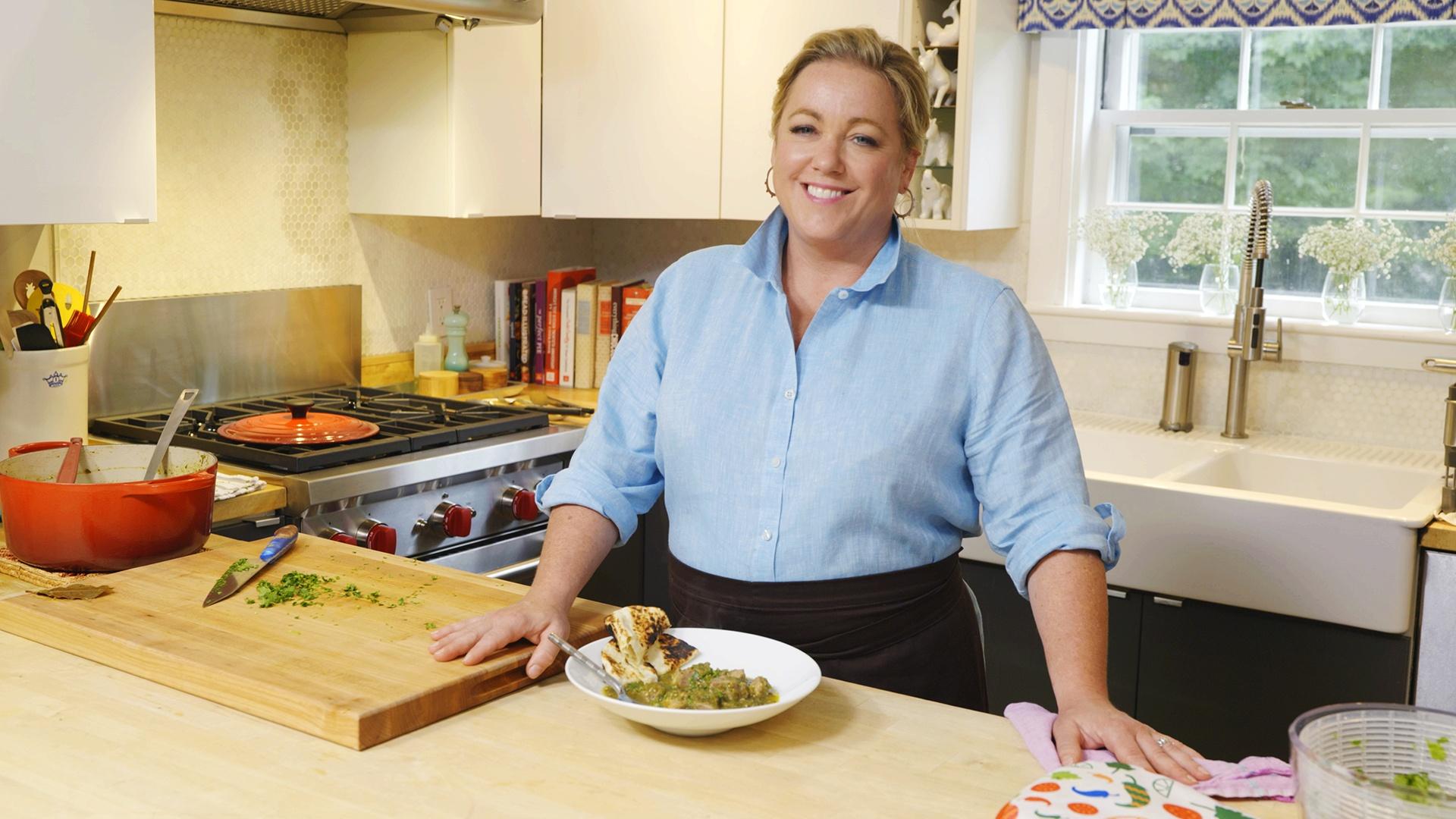
-Welcome to "America's Test Kitchen at Home." Today, I'm making a foolproof recipe for chile verde con cerdo. Jack's gonna tell us all about the world of chili products, and Elle is going to make refreshing cctel de camarn. We've got a lot in store today, so stick around. Growing up, chili for me was always a red-style chili made with ground meat.
So when I got older and I had green chili with chunks of pork in it, my head exploded. And it is now my all-time favorite thing to make. Now, this version of chili is based on a traditional recipe from Mexico called chile verde con cerdo. That's green chili with pork.
And when you choose the pork for this chili, you want to choose a cut from the shoulder because they braise well and they turn meltingly tender in the oven. So, here we have a piece of Boston butt. And even though it's called butt, it's from the shoulder. And it weighs between 3 1/2 and 4 pounds.
And what we're gonna do is first cut it down into big chunks, 1 1/2-inch pieces. And as I cut it down, I'm gonna trim away some of that fat, and I'm gonna save the fat 'cause we're actually gonna use the fat to help build some more pork flavor in the stew. What I like to do is use two knives -- chef knife and a boning knife. And I'm gonna first cut it into slabs that are about 1 1/2-inch thick, and then I'm gonna go in there and cut that down into pieces and then carve out any of those pieces of fat.
And I'm working with one at a time. I'm just pulling out any of the big, hard pieces of fat because I want to use them separately in the chili. And now that I got the big hunks of fat out of there, I'm just gonna go ahead and cut this into nice, big 1 1/2-inch pieces. Some of them are gonna be a little wonky-sized because the pork butt is lots of muscles that fit together.
And when you cut it into pieces, you might have access to other pieces of fat. So you can just trim those out. And as I go, I'm gonna chop the pieces of fat up into small sizes. Alright, so that is all of the meat.
Just gonna toss this pork with a tablespoon of kosher salt. This will season the meat throughout and make sure it stays nice and juicy during braising. So, we're just gonna cover this with plastic wrap and we're gonna store this in the fridge for at least an hour while I clean up and we get cooking. Now I'm gonna start by cooking those pork trimmings that I saved.
I'm gonna brown them in this pot with a little bit of water. This is a cup of water. By cooking this fat with a little bit of water in the Dutch oven, first, that fat will begin to render, and that's gonna be good flavor in our chili. Now, second, the water is gonna pull some of the protein out of the pieces of meat in there, and that's gonna then brown on the bottom, which makes a fond, which is great for flavor.
And it means we don't have to brown all that pork later. So, with one quick step, we got two things. We got good pork fat and good browning. Alright, so while that cooks, let's take a look at the vegetables.
Most important are the tomatillos. Now, fresh tomatillos are best if you can find them at the store, but canned tomatillos work well here, too. You want about a pound and a half. And if you've never used a tomatillo before, they usually come with these papery skins.
You can see how fresh this one is. That skin is almost like a leaf. As they age, it gets a bit more dry and papery like this, but these are all pretty good. And you see how the skin is sticking.
That's because underneath this papery layer, you have the tomatillo and this can be a little bit sticky. And so what you want to do is you want to peel off all the skins and then you want to give these a good rinse to get rid of that tackiness.
Pot sizzling
Ooh, you can hear that pork sizzling in the background. Let's go take a look and see what's happening in that pot. Alright, so it's been about 12 minutes, and you can see all that water has evaporated off. And now the fat's come out and it's starting to sizzle.
Smells really good. We're gonna get some browning around the edges of the pot and also on the bottom, and these pieces of pork are gonna turn a beautiful golden. Alright, so that's gonna take another five minutes or so. Now let's turn our attention to all the vegetables that go into this green chili.
So, we have poblano peppers, which have a mild grassy flavor. You have five of those. One jalapeo for a little kick of heat. And last but not least, some cilantro, which isn't here, because we're gonna add it at the end to maintain its fresh flavor.
An onion, some garlic. And the thing about all these vegetables is we're not just gonna add them to the pot right away. We're gonna broil them first, really reduce and intensify those flavors and get a little bit of that char on them 'cause that is a key flavor in this chili. Alright.
So, here I have a rimmed baking sheet lined with foil for easy cleanup. So here are all the tomatillos. Don't need to cut them in half. You can just leave them whole.
I'm gonna add some garlic. This is five cloves of unpeeled garlic. They're gonna go right on the tray with everything else. Now these vegetables need a little bit of prep.
Here's our jalapeo. Just gonna take the stem off. I'm gonna cut it in half. Now, I'm leaving the seeds and the ribs in, which we all know is where all the spice is.
After we broil, we're gonna take those seeds out and determine how spicy we want things. Alright. Now the poblanos. We have five poblanos.
We want to cut them in half and get rid of the stem and the seeds. Of course, I already washed these. Now, an easy way to stem and seed them is to cut them in half first. And then with your fingers, you can just peel out the stem, shake out any seeds, and then put it right on the baking sheet.
Last but not least is an onion. I'm gonna trim off the stem. I'm gonna cut this onion into eight wedges through the root end so that those wedges hang together. Alright, so I find it easiest to peel the onions after you've cut them into wedges.
Just peel off that peel, and sometimes that first layer of onion, which is a little slimy or a little dried-out. The trick, of course, is getting this all to fit on one sheet pan. It's gonna get a little crowded. So, you want all the peppers to be skin side up.
Last but not least, let's fit these onions on there. So, these are almost ready for the broiler. Just gonna drizzle with about a tablespoon or so of vegetable oil. Now, I have that rack set 6 inches from the broiler element.
That's gonna ensure that everything gets a nice char and gets a good roasted flavor, which is key for this recipe. Alright. Into the broiler they go for about 10 minutes. So, let's take a look at the pork we have in this pot.
Now, remember, these are all the trimmings. Ooh, they look good. Alright, so I'm gonna take these out using a slotted spoon, leaving all the fat in the pot, of course. Mmm.
Alright, now for the fat left in the pot and all that nice fond you see around the edges and on the bottom. We're gonna pour off all but 2 tablespoons of fat. That looks pretty good. And now let's take a look at the vegetables that have been under the broiler.
Ooh! That is burned perfection. That is exactly what they should look like. And I know it doesn't look great, but it's perfect.
We're gonna peel a lot of that black stuff away before we add it to the chili, but underneath are those roasted vegetables that have a really intense flavor, which is perfect for the chili. Now the veg have cooled down a bit, so they're a bit easier to handle, and now we're gonna start by taking off the skins from the peppers. I'm gonna start with the jalapeos. Now, I left the seeds in them.
Seeds and the ribs contain all that heat. I'm gonna scrape those out. You know, it's personal preference whether you want to add that to the chili or not. My personal preference is to add about half of them in because I like a little heat, but I know not everyone does, and this is a big pot of chili.
Just gonna peel off the blackened skins. Lots of ways you can do this. I like using my fingers. Sometimes, if they're a little sticky, you can use paper towels to give you a little grip or even a paring knife to help scrape it off.
And this is all going into a sauce that's gonna get coarsely chopped, so don't worry about keeping that jalapeo intact. And a little skin left on there is totally okay. Just gonna add a little flavor to the chili. Alright, now for the poblanos.
So, these I'm gonna lie flat on the board. And like I said, you can use a paring knife. You can use any sort of utensil to help you get under that skin and just scrape it off. Last thing to peel are these pieces of garlic.
And really, they should just pop right out of their skins now that they're nice and roasted. Alright, now, for the tomatillos and onions, they can just go right into the food processor along with any juice that's accumulated on the tray. Alright, so now we're just gonna pulse this. Four or five pulses.
We want a nice coarse puree. You don't want to make it too smooth. We're not looking for a smooth sauce -- more like a salsa. Ah, that is perfect.
Here, you can see the texture of this. So, it's not a smooth puree. It's just a chunky salsa. So this is perfect.
Sniffs
Ooh! I can smell those tomatillos and those jalapeo seeds. And, of course, you could add more if you want to to make it a little extra spicy. And the cool thing about spicy food is that when you eat it, you're actually playing a trick on your brain.
Here's how it works. In a chili pepper, the molecule responsible for the spicy flavor is called capsaicin. When capsaicin is eaten, it activates receptors in the mouth, which also happen to be the same receptors that respond to physical heat, like hot coffee, for example. This phenomenon is known as chemesthesis.
So the message that your mouth sends to your brain is, "The temperature in my mouth is painfully high." So the brain reacts accordingly, instructing your body to react just as it would for actual heat. Your face gets flushed as blood vessels dilate to dissipate body heat. You start to sweat to cool yourself down. And the body may also release endorphins, which are natural painkillers that create a pleasurable sensation.
And that's why some people say spicy food is habit-forming. Now, a few other ingredients also play a trick on your brain in the same way, including ginger, horseradish, and black pepper. We've done all our prep and now it's time to assemble the chili in the pot. And remember, I have those 2 tablespoons of pork fat that are heating up over medium heat, and I can see them starting to shimmer.
And now is when we're gonna add the spices. So we're gonna add a teaspoon of oregano, teaspoon of ground cumin. Adding the spices to the fat just allows them to bloom and really permeate through the whole chili, so don't skip this step. 1/8 teaspoon of cinnamon.
You're not gonna pick it out, but it adds a nice, good floral backbone. And a pinch of ground clove. Alright. We're gonna let that cook just for 30 seconds or so, until you can smell it.
Those flavors are starting to go into the oil, and that's what will help permeate through the whole chili, so don't skip this step. Alright, next we're gonna add the tomatillo and poblano sauce, two bay leaves, 2 teaspoons of sugar, a teaspoon of black pepper, and a teaspoon of kosher salt. Last but not least, we're gonna add the pork, which has been resting all this time in the refrigerator with that salt. So we're gonna bring this up to a simmer.
And if you notice, there's not a lot of liquid in that pot, because we didn't add any broth or water, and that is by design, because as the pork cooks, a lot of liquid's gonna come out and it's gonna turn that salsa into a lovely chili sauce. Alright. So this has come to a nice simmer. So we're gonna put the lid on.
Now, the other trick here is we're gonna cook this in the oven, a 325-degree oven, because the oven has a nice even heat and there's no hotspots, so the pot won't scorch. Alright, so it's been in the oven for an hour and a half, and now I'm gonna test the doneness of the pork with a fork. It should be fork-tender. Oh, yeah.
I can feel the resistance on my fork is very slight, which is perfect. You want a little bit of texture to chew on. You don't want it to be fall-apart, but you want it to be nice and tender, so that is perfect. So we're gonna set this aside and let it rest for 10 minutes 'cause it's quite hot.
While that rests, we're gonna toast some tortillas. Now, there are a few ways to toast tortillas, but my favorite way if you have a gas stove is to do it right on the burner. So what I do is I turn the burner on and then I put the tortilla right on the burner. Actually, what I like to do is pretend I'm a short-order cook and then I do all at once.
Let's see. Ooh, see how that gets a little bit of nice char on it? I actually like a little bit more char, so I'm gonna let that go a little bit. And it takes about 10 seconds or so.
That's how I like it, 'cause that charring is nice flavor. Alright, put these in the tortilla warmer. And if you don't have a tortilla warmer, then you're missing out, because they stay warm in here for up to 30 minutes, which is really nice. It means you can do them ahead of time.
Alright, we're gonna let that chili rest, I'll finish toasting these tortillas, and then we can taste. Ooh! So, the chili has been resting for 10 minutes. Now, there's lots of browning around the sides of the pot here.
That is good flavor. You want to stir that in, along with any fat that's risen to the top. Oh, I see a bay leaf. Mm-hmm, you get to come out of the pot.
There's another one lurking in there. We'll find it. The last bit of green in our green chili is some fresh cilantro, which, of course, we're adding at the end to preserve its fresh flavor. We're gonna add about 1/2 cup.
Obviously, I washed it. And I'm including a lot of the small stems, too, because those stems have a really nice, sweet flavor. Alright. Time to give it a taste.
Mmm. A little cilantro on top never hurt anybody. Nice tortilla. Now, these are flour tortillas 'cause it's what I like, but corn tortillas also taste good here.
Oh, yeah. Age-old question -- do you use a fork or a spoon? Turns out, I'm a spoon person. Ohh!
I love that hit of acidic tomatillo, that little kick of jalapeo. Mmm, and the pork is not falling-apart tender, but it is super juicy and it has just a little bit of chew, like a good chili. Also, I know from experience that this chili freezes like a dream, especially if you use little pint containers. Thaws in about a day, and then you have lunch at the ready.
Mmm! If you want to make this awesome chili, don't forget to save those trimmings and brown them in the pan, broil the vegetables for extra flavor, and cook the chili in the oven. From "America's Test Kitchen at Home," a great recipe for chile verde con cerdo. It's really good.
-I like spicy food, so there are a lot of canned and jarred chili products in my pantry, but they can be confusing. Let me explain what you need to know. First up, diced green chiles. So, these are fresh chiles, usually Anaheims.
They are roasted, peeled, and diced. Most brands aren't spicy enough. See, they're really sort of finely diced. Use them in salsas.
We like the Goya because they're actually spicy. Also fresh chiles, but a different variety -- pepperoncini. These are Italian, so you know I love them. But they are in a vinegary brine, so they're more puckery than spicy.
Great whole like this on an antipasto platter, or you can use them in salads, sandwiches. I love them chopped up on a pizza. Next up, my favorite ingredient -- chipotle chiles in adobo sauce. It's really two ingredients in one.
You get this amazing sauce -- tomatoes and garlic. Then you get these chiles. Look at these. These are whole jalapeos that are smoked and dried, super spicy, a great addition to so many different dishes.
Then we come to all the chile powders. So first up is what we call chili powder with an "I." So this means it's a blend. There's usually garlic powder, oregano, cumin. This is from Morton & Bassett.
It's our top rated. Chile powder with an "E," not an "I," means it's 100% dried chiles. In this case, it's anchos, so it's fruity, but there can be chipotle chile powder. Any chile can be turned into a chile powder, and they're really gonna vary depending on the source chile.
Last but not least is the cayenne. The cayenne is probably the spiciest thing here on the table. It's 100% dried red chiles, usually cayenne. Thing to know here is that this is gonna lose its heat pretty quickly.
So buy small jars, use them quickly. So, my favorite chile products. They all have a place in my pantry and in my cooking. Enjoy the heat.
-Anytime I make a recipe that pays tribute to another country or culture, I like to take a look at how the dish highlights ingredients and technique, whether that means making my own spice blend or making my own sauce. And even though cctel de camarn has simple components, it is no exception to the rule. So today, I'm gonna use what I have here at home to re-create my visit to Mexico and all the good eating that I did, right here in my kitchen. I'm gonna start with 1 1/4 pound large shrimp, and we're gonna peel and devein these shrimp.
And that sounds intimidating, but it's actually a very simple process. I'm gonna show you. I'm gonna start with holding the shrimp tail out, and using my shrimp shears, just cut down the spine of the shrimp shell. We're taking all of the shell off, so I'm gonna cut right down to the tail.
And then peel the shell. Discard it. And there's a vein in there, so I'm just gonna use the tip of my paring knife to remove the vein, and you're all done. Super easy.
Okay, so I'm just gonna keep peeling and deveining until we're all done, and then we'll start cooking. Okay, so we're all done peeling and deveining the shrimp. Now it's time to poach it. So I have 3 cups of water boiling here.
I'm gonna add the shrimp. Alright. So, all the shrimp is in. Now I'm just gonna add the salt.
It's 1 tablespoon of table salt. Just give it a stir. And I'm gonna put the lid back on, take it off heat, taking it over to the table. This is a gentle poaching method, so it doesn't really need a whole lot of time.
It actually only needs about five minutes. And at about two minutes, I'm gonna give it a shake just to make sure that all the shrimp are done. Okay, so it's been five minutes and this shrimp is ready to go into an ice bath to stop the cooking process. Poaching shrimp can be very tricky because you can overcook it, but this gentle poaching method is quite ideal.
You get sweet, tender shrimp. So this just needs to sit in an ice bath for three to five minutes. Alright, so the shrimp is all ready. We're gonna start cutting each shrimp crosswise into three equal-size pieces.
So I'm just gonna continue to cut the rest of the shrimp and we'll move on to the cctel sauce. Now for the part that brings back the best memories for me -- the cctel sauce. We're looking for 3 tablespoons of lime here. That's about the juice of two juicy limes.
I love using fresh lime juice. Next, I'm gonna add 1/2 cup of ketchup. The sweetness of this cctel sauce is rooted in ketchup. Next, I'm gonna add 2 teaspoons of hot sauce.
This hot sauce is really gonna bring some balance to the sweetness. And finally, I'm gonna add 1 cup of V8. V8 is ideal for this recipe for a variety of reasons. One is that it's a great blend of vegetable juices and tomato.
And the other is that it has amazing viscosity, which means it's not watered down like other tomato juices. It's perfect for this nice, rich cctel sauce. And I'm also gonna add 1/4 teaspoon of table salt. It's already coming together so nicely.
It smells so, so good. And now I'm gonna add the shrimp. I'm gonna set this aside and start working on our fresh ingredients. First, I'm gonna start with a half of an English cucumber.
They're very long, so half is all you really need here. And I'm gonna cut that half into 1/2-inch pieces. I like to make planks and then cut the planks. I'm just gonna add this to the bowl of shrimp and sauce.
I'm gonna add 1 cup of red onions, finely diced. Think this is what they mean by "eat colors." This is great. Now I'm gonna add an avocado. I'm gonna half it.
And this is really ripe. It's nice and soft. You can tell by how easily my knife is moving through it. Pop it open.
That is the most beautiful avocado I've seen in a long time. That's gorgeous. I'm gonna take the pit out and I'm gonna cut this avocado into 1/2-inch pieces. This nice, ripe avocado is gonna add a really creamy texture to these really fresh and crunchy ingredients.
I'm pretty excited about it. There you go. So easy. So pretty.
I'm gonna do the same thing with the other half. Alright, finally, we're gonna end it off with 1/4 cup of cilantro, and I'm just gonna chop it up. I like to just kind of gather in those leaves and make sure everything gets chopped evenly. Measure out 1/4 cup of it.
All of the work is done. It was so easy and so fast. I'm just gonna give it a good stir. And it's looking and smelling like vacation in here.
I'd just like to thank the good people of Mexico for being so innovative on the cctel. That V8 sauce really sticking to all the ingredients. I'm ready to eat it. I'm gonna put a little lime squeeze 'cause that's how I like my cctel done.
And I actually want a little bit more of a little kick to it, so I'm gonna add some more hot sauce. Saltines are standard for this recipe, but if you don't have saltines, you can use tortilla chips or you can use thick-cut potato chips. I prefer the saltines. So, I'm gonna go ahead and dig in.
Mmm. That is so good. This is amazing. The sweetness, the tangy, the spicy -- they all go so well together, and the V8 really just lended smooth tomatoey flavor to it.
Not too much, not too little. This is amazing, just like I remember it. If you want to make cctel de camarn, be sure to poach your shrimp gently, and also use V8 for its viscosity. From "America's Test Kitchen at Home," fresh and fantastic cctel de camarn.
-Thanks for watching. You can get all of the recipes from this season along with our product reviews and more at our website -- americastestkitchen.com/TV.









 Passport


















Follow Us