












PBS Wisconsin Passport
Watch this video with
PBS Wisconsin Passport
Become a member of PBS Wisconsin, support your local community, and get extended access to PBS shows, films, and specials, like this one.
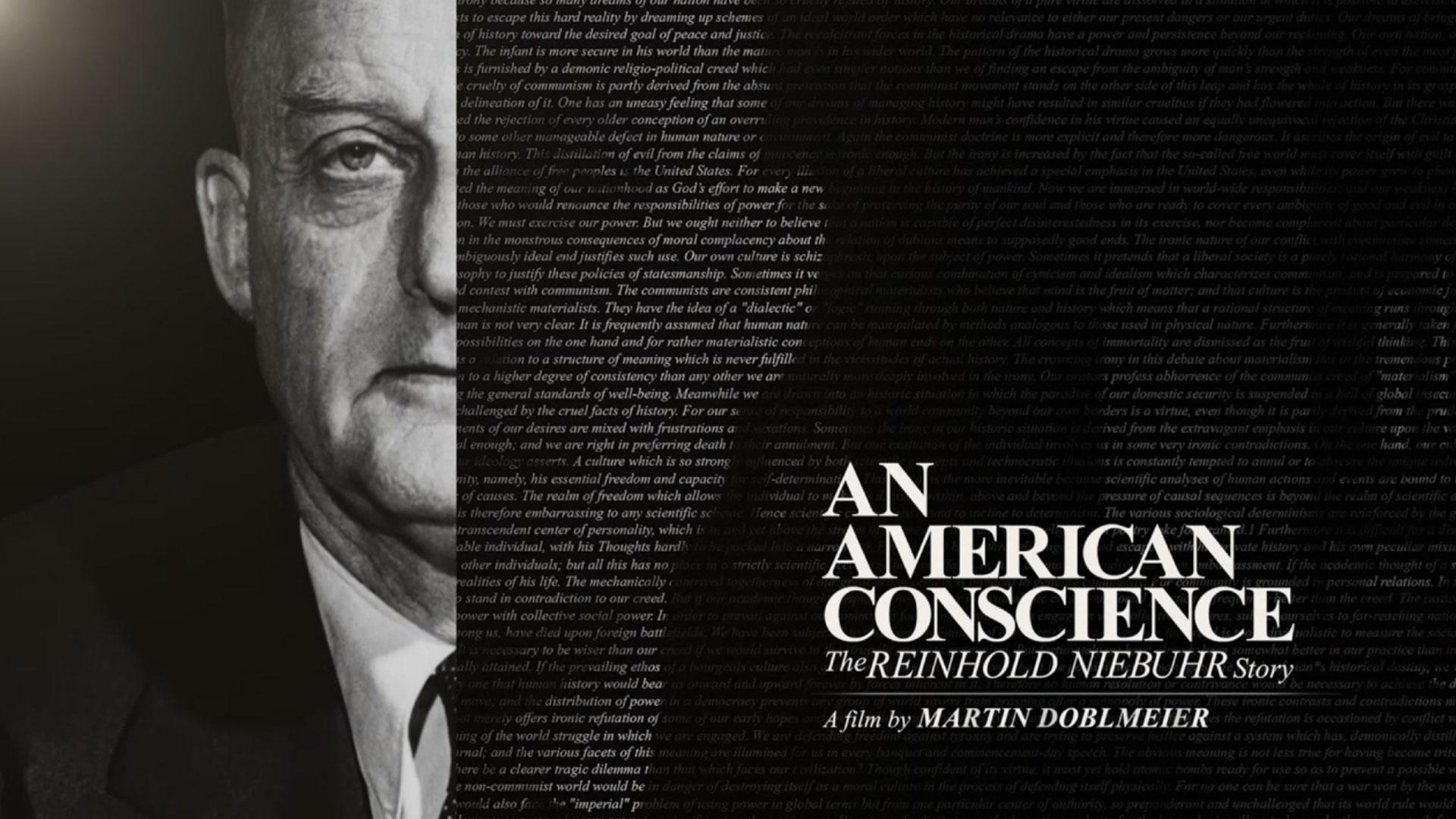
An American Conscience: The Reinhold Niebuhr Story
04/02/17 | 57m 20s | Rating: TV-G
Examine the career and global impact of American-born theologian Reinhold Niebuhr, who became a voice of conscience to a country reaching the pinnacle of its economic and political power. Through archival photos, recordings and interviews, the documentary explores seminal role in American life. Perhaps the clearest indication is the popularity of his Serenity Prayer, used by Alcoholics Anonymous.


Copy and Paste the Following Code to Embed this Video:
An American Conscience: The Reinhold Niebuhr Story
Music
NARRATOR
He may be best known as the author of the famous Serenity Prayer.
HAL HOLBROOK READING NIEBUHR
"God, give us grace to accept with serenity the things that cannot be changed."
NARRATOR
But American-born Reinhold Niebuhr, a theologian, a celebrated writer, and a progressive social thinker, brought a distinct and prophetic voice to some of the most defining years in America's history.
DAVID BROOKS
Barack Obama, a pretty progressive democrat. Jimmy Carter could draw on Niebuhr. Some of the Reaganites like Niebuhr, some of George W. Bush people like Niebuhr.
Everyone picked something they liked.
PRESIDENT JIMMY CARTER
So, Niebuhr was always present in my mind in a very practical way, particularly when I became President and was facing the constant threat of a nuclear war which would have destroyed the world.
NARRATOR
Civil rights leader Martin Luther King, Jr. wrote of Niebuhr from the Birmingham jail.
ANDREW YOUNG
Whenever there was a conversation about power, ah, Niebuhr came up. Niebuhr kept us from being naive about the evil structures of society.
MARK MASSA
Reinhold Niebuhr was the great public theologian of the 20th century.
ANDREW BACEVICH
Well, I think a prophet in politics is someone who sees what others are blind to.
CORNEL WEST
Reinhold Niebuhr makes me shake and tremble as a human being, when I think of the depths of his courage.
NARRATOR
Reinhold Niebuhr was an American original whose understanding of human nature, justice, and social behaviors, propelled him to speak openly, and often critically, to an emerging nation that saw no limits. But that critical voice also landed him on the FBI watch list for decades.
ELISABETH SIFTON
The FBI attitude to him was always, not that he might be, but that he was a Communist.
STANLEY HAUERWAS
I not only admire Niebuhr, I love him. I disagree with almost everything that he said.
NARRATOR
For Niebuhr the priority was always justice. His guiding principle, hope in a redeemer God. His weapon, an extraordinary gift for clarity of thought that made him a leading voice of conscience for his time, and some say, beyond.
HOLBROOK READING NIEBUHR
"Man's inclination to justice makes democracy possible. Man's inclination to injustice makes democracy necessary." Reinhold Niebuhr.
ANNOUNCER
Major funding for this program was provided by the Lilly Endowment. With additional support from the Arthur Vining Davis Foundations, Strengthening America's Future Through Education, and the E. Rhodes & Leona B. Carpenter Foundation.
TV ANNOUNCER
The Mike Wallace interview.
MIKE WALLACE
Good evening, I'm Mike Wallace. This is Dr. Reinhold Niebuhr, a Protestant minister, one of the most important and challenging religious thinkers in the world. Through his writing, Dr.
Niebuhr has helped mold the world's thinking in religion, morality, and politics. Dr. Niebuhr, tell me this. Is freedom necessary?
REINHOLD NIEBUHR
It's necessary for the individual because the individual, no matter how good the society is, every individual has hopes, fears, ambitions, creative urges, that transcend the purposes of his society.
WALLACE
Do you think that, because you are Christian, you're a more valuable man in our society, or more worthy in the eyes of God?
NIEBUHR
Certainly, anybody who says, "In the eyes of God," is pretentious. How do I know about God's judgment? One of the fundamental points about religious humility is that you say you don't know about the ultimate judgment. It is beyond your judgment.
And if you equate God's judgment with your judgment, you make, you have a wrong religion.
Music & Crowd Cheers
NARRATOR
With the end of the Second World War, America begins one of the most prosperous periods in its history. The potential for the nation seems limitless. But at the same time, with the dropping of the atomic bomb on Japan, a new atomic age begins, raising enormous moral questions. And the rise of communism in both Russia and China only fuel global tensions.
HEALON GASTON
America is in a position in the aftermath of the Second World War where it has really, in a sense, kind of taken over the helm of the western civilizational project because Europe is in ruins. Americans are left with incredibly consequential questions about the future of the world. And so, Niebuhr becomes the figure that most helps Americans think through the demands of that position.
MASSA
Niebuhr loved the United States, and recognized and actually took very seriously America's obligation to be the leader of the free world in what was just then heating up to be the Cold War. But he wanted to, to offer some caution, some realistic cautions there, especially because we were a young country, and an overconfident country, and in a sense the last country standing at the end of World War II.
NIEBUHR
Now, we are living in a nuclear age and the science that was supposed to be automatically for human welfare has become a nuclear, a science that gives us nuclear weapons. This is the ironic character of human history and of human existence. You can't say that religion or irreligion will give us a particular answer to the nuclear dilemma. I think, I have one answer that is partly religious, and partly secular, and that is to say, "We ought to at least recognize that we and the Russians are in a common predicament."
ANDREW FINSTUEN
So, Americans are dizzy. They're dizzy with opportunity and they're dizzy with sadness, with what has just come to pass over the last few years, and as a consequence you have people searching for answers, searching for meaning, and the church has become an area that boomed. By the 1950s it is the highest it has ever been in the United States, both before and since.
NARRATOR
And with religious figures like Niebuhr, Paul Tillich, Norman Vincent Peale, Billy Graham, Martin Luther King, Jr., and Abraham Joshua Heschel, America is turning to a different kind of writer.
BROOKS
Their audience was secular as much as religious. And so, they were going for the big bite. They were going to influence the whole culture and not just people within their church. It was hard to talk about public life without talking about the moral implications because they were so overwhelming.
And I think all those things invited the creation of all these big figures who were public theologians and now, we basically don't have them anymore.
NARRATOR
But Niebuhr savored the role of public theologian.
MASSA
He offered important, sophisticated, and compelling images and metaphors for understanding why the United States was a great nation, but because of that, why the United States was always in danger of betraying its mission. And he did that using ancient symbols of Christian theology. Symbols like original sin, and grace, and redemption. And he did it in a way that secular intellectuals loved and listened to.
GARY DORRIEN
Niebuhr was delighted that there was this whole group called "Atheists for Niebuhr," who were wanting to take the political philosophy and just not dealing seriously at all, or think it's dispensable, that Reinhold Niebuhr is someone who's on his knees at night praying. Ah, and for whom, giving testimony, being a witness to the saving acts of God in history, you know, defines his work.
NARRATOR
With American exceptionalism on the rise,
Niebuhr writes one of his most influential books
"The Irony of American History."
ANDREW BACEVICH
Well, I believe that The Irony of American History is the most important book ever written about U.S. foreign policy.
HOLBROOK READING NIEBUHR
"We are drawn into an historic situation in which the paradise of our domestic security is suspended in a hell of global insecurity."
BACEVICH
Well, I think a prophet in politics is someone who sees what others are blind to. So, Niebuhr early in the cold war takes issue with this Manichean frame that communism is evil, the Soviets are evil, and by contrast that we are good, we are innocent. And therefore, we are justified in doing almost anything we choose to do in opposition to this evil. That was a very important thing to say in the early Cold War.
HOLBROOK READING NIEBUHR
"We find it almost as difficult as the communists to believe anyone could think ill of us, since we are as persuaded as they that our society is so essentially virtuous that only malice could prompt criticism of our actions."
NARRATOR
Despite his critical public voice, and the fact he's on an FBI watch list, the head of the U.S. State Department Policy Planning Group, George Kennan, invites Niebuhr to help shape America's policy in an era of growing Cold War tensions.
SIFTON
These were incredibly, difficult, political, moral, ethical issues, and I don't think my father believed that, I know my father didn't believe that he had any special insight into this except a willingness to look at this question and talk about it with the people who cared.
BACEVICH
There were some voices that proposed that we should use this asset, this advantage, to eliminate the Soviet threat. Niebuhr responded forcefully to that in rejecting it. And insisting that under no circumstances could preventive war ever be justified. Insisting that even where war may at times be a necessity, it was always a necessity to be exercised only as a last resort.
NARRATOR
The Niebuhr of the Cold War era sees communism as an evil that must be resisted even with military force. He's very different from the Niebuhr of decades past when he called himself a Pacifist and Socialist. Now, some think he has betrayed his own values.
HAUERWAS
What Niebuhr does, it gives you a sense that you know the way the world is and you have a role in it. Isn't that wonderful? You know why it is that justice is going to require conflict in a way that frees you from the sentimentalities that are so often associated with Christian language of "Oh, we need to be reconciled. Oh, we need to love our enemy," so on.
Niebuhr makes you a hard-headed player in the world in which we find ourselves as a Christian. Isn't that seductive?
NARRATOR
Reinhold Niebuhr was born to German immigrants in Wright City, Missouri, June, 1892. His father, Gustav, was a pastor and the family
produces two important religious figures
Reinhold and his brother Helmut, known as H. Richard.
DORRIEN
And they're very different personalities. Reinhold is this buoyant, tremendous personality that just wins people over, and extroverted, and so on. And so, had his father been. He's the apple of his father's eye, his father, mean he, to young Reinhold growing up, Gustav was just the model of who
he wanted to be
the most interesting person in town. And Richard Niebuhr experiences Gustav in a very different way. To Richard, the father was forbidding, and severe, and he did not have a close relationship with his father. He felt that his father pretty much was disapproving.
NARRATOR
Reinhold begins his education at Elmhurst College and then attends Eden Seminary outside St. Louis where he needs an assistant because his first language is German. Yet, he graduates Eden Seminary valedictorian. From there young Reinhold heads east to Yale Divinity School.
ROBIN LOVIN
What happens to Reinhold Niebuhr under the influence of his professors at Elmhurst, and Eden, and then at Yale, is he really does become a very serious theologian. He's reading basic works in the history of theology and this shows up again much later in his own teaching, but he's not an academic theologian. Never, never is. Never tries to get a PhD.
NARRATOR
Niebuhr writes that at Yale he bluffed his way through with industrious reading saying, "I feel like a mongrel among thoroughbreds." But prompted by the earlier death of his father, Gustav, 20-year-old Reinhold leaves Yale to take over his father's church in Illinois. It would not be a long stay as he, and his widowed mother, soon head for Detroit where Reinhold will pastor Bethel Church. The church has only 18 families. By time Niebuhr leaves, it will be close to 600.
Soon after arriving at Bethel, World War I breaks out across Europe. When America enters the war, Niebuhr tries to enlist, but is rejected because of a heart murmur.
Explosions & Gunshots
NARRATOR
When the war ends Niebuhr travels to Europe to see first-hand the utter devastation.
HOLBROOK READING NIEBUHR
"Gradually the whole horrible truth of the war is being revealed. Here was simply a tremendous contest for power between two great alliances."
DORRIEN
And they came back saying things about, "I need to deal with what I just saw. This is what comes of war. Those idealistic sermons we gave about making the world safe for Democracy, and it's going to be "the war to end all wars." So he says, "I am done with the war business." You know, "I am done." He says it again, "I am done with this business. I hope, I can stick to that conviction."
NARRATOR
With "the war to end all wars" finally over, Niebuhr turns his attention to the Bethel congregation. Many work in management or on the assembly lines in Detroit's booming auto industry.
HOLBROOK READING NIEBUHR
"The new Ford car is out; it is the topic of the day at all the world centers. We went through one of the big automobile factories. The heat was terrific. The men seemed weary.
Most of us run the cars without knowing what price is being paid for them."
GASTON
He tries to expose Ford and he says, "Look, you know, this assembly line production, is it actually helping the industrialists, not the workers, despite his claims." So Niebuhr, you know, definitely wanted to get in there and say, we need to expose the situation and the power dynamics at work in it. Right, in fact, power turns out to be the major preoccupation of his thought and his primary legacy. And you could see it cueing up right there with Henry Ford.
HOLBROOK READING NIEBUHR
"An industrial overlord will not share his power with his workers until he is forced to do so by tremendous pressure."
MASSA
As a Protestant pastor of an affluent congregation, Niebuhr was troubled by the fact that as individuals he knew most of the members of his congregation to be good, concerned, altruistic people. And yet, as a group, they seemed selfish, and self-interested, and unwilling to involve themselves.
NARRATOR
The other reality is that Blacks are migrating north in record numbers looking for work in the auto industry. Many are now living in squalor. Niebuhr feels compelled to get involved.
HOLBROOK READING NIEBUHR
"The situation the Colored people of this city face is really a desperate one. Thousands in this town are really living in torment, while the rest of us eat, drink, and make merry. What a civilization!"
NARRATOR
Niebuhr is named chairman of the Detroit Interracial Committee which will investigate the growing problems. Working with pastors and city officials, the Committee produces a report entitled, "The Negro in Detroit."
RON STONE
Report's quite complete. It asks for the white churches to provide some grants to the black churches, but it calls for the integration of the police force, integration of the housing commission, the hiring of African Americans for positions in city government and for teachers.
GASTON
Every person that came in contact with Niebuhr could see that he was remarkably intelligent and they wanted to sign him up for whatever it was they were doing. And this allowed him to take some of his energies outward and really develop his skills. So he was becoming a really, you know, a great writer during this period. He was becoming an accomplished speaker; he was becoming a political activist.
NARRATOR
Niebuhr's activism attracts the attention of Henry Sloane Coffin who offers him a teaching position at Union Theological Seminary in New York's Upper West Side. The Detroit Black Community feels it's losing a friend.
JOHN DANCY'S WORDS SPOKEN
"I am expressing the feelings and sentiments of the great majority of Negroes in Detroit when I say, That there is genuine regret in the minds of the Colored group at your leaving. There are many of us still mindful of your usefulness in trying to do things for better understanding and relationships between the races in the city of Detroit." John Dancy.
NARRATOR
Niebuhr arrives at Union Theological Seminary in 1928.
MASSA
He arrived without a doctorate and the other people on the faculty were outraged by that. Like, who is this little upstart, this little son of German immigrants from the Midwest who doesn't have a doctorate from an Ivy League institution.
NARRATOR
Even with the support of President Coffin, Niebuhr is barely voted in by the faculty.
DORRIEN
As soon as he got here, I mean he has just a tremendous impact on the place. I mean he's a galvanizing figure, students flocked to his courses, and he hadn't been here very long when the faculty realized they're just going to have to swallow this because now the question is gonna be, "are we going to be able to keep him?"
NARRATOR
Founded in 1836, Union was one of the first independent multi-denominational seminaries in America. In many ways it represents the heart of American Social Gospel thinking.
LOVIN
The American Social Gospel had a kind of optimistic idea that we could change the power relationships in society, ah, just by helping people, ah, that, that if everybody would just be more loving. I think what Niebuhr understood, maybe what people were beginning to understand in America as a whole at that point, was it wasn't going to be that easy.
NARRATOR
Soon after coming to New York, the nation finds itself in the grip of the Great Depression. Niebuhr begins molding together ideas of Christianity, social justice, politics, and Marxism, and he joins the Socialist Party.
STONE
Norman Thomas was the Socialist candidate for President. He was certainly, totally loyal to the United States. Reinhold Niebuhr was vice president of the Socialist Party under Norman Thomas; they were regarded as the "Young Turks" who took over the Socialist Party.
NARRATOR
Niebuhr runs for New York State Senate on the Socialist ticket, but loses, badly. During his first years at Union, a brilliant young student arrives from Germany, Dietrich Bonhoeffer.
HAUERWAS
Bonhoeffer came to Union and he expected to be deeply impressed, because Union had such a high reputation by the theological substance of people at Union. And he was taken aback by what he called "the thinness" of the theological expressions that were being given at Union. So, he was quite suspicious of Niebuhr.
DORRIEN
And Bonhoeffer did have a kind of pretty snotty attitude about that. He said, "This place has no real theology." And his way of talking about this is to say, you know, here in the United States, it's as though theology is a kind of handmaiden of social ethics. Bonhoeffer thinks this can't be good.
NARRATOR
Yet, Bonhoeffer, and Niebuhr begin a unique, and lasting friendship. Bonhoeffer returns to Germany just as Adolf Hitler and the National Socialists are seizing power. There another young Theologian, Paul Tillich, is gaining attention. Tillich's writings have their early roots in the trenches of World War I.
DORRIEN
The colossal carnage of the war that just is God awful horror, and suffering, and Tillich had two massive nervous breakdowns himself.
FINSTUEN
Tillich sees the worst of humanity, and yet what's remarkable is that he holds onto faith. In fact, in a sense, sets his project, his life's project, to reinterpreting the faith in an era where World War I can happen. And he dedicates his life trying to figure out how to make sense of what it means to be human in this kind of a reality.
NARRATOR
Tillich's writings put him at odds with the new Nazi government. So much so, his life is now in danger. Niebuhr is aware of Tillich's plight and he appeals to his own Union faculty, the same faculty that resisted Niebuhr's coming.
DORRIEN
And the Union faculty, bear in mind this is the depth of the Depression, the Union faculty, everybody on it, took a five percent pay cut in order to bring Tillich here. And also, Tillich's gratitude, he would say, you know, "Reinie saved me." And that was not even an easy thing for Tillich to say.
NARRATOR
And during those early years at Union, a young student from Oxford, England, Ursula Keppel-Compton, would change Niebuhr's life. Although, it was not love at first sight.
WILLIAM HUDNUT
My mother, and Ursula were contemporaries, and she and Ursula sat right next to each other at a lecture given by this bright, new, young theologian, down the street at Union Seminary, named Reinhold Niebuhr. After he was finished, Ursula turned to my mother and said, "Grossly overrated," in her clipped British accent.
GASTON
It's important to remember that, by the time Niebuhr comes to Union, he is already in his late thirties, early forties. He's a confirmed bachelor at that point. He's shown very little interest in previous, um, settings in the prospect of finding a mate, um, but he finds in Ursula Niebuhr someone who is a serious intellect in her own right.
NARRATOR
Reinhold and Ursula, though 15 years apart in age, marry in England's Winchester Cathedral.
SIFTON
Oh, it's a wonderful love story and they just adored each other. They were wonderful together. And they appreciated the drama of this highly educated, pretty, young, Oxford woman capturing the heart of this, as he called himself, a "Yahoo from Missouri."
NARRATOR
Yet, this "Yahoo from Missouri" is about to take the national stage with a groundbreaking work that brings together his theology, his Detroit experience, the harsh realities of the Great Depression and the rise of new social orders. The book is called "Moral Man and Immoral Society."
WEST
It remains the most important text in Christian ethics to this day.
HOLBROOK READING NIEBUHR
"Individual men may be moral in the sense that they are able to consider interests other than their own, capable on occasion of preferring the advantage of others to their own. But all these achievements are more difficult, if not impossible, for human societies and social groups."
PRESIDENT JIMMY CARTER
One of the things he thought was the greatest foundation of sinfulness was pride, self-ego, and an absence of consideration of your own fallibilities, and own potential for mistakes. And he drew a distinction too between the, I'd say relative purity of a Christian life on the one hand by individuals, and how an entire community, a larger community, or even a church congregation couldn't measure up to that high standard.
WEST
At the time the book was published, varieties of liberal theology were highly influential. And the common denominator of these liberal theologies tended to downplay the tragic dimensions of the human condition. The ways in which all of us are, in some sense, shot through with greed and envy and resentment. What Christian theologians traditionally would call "sin." Niebuhr comes in with this tragic sensibility, Augustinian sensibility.
He says, "No, we all are fallen, we all are finite, we all are fallible." There will never be a utopian society in human history. There'll never be paradise in space and time. That we all are corrupt in terms of the choices that we make so it's not in any way just a matter of good on the one side, evil on the other. The good and evil shot through our souls, there's a civil war taking place on the battlefields of our hearts, each and every one of us, no matter what color, gender, sexual orientation, civilization.
So it's going to be very much about power, it's going to be very much about conflict. And the best we can do as human beings is to generate democratic possibilities. Democracy, he says, "Is approximate solution to insoluble problems."
NARRATOR
Niebuhr believes in order to move toward justice, structures need to change, and that may require certain action.
LOVIN
The basic point that he's working on is power relationships only change when people are able to use power to force those changes.
WEST
He says, that under certain circumstances you can use violence. I mean, part of the greatness of Reinhold Niebuhr is that he was willing to risk his popularity in the name of integrity. That he was very popular among pacifists in the 19-teens and early '20s. When he wrote "Moral Man and Immoral Society," many of his fellow comrades saw this as a flagrant act of betrayal.
And he had to engage them and tell them, I have changed my mind owing to these kinds of arguments and insights that I have learned.
BROOKS
When you change your mind in public, and if you're a public figure and public intellectual, your friends hate you and your enemies hate you more. You would think if you said, "I was wrong, I actually agree with these people," they would welcome you with open arms. But that's not how the world works. They sense weakness in you and they pounce.
And so, when someone would break ranks or change sides, often you're alienating everyone all at once. And so, it really does take a level of courage to do that. But I think he just couldn't stand with his earlier well-intentioned idealism.
HAUERWAS
What is missing in Niebuhr is any account of the church. The Christian account of the way things are is always going to rely on the fact that there is an alternative to the way things are, called "the church." Niebuhr had no account of that.
NARRATOR
Niebuhr's convictions are challenged by his own brother, H. Richard, now a Professor of Theology at Yale Divinity School. When Japan invades Manchuria, the United States must decide how to respond. The two brothers engage in their only public debate.
HAUERWAS
Richard wrote an essay called "The Grace of Doing Nothing," in which he argued against the American preparation for war. Reinhold thought that, that was naive and close to immoral. Exactly because, given the reality of the world in which you live, you'd better start preparing for war.
SIFTON
Students of my uncle, who tremendously admired him and thought very highly of him, sometimes developed criticism of my father on the grounds that he was more famous, he took up more of the oxygen in the room, he was known better than his younger brother, who was the better theologian and the better writer. That's no surprise to me. That's what my father thought!
Chuckling
SIFTON
He thought that Helmut was the finer thinker, the clearer writer. "True I have the gift of gab," he would say, "but Helmut is the better theologian." That was family doctrine.
NARRATOR
By the mid-1930s Reinhold Niebuhr sees life in America improving with Roosevelt's New Deal programs. In Russia Niebuhr learns of the harsh form of communism being forced on the workers. So now, the one-time socialist is rethinking his affiliations.
SIFTON
So, my father belonged to a number of these groups which became communist in the course of the 1930s and if you look carefully you can see that at some point he said, "Oh I can't belong to this anymore; Communists have taken it over."
NARRATOR
1939 and Europe can sense another World War is just off the horizon.
NIEBUHR
Well, the 20th century is in truth primarily distinguished by the fact that it has disillusioned all the hopes of the 18th and 19th centuries. These centuries dreamed of justice, peace, world civilization, and universal enlightenment. The realities of the 20th century are war instead of peace, poverty and class conflict instead of justice, nationalistic passion instead of world government, and racial prejudice instead of world enlightenment.
NARRATOR
Reinhold Niebuhr is invited to Scotland to give the famous Gifford Lectures, considered by many, the equivalent of the Nobel Prize for religion and philosophy. The lectures will be published under the sweeping title "Nature and Destiny of Man."
FINSTUEN
He talks about our goodness and our wickedness. He talks about us as sinners and saints. But that we are always a combination of those two impulses. And that's what helps Niebuhr articulate the problem of what it means to be human, and I think is what resonates with people who feel themselves this way.
BROOKS
Sin. It's about the presence of sin in all of us, in all our decisions, and even in the good things we do. And that word is really gone out of fashion. The whole concept seems too dark, um, too religious, ah, and too, um, negative, ah, in an age where we're all supposed to believe we've got this golden figure inside, and we're all wonderful, and we should all discover our passion, and be true to ourself.
If you had told Niebuhr, "you know, you really should be true to yourself," he would have said, "well myself isn't that great. It's got some nice parts, but it's got some nasty parts too, so I don't really think, I should be true to myself. I should be true to the Lord."
LOVIN
He goes back to Augustine. He gets an account of human nature in which pride leads people to risk things that ultimately are going to be destructive to the whole society, and we have to learn to see ourselves in relation to God's action in history in order to resist that temptation.
NARRATOR
Niebuhr begins his lecture series in the spring of 1939. By the time he returns to Scotland to finish them, it's the Fall and World War II has begun.
HAUERWAS
There were bombs exploding in Edinburgh. You were in the midst of war, ah, as he delivered these lectures. Which, um, I think made them all the more powerful because part and parcel of the arguments is if you want justice you better be ready to kill someone.
Plane Engine Accelerating
Bombs Exploding & Gunshots
December 1941
Japan orchestrates a sneak attack on Pearl Harbor and America is thrust into war. Niebuhr is now nearly 50 years old and the father of two children. His days are filled with family, writing, and lectures. Together, Niebuhr and Paul Tillich propel Union Seminary to even greater prominence.
And Niebuhr helps to launch the publication "Christianity and Crisis" as a way to offer a critique of pacifism. Between his books and countless articles, it becomes one of his more productive periods.
SIFTON
He wrote all the time and he had an interesting gift, I think of it as a gift, but he could write in the middle of chaos going on, i.e. two small children, a dog, and a busy wife, but he could keep going at the typewriter, morning, noon, and night.
NARRATOR
It's during the war that Niebuhr's Serenity Prayer gains widespread recognition when it's included in the prayer books given American G.I.'S on the front.
HOLBROOK READING NIEBUHR
"God give us grace to accept with serenity the things that cannot be changed, courage to change the things that should be changed, and the wisdom to distinguish the one from the other."
NARRATOR
The Serenity Prayer evolved over many earlier talks and writings dating back to the 1930s. It gains an entirely new audience when it becomes widely used by Alcoholics Anonymous.
SIFTON
He did not wish to make a big deal of authorship of a prayer. A prayer is not something you copyright; it's not something you say, is mine.
NARRATOR
At Union Seminary, professors traditionally live on campus. So Reinhold, who asks his students to call him "Reinie," and Ursula, who teaches religion at nearby Barnard College, begin their own tradition of weekly student gatherings in their apartment.
STONE
Ursula was a bright, I think she was the first woman ever to win a first degree at Oxford in Theology. She was an intellectual in her own right. She loved to debate, and argue, and most of the Union Theological students were sort of terrified of her, because she was witty, and well-informed.
NARRATOR
As World War II draws to a close, Niebuhr is asked by the U.S. State Department to become part of a team that will help shape a post-war world. One of the issues is the creation of the State of Israel.
SUSANNAH HESCHEL
My father, and Reinhold Niebuhr, and Ursula Niebuhr talked a lot about Israel. And Reinhold Niebuhr was very strong, a very strong supporter. And I think Niebuhr was also well aware of the history of Christian attitudes towards Jews and realized that has to change.
NARRATOR
The irony is that while Niebuhr is helping to shape American policy, he is still on the FBI watch list with a 600 page file dating back decades.
STONE
That file contained a collection of denunciations of Niebuhr, often by clergy and others who were suspicious of his loyalty for one reason or another. It revealed that the FBI had gone through the card files at Union Theological Seminary, that they'd asked local clergy about Niebuhr's loyalty, that they'd asked about why Niebuhr was so critical of some policies of the government. And in the file was one handwritten note by J. Edgar Hoover to the agents in New York city saying, "Keep up the investigation.
Anyone who belonged to so many left-wing organizations must have been a Communist, period."
SIFTON
Yeah it was a part of our life then, and it was unpleasant, and creepy, especially because so much of it was false.
NARRATOR
Niebuhr's prolific writing, his various teaching commitments and exhausting travel schedule are all beginning to take their toll.
LOVIN
So, he's obviously pushing himself to the physical, mental, emotional limits, and ah, eventually this catches up with him and ah, he has a major stroke, perhaps other smaller strokes.
SIFTON
Well, of course, it was extremely traumatic and very upsetting. He was at first, bedridden, and needing a lot of nursing, and medical care, and it changed everything for my mother. I don't know how she dealt with her teaching obligations that year.
HOLBROOK READING NIEBUHR
"The physical ills that consign me to the sidelines, furnish me with insights about human nature that never occurred to me before. I learned about the goodness of men and women who went out of their way to help an invalid. As for my wife, we had been happily married for two decades, but I had never measured the depth and breadth of her devotion until I was stricken."
SIFTON
People wanted to come and see him and talk to him, and she had to monitor that. And she believed my father believed that political types and secular friends were much more fun than clerical friends, who would come in and say, "Oh Reinhold, I'm praying for you," a tone that my mother just couldn't stand.
NARRATOR
The stroke affects his speech. His left arm becomes impaired. Yet, despite the shock of the setback his desire to work is so strong he is back within a month. He resumes work with one of the organizations he helped found, Americans for Democratic Action.
Here he works alongside some of the country's most prominent Democrats, including Eleanor Roosevelt, the Historian, Arthur Schlesinger and Hubert Humphrey. And it's during this period Niebuhr begins a remarkable
friendship with a rising Jewish scholar
Abraham Joshua Heschel.
S. HESCHEL
The story really begins when Reinhold Niebuhr wrote a review of my father's book, "Man Is Not Alone." Reinhold Niebuhr understood that book. Now, I have to say, for a Christian theologian, such as Reinhold Niebuhr, to be willing to write a review like this, to be able to understand and appreciate what a Jewish thinker is trying to do, that's also extraordinary. In the history of Christian theology, think about it, how often you find a Christian theologian studying the book of a Jewish theologian, and writing with such appreciation and understanding.
Crowd Chanting
NARRATOR
As the civil rights movement begins to grow in America, Niebuhr's 1932, "Moral Man and Immoral Society" has new life.
WEST
And in that text he explicitly not just talks about racism, but he talks about the need for there to be a leader and a movement that builds on Gandhi and uses nonviolent strategies in order to try to break the back of racist institutional practices, and that's 1932. Martin Luther King, Jr., sitting there at Crozer Theological Seminary in Pennsylvania, later on sitting at Boston University as a PhD student, he reads, "Moral Man and Immoral Society," he has some notion of what Gandhi was up to in the struggle against British colonialism, and says, My God. We've got something indigenous here. We've got something organic here.
We've got an American intellectual who is acknowledging a degree to which certain kinds of spiritual gifts that Black people have honed out over time can contribute to a struggle for justice by using nonviolent strategies.
YOUNG
Martin coming out of a Baptist and Niebuhr background just felt that the depths of immoral society, the institutionalization of sin, was not going to crumble easily. And it hasn't.
NARRATOR
Throughout the civil rights era, school integration is one of the most volatile issues facing America. At one point, Martin Luther King Jr. believes it will only succeed with the intervention of the President. King turns to Niebuhr for his support.
Niebuhr declines.
WEST
He has been reading Edmund Burke. And Edmund Burke, one of the great founding fathers of modern conservatism, subtle, sophisticated, but calling for what? Slow, organic change given the manners, and mores of any region, and the society; you don't wanna unsettle them too much. You don't want to trouble them too much, because it can lead toward chaos.
DORRIEN
For all of his passionate argument about the evil of racism, Niebuhr himself doesn't think about racism in terms of, what we would say, in structural terms or cultural terms. He doesn't think about white supremacy itself as a structure of power that's based on privilege that presumes to define what is normal.
NARRATOR
Even though the stroke clearly slows his pace, Niebuhr remains active in politics, particularly in the 1960 election. Niebuhr introduces candidate John Kennedy at the Liberal Party dinner. He does it despite what he sees as the thinness of JFK'S religion.
HOLBROOK READING NIEBUHR
"In regard to Kennedy's promiscuity, I quite agree it may be good reason to vote against him. I regret we will not have a President with strong moral fiber, but he will be intelligent, shrewd, and perhaps on the edge of unscrupulousness."
PRESIDENT JOHN F. KENNEDY
The next four years are going to be difficult and challenging years for us all.
NARRATOR
Kennedy wins, but will not survive his first term. His successor, Lyndon Johnson, is an advocate for greater civil rights, as Martin Luther King Jr. continues to lead national marches. In his earlier, "Letter from a Birmingham Jail," King draws on Reinhold Niebuhr.
YOUNG
As Martin read "Moral Man and Immoral Society" and "Nature and Destiny of Man," he also read Abraham Heschel's two-volume work on "The Prophets." In fact, he used it regularly in his preaching. And so, when Rabbi Heschel showed up, ah...you know, it was like the Old Testament prophet,
Chuckles
YOUNG
ah...you know, coming to Selma.
NARRATOR
Niebuhr's health prevents him from being part of the marches, but he stays informed as he and Rabbi Heschel take walks behind Union Seminary on Riverside Drive.
SIFTON
I feel that Heschel and Niebuhr became friends partly because they both needed a really good close friend who understood their inmost spiritual intentions, and they hadn't found it elsewhere, but they found it in each other.
S. HESCHEL
It was during one of their walks on Riverside Drive that Reinhold Niebuhr asked my father to deliver the eulogy at his funeral. My father told me and I was... We were all taken aback. Because here was a great Christian theologian, he must know Christian pastors to ask.
Why a Jew? And I think asking my father, in itself, is something of great historical moment.
Helicopter whirring, Machine gun
Gunshots and Men Shouting
NARRATOR
Vietnam, part of the reason the country is so divided is because it's the first war Americans can watch on television.
DORRIEN
It just sickened him to turn on the television and see the reports about incinerating villages and the like. It just made him ill. And this is someone who, you know, he deeply loves his country and he says, "I can't even believe the feelings I'm having about what my country is doing there."
NARRATOR
It may be one of the great ironies that, despite Niebuhr's public criticism of the Vietnam War and being on an FBI watch list, President Lyndon Johnson awards Niebuhr the Presidential Medal of Freedom, the highest honor given an American citizen. Niebuhr is too ill to accept in person.
VOICE OF PRESIDENT LYNDON JOHNSON
Theologian, teacher, social philosopher, he has invoked the ancient insights of Christianity to illuminate the experience and fortify the will of the modern age.
NARRATOR
With the election of Richard Nixon, an ailing Niebuhr sharpens his criticism, particularly around the association with popular evangelist, Billy Graham.
STONE
He went after Nixon particularly for the misuse of religion to bless his politics. Now, politics is tough, and religion has a potential for being tough, and when you mix the two together you get a very explosive combination.
FINSTUEN
The idea that America is a Christian nation plain and simple is problematic for Niebuhr in a way it is not as problematic for Graham. Really Niebuhr just increasingly gets frustrated with Graham for what he sees as a blindness to other social ills in the United States because Graham's primary focus is on the individual.
NARRATOR
The 1960s and Niebuhr is retired from Union Seminary. The family spends much of its time at their home in western Massachusetts. He suffers bouts of depression and in many ways withdraws from public life. Yet, he and Ursula agree to teach a course together at her Barnard College.
SIFTON
It also helped him by getting him out of the house and in front of people. It was a canny way of drawing him back into a world that he had been so active in for so many decades. So, that was my mother shrewdly pulling him out of the...you know, off his bed into a classroom, and that cheered him up. These were years when he was suffering quite often from quite severe depressions.
But a teacher like him can't be depressed in front of a whole bunch of smart undergraduates. And so, he would rise to the occasion.
S. HESCHEL
Reinhold Niebuhr was in bed. And he was no longer able to walk, but he was incredibly warm to me, and welcoming, and enthusiastic to see me, and I sat with him, and we talked for some time. He was so kind, and he was so interested, and so full of warmth. And at the end, when I had to leave, he said to me, "Give me a kiss." And so, I kissed him.
I kissed his cheek.
NARRATOR
Reinhold Niebuhr dies June 1, 1971. He was nearly 79.
His funeral takes place in the family's home church
First Congregational in Stockbridge, Massachusetts. As promised, Rabbi Heschel delivered a eulogy, saying, "For many of us, the world will be darker without you, your life was an example of one who did justly, loved mercy and walked humbly with his God."
S. HESCHEL
It was a sad day and my father was very sad. He really felt he had lost a great friend. And that the United States had lost a treasure.
NARRATOR
Reinhold Niebuhr never earned a doctorate. Yet, he would receive honorary degrees from Princeton, Harvard, Yale, Oxford, Hebrew University and others. And while, his may not be a household name, many, especially those entrusted with positions of responsibility; still find in his words a treasure worth remembering.
YOUNG
I quoted Niebuhr one time and Martin said, "You don't know about Niebuhr. You should be ashamed to quote Reinhold Niebuhr that way." And he went on and I... We were in New York, and I made notes about what he said, and when I got back home; I got my "Nature and Destiny of Man" down off the thing, and it was almost as though he was quoting a paragraph verbatim, it was stuff that was that powerful.
NIEBUHR
I wouldn't judge a man by the presuppositions of his life, but by the fruits of his life, and the fruits, the relevant fruits, I say, a sense of charity, a sense of proportion, a sense of justice.
BROOKS
I would say, Niebuhr had audacity. He wrote with audacity. He wrote big books on big subjects. He took big public stands.
PRESIDENT JIMMY CARTER
I think 50 years from now, or 100 years from now, we will be faced with the same quandary, or challenge, or question that Niebuhr addressed so well.
WEST
Reinhold Niebuhr was like a jazz man. He had his own voice. It was distinctive, it was dissonant, it didn't fit.
STONE
He would take a political problem and analyze it in terms of the history of political philosophy, but also, in terms of what he thought was true about the world. And I think, that's why people read him, and loved him, and thought about him.
HOLBROOK READING NIEBUHR
Nothing worth doing can be achieved in our lifetime, therefore, we must be saved by hope. Nothing true, or beautiful, or good makes complete sense in our immediate context of history, therefore we must be saved by faith. Nothing we do, however virtuous can be accomplished alone, therefore we are saved by love.
Music
Announcer
Major funding for this program was provided by, the Lilly Endowment with additional support from the Arthur Vining Davis Foundations, and the E. Rhodes & Leona B. Carpenter Foundation. To learn more about Reinhold Niebuhr visit
A DVD of An American Conscience
The Reinhold Niebuhr Story with extended interviews and bonus features and a soft-covered companion book are available online at mpt.org/shop or call the number on your screen.
Search Episodes

Donate to sign up. Activate and sign in to Passport. It's that easy to help PBS Wisconsin serve your community through media that educates, inspires, and entertains.
Make your membership gift today
Only for new users: Activate Passport using your code or email address
Already a member?
Look up my account
Need some help? Go to FAQ or visit PBS Passport Help
Need help accessing PBS Wisconsin anywhere?

Online Access | Platform & Device Access | Cable or Satellite Access | Over-The-Air Access
Visit Access Guide
Need help accessing PBS Wisconsin anywhere?
Visit Our
Live TV Access Guide
Online AccessPlatform & Device Access
Cable or Satellite Access
Over-The-Air Access
Visit Access Guide




Follow Us