Coming up next
Meet a maritime archaeologist who dives into history,
splashes loudly
Coming up next
an ambitious teen determined to dance, a pair of Irish road bowlers, and an animated tale reliving the first day of school. It's all ahead on "Wisconsin Life!" "Wisconsin Life" is funded in part by Alliant Energy, Lowell and Mary Peterson, American Transmission Company, the Focus Fund for Wisconsin Programming, and Friends of Wisconsin Public Television. Anchors away. I'm Angela Fitzgerald, and this is "Wisconsin Life." I've taken to great heights, to explore the Fincantieri Bay Shipbuilding in Door County.
From up here, I can see the entire shipyard in Sturgeon Bay. Door County is known for its rich history of shipbuilding that continues to this day, with companies like Fincantieri Bay Shipbuilding. This company builds ships entirely on-site, which includes welding, construction, assembly, and painting. The equipment to get the job done is huge, from large floating docks to super tall cranes.
During the winter, boats are brought in to the docks to be repaired before the spring thaw. It's an impressive display of engineering to construct these huge vessels that travel around the world. I'll make my way to the ground where I'm a bit more comfortable. Before I do, let's sail into our first story.
As we head below the surface in Sheboygan to meet a maritime archaeologist as she explores history underwater. There is a lot of Wisconsin history connected to the Great Lakes, but most of it deals with ships on the water or the towns along the coast. Tamara Thomsen and her team are interested in the lake's hidden history. Shipwrecks resting on the bottom, hundreds of feet below the waves.
It's more than just a pile of wood on the bottom.
inhaling air from scuba regulator "whoosh"
Coming up next
Tamara is a maritime archaeologist with the Wisconsin Historical Society. This particular shipwreck is broken up. It's sort of filleted open. This is the "I-A Johnson," a scow schooner that sank in 1890, a few miles off the coast of Sheboygan.
It hit another ship in the middle of the night, broke apart and sank while being towed back to shore. It's absolutely lovely shipwreck. We don't know much about scow schooners. No one died.
And the cargo was food and supplies. As shipwreck stories go, it's pretty mild. But don't tell that to Tamara.
chuckles
Coming up next
I have not found a boring shipwreck yet. Her team has a week of dives planned, but don't look for any artifacts to show up in a museum.
Tamara Thomsen
We don't collect. What we do is we collect information. There's not a lot that's understood about how these ships were built, especially the ones that were constructed early. A lot of those construction techniques were based on apprenticeships.
So, you learned how to build the ships. And then you started developing your own ideas on how to make them, how to construct them. Tamara has spent more than 15 years diving for the State Historical Society, but this is more than just a job. That's right.
It's 90 degrees out. I'm dressing for 40.
splash
Tamara Thomsen
I just love working underwater. I love being underwater. She first wanted to dive in high school. I begged my father.
I said, "Can we please take scuba diving lessons?" And he would say, "Next year, next year, next year......next year." And it never happened. So, when I came to school at the University of Wisconsin, it was offered as a class.
expelling bubbles from regulator
Tamara Thomsen
Ironically, after Tamara learned to dive, her father did the same. And they were able to enjoy the sport together. She dives year-round. When the Great Lakes are too cold, there's always cave diving in Mexico.
Tamara
It's very peaceful. You can't talk. You're not listening to the radio or being distracted by a million different things. You're just there.
And you're just sort of in your own world. Sort of my way of checking out from the normal world, I guess. And being able to relax and really find peace. She first started volunteering with the Historical Society, and they offered her a job.
She found there's no shortage of shipwrecks to explore. In Wisconsin waters, we have cataloged 752 vessels.
splash
Tamara
Not all of them can be reached by diving. If you can get any kind of imagery or if you can drop down so that we can get some measurements on them.
Yup. - Angela
Tamara and a crew are using a remotely operated vehicle to visit the "Thomas Friant," which sank in 1924 in Lake Superior. There it is. So, you can see it says "Thomas Friant," which is really cool. Certainly, on the Great Lakes, we are-- we're not going to find any gold.
The thing of most value is understanding the people who work there and sometimes lost their lives there. What we saw on the "Thomas Friant" was a lot of fishing equipment. Fishing equipment from the 1920s. So, for what they would use on a gill-netter, where they put the doors?
How they operated the equipment. All of that, we were able to understand or learn from the video that we collected. Tamara says the history underwater can help the history above water. If you look at every individual shipwreck, every one is representative of sort of this timeline of commercial use of our waterways.
We're starting to get to a point where we've seen enough of the collection of vessels that we have in our museum under the water that we're able to start putting the story together. As much as the R-O-V helps, there's nothing like seeing a wreck in person. Oh, my goodness. It's new every time.
It's great. So, even the old shipwrecks that I've seen before, I see something new every time I go there. I'm still learning every day. And I still love it every day that I can get out on the water.
Let's now make our way to Middleton to meet an accomplished teen preserving a different kind of tradition.
"Krishna Kauthuvam"
chanting lyrics to staccato tapping
Yup. - Angela
When I was in around eighth grade, I was very stressed. And what I would do is I would go down to my basement, and I would just dance.
chollukattus or rhythmic syllables
Yup. - Angela
So, looking back and realizing, "All those things that I've done while dancing, actually helped me relieve my stress." Without dance, I couldn't say that I would be the person I am today. My name is Shruti Parthasarathy, and I am a Bharatanatyam or classical Indian dancer from Middleton, Wisconsin.
"Muruganin Marupeyar"
Yup. - Angela
Muruganin Marupeyar Bharatanatyam is an ancient Indian classical dance form that originated from southern India thousands of years ago. Marupeyar azhagu And it essentially tells mythological tales of gods and goddesses.
traditional Indian music
Yup. - Angela
So, It's kind of like a play, but with the musicality of dance into it.
patting rhythmically
Yup. - Angela
My teacher is from Chennai, India.
teacher sings Indian song
Yup. - Angela
We communicate for dance class via Skype. And Bharatanatyam, just to give a little excerpt about their solo recitals, is that we do two-hour solo recitals, which we call a "Margam."
teacher calls out dance steps
Yup. - Angela
So, in terms of what I work on, usually when I practice at home would be mostly my technique and stamina. Stamina is very key, especially like I've mentioned before, two-hour solo recitals require a ton of stamina.
teacher gives feedback
Yup. - Angela
You need to keep going!
breathily
Yup. - Angela
Okay. One, two, three, four... My teacher and I, and I think everyone else, was very skeptical about Skype. Because at the time we were like, "There are lags or things that can happen.
How was dance going to work?" Because it's such a physical thing. It's very hard to do over a screen.
teacher sings and taps rhythm
Yup. - Angela
The bond we have makes it very easy for us to connect. And the one on one relationship is just... I wouldn't trade it for anything.
Announcer
Shruti Parthasarathy.
cheers and applause
Announcer
Middleton, Wisconsin.
cheers and applause
"Muruganin Marupeyar"
Announcer
Bharatanatyam has taken me almost all over the world. I performed in Minnesota, Miami, New York, many places in India.
man singing traditional Indian song
Announcer
I think the best part of it is that it's not just that moment. I mean, it's clich, but it's-- What matters is the journey, not the destination. And it's very applicable in Bharatanatyam because every single day you're practicing, you learn something new. And it's not just about, you know, your technique.
You learn something more about yourself.
Shruti Parthasarathy
Put your left leg out. Tap right. Bring it back. In the future, I really hope to continue Bharatanatyam and pass it down to future generations.
Whether it be opening a dance school in the United States, and I'm also now very interested in, too, Bharatanatyam therapy. So, when you're stressed, these are simple things that you can do to relieve stress. I have started, essentially, like, a movement which is called "Calm with Kalaa." Kalaa means art form. And what I really hope to do with this is show kids my age and younger there is a way to handle stress in a very simple way.
We're going to tap one. Bharatanatyam, even though it's very traditional and very unique with many technique elements and things like that, there are very, very simple elements to it that are proven to relieve stress.
jazz music
Shruti Parthasarathy
Bharatanatyam is a workout for all parts of your body. We use... from our facial expressions to our toes, every single part of our body is being used constantly. So, it is a very good workout.
Apart from the physical benefits, it gives you a mental calmness in your mind. I would say my favorite part about doing Bharatanatyam is finding more about myself. As I dance every day, I discover more about me and who I want to become. And I think what really makes me come back to it every day, apart from it's just my passion, is that it's my personal identity that I would never want to lose for anything.
cheers and applause
Shruti Parthasarathy
I'm in Sturgeon Bay aboard a floating dry dock exploring the local shipbuilding industry.
employees conversing
Shruti Parthasarathy
At Fincantieri Bay Shipbuilding employees work around the clock to create and repair these massive floating vessels. To understand how it all works, I met supervisor of skilled trades, Joel Kaczmarowski. Shipbuilding is an ancient trade that we now do with modern techniques, modern equipment. The science that goes into welding and metallurgy and steel fitting is pretty intense.
It's fun to see that every day. There's a lot of moving pieces. We receive raw steel from the mill. Comes in on trucks.
We start by
all the plate steel that comes in, it all gets blasted and primed. After that, it moves through our factory where parts are cut out of that plate. They're formed, they're made. After that, it moves to assembly.
We sometimes take thousands of parts and move them and build them into sections. We take those sections, move them out to our graving dock where we might put two, sometimes three of them together. Modular parts of our ships that we build. We set those down on the dock.
After that process, after they're all-welded, fit up, painted, that floats out of there almost a complete vessel. Exciting to be a part of! Exciting does describe the atmosphere throughout the yard including in the building where I met welder Gabriel Host-Jablonski. The entire nature of my job is to take two pieces of metal and make them one, which is really great because even when we mess up "a lot," we just cut them apart and make them one again.
Oh, nice! - It is actually very satisfying. With that, it was time for sparks to fly.
welding gun's electric arc sizzles
We start by
Oh, wow! Is the metal still solidifying, or is it still kind of in a liquid state? No, it's going to be rock solid now, but it's very, very hot. What we've done is just pumped a whole lot of energy into it through the metal, essentially fusing it all together.
From welders to steel fitters, satisfaction in the work is something I hear throughout the shipyard including from Kylie Owens. I am a steel fitter. I tack, torch, a little bit of everything for the welders, put the boat together, before you get full...
Angela
Full assemblage?
Kylie
Full like that, yeah. I kind of do all that stuff so. Nice!
birds call "mew, keow"
Kylie
So, how long have you been doing steel fitting? Two years. - Two years. How did you get into it?
Believe it or not, I was working at McDonald's, and I was kind of bored and wanted to learn something new. And a buddy of mine told me to apply here. And I did, and I've been here ever since. So, how has it been?
It's a lot different. It takes a lot of physical differences to do this job compared to others. No matter how tough the job may get, one thing everyone has in common is a love for what they do. Some of the ships we work on, they were built long before I started my career.
And the ships we're building now, they'll be sailing the Great Lakes long after I retire. So, it's cool to be a part of that. I love working here. For me, as a welder, I get a variety of different work and what I can say is most of us really enjoy this work because it's physical, it's honest, and very proud of this work.
We show up, work hard every day, and we do like the whistle at the end of the day to let us know it's time to go home sometimes, too. But I think for most of us the grandiose nature of our job, to create something so big makes us feel like little kids playing on a boat.
ship horn blares
Kylie
From ship construction to winter repairs, these workers are keeping the tradition of shipbuilding alive in Door County. Up next, we head to Onalaska to meet a pair keeping an old Irish ritual alive.
hard object rolling on the road
Kylie
Ball coming. It's a little cannonball. So, when you say, "I'm going to go chuck a cannonball down the street," people get really confused. You have to Google it, and once you do, you realize, "I want to do that.
Why not chuck a cannonball down the road?" That's exactly what it comes down to. That might live.
Angela
On the backroads of La Crosse County, Luke Seielstad and Brady Hoeth have come to play... That'll do. - Basically, it's a sport that they do in Ireland on back roads. Irish road bowling is a sport born during the Renaissance...
and now enjoyed by these modern-day Renaissance men. It's a historic thing that happened in Ireland all the way back to the 1600s. There is a theory that the Irish stole cannonballs from English and didn't want to carry them the whole way, so they just threw them down the road. The weapon of choice these days...
Luke
We call it a bowl. That's why they call it Irish Road Bowling. B-O-W-L and it weighs 28 ounces. So, it's a 28-ounce steel and lead and iron ball.
On this particular evening... I gotta figure that out. Luke and Brady scout the course for the 5th annual Irish Fest Road Bowling Championship. I'm really kind of wondering if they are going to let us play that back section.
The gravel? That could be interesting. And these defending champions are ready for battle. When you talk a big game, you have to be able to put up a fight.
Angela
So, let the championship begin.
jovial fiddle music
Angela
Think we're going to win?
Luke
Absolutely! We better.
hard bowl rattles against the road
Luke
Bowl coming! Once a year, I live for this game, just like Irish Fest. The rules are simple; As simple as propelling a two-pound cannonball. It's heavier than you think.
And you want to chuck this two-pound ball as hard as you possibly can as far as you possibly can. And it's exhilarating; it really is. It's liberating. There you go.
- Nice throw! You can't toss it overhand; it's all got to be underhand hand. You can be gentle, you can be hard. But the answer is you have to go across the set course in the fewest number of throws; It's kind of like golf in that respect.
The gamesmanship is intense... Stop talking and start bowling. You gotta put some mustard behind it. That's a nice line.
Get that bowl, get that bowl! This might look like chaos... Is it far enough or not? Yeah.
But there is a method to Luke and Brady's game plan.
Brady
I think Luke kind of takes care of the long power shots.
Luke
I thought it was going to wind up short and it just kept going.
It works out having a partner like Brady
He has the finesse role, he can make those curves, and things like that. Look at that too, dead on, DEAD ON! Where it goes off the road, that's where you mark it. Hey, you wrote 19, right?
So, this is 20. - Yeah. Between the two of us, we make it work. Perfect.
Making it work isn't always easy. One bad throw...
playful fiddle music
It works out having a partner like Brady
We'll find it. Other times, that's just how the bowl bounces.
Brady
You could have a perfect shot, and one little rock in the middle of the road might just send it flying the other way.
Luke
Stay up.
exhales audibly
Luke
MULLIGAN!
Angela
Then again, redemption lies in the luck of the Irish.
Brady
Good roll, Luke.
Luke
Told you about that side. Ayy, we'll take a kick. That's what I'm talking about!
Angela
The game also teaches patience and perseverance. Road bowling takes a lot of time, only because you lose the bowl.
ball rolling, mischievous music
Angela
Right off the edge?
Brady
Yeah. It didn't go that far either, but I just didn't watch the exact spot it left. Thankfully, there are a bunch of people there that are watching it and that are willing to help you find it. Otherwise, you spend a lot of your time tromping through the grass and just trying to find your bowl so you can throw again.
Luke and Brady in unison
Brady
That'll do donkey, that'll do."
Angela
At the end of the day, with the battlefield behind them, Luke and Brady win another championship while sporting their Irish pride
Brady
We've got a lot of Germans, Norwegians around here, and they have all their festivals and stuff. It's kind of cool to bring the Irish bit in. I hope people get excited about it. I hope they see how much fun we have, and I hope we bring more people into it.
For our last story, writer Joe Shaffer shares the terror that comes with the first day of school in this animated tale.
muffled chattering
Brady
The first day of school. Lockers will slam, and bells will ring. Pencils will be sharpened, and chairs will creak. You will see more people in one place
stampeding feet
Brady
than you have in months.
student screams
Brady
If you're like me, you'll be nervous.
heavy door closing
Brady
I'll be a junior at West High in Madison this year.
muffled chatter
Brady
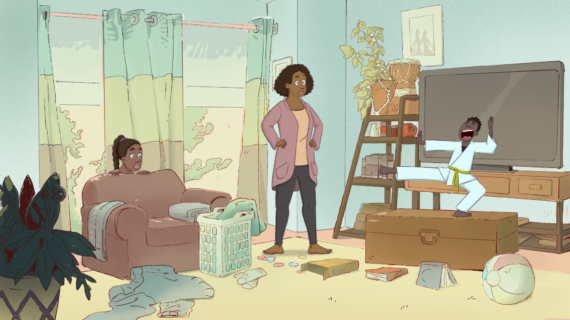
I've never been a very confident person, and the first day of school terrifies me. It's not just the return of homework and tests. The first day of school means "relating" to all of your classmates. When you pass the ten or so people you actually know, you say, "Hi." For the other two-thousand, nine-hundred, and ninety, you stare straight ahead.
You endure the feeling that, for the past three months, everyone was having more fun than you. Meanwhile, you watched all nine seasons of "Everybody Loves Raymond." You shake it off and go to your first class. Now comes the worst part of all.
The thing you've been dreading all summer
Name Games.
trembling, teeth chattering
The thing you've been dreading all summer
The rules may vary, but the concept remains the same. "Tell us about yourself. "Let us get to know you. Expose yourself to judgment from your peers." The risk of humiliation is tremendous.
"Okay, class," the teacher says, "Can you name three facts about yourself?" They 're not just asking for three facts.
bell rings in a deep tone
The thing you've been dreading all summer
They're asking you to sum yourself up.
ominous vibration
The thing you've been dreading all summer
Your heart is palpitating.
heart beats "club dub" loudly
dripping
The thing you've been dreading all summer
You're sweating profusely. Why did you wear boots on the first day? It's still summer, but you just had to have that extra inch of height. You cleared six feet, but, good God, at what cost?
Now there's just one more kid away from your turn. The guy in the polo shirt is talking about how his uncle owns a farm. You're jealous. That's really not such a bad fact.
Can you top it? Humor might be your best option. But then again, a joke is risky. What if no one laughs?
screaming
The thing you've been dreading all summer
Now the kid in the polo shirt has only one more fact to go. Turns out he's passionate about dirt bikes. Why ardent you passionate about anything? He works in a joke, and it gets a chuckle.
At this point, you would give your soul for a chuckle. Finally, it's your turn. There's a pause. Everyone's looking at you.
The kid in the polo shirt seems so happy he survived.
chatter in background
The thing you've been dreading all summer
And then, a gift from the gods. The sweetest sound known to man. The clear... bright...
brrrrinnng
The thing you've been dreading all summer
Class is over.
exhales audibly
The thing you've been dreading all summer
You pack up and meet your friends for lunch. You marvel at your good luck. Maybe this year won't be so bad after all. From tall cranes to huge ships, we've seen a lot as we explored the Fincantieri Bay Shipbuilding yards.
If you 'd like to learn more about shipbuilding in Wisconsin or any of the people you've seen today, visit "WisconsinLife.org." And if you have a story to share email us at [email protected]. I'm Angela Fitzgerald, and this is our "Wisconsin Life. Bye. I've heard you had some funny stories about third shift operations.
Right.
Angela laughs loudly
The thing you've been dreading all summer
You don't have to share-- just, that is what I heard. I was told what happens on third stays on third... There you go. Like being in Vegas, basically.
both laughing
The thing you've been dreading all summer
"Wisconsin Life" is funded in part by Alliant Energy, Lowell and Mary Peterson, American Transmission Company, the Focus Fund for Wisconsin Programming, and Friends of Wisconsin Public Television.


 Passport














Follow Us