








PBS Wisconsin Passport
Watch this video with
PBS Wisconsin Passport
Become a member of PBS Wisconsin, support your local community, and get extended access to PBS shows, films, and specials, like this one.
Whose Water Is It Anyway?
05/05/19 | 26m 46s | Rating: TV-G
After experiencing the heat and dryness of the desert sun, the Schley’s have a whole new appreciation for water, and with help from the City of Arvada, they explore the question of where exactly their water comes from. From the continental divide to their faucets and fields, they follow the Colorado watershed and learn that water should be used wisely in their new endeavors.


Copy and Paste the Following Code to Embed this Video:
Whose Water Is It Anyway?
light music
Man
See how the brook in that white wave runs counter to itself. It is in this backward motion toward the source, against the stream, that most we see ourselves in the tribute of the current to the source. It is from this in nature we are from. It is most us.
Gina
We are Gina and Rodman Schley.
Rodman
For the past few years, we've been exploring our community and learning from other people how to live a more sustainable life.
Gina
And now, we've bought a farm. You in? - Come on, let's do this!
Rodman
I'll be building our home.
Gina
And I'll be working the land.
laughter
Gina
It's all part of our Urban Conversion. So we came out to learn about mushrooms, but I'm really taking a lot of knowledge away on the soil. And it's making me think about our farm and what we need to do to cultivate the soil.
Rodman
To go to the Tough Mudder and actually get in the mud, you know, to be covered in mud and kind of be one with the mud was kind of a different experience.
Gina
Farming is starting in the spring. You really get a sense of how the soil comes alive.
Rodman
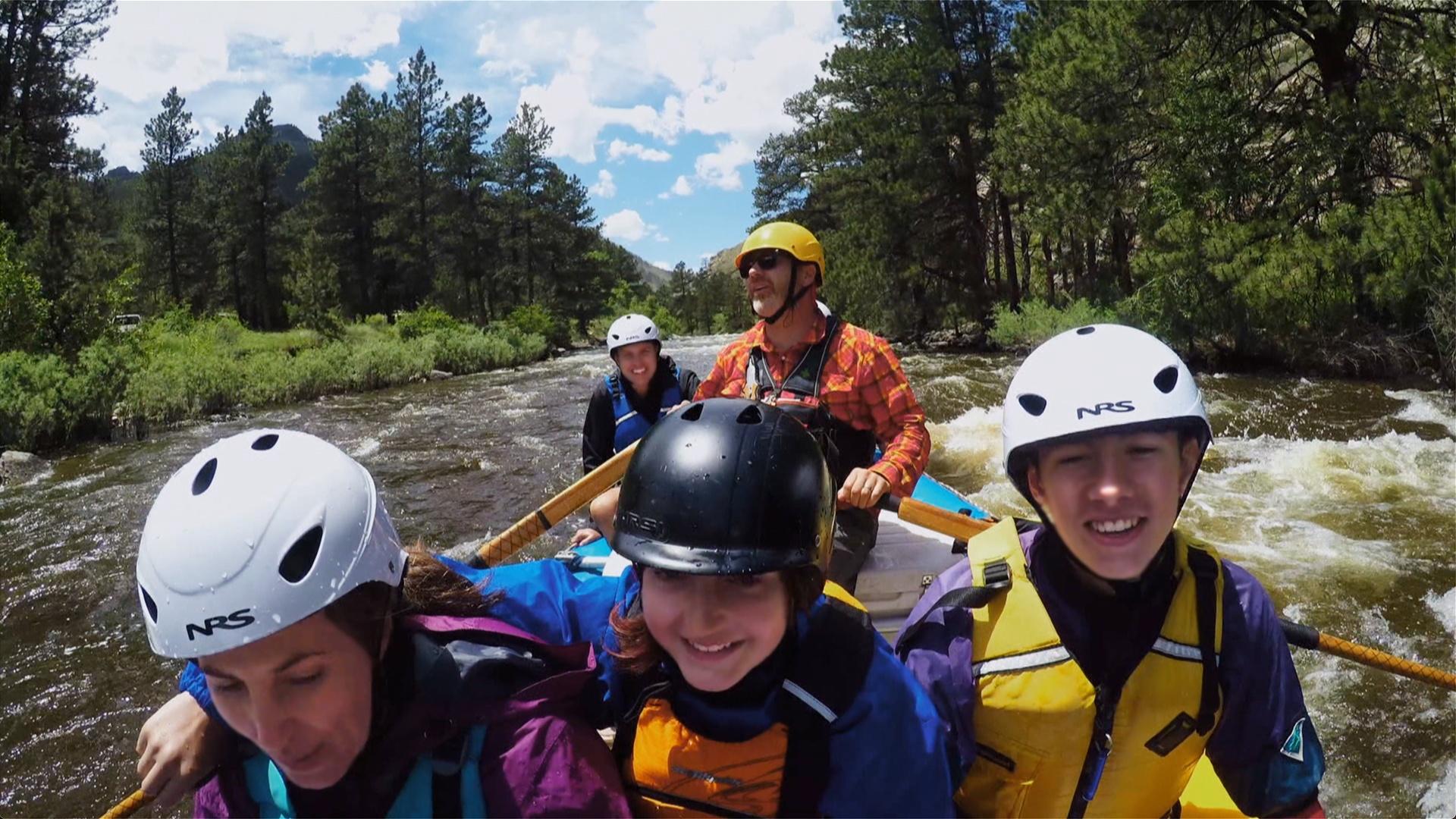
Think about how important soil is our life. It's one of the most important things that we have on this planet. I mean, you never think about water on a real deep level. Our kids see the water at the faucet. They see it coming out, they turn on the handles, and the water comes out. They have no idea where the water comes from. So we wanted to follow Colorado's watershed from the source all the way to our farm. So I called up my friend Julian, who's a whitewater rafting guide, and I asked him if he could take us on a easy, mellow float trip. Float trip. We're gonna do Upper and Lower Mishawaka, Poudre Park, Pine View Falls, and Bridges, about 10, 11 river miles. Class 3, 4 whitewater. Class 4 rapids is not a float trip. That's how it started, it kind of evolved into a little bit more of a hardcore whitewater rafting trip. If you're in the river, swim like you mean it, come to the raft, and get in the raft. I don't think I'm gonna get wet at all out there. You know, you're talking about the expert rafter, so I'm sure I'll stay dry the whole way down. Not. All right, is everybody ready to go rafting?
groups cheers
Rodman
Load it, everybody look out.
light music
Rodman
So much relies on this water, right? We're here recreating, but this water fills all the reservoirs downstream. It goes and feeds all the agriculture of eastern Colorado. Oh!
Gina
Being on the rapids really brings home how powerful water is. You're floating on this raft, hanging on and you're scared. And it really just kind of opens your eyes to the power of water, it can kill you and it also can sustain you.
Julian
We're on the eastern side of the Continental Divide. The Colorado Rockies divide the Western drainages. The Colorado River, right, going to the Pacific Ocean from the Eastern drainages. Heads up. Oh! Hang on. Yeah, this is all snow melt. So, you know, less than a day ago this was all snow. That's why the water's so cold. It's freezing! That sucked. That was awesome.
laughs
Julian
Nah, that was great, I loved that. I mean, coming down the river. Those rapids were a lot more than I thought they were gonna be.
group shrieks
Julian
Class 3, class 4. - Class 3, 4. We're thinking come on, now, Julian. And I go into, like, anxiety mode.
Rodman laughs
Julian
Thinking that we have kids on this boat. Oh my gosh. That was not delightful. That nearly swept me off. My nephew is on this boat. Expendable.
laughter
light music
Julian
Julian, that was awesome, thanks for taking us out. It's amazing to think that all this is snow melt. We're rafting on this water today and we're drinking it tomorrow. And we're watering our crops and fighting legal battles over it, ranching our cattle, it really defines the West in a lot of ways, Rodman. Yeah, but who owns this water? I mean, it starts off as being no one's water and then people lay claim to it as it goes downstream. You know, I thought about the law of water, but it's a complicated and it's all subdivided into a million parts. I always used to think water was free. Yeah, it's not. No such thing as free water. It's not, particularly here in the dry Rocky Mountain West, it's a finite resource. I love to play in the mountains, that's why we live here. That's a big part of who we are and the way we raise our families, and this was the snow I was skiing on in January and February, and now we're having a good time rafting it before it feeds us. One, two, three, sit 'er down.
Gina
Taking them up into the mountains and getting on water that was cold, that just melted from the top of the mountains and rafting on that really kind of hit home.
Rodman
How cool is that we can take them up there and show them where their water was coming out of the mountain and eventually ending up right at their faucet? It gives them a better appreciation of the water, where it comes from, and just in general about how important water is to us.
thunder
Gina
In farming, water is so critical. But it's nice to be able to control it. Whenever I look at the weather and I see a thunderstorm coming in, crossing my fingers that it's just a nice rain shower and it's not a damaging hailstorm. In Colorado, I knew that I was going to have to set up some type of drip system irrigation. Now, the lavender plants that we're planting, they don't take a lot of water but they do need to be watered, and all of the specialty flowers that we're growing, they need a drip system irrigation. Eww! What if it doesn't fit? You just gotta try to really push it in. It doesn't fit. Oh, it fits! We have a whole new appreciation for farm families and how hard the whole family has to work. I bought an irrigation system online. It's a drip irrigation system, it waters the plants directly. I needed help, it's definitely a two person job, and Rodman was nowhere to be found. Probably working on the house, bro. So I had to pull in my kids. And they're 10 and 13, but they were totally capable.
Rodman
The thing that I love the most about being out here is getting my kids out here. I love seeing them get their hands dirty and being a part of these projects. Mom, I'm done doing these. Back in the day, farmers really put their kids to work, and I think today we don't put our kids to work as much as we probably could. We had to pull out all of the irrigation tape, cut it to length, put it in place, staple it down, and they were totally capable of doing all of that. Farm girls! Getting the hang of it. So we need two more kids. What?
laughs
Rodman
No! Maybe we could hire a couple more kids. I don't think that's how that works.
light music
Rodman
To better understand where our water comes from, I'm gonna meet with Jim with the Arvada Water Department to see how water is processed and then delivered to our homes. This is beautiful out here. Well, this is the city's Arvada Reservoir. It was constructed in 1980, and we've actually turned it into a nice recreational area as well. We have hiking trails out here plus a lot of fishing. So the water basically comes from snowfall and then eventually ends up here? So Colorado is a very arid state, in this area we only get about 15 inches of rain a year, which is really not enough to grow anything. A lot of our snowfall, our water supply, is actually in the mountains in the form of snowpack. And then in the spring, summer, when it begins to melt we divert it out of the creeks and put it into storage reservoirs like this. And then they come into this reservoir, and this water here gets treated and then delivered?
Jim
Yes, we have a water treatment plant on the other side of the embankment here, about 300 yards from here. I could show it to you. I'd love that, I think I can walk 300 yards. Great, let's go. All right.
light music
Jim
So what is this room? This is the control room for the water treatment plant. They do trending reports, they give a lot of chemical feed information and such. That sound that you're hearing indicates that we're about to do a backwash, that means we're gonna clean a filter. So we don't need to evacuate. No. - We're good, okay.
Rodman
So they sit in here monitoring levels and... They're actually operating the plant from here. There's some monitoring that goes on, but they're sitting here controlling the operation.
light music
Jim
This is the filtration part of the treatment process. Water comes in from the pretreatment building, where we've dropped out a lot of the dirt that was in there. Either side of here are filters, as we call 'em. They start with a carbon layer, which takes out a lot of taste and odor issues, works its way down into sand and gravel, which traps the rest of the impurities that are in this, in the water. As the water begins to come in, we begin putting chemicals in it to make the particles that are in the water begin to collect, clump together, forming what we call is a flock. Flock is heavy, that'll actually settle out farther down in the process. It reacts in this tank here. Flows out into this trough, moves around, and then goes into the next building, which is what we call the pretreatment. This is where the water is still being mixed. We've added additional chemicals. And we have a basin here with several distinct areas. Down below the surface there are paddles which are slowly churning. They're continuing to mix the water together. And if you look very carefully you can start to see that the flock is beginning to form. Looks clean in the river, we make it look a lot worse but this is part of the process of getting all these impurities out. Man, I could really use one of those for our swimming pool. Well, maybe you guys can come over and help me with my swimming pool.
scary music
Jim
I've heard about your swimming pool. I'm not sure I even wanna take that one on. No, it would be a pretty tough one.
Rodman
There's all these different moving parts, there's different holding tanks where you can see water goes into one place and it gets filtered, then it goes to another place and it gets filtered. It just keeps going through these processes, until the end of the day you've got clean water that is piped to the residents. So this is last stop, this is where our water's stored before we get it to our houses?
Jim
That's correct, we have a combined capacity of about seven million gallons here. These tanks here buffer the demand. So, you know, you're turning on your faucet and everybody does it at the same time, it'll drop a little here, but then we can recover when everybody turns everything back off, so. You know what I wanna know? I wanna know if they're still putting fluoride in our water. I heard that they treat the water with fluoride. Why do they do that? Well, fluoride has always been controversial. It was controversial back in the '60s when it was being added. The voters had a referendum on this back in the '60s and they voted to add it. And it just stayed? I can't, until somebody does another referendum, it stays. I don't brush my teeth anyway. Twice a day, no matter what.
laughs
Rodman
Perfect, well, thank you for this tour. This has been very educational, I appreciate it a lot.
Jim
Thanks for coming out.
gentle music
Jim
So we're bringing Tom, the landscape architect, back out to the property. Earlier when we talked with him, we really connected on biodynamic agriculture. So if we design a farm to be beautiful, as well as efficient and practical, that's the point of beginning. He has a very insightful perspective on agriculture, and specifically water. One thing that we're actually looking at here is gray water systems. Beautiful. How do we reuse that water, that we're using, you know, can that go out onto the landscape and rewater? This is so important, that we develop a consciousness, awareness, that leads to our conserving water. Something, as a gift. Talking to Tom about water, it's like, I've never had a conversation with anyone who really has that type of perspective on water. So it's really good to talk to a guy like Tom who gets it at a much different level. He can comprehend the connection between water and our usage, so it's great to have Tom out. Absolutely. We generally are in such a disconnect with what life is, in the same way that we can say our experience of water is when we turn the tap on it comes out. Think of the way that we commonly experience water. The vortex. When we pull the plug on the bathtub, it has this powerful vertical movement. And what does that do to the water? Imagine it is a powerful drawing in of those formative forces that come from a vast periphery. And when you're stirring the vortex... You're bringing those forces in from the periphery to a point. And you're potentizing, you're enlivening the ability of water to sustain life, and then when you put certain herbal, mineral preparations, the preparations we use in biodynamic agriculture, into the water, it potentizes them. And if we take a stream of vortices, if you give these movement forms back to water to play with, it becomes a vortical, meandering heartbeat.
laughter
Jim
Wow. This is what biodynamics is based on, if you will. You're getting deep on me. I'm gonna have to really think about that one for a long time.
upbeat music
Rodman
Gina and I are looking at some water efficiency issues in our new house, so to learn about how we can be a little bit more efficient with our water usage, we're gonna meet Kevin at the house to install some toilets. I'm pretty excited about it, you know? We've been trying to get this whole LEED Platinum certification on this house, which is really important to us, and, you know, you guys came and gave us these Carrier units. Not like anything I've ever seen before. A little bit different. I think I'm gonna have you kinda walk me through 'em. Tell me how they work and why I should have this in my home, how I can save, how I can be efficient in my conservation of my water. Let me show you how it works, I'll walk you through it.
upbeat music
Rodman
Obviously this does not look like your normal tank and toilet system. Talk to me a little about the efficiency, how this works for me in terms of water conservation. And quite honestly, how do you flush the darn thing? You've got your flush plates, you've got, it looks like, what, two buttons on this thing? Two buttons, it's dual flush, yeah. So big flush, little flush, okay? Colorado's a water sense state, and the requirement is 1.28 gallons per flush. With a dual flush system, what the EPA does is they take an average of one big flush and two little flushes. So that gives us to 1.06. From a sustainability standpoint, a lot of our water consumption is achievable through reducing our water usage in the toilet. But using dual flush systems, or water sense compliant systems, we are able to offset our water consumption, and it's a great contribution to sustainability. These toilets are designed to work with that. So this is the bowl that we were looking at.
Kevin
This is the bowl. So without connecting it, just to give you an idea, this'll mount up to the carrier, it'll be elevated off the floor, and it's a small footprint. For small bathroom design, you've got a small space to work with and you want it to be comfortable and you want it to be usable. And this allows you to capture six to 12 inches of extra space. Instead of having a bowl with a tank mounted on it sticking far into your bathroom space, all you have is the bowl hanging on the wall. The other reason for creating space, people who are gonna live in their homes longer, whether it's for a wheelchair to turn around or a walker, it's making that space more accessible, more usable for people who are gonna live the rest of their lives in their home. Well, that looks really simple. I mean, the whole system looks pretty simple to me, for what we've got going on. I mean, you think about just a regular, standard toilet, but this is just way sleeker, so much more, it's just a beautiful system. The whole thing is beautiful top to bottom.
gentle acoustic music
Kevin
You know, we'd learned so much about water we really wanted to take an opportunity to have our kids experience water, feel it. So what better way to do it than go to the hot springs? Where we can really go out and see water, feel water, be a part of water, and enjoy water. And really teach them that water doesn't only come from the sky but also comes from the ground. Hello. Hi. - Hi. Welcome to Orvis Hot Springs, guys. Thanks for having us. Let me show you guys around and we'll get you guys soaking. Perfect.
Mindy
Orvis Hot Springs first opened as Orvis Hot Springs in the mid-'80s, but originally it was called the Orvis Plunge and that opened in the 1920s.
relaxing music
Mindy
Rodman
This place is beautiful. Where does all this water come from?
Mindy
Well, we have three different sources here. We have the crater, which is across the street, and we have that on a gravity feed. We have the well pit, which is actually a cave. So the water is very clear, artesian. And we pump that out into some of our pools. And the main pond is actually a source of its own. And are they all different temperatures? The crater comes out at about 127 degrees. The well pit is at about 119 degrees on average. And then the main pond, it's kind hard to tell just because it's bubbling up from the bottom. So that's way too hot to sit in. What temperature do you bring them down to so people can enjoy them? We try to keep stuff at about 104 degrees. That's the most therapeutic. We do, however, have the lobster pot, which is 112 degrees. The lobster pot. - You could probably do that. I couldn't do that.
Rodman
I don't know, 104, 105's pretty okay for me. We also have the cold plunge, which is only about 63 degrees. Nice, kinda like jumping into a cool pool right afterwards, might be some therapeutic elements to that too, I believe. People have been seeking out hot springs for ages. Who were the first people to use these pools? The Ute Indians were the first people to actually soak in these pools. They bubbled up on their own and they used it as therapeutic healing waters. Nice, and so what minerals are in these pools that make them so therapeutic? Lithium is the most famous one. And what does that do? It's very relaxing. There's also manganese, magnesium, fluorine, calcium. There is sulfur, but as you can tell there's a smaller amount of sulfur, because it doesn't smell like it. Thank you for having us here today. Of course, yeah, enjoy your soak, guys. Thank you. Orvis is in the San Juan Mountains in Colorado, and that's one of the things I love about Colorado, was all of the hot springs that you can go to. So it was a beautiful setting. There was no better way to end your night, you know, than to go and sit in those hot springs, relax, just let all your muscles and all your tensions release. I mean, it really is connecting with water. It's going in and water having that impact on your body and your soul, it was just fantastic. We'll definitely go back there. I would too.
light music
Rodman
We should try to make the hot tub like this in our backyard. You're gonna need an aquifer, but. That's all right, we'll make our own, we'll create one.
water rushes
Rodman
What do you girls think, is this nice or what? Yeah. - Yes.
Gina
Girls, think about it. The water comes out of the earth, deep into the earth. They don't even know how far it goes down. Yeah, they can't get to the bottom of it, they're like 40 miles down now. Now, you know, with our farm we have a pool. Good to have water conservation and how to have that in a really wise, you know, conscious way. I wonder if there's something that we can do with that water to where it's more natural like this. Of course, not a hot springs, but it could be salt water or saline.
Rodman
Well, I wanna figure out how to heat the pool too and be very conscientious about the energy that goes into heating the pool. I liked Orvis, you know, it did have a clothing option, but, you know, it's cool. But some people do take advantage of that option. That's right. Let's get a shot of me throwing my swimsuit up on the shore.
laughter
Rodman
I think that would be funny.
light music
Rodman
I think I have a much better appreciation of water, where it comes from, how sometimes it's limited. Living here in the desert, we're lucky to get stuff out of the mountains, but a lot of times we don't think about how scarce it can be at times. For us to be able to have clean water at the turn of a faucet is pretty incredible. So it's really hard to get your kids to really adjust to water conservation and really think about the consequences of water usage. We work pretty hard with our kids, and it helps to go on these trips so they can reconnect with water and understand it. Absolutely, there are so many people in the world who don't have clean water access. And we have it so easily. The water that comes in from Colorado really is going to so many people and we wanna be very wise with how we use it and really respect it and teach our children to respect it and to not be wasteful of it. It is kinda like we take it so for granted that we don't really think about its usage. And so opening our eyes to clean water and just water conservation makes you really rethink about how you're using water.
group exclaims
upbeat guitar music
upbeat guitar music
Rodman
Sustainability is a huge topic. On urbanconversion.com, we've covered it all. We bring you news, how to's, quick tips for going green, and much more. My education may start on the show, but it continues at urbanconversion.com.
Search Episodes

Donate to sign up. Activate and sign in to Passport. It's that easy to help PBS Wisconsin serve your community through media that educates, inspires, and entertains.
Make your membership gift today
Only for new users: Activate Passport using your code or email address
Already a member?
Look up my account
Need some help? Go to FAQ or visit PBS Passport Help
Need help accessing PBS Wisconsin anywhere?

Online Access | Platform & Device Access | Cable or Satellite Access | Over-The-Air Access
Visit Access Guide
Need help accessing PBS Wisconsin anywhere?
Visit Our
Live TV Access Guide
Online AccessPlatform & Device Access
Cable or Satellite Access
Over-The-Air Access
Visit Access Guide




Follow Us