








PBS Wisconsin Passport
Watch this video with
PBS Wisconsin Passport
Become a member of PBS Wisconsin, support your local community, and get extended access to PBS shows, films, and specials, like this one.


Santa Clara, Hour 2 (2015)
Antiques Roadshow hit the mother lode of treasures in Santa Clara, California.
MAN
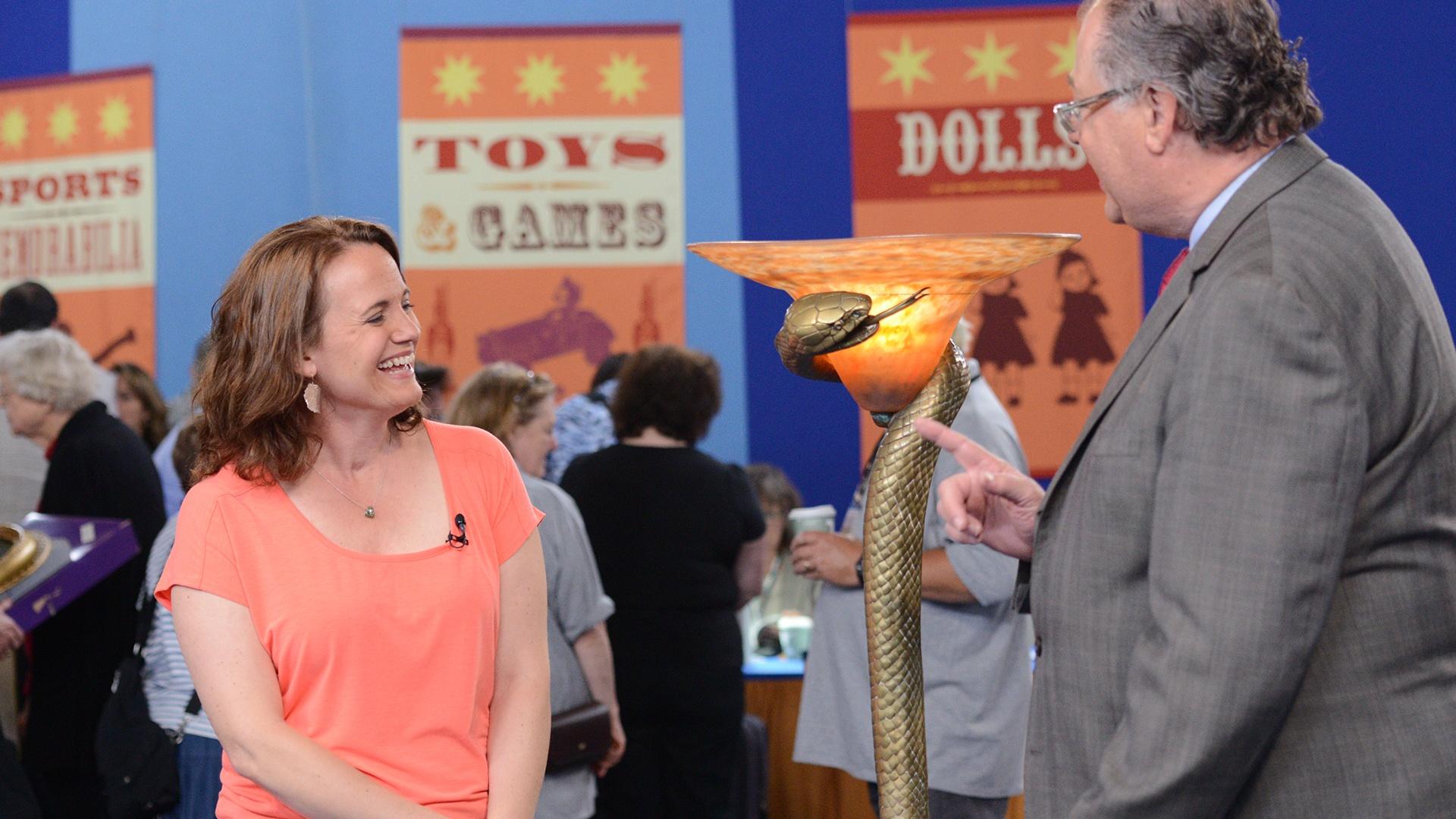
The story goes that this piece was used by the three boys to dig holes in the backyard. Wow. That's crazy. I didn't realize it would be that much. Oh! Oh, the poor things have been abused for many years. I'll take better care of them. More surprises in store, coming right up. Welcome to Antiques Roadshow. Hi, I'm Mark Walberg in Santa Clara, California. This part of the state is known as Silicon Valley, one of the largest technology hubs in the world. Although the hunt for the next big thing is on many people's minds here, we're on the hunt for the best old things. Let's see what our experts have found. It's been in the family for a number of years. It was one of those things where all of a sudden, no one wanted it anymore. (laughs) People aren't really into snake motifs so much, and it had to fit into the right place. So I decided it would be nice to have, and I honestly don't know all that much about it, except that I believe it's bronze. I believe it's from a French artist, maybe the early 1900s. That's about it. Well, it is very clearly signed on the base. It says Edgar Brandt, "E. Brandt," and Edgar Brandt was the leading metalworker in France starting in the 1920s up through the 1940s. He actually didn't die until 1960. His main body of work was wrought iron. He was the master of wrought iron in the '20s and '30s. He did all kinds of architectural work, he did doors, radiator grills, fences. He worked in Paris, he also worked in New York City. And this is one of the lamps that he made. This came in two sizes-- it came in this size and it came in a table size. No kidding. And sometimes they have this glass shade, and they also come with an alabaster shade. Alabaster is a soft stone that's translucent. Right. Brandt made this part, this is made out of bronze, and the shade was probably done by the Daum Glass Factory. Daum Nancy is in the eastern part of France by the German border. This is from the Art Deco period, from the 1920s. "Art Deco" term comes from an exhibition that was held in Paris in 1925. And Brandt, as a matter of fact, designed the entrance gate to that fair. No way. This is like his most famous, famous piece. And it has a title... I know my French is awful. That's okay. And we're going to get all these letters and emails. It's called La Tentation-- "The Temptation," or "Seduction." Oh, well, makes sense. So it's this wild snake coming out of a basket down there. Right. The 1920s is when Howard Carter found King Tut's tomb, so there was a tremendous amount of interest in things that were Egyptian. Okay. They sometimes call it Egyptomania. Very, very desirable, it's very rare, lots of fakes, lots of reproductions, so it's nice that the one you have is a real one. All right! That's the good part, right? That is the good part. And there's a better part. Okay. In terms of the value, the condition on this is a little shaky. It has some problems here with this green. Bronze is mainly copper, so when it deteriorates, it turns this green. It's the reason the Statute of Liberty is green. In a gallery setting, you're talking about $35,000 to $45,000. No kidding! (chuckling): Wow! That's incredible. So if you were to see one like this in, like, pristine condition, what is that then? There was one at auction that brought $62,000. Wow. So I assume the condition was better. It also had a very strong provenance, which can be important. But I think $35,000 to $45,000 is pretty good. That's incredible. That's pretty good for a snake lamp. I inherited it from my mom. She was given this in 1931 by a friend of the family's. And prior to that, it had been in a window display at Macy's in downtown San Francisco. And, you know, it's an automaton. Okay. And it was made by a French firm, Lambert. Leopold Lambert was one of the great makers of French automatons, starting in the late 19th century and well into the early part of the 20th century. This is a classic. It's a magician. When it operates, he bangs the cone with his wand two or three times, lifts it, and various things appear. All this is accompanied by a music box. These were made not as toys. These were made for the well-to-do to decorate their homes and to intrigue children, but they were not to touch. They were fairly expensive in their day. After winding it, we pull this, and let's see the action. (music playing) As if by magic, the watch is gone. It worked. The values fluctuate depending on condition. This one has some condition issues, it has some condition pluses. It needs some mechanical work. It has a little fraying on the collar here. This example would fall in the range for an auction estimate of somewhere between $10,000 and $15,000. Wow, that's crazy. I didn't realize it would be that much. I brought in three plates that for a long time I assumed were all done by my grandmother, but when we got the tickets for the Roadshow and I started looking at them more carefully, I saw that the signatures are different. My grandmother's name was Shepard, so this one obviously she painted. But the other two, I don't know if it was a friend of hers or a relative of mine. I don't know anything at all about the other two plates. This type of ware is generally referred to as China painting. Now, in the late 19th century and into the early part of the 20th century, ladies of fashion would get together in China painting parties and paint these plates, or blanks. So all of these blanks have a mark on the back of them. We won't turn them around, but they all say, "Limoges." There were also German and Austrian makers that made the blanks. They would be imported to the States. Let me tell you a little bit about this other signature here. So it says "Franz A. Bischoff." Franz Arthur Bischoff. He was born in 1864 in Austria, which I think is now part of the Czech Republic where he was born, and then died in 1929. So he's kind of a success story as an immigrant. He ended up in Dearborn, Michigan, where he opened a China painting school, so he would help ladies get better at painting their China painting. And eventually, he became known as the king of the roses painting. And you can see in this big charger here, the roses, every time you look at them, they just get more and more depth and more and more beautiful. He also painted this one, a smaller one, and it says here, "1908" and "1908." Okay. Now, Bischoff went from Michigan and came out to California around 1900. In 1908, he built a house in Pasadena and used that as his studio. So your grandmother may very well have worked with Bischoff. At this point, Bischoff got into oils, and he had these huge oils with wonderful roses. He did these great California landscapes that sell for quite a bit of money. You don't see the china painting of his all that often. I would put an auction estimate on this platter, which is a nice big one, at $10,000 to $15,000. $10,000 to $15,000. And this one, which is a little smaller, I'd put, like, at $3,000 to $5,000. Now, one of the oddities of china painting is most of the people were not professional painters. Right. So without it being Bischoff, your painting over there may be worth $100 to $150, that's all. Yeah. But you have this wonderful thing from your family. Right. So you won't put them in the dishwasher at this point. No, I won't put them back in the kitchen sink and wash them again. I won't hang it with a coat hanger. This is paint on pottery, so anything that you would not do to a painting you would not do to these. Oh! Oh, the poor things have been abused for many years. I'll take better care of them. I brought a letter that my father wrote my mother during the war.
APPRAISER
So Mother is "Darling." Mother is "Darling." And where did he write this from? He wrote it at the Eagle's Nest, Hitler's home, in Berchtesgaden, Germany. His home in the Alps? In the Alps. And we actually have "Der Fhrer," which was his term, "The Leader." We have the German eagle with the swastika. And there's a big controversy over the collecting of Nazi memorabilia. I can imagine. I love this because it's anti-Nazi memorabilia. Did he ever talk much about being up there? He didn't talk about the war very much at all, to tell you the truth. Who did he serve with? The 101st Airborne, 502nd. He was stationed in England before the Normandy invasion. So he dropped on Normandy? Yes, he did. What's cool is 70 years ago yesterday, he's coming out of a plane, not knowing if it would work. There was just as good a chance it wouldn't work. Yes. Later, he's sitting at Hitler's retreat in the Alps, writing on his stationery to his sweetheart, "Darling." And he says, "A few years ago, "I was reading of how 'Der Fhrer' was going to rule the world, "and now I'm here in his house, using his writing paper and thinking of what a jerk he was." (chuckles) That pretty much sums it up. It sounds like my father. That regiment had been through hell since D-Day. They jumped, they fought, they were stuck in the Battle of the Bulge. Those guys were amazing. We were so fortunate that they were there. I like at the top of the letter, he makes the notation, "Here's something to put in your scrapbook." Since it's a family piece, we'd be looking for an insurance value. Okay. This is a piece that, if it were my family, I would insure it between $500 and $600. Okay, that's great.
WOMAN
This was my great-grandmother's piece, and she was born in 1879, and she did some traveling before she got married. We know she traveled in Europe for some time, but we don't know if it's European or American. She lived in Pittsburgh. And because there was no mark at all, I really didn't think that it was worth much. We really know nothing. In about the 1850s, trade was opened with Japan, and then in the 1860s and 1870s, they had things called exhibitions where they introduced new things, and the Japanese style was introduced into all kinds of architecture, jewelry. This little brooch is Japanesque. I think it's probably French. It is 14-karat gold. Oh, wow. It has tiny single-cut diamonds in the leaves. The little red flowers are actually enamel. And then we have a giant wasp, which indicates new beginnings. It was a symbol represented in many cultures. Wow. It has the simplicity of Japanese design inspired by nature. Have you any idea what it might be worth? No, not at all. My mom said, "Oh, I think it's worth $25," and we weren't going to bring it, so... Retail, on today's market, it would sell for about $1,500. Wow!
MAN
My great-grandfather had what I was told the largest mercantile store west of the Mississippi during the mid, late 1800s. The table came to him when a fellow was commissioned to do the table. He came to my great-grandfather and asked him if he could get his groceries on credit while he was building the table. He told him that when he finished the table, he would then pay him for the groceries. When the table was finished, the man who commissioned the table tried to pay the artist less than what he originally agreed upon, and so he told him, "Forget it, I'm going to give the table to my friend who helped me out during this time." And so that's how my great- grandfather got the table. Well, it is a spectacular, grand table. Thank you. And we were having conversations about it, the other furniture appraisers, and there was some disagreement on whether or not it was an American table or a European table. Oh, interesting. And the reason for that is that it has such Germanic qualities to it. We settled on American because there is secondary wood under the table, which is pine. The table itself is walnut, and it has this great burled walnut veneer on the top. Yeah, it's beautiful. And you can see how beautifully it's matched in this quarter section so that you have a bookmatch veneer. The table was late 19th century. We would call it a Renaissance revival table. And it really is looking to Europe for its inspiration. And if you look at what the craftsman did with this table, at the base especially, he brings in a lot of history. You see that there's an Egyptian figure inlaid here, and then also a griffin figure, which is body of a lion, eagle wings-- it's really a mythological figure. And then also this warrior. During the 19th century, Victorians were collecting all sorts of things, and they're collecting stories in this table for sure. And then there's this lovely ivy border around the top of the table, which symbolizes friendship and fidelity and... Oh, okay. So it's really sending us a lot of messages. Family history tells you that it was made in California. That's sort of a stretch for me. Why is that? Well, because they were not really making a lot of furniture like this in California that early. Oh, interesting. Most of the furniture that we see of this quality is happening in the New England area into New York, Chicago. Sometimes family stories, they can morph a little. I have no doubt. I would say that it's probably got an auction estimate in the $3,000 to $5,000 range. Oh, very good. I was in Occidental, California. It's north of the Golden Gate. Came across a thrift store and decided to go in there. I saw this clock, and my mother is a big fan of lighthouses, so it was an intended gift for her, but I kind of decided to hold onto it for myself. I spent $150 on it about a year ago. It's just been sitting in the centerpiece in the house for a while. This is the result of a man who was a mechanical genius. He was French, so the clock is French. Okay. And his name was A.R. Guilmet. And he's most famous for his mystery clocks. Mystery clocks are clocks where there's no apparent reason for the pendulum to be swinging. But he's also very famous for this series of clocks that he called his industrial series. This is one of at least ten different clocks, each depicting something to do with industry. There are windmill clocks, there are steamship clocks, there are locomotive clocks. This lighthouse clock is one of the more popular in the series of industrial clocks that Guilmet produced. I'm sure they were "mass produced," but not in the same way domestic clocks were. Maybe hundreds were made. It dates from about 1880. It's a good example of what we call automata. The top rotates as it would if it were a full-sized lighthouse, this representing the beam. Collectors want one of every one of these series of industrial clocks. Really? So they're highly sought after. The lighthouse will rotate about 12 hours on each wind, but the clock will run a week. Really? It also has a barometer, and thermometers on either side. When you brought it in to our table, my colleague and I both flipped, especially after hearing that you bought it at a thrift shop. We appraised its value at retail for between $3,500 and $4,000. Really? Every day. Talk about a good investment. Very much so. Oh, man. My mother gave this to me about ten years ago. She lived in Vancouver, Canada. She got this from my stepfather. He took a trip to China as part of a delegation from Canada, and it was a gift to him from the people of China. When was this trip? I believe it was in the late '70s. I was told by my mother that it's a Chinese throne cloth or a robe, and that's really all I know about it. I've had it for ten years, and it's basically been in a box in the closet. Well, it's not only a Chinese robe, it's an Imperial Chinese dragon robe. And it's uncut, which is quite unusual. Normally, you see them as a robe with long sleeves, and a cuff and collar. Why was it uncut? Because the emperor wore these and changed robes every day or two. So there was a backlog of these ready to be made up on the spot when he changed his robes. This was made about 1880, and it was probably stored in Beijing until the 1970s and then gifted to your stepfather. You have the Imperial five-clawed dragon on a yellow ground. Yellow was restricted for imperial use. You have peaches of long life. You have bats, which are also symbols of happiness, and when associated with what we call the reverse swastika-- which is actually not a swastika at all, it's a Buddha's heart, and other symbols-- it basically is a symbol of imperial power. Is this on silk? Yes, it's on silk. Now, what this is missing is the back slip, and unfortunately, half of it in the back is gone. Okay. So we're lacking the collar, and we're lacking the interior back slip. At auction, in this condition, even with a partial loss, the piece would be worth at least $10,000 to $15,000. Wow, really? It's very difficult to find these uncut robes anymore. If it were complete, you'd be about $20,000 to $30,000. So you have a marvelous piece here. Well, thank you, that's beautiful. You don't have to be a pinball wizard to enjoy this classic arcade game.
The goal
keep a plunger-launched ball on a playing surface rigged with obstacles and blinking lights, and score a lot of points. Simple, right? Maybe not as easy as it looks. The Pacific Pinball Museum has a fantastic collection of machines. After we tested our skills, I tested Roadshow appraiser James Supp on his pinball knowledge. (bells chiming) Aw! You know, even with the graphics of modern video games, nothing really compares to the fun of a pinball machine. This is so much fun. What's the history of pinball?
SUPP
Well, pinball has its origins in the 1700s. It's based on a French game called bagatelle. Later on in the 1870s, Montague Redgrave developed a spring-powered plunger put into a little tabletop game that could be played in bars. It became very, very popular, and that led to modern pinball. In the 1930s, you had a lot of these bar games and saloon games, and there was a fear that that would lead to delinquency. Mayor LaGuardia of New York in about 1942 banned pinball, and the ban wasn't rescinded until the mid-'70s. Because it was illegal for so long and in so many different places, it became a symbol of youth and rebellion, which made it pretty cool. I can remember walking around, bumming quarters from my friends to try to get a shot at playing Fireball. Tell me about this game. Well, Fireball is the iconic early '70s game. It was released by Bally in 1972. The back glass is absolutely brilliant. You've got a really exciting board, you've got flippers that slide in and out, and in the center here, you've got this spinning wheel that tosses a ball in random directions.
WALBERG
This is a bone of contention for pinball players because you love it and you hate it.
SUPP
Oh, yeah, it's a really lively board. It's really a fun game to play. When Bally's was originally selling Fireball, it sold for $895. And nowadays, you can get one in good playable condition for around $2,000 to $3,000 retail. There are very few vintage machines that haven't been altered, so one in good restored condition is almost as much as one in original condition. It's going to be hard to tear me away from the Fireball machine. It's bringing me back to my misspent youth, but I understand there's another machine we should take a look at. Well, we'll look at a machine from my misspent youth, how's that sound? ( Addams Family theme playing ) All right, James, we move up about 20 years to the Addams Family pinball machine. This is a popular game. Oh, yeah, absolutely. And the reason it was so popular, it was based on a very successful television/movie franchise, The Addams Family. Now, this is based off the 1991 movie. Bally's released Addams Family the game in 1992. Anjelica Huston, who played Morticia Addams in the movie, and Gomez was played by Ral Juli, and their voices were actually used in the game itself. It's got a bunch of elements from the movie built into the game. It has Fester Addams with the lightbulb in his mouth, a tremendously fun game. When it came out, it cost a few thousand dollars, and they sold over 20,000 units. Now, it was so successful, they actually did a second release called the gold edition with another 1,000 units on top of it. And the only real difference was it was a gold cabinet. It made it the best-selling flipper pinball game of all time. This game has become very popular all over again.
WALBERG
Because the teenagers of the '90s now have jobs and they can buy them.
SUPP
Exactly. So what would we spend if we were going to get an Addams Family pinball machine? Well, a professionally restored pristine copy will run you about $12,000 to $15,000 retail. But most of the time, you can find a good, playable unit for around $4,000 to $6,000. Now, before we go, I think we should... we should play a little of The Addams Family. Let's do some doubles. You got it. (theme music resumes)
WOMAN
I have brought you a collection of books by Ray Bradbury. My husband's aunt, Jennet Johnson, was a teacher in Los Angeles High School and taught English. Uh-huh. When Ray was 17, he took her class in short story writing, and it seems to have been a seminal influence on his writing because he would send her books that had just come out with wonderful dedications in them to her. All the books that are here on display are all inscribed and signed to your aunt. And the first, earliest inscription I found on the copy of the paperback, it's an inscription from 1951 where he is very complimentary to your aunt. It's a lengthy inscription signed by Ray Bradbury. The second inscription that I really liked was done in 1962, and it is in this copy of Ray Bradbury's novel Something Wicked. And this is the presentation copy to the dedicatee. Mm-hmm. He dedicated this book to your aunt, and it says here, "To Miss Johnson, "I've said it all on the dedication page, "but additionally, here is...", and he recreates the design of the cover. I love that, yes. And then he signs it here, "September 1, 1962." And the dedication page, where he says, in print, "With gratitude to Jennet Johnson, who taught me how to write the short story." And for an English teacher, I think that is an incredible achievement to teach someone like Ray Bradbury how to write, and it is very forthcoming of him to keep her in his heart and to acknowledge her influence. And that reaches all the way into the 1970s, where he published another book that he dedicated to her, and this one is inscribed and signed by Ray Bradbury. In addition to all this, can you tell me a little bit about the letter that you brought? I knew that Ray loved Auntie Jane, and when she died, I sent him a short note to let him know that she was gone. And this is the letter he wrote in response, in which he talks about how much she meant to him. Yes, it is an extremely moving and emotional letter. I was so impressed by this group and also by the way it reaches from 1951 all the way to 1979. Have you had the books ever appraised? No, we never have. Auntie Jane would send them to us as she got them, and we are saving them for our boys. We don't intend to sell them. Well, if you were to offer the books at auction, I would recommend to keep them all together. My conservative estimate would be $6,000 to $8,000. Goodness. Okay, that's good to know. We will take good care of them. I would figure the insurance to be right around $12,000. Okay, good. There's just one thing that would make
a wonderful difference
if you had also his most famous book, Fahrenheit 451. Oh, I know. A nice copy of a first edition of that with an inscription could easily sell for $10,000, $15,000. Oh, goodness gracious.
MAN
My mother and her two sisters were each given one of three paintings back in the mid-'60s, I believe. I think the two sisters sold theirs quite quickly after they received them, and my mother was offered $500 for the third one of the three, and she turned it down. She gave it to me about 20 years ago. I've kind of had it in different storage areas, never put it up for display, never had it in a frame or anything. William Robinson Leigh was born in 1866 in West Virginia, lived on the family farm. He showed some talent as far as being an artist, so he went away to study art in Baltimore, and then from there, he went to Europe to study from 1883 to 1895. In 1896, he went to New York and he established a studio there, and he did magazine illustration for magazines like Scribner's. And he was also at that time painting landscapes and portraits, but he was not successful, and he wasn't particularly happy, I think. So in 1906, he made his first trip to the Southwest, and he really fell in love with it. And a year later, he was able to negotiate a deal that, in exchange for painting a painting of the Grand Canyon, he would get free transportation. This was for the Santa Fe Railroad. And they loved the painting so much that they bought five more. Between 1912 and 1926, he spent every summer in the Southwest, mainly in New Mexico and Arizona, and he focused on painting Indians, particularly Navajo and Hopi. And this picture is of a Hopi maiden. You can tell that she's unmarried by the way she's dressed and also by the style of her hair. Wow. It dates from 1917. It's signed "W.R. Leigh" and it's also inscribed "N.Y." for New York because his studio was in New York, and he would travel to the Southwest generally in the summers. Okay, I see. This is probably in northern Arizona at the pueblo. This is in oil, and it's painted on something called artists' board, which is almost like a kind of cardboard. It's really a lovely work. What's also nice is that on the reverse of the painting, it's inscribed with the title "Drying Corn." Leigh was particularly known for his brilliant use of color and the effects of sun and light, and I think this would clean up beautifully. Do you have any sense at all as to what the value might be? Not really, other than seeing one of his works on the Roadshow, a previous episode, but it was one of his landscape paintings, I think, that was appraised. It was quite larger, and it appraised quite well, so really no idea what this work might be worth here. If this were in a retail gallery, I think the asking price could be as much as $75,000. This is really a little gem. Whoa, wow... wow. So I would say to you it's time to put it in a frame. Okay, I think so. Wow, that's a lot more than we thought for. That's absolutely amazing. I started collecting this stuff in the '60s, find it here and there, a couple pieces at auction, but I haven't collected for over 30 years, so... First of all, it's porcelain of a very thin, high-quality nature that we call eggshell porcelain. And it's the specialty of a Dutch company called Rozenburg, who were based in the Hague in Holland. Like a lot of companies at the time, they believed in marking it and used a quite comprehensive marking system. First of all, it tells us it's made by Rozenburg in the Hague-- "Den Haag." It also has a little mark here, kind of a bee, which is a date symbol, and from year to year, these symbols changed. This one tells us 1899 or 1900. Next to that, we can see a little kind of window they call it there, that little cross-hatch mark. That's the approval mark. It means that the artistic director has looked at this in the final stage of production and said, "Thumbs up, this is a good piece." And you'll see the little number there, "1644." That's what the factory called the work order number. And here, we can see the monogram of the artist who decorated it. This is Samuel Schellink, and Schellink was perhaps the best-known of the artists around this time and very active about 1900. The word I often use for Rozenburg is "exquisite." The quality of everything is just very, very fine, and they all seem to date to between the mid-1890s to the early 20th century. Do you have a favorite piece here? This one here. This little vase? You have good taste. I think this is the most valuable one. The form is exquisite. The form and the decoration were the result of two different people, so there's a lot of artistry here. It's painted with wisteria, and on one panel at least, this spider in a web. What you've got is really the best example you'll find of the Dutch Art Nouveau movement. The company itself was founded in the early 1880s and closes during World War I, so it spans the entire period, really, of the Art Nouveau movement. And the tradition of Art Nouveau in Holland is a little different than it was further south, into France, where it all started, and other parts of Europe. I love the plate in the middle with those two exotic birds. Just a real tour de force of painting. And you bought them in the 1960s and '70s? Mm-hmm. Could you tell me, for instance, what you paid for this one? That one was the most I paid, and I paid $1,200 for it. And I ate Top Ramen for a month because it was a lot of money then. Well, I think you made an excellent investment. Rozenburg is very highly respected, very highly collected, and it's very fragile, so it tends to break. There's sort of less and less of it all the time. A low estimate for this vase, at auction, would be $4,000 and a high of $6,000. Do you remember what you paid for the other items? You know, I really don't. The only one, the small saucer, I paid $120. I'd say this little vase, certainly a low estimate of $2,000 and a high of $3,000. This piece I would give a low estimate of $3,000 and a high of $4,000. The two little vases, I'd probably give low estimates of $1,500 each, and with a high of perhaps $2,500. And the least valuable piece is the little piece in front of you. It's a saucer, and it would have had a cup on it. I would put an estimate of $500 on that.
WOMAN
My father-in-law obtained the ring in the '70s, but he met the artist in 1960, and he actually acquired four to five pieces. They were wedding pieces. The lady was getting divorced and she wanted to trade them. And so my father-in-law did not like the rest of the pieces, and so he melted the other four of them down and he just kept this one.
APPRAISER
It's what we call of the Modernist school, and it has a nice connection here to the Bay Area. It's made by an artisan who was in Berkeley, and her name was Margaret De Patta. And De Patta started her studio in the 1930s, and she worked over in Berkeley, and when she went to school, she studied under the artist Lszl Moholy-Nagy, and he was a very famous graphic designer. He worked in a lot of different mixed medias, and he was very well-known and is very well-known in the art world. And he had a great influence on her, and they did a lot of photography and different things together, and it really came to help form her style for the Modernist movement. And she really was probably one of the most well-known of that school here in the Bay Area. In fact, she was one of the people who helped start the Metalsmith's Guild here in the Bay Area for upcoming artists and craftsmen and metalsmiths, which is still in existence today. So she was very influential. She worked with these very sort of curvilinear forms, and she had a real interest in transparency of stones. So the stones that we have here are a few diamonds, and this is a piece of smoky quartz. It's just a tablet of smoky quartz. And what she's done that's sort of beautiful here, the engagement ring and the wedding band nestle together. Okay. So we've got this very modernistic piece, and then the ring itself is stamped on the inside of the band as well, so this is how we know it's by De Patta. Now, the ring I believe was probably made in the 19... late '50s, early '60s. Okay. This is the time period which is very, very collectable. At auction, I would estimate this item between $4,000 and $5,000. Oh, my God, are you serious? Yes, because of who it's by. If this were a no-name gold ring with some diamonds and smoky quartz, it would have a very insignificant value, but it's because it's De Patta that it is that valuable. That's amazing. I can only wonder, because there was four other pieces... Oh, I know. Yeah. Well, don't tell your dad that. (laughs) And she did do production line pieces, but this is not part of the production line, so it probably was a one-off custom design for the client. Okay. It's a wonderful piece. Thank you!
MAN
My father's uncle was a neighbor of Robert Frost in Cambridge, on Brewster Street, and I assume that Robert Frost gave them to him. Now, did you ever meet Frost? I did once or twice-- this was a long time ago. One time, I recall we came out of my uncle's house and walked down the steps, and there was a lot of snow on the ground, and Robert Frost was walking down the street and we started talking, and he was going to go into Harvard Square, so we gave him a ride into town. They were very good friends. The first book we have is A Boy's Will. Now, that's Frost's first book. It isn't the earliest edition. The first edition was done in London. But it's early in an American edition. But what's really important about this book is when you open it up, is a poem. It's entitled "San Francisco." Now, this was West-Running Brook. It was done a little bit later, in 1928, but here's the same poem, called "A Peck of Gold." Here, it's "San Francisco," here, it's "A Peck of Gold." Frost signed a lot of books. This one is a signed book also. Probably in the value, retail, of a few hundred dollars. A lot of times, he wrote in a stanza, just two or three lines. That can up it to $2,000, $3,000, $4,000. But when you have a whole poem and a poem that has a different title, so there's something unique about this, that even gets better. I would say you're easily talking a $5,000 to $7,000 book, easily, and that might even be conservative on a retail basis.
WOMAN
It's a jewelry box. It was inherited by my daughter. She was ten when her stepmother Sherri died, and about five years later, her dad decided that my daughter should get her stepmother's jewelry box, which we had admired and loved. The only thing I know about it is what Sherri told me, which was that it was a gift to her grandmother. When she and her husband lived in a houseboat on the Yangtze River in China in the early part of the 20th century, her husband worked for a trading company, so they had a lot of guests that came and went from their houseboat, and somebody gave this to her, and that's really all I know about it, and I've wondered for 35 years, where was it made. We know right away this isn't Chinese. The background material is burled walnut, and this is brass. It's done in an Art Nouveau style. We believe it's from the Art Nouveau period, anywhere from 1890 to about 1910. We know that it was made in Austria, so it traveled from Austria to your relative in China, and now out to California. Despite all those weather changes, the condition is fabulous. Oftentimes, with this type of intricate inlay, we see lifting, we see separations. One of the interesting things about this object is the stories in these vignetted panels here. We have Snow White and the Seven Dwarfs on the front. Turn it around this way,
we have a number of other Grimm fairy tales
Hansel and Gretel in the corner, Puss in Boots in the other corner, we have the Six Swans in the middle, and others. The work on it is spectacular. If we open it up, we can see inside, it's fitted. It is a jewelry box. It's in really, really beautiful condition. It's a phenomenal piece. The artistry and the work on it couldn't be better. It's one of the finest examples of this type of work that we've seen. At auction, we believe it would fetch between $3,000 and $5,000. Wow! Oh, amazing. It is amazing. I've known it was a special box. I would just love to know who gave it to Sherri's great-grandmother. Well, the box knows, and that'll have to do for now. That's true. I brought a poster that I discovered in Menlo Park because I was looking for something to fill a rather large wall in my home, and I've been looking for about three to four years, and I saw it in a window, and I knew I had to run in and check it out and find out what it was about because it really caught my eye and drew me into the store. Well, I think you got a very nice piece. It's a French color lithograph poster, printed in Paris about 1910. It's for a champagne liqueur, which was a popular kind of drink in that period. Great color. It doesn't have the artist's name, which is a little negative, but in posters, the key thing is the image. So if it's a boring image by a good artist, nobody cares. This is a lovely image by an unknown artist. That's fine. It's got the tax stamp up here. Some people get all excited about that, but what it basically means is the publisher or printer paid to have it put up. It doesn't make it authentic; it means they paid for the tax on hanging them. Sometimes, if a poster's never left the factory, it doesn't have the tax stamp. It's still neat to have it. She's got great color. I love her costume. They're color lithographs, which is a technique that was invented in the 1790s by Alois Senefelder, but it expanded greatly over the next hundred years. By the time you get to this period, they're printing in, like, six or seven colors for a poster like this, each one drawn on a big piece of Bavarian limestone. How long would it take them to produce it? It may be printed by multiple artists who'd be working on multiple stones over probably a month or so. Condition-wise, it does have a little bit of tearing over here, but that's not too big a deal on a four-by-five-foot poster. The key thing is color-- bright, rich colors. You can't fix that. You can fix a tear, you can't fix the colors if they go away. May I ask what you paid for it? I paid $1,200. I think you got a very nice deal. A retail price for this would be around $3,500 or $4,000. Okay.
WOMAN
I bought it at an antiques store on Union Street in San Francisco. I saw a bunch of them in the display window and said, "Oh, they have to be too much," but stopped, and I said, "Wow, I can afford this. It's one week's salary." Oh, my goodness. That was the big sacrifice. Wow. I wanted the other ones, but they just... you couldn't do it. And there was a comparable five or six others that were this quality. What do you know about this basket? Well, I know it's California, Central Valley. I'm not sure the exact tribe. It might be Yokuts or western Maidu. I'm fuzzy on that. I know it's a bottleneck because of coming in and going up like that. Well, your basket definitely is from California, and it is a Yokut, and it is a lovely bottleneck, a nice, flat top with a nice neck. This is called the shoulder right here. And your design makes it Yokut too, which is the diagonal diamondback rattlesnake design. Beautifully woven, stitched going the right way for Yokut. At one time, these baskets were made for rattlesnakes... Ooh! and they would do a ceremony where there was actually a rattlesnake in the... Oh, really? Oh, yes. I had not heard that. But then, when the tourists come along, they love these baskets. Without the snake. The basket is probably circa 1900, and during that time, they were making baskets like this for the tourists, and the tourists loved the little figures on them. Oh, okay. They could probably sell it for a little bit more at that time because of the figures. Oh, okay. Yes. This basket in the early 1900s, I would imagine that the price might have been maybe $100, $150, and that would have been very strong, because a man's salary at that time was probably five dollars a week. Okay. It does have some damage. All around the rim, there would have been these little quail top knots from the quail, and then you see a little... oh, nubs of red. That would have been old, old red trade yarn, and that would have been all over. I can see it. I'm sure the moths must have loved it. The moths love it. But it is delightful. It's probably around 14 inches, maybe eight or nine inches high. Do you have any idea what this basket is worth? I know it has to be worth $1,000 or $2,000 or something, but I don't know... $2,000? I'm just guessing, but I don't know if it's kept going up from my $115 or whether the economy has flattened it. When did you get this basket? I believe it was about 1967. A retail value of this basket would be somewhere in the vicinity of $24,500. Oh... no, I did not envision that it had gone that much more. I can't do the math in my head. That's a lot of working days, isn't it? That's very nice, that's very nice. It is a lovely basket. Without the damage on this basket-- which can be replaced, but they can't get the actual old red yarn-- we are talking about a basket that is probably, retail value would be $35,000, maybe more. Wow. That's very nice to hear. Well, I thank you for bringing it in. Back on the shelf!
MAN
I brought in a Myrick's tooth, a scrimshawed piece that was in the family since early in the 1900s. The story that I was told by my dad was that in 1920, my great-grandfather received this from a hobo that he'd helped out. The story goes that this piece was used by the three boys to dig holes in the backyard for a period of time. That would have been when, in the '20s? About '28, '29, in that period. So it's had quite a history in the family. It's a picture of the ship Francis. And you mention that it's a Myrick tooth, and Myrick was one of the first people to sign his scrimshaw. Oh, okay. So it was early, and because of that, we were able to track a body of work. Mm-hmm. And I'm going to rotate it and show the signature, and it says over here, "By Fred Myrick." Myrick was born in 1808, and he's quite famous-- famous as a seaman, and famous for his work on the ship Susan. Okay, we'd heard quite a bit about the Susan's tooths. Yes, and there's a body of work of Susan teeth, probably 20 to 25 pieces that are known. So we can track him, we can track his work, his progress as an artist, and this one for the ship Francis, because the Francis was commissioned in 1828. It eventually sunk in 1854. So we feel that he probably served on the Francis after the Susan. Mm-hmm. And as we can see, the work is exquisite. It really is beautiful. And I'm going to rotate it here and show the other side, which has another depiction of the Francis, beautifully done. There's some red staining there. What was that from? Yeah, the red staining, we believe... It sat in my grandmother's house for years on a red velvet, and that was the only thing we could figure stained it. That could be cleaned very easily. So the tooth is a sperm whale tooth, and it falls under the Marine Mammal Protection Law. As I understand. And in order to transact business with this tooth,
you have to prove two things
number one, that it's at least 100 years old, which we know it is. We know it's close to 200 years old. And we have to know where it's been since the law was passed in 1972. Okay. Because you know it's been in your family possession since the '20s, at least, we pass on that aspect as well. Oh, excellent. Today, we're going to give it an insurance valuation of $150,000 to $200,000. That's extraordinary, for something that four boys used to dig in the ground. Will this stay in the family? Oh, most definitely. It's just part of the family and the story of it and how it came to us. It's definitely a family treasure. And now it's time for the Roadshow Feedback Booth. My San Francisco Seals hockey memorabilia is worth $500. A lot more than my fake jewelry. We brought these pocket watches, and we found out this one is made by a famous watchmaker, and it's worth about $4,000. And this one looks the same as that, but it's worth nothing. It was sitting on my coffee table with candy in it. The grandchildren would take candy out of it. Now I find out that it's Steuben glass and it's worth between $700 and $800. So I don't think the grandchildren are going to get candy out of it anymore. This button mold has been in my family for four generations. It was handed to my great-great-grandfather from Emperor Maximilian in Mexico. And I just want to thank Bruce, who did an amazing job of telling an incredible story about how this was given to my great-great-grandfather in prison. I had no idea that it was written about and that he knew. It's wild. Right on, Antiques Roadshow. This was going to bring me lobster and champagne, and instead, I'm going back to gruel and cheap beer, but I had a swell time. Thank you, PBS and thank you, Antiques Roadshow. I'm Mark Walberg. Thanks for watching. See you next time on Antiques Roadshow. What you got? Captioned by Media Access Group at WGBH access.wgbh.org
Search Episodes

Donate to sign up. Activate and sign in to Passport. It's that easy to help PBS Wisconsin serve your community through media that educates, inspires, and entertains.
Make your membership gift today
Only for new users: Activate Passport using your code or email address
Already a member?
Look up my account
Need some help? Go to FAQ or visit PBS Passport Help
Need help accessing PBS Wisconsin anywhere?

Online Access | Platform & Device Access | Cable or Satellite Access | Over-The-Air Access
Visit Access Guide
Need help accessing PBS Wisconsin anywhere?
Visit Our
Live TV Access Guide
Online AccessPlatform & Device Access
Cable or Satellite Access
Over-The-Air Access
Visit Access Guide




Follow Us