








PBS Wisconsin Passport
Watch this video with
PBS Wisconsin Passport
Become a member of PBS Wisconsin, support your local community, and get extended access to PBS shows, films, and specials, like this one.
Santa Clara, Hour 1 (2015)
04/20/15 | 52m 59s | Rating: TV-G
ANTIQUES ROADSHOW is in Santa Clara, where host Mark L. Walberg and appraiser Stephen Fletcher travel to the Japanese American Museum of San Jose to learn about arts and crafts made by Japanese and Japanese Americans interned in camps during World War II.


Copy and Paste the Following Code to Embed this Video:
Santa Clara, Hour 1 (2015)
This week, Antiques Roadshow is in Santa Clara, California. I went home to my husband, I said, "There's a table there, it's really expensive," and so he said, "I can't say no to a pregnant woman." (chirping)
MAN
Isn't that cool?
APPRAISER
It's super cool. That's more than I expected. What other treasures does Santa Clara have to show Roadshow fans? Stay tuned. Welcome to Antiques Roadshow. Hi, I'm Mark Walberg in beautiful Northern California. We're in Santa Clara today, the Mission City, named after St. Clare in 1777. Many folks here would love to know the origins of their treasures they brought with them today. What do they find out? Let's take a look.
WOMAN
This has just been a doll that's been in my family as long as I can remember. It was something I saw as a kid growing up, and the story that I learned later was that my great-grandmother, when she emigrated over from England, she came to the U.S. and they moved to L.A., and she worked for the Salvation Army. So that was probably in the early 1920s, and that's where she picked up the doll. And it's just been around ever since. Do you know anything else about her? It's always been in a case that my grandfather made for me, and my mom used to look at it, play with it, and that's it. It's just got beautiful clothes, and its eyes open and close, and never even looked anything up about it. This doll is from Germany. It's made by a maker called John D. Kestner, made about 1910. Wow. It's an Asian doll or Oriental. It's a bisque head and a composition body. It's a baby doll. It's a five-piece baby body, and the arms are bent, and the legs are bent also. It's also marked on the back of the head, "Made in Germany," and the mold number is 243. And also it's marked "J.D.K," for John D. Kestner. Probably maybe five percent of what they made were Asian dolls. And also, Kestner was a pretty prolific maker, and he did such a good job on making the mold and the faces and the coloring and everything. His dolls are more sought after than other dolls. Oh, wow. If this doll was at auction, it would bring between $3,200 and $3,500. Wow! (chuckles) That's incredible. Very nice example of the doll. Wonderful, I never would have imagined. My husband's father was Maynard Dixon. He always had Indian artifacts and things in his studios wherever he was. And when he died, of course they went to his then wife, Edith Hamlin. And when Edith passed away, this was given to us. Well, what a wonderful gift. Oh. Do you know about the tribe that it's from and its age? Well, we think it's Zia. It is, Zia Pueblo. This is a northern Rio Grande pueblo in New Mexico famous for its pottery, particularly famous for some of its large pottery. It's hard to say who made this exactly. It may have been made by the Medina family, a large family of really well-accomplished potters in New Mexico. We'd have to do a bit of research, though, to really know that for sure. The imagery reflects bird feathers and bird wings, so it relates the pot to the upper world. I particularly love this long, undulating line. It divides the upper pattern from the lower. It gives a completely different register. We see it differently. It's 18 inches tall and 20 inches wide. That's about as big as Pueblo pottery gets. Maybe an inch or two more, but they don't survive. This is a miracle of survival. It's in great, great... We try. It's in great condition. Of course this is a ceramic pot. This is the tradition in the Southwest. The ladies would take clay from a native source, they'd roll it into long tubes, roll it around... Coils....create the pot and then flatten it with a stone or a rag. They'd polish it, then they'd paint, and they would fire it in a kiln. It's very difficult to fire a big pot; it can break. This woman was a very, very accomplished potter. Dating, my guess circa 1920. Why do you say it's a woman? You think because the potters were... The tradition amongst the Pueblo tribes was that the women did the pottery. The men did the weaving. Do you have a feeling for value on a piece like this? We were told at one time a few years ago about $18,000, but I have absolutely no idea. The value for us is far beyond the money for my husband. It's a personal... it's a matter of family. Absolutely. Of course. $18,000 a number of years ago may have been appropriate, maybe 20 or 25 years ago. The value of large Zia pots with this spectacular design really increased considerably. The pot I think just by itself would be, on a retail basis, valued in the neighborhood of $50,000. (chuckles) However, since this was Maynard Dixon's pot and perhaps in his studio, certainly one of the objects in his collection... Absolutely. I think we have to increase that a little bit. I would value this pot on a retail basis in the neighborhood of $70,000. Oh, my God. And if you had to insure it, maybe a little more. Well, as I say, the money is wonderful, but it's the spirit and what it means to my husband and that's what really counts. I brought you our dining room table. We bought it in 1986. I was pregnant with my son. I walked into an antique store in Cambridge, Massachusetts. I saw this table and I completely fell in love. I had never seen anything like it. I put a deposit down, I went home to my husband. I said, "There's a table there, it's really expensive, we don't have a lot of money, but we have to have this table." And so he said, "I can't say no to a pregnant woman." So we ended up buying the table. Well, when we look at a piece of furniture, we examine it first to find out what does it tell us about a given piece? And here when we look at it we can say this is oak, which is a wood that's used for centuries, but it's very common to be used at the 19th century to the 20th century. Also, designwise, we can see this element here, which is very Victorian, late 19th century. As we drop down the leg, we see these cross members here and these through tenons. And this one piece runs all the way through the leg. This is a design element that you see in the first part of the 20th century with the Arts and Crafts movement. So this is a transitional piece from the Victorian to the Arts and Crafts movement. And we can really date this to a very specific time, like 1895 to 1900. And in that time in America it's very innovative. The 19th century is marked by the Industrial Revolution and innovation from all sectors of industry and certainly in 19th century furniture as well. This has some very unique components, doesn't it? Yes. And we see on the ends here this tambour top. Right. So unlike a table when we go to the dining room table for Thanksgiving or Christmas, we don't have to go to the carriage house and pull out these bulky leaves. We just simply pull out this handle. Yup. And crank it. And what's fascinating about this to me is these legs move, it's almost... it's almost free-floating. Right. The casters are recessed. When we look under the underside of the table we see these tremendous gear mechanisms that it's almost like a car. (chuckling): Yup. (grinding) I mean you can hear it just "cha-chink, cha-chink." So a great innovation. So I think none of my fellow appraisers have seen this table, I've never seen anything like it, anybody I've talked to has never seen anything like it, can't see anything like it online. So you think, "Well, how did it come to be?" Right. And I think this is clearly a factory-made piece of furniture. Uh-huh. So my suspicion is that this unknown furniture factory probably on the Atlantic seaboard somewhere manufactured this piece as a sample piece to see if it would catch. Ah... And I think the cost of it became prohibitive so that the market couldn't absorb it. Fabulous piece of furniture, though. Thank you. I thoroughly enjoy it. Do you mind if I ask how much you paid for it? We paid $1,800 in 1986, which was a lot of money for us at the time. 19th century furniture, particularly today, is one of those things, it hasn't changed a lot. The market goes up, it goes down, and it's probably at a low point today. Everybody in the building loves this table. (chuckles) But I think it caps out at a certain price. So probably if we were to put it in auction, I would estimate it at $2,000 to $3,000. A little bit more than what you paid for it, but I think it would find a ready marketplace. Yeah, but I would never want to sell it.
MAN
We found the pig at the Salvation Army.
APPRAISER
No kidding. In Sacramento. How long have you owned him? We've owned him for about five to six years. And how much did you pay for him in the Salvation Army store? Ten dollars. Ten dollars? Well, I think you made a great investment. The company associated with these pigs is called Wemyss, which is a Scottish pottery. Okay. Although they moved from Scotland down into England in the 1930s, and this particular one has a mark on it. I'm not going to turn him over because he's a big guy. The mark on the bottom tells us he was likely made in the 1930s and retailed in London. And they painted him in different ways. A lot of them are painted with roses, which really represents England. A lot of them are painted with thistles for Scotland, and this one has shamrocks, which of course is Ireland. You don't see so many shamrocks, but I kind of like that. They're all hand-painted. They made them in different sizes. This is the biggest size they made. If it came to auction today, it's hard to say. But the condition is so nice, the colors are so good, the eyes are strong. I think it would be estimated at least $1,000. Okay, good. But maybe as much as $1,500. Okay, great.
MAN
I bought this painting about 25 years ago in an antique/thrift store in Whittier, California. Was it framed then or... It was framed, but not in this frame. I acquired this frame at a yard sale a couple of blocks from my house. Oh, gee, well, you have quite good luck, I'm thinking. What did you pay for it? I bought it for $700 on payments when I bought it. Oh, my, $700! So you must have liked it quite a bit. I thought it was beautiful. I liked the subject and I just thought I wanted to buy it. Well, it's a lovely Olaf Wieghorst painting. Let me tell you a little bit about the artist. He was born in Denmark in the late 19th century, and in 1918 he moved to the United States. And for a while he settled in the Southwest doing odd jobs-- cowboy jobs, military jobs. Wieghorst spent an awful lot of time in New York City. He moved there in the '20s and was a mounted police officer in Central Park. Wow. So, while he's known for his absolutely wonderful Western scenes, he spent a good bit of his career in New York City. He was always interested in horses and scenes of the old West. And when he retired in the '40s, he did move to California and continue his career painting scenes of the Southwest. It's a lovely example of his work. I like the fact that the background has been kept open. It gives the piece a more contemporary feel. The painting is oil on canvas, and this monogram references a ranch that he worked at when he came over to the United States early on. He began using the monogram in 1923. I don't want to commit to a specific date for the painting because he did have a very long and prolific career, but I think we're looking mid-20th century. It's a contemporary frame, but a vaguely Southwestern-style frame from the 1930s or '40s. So it complements the painting very well. I only paid five dollars for the frame and it fit perfectly. So I gave you kind of a hard time about how much you paid for it. It was a lot of money back then. Well, it's a lot more money now. Wonderful. For retail, I would estimate the painting at between $20,000 and $30,000. Wow. Now my wife can retire.
WOMAN
My grandmother brought this book from Italy when she moved here in 1980. It had been in our family for, I would say, 150 years, slowly collecting autographs from various famous people.
APPRAISER
Now, where do you think some of them came from? My family owns a hotel in Sorrento. They owned one in Florence in the late 1800s, early 1900s, and I believe that a lot of these signatures are from people that were their guests. But you can't absolutely say, but you think that's where. I... my grandmother was pretty sure, but I still cannot prove either... any of this. This book is absolutely cram full of autographs of well-known,
famous people
authors, scientists, musicians. Now let's open to one page in particular. Here, now you have a Steinbeck. So that is John Steinbeck's note, and it's particularly written for this book. It says about being in illustrious company in this book, so my grandmother was positive that he knew about the book and was happy to be a part of it. Whether they were guests at the hotel or friends of guests or acquaintances, they obviously got autographs and they pasted them and put them in. They did. Let's look at the next page. And again, there are all sorts, but I thought these three... You have Leo Tolstoy, Rudyard Kipling, Mark Twain, and just many, many. I mean there are way, way more than we could possible show. Absolutely. Now, have you done anything on value or looked up any? I have had this book appraised by a large auction house, and the gentleman basically told me it was worth nothing. Worth nothing. Well, that I'll tell you I'll disagree with. I'm not quite sure what they had said. I don't see how they could have come to that conclusion. This book is worth thousands of dollars. I mean you have some spectacular autographs. There's Verdi, there's Zola, there's Edison. I would say a retail price, selling it as a book, would be a minimum of $25,000 to $35,000. I was curious as to... if we take some of these signatures out, would that have any relevance on the value? It would probably have a lot of relevance on the value. Now, it would be sort of really nice to keep the collection together as a collection. But if you're looking at it purely monetarily, the collection is worth way more as individual items. So if you took these apart... Now, I'll also point out one thing, too, is a lot of this is done back-to-back. Yes. So it would be an expense on the ones that don't come out easily to have a conservator remove them. So that would add cost to it. But I would estimate that if you took these apart one at a time, that $25,000 to $35,000 retail might turn into a $50,000 to $75,000 retail, and maybe even more, because there's no way we have time here to look at each individual... So your grandmother gave you a great gift. Thank you for bringing it. Thank you so much. It was my pleasure.
MAN
I don't know a lot. It was my father's cousin, Uncle John, and he lived in Manhattan. He actually worked with Coco Chanel, as I understand, in the '40s and '50s. And when he passed, my father flew to this beautiful apartment he had in New York and picked out just what he could carry home in a suitcase. I understand there were some pretty valuable things left by friends that wanted a memento. But this came home. And so I now have this, and it's pretty, but that's about all I know about it. And do you know what it's called? I've always called it the bird music box. Okay. So it's called an automaton. It's French, around about 1830 to 1850. And the movement inside is Swiss, and if we give this a moment I'm going to open it up and we'll be able to listen to the music, okay? Fantastic. (chirping) Isn't that cool? It's super cool. It's a wind-up movement, and we have the key here, which is really great to have this little bird-shaped key. Sometimes they get lost. It's made of silver and enamel, and all of the painting on it is enamel. The painting here is after a painting by Jean-Baptiste Greuze, and it's of a girl letting a bird out of a cage. Oh, I never noticed that. And actually, the bird in the cage is emblematic of her purity. So she's actually releasing her purity. Oh, my. Yes, so it's sort of mildly erotic in nature. We've looked at the inside, and what's also very interesting-- I'll turn this around here-- is that there is this compartment in the back. What is that? I mean, I thought it might be a snuff box or something. That's a great question, and in all honesty, we've spoken with a number of appraisers here, and its true purpose we don't know. It could have been for ladies' patches. It's possible that that would be a place that you could store the key. It's unlikely for snuff; it would have spilled out. And because these music boxes were traditionally laid out, you wouldn't have any valuable items in there. If this were to come up for auction, an auction estimate would be $8,000 to $12,000. Oh, fantastic. That's something I better thank Uncle John for, wherever he is. That's great. (chirping)
WALBERG
The human drive to create, even under difficult conditions, is a strong one. These are examples of arts and crafts made by Japanese and Japanese-Americans held in U.S. internment camps during World War II. Roadshow visited the Japanese American Museum of San Jose to explore these remarkable artifacts, works that express beauty, dignity and perseverance in the face of hardship and injustice.
DELPHINE HIRASUNA
The definition of gaman is to bear the seemingly unbearable with patience and dignity. And this was their way to gaman in camp. Most of the objects were made by untrained artists, farmers, gardeners. I've always loved this cow that was made by the father of a guy I went to high school with. Akira Oye was his name, and I knew he was a farmer. I never knew that he had any artistic ability. I was very fond of that. There was a slate teapot made by a gardener in Oakland, Homei Iseyama. There was a slate quarry in one of the campsites, and he started hacking out these teapots that were just beautiful. What happened to the arts and crafts created in the camps after the war? Many people just threw these things they made in camp away. They just left them behind. Even as recently as 15 years ago, someone has said, "Oh, my father was cleaning up and he said, "'Throw that in the garbage, I don't want to remember that.'"
WALBERG
Stephen, how would you categorize the art that was created in the internment camps? Well, I think we could put them in maybe a couple of different categories. Some of the articles are very folky by nature, they have a certain naivet about them, while others are very sophisticated, extraordinarily well designed and very evocative of Japanese culture, beautifully crafted and really quite extraordinary. I think you'll find that there are a variety of people now looking for them. They may be dealers or they may be private collectors. I think there's an effort, too, to see that these pieces reach museums and institutions. The bird pins that were produced from illustrations that might have been found in National Geographic magazines or bird books may bring in the few hundreds of dollars, while some of the pins that were signed by the artists can bring in the high hundreds and perhaps even more. We have an example here of a carved cow that was made in the Rohwer camp. I think at auction a carving like that today could bring perhaps $1,000 or more. Now, the slate teapots are beautiful and they're functional as well. Tell me about those. Those to me are examples of how I don't think they're folky at all, but rather they're very sculptural, very beautiful, and I think sophisticated in the design, and very similar, I think, to pots you might find having been made in Japan itself rather than here in America. I think those may well bring in the low four figures at auction.
HIRASUNA
What has amazed me is the number of people who signed the visitors' book who said that they never knew the camps existed. Someone said to me, "Oh, how long were they in the camp? A few weeks?" And I said, "Try three and a half, four years." And because I knew these people-- I mean, some of them, when I was growing up-- I knew that they never talked about having any interest in the arts, and that yet these exquisite things came out and were handed to me, and I was just blown away. Delphine, thank you. It's been remarkable speaking with you and such important subject matter and beautiful art that you're sharing with us. Thank you.
WOMAN
My mom ordered this for my dad in 1969. She met the artist, Sam Maloof, at a Pasadena art museum, and they agreed that she would order a piece of furniture from him. And she went to his home in Pomona area. His shop is next to his house, and she placed an order for this chess table for my father. She also ordered a chess set separately, but which we don't have anymore. But we have the table and the chairs.
APPRAISER
Well, at the time Sam died in 2009 at the age of 93, he had made furniture for several presidents. He had made furniture for celebrities, and captains of industry. And all this is kind of amazing because he was completely self-taught. He differs from a lot of other craftsmen that are known from the Post-War American period in that his work was very soft and fluid and curved. There was almost no natural edges left, or knots, or peculiarities in the wood that other woodworkers from this period liked. He really liked a soft, curved, almost rounded-off look. The chairs are really interesting to me because they have the original upholstery. And I don't know whether your family picked out the upholstery or Sam picked out the upholstery. I believe my mom picked it out. This is very much my mom's style. When your parents went to Sam's showroom, they would have seen a lot of Navajo carpets and rugs, and in this case, we have an American Navajo blanket or rug cut to be made into upholstery. If you hadn't told me that it was made in 1969, I could tell you that this has all of the hallmarks from the late '60s. The stamp that's on the chair says, "Designed, made, Maloof," and then "California," which is missing from here because of the curve. And he identified himself with California. He was an inherently a California artist. He was born and raised in California, he learned his craft here, he perfected it. And it has a very interesting element on the top of the backrest. It has these horns that are a little unusual. In the later period in the 1980s, a lot of these horns were shortened or actually disappeared entirely. The wood is American black walnut, and the lighter squares I believe is ash. Okay. When he was alive, these chairs would have been worth a little bit more. But I think we're going to see the prices go up dramatically in the future. Okay. I would sell the chairs, if they were going to be on the open market, separately from the table, because there are more people who would want a pair of chairs than they would a set. Mm-hmm. If you were to sell the chairs separately, I think they would sell for about $10,000 at auction. Wow. Wow. That's great. I had no idea, yeah. So the table, as a game table, is a little less desirable today as back in the '50s and '60s, when game tables were more popular. But because of the size and the condition of it, which is really very beautiful, I would also place the table's value at about $10,000 at auction. Okay, great. That's fabulous.
MAN
This was a present for my father in Germany for his bar mitzvah. My father's bar mitzvah turned out to be on April 1, 1933, which was the day that the first sanctions against Jews, the boycott of Jewish stores, was implemented by Hitler, who had become chancellor only ten days earlier. This had caused such a stir that the bar mitzvah itself
was held at 6
00 in the morning so no one would know. But the real story happened six years later, when both my grandparents and my father were trying to get out of Germany. And both my father and my grandfather, after Kristallnacht in November of 1938, were put into concentration camps. And my grandfather got out in one day, and my father took three weeks to get out. And it turned out that my grandfather's personal physician in Berlin had a lot to do with helping both my grandparents get themselves, as well as things out of Germany that at that time were not allowed to be taken. And that's where we thought the story ended. But Albert Speer published his autobiography, Inside the Third Reich, and Albert Speer was Hitler's chief architect. And we were amazed when we read in the autobiography that it turned out that the physician was Theodor Morell, Hitler's doctor. And we were obviously just blown away by the fact. We didn't know. My dad had a lot of stories of meeting with Dr. Morell after he was released from concentration camp. So he was a young man at that point? He was 18. There's one story that my dad tells is he goes in about a week after he'd been released for a check-up, and the doctor was very cold towards him, and my father-- you know, by this time it was very late in 1938-- was really worried. Well, the doctor's nurse leaves the room, and Dr. Morell says to my dad, "I'm sorry I was so mean to you. "The nurse, she's just a real Nazi, so I have to act this way," and then he was fine. I think about it and I think of my dad, and I think about what he had to go through to get out. And the fact that he was able to take this with him and keep it, it's not going anywhere, so it's a very special piece to us. Well, that's it. I mean I think as appraisers, you know, obviously we're looking at the objects, but it really is the stories behind them is really pretty special. And it certainly is something that may have had a little bit of age at the time that he received it, but it was made in the probably early 20th century, and it's got a kind of great style to it. It's maybe intended as an heirloom item. It's made out of silver, sort of German 800 fine. It's a little less silver content than sterling. It's got this great decoration with sort of the lions and the Ark, it's got the crown. So it has all of the iconography that you expect to see on a Hanukkah lamp and the Hebrew text. It is missing one thing-- it is missing the Shamash, so... And I had no idea. Yup, so there's a little point up here where it would've sat in. Those are often lost, so it's not a big factor. For insurance purposes, for the lamp I think you're looking at a value of maybe around $3,500. Really? I mean it's not that important, but I'm surprised. Definitely document that and keep the history with it. It's important. It's staying close, I promise.
WOMAN
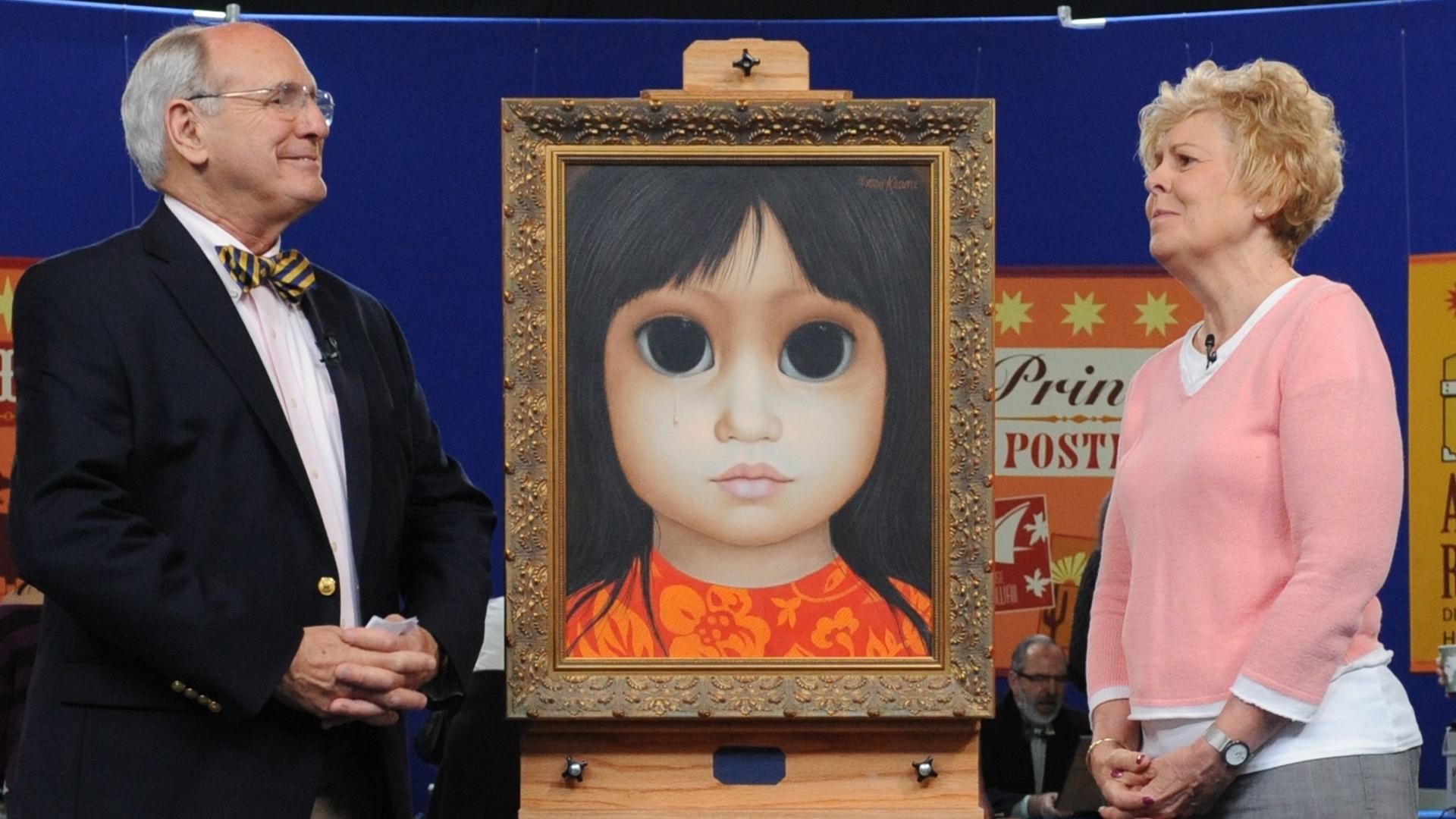
This is a Margaret Keane painting that I think was done in the mid-1960s.
APPRAISER
Right. My mother-in-law purchased it on a trip to Hawaii, and I know she didn't pay a lot for it because she didn't have a lot of money, so we inherited it in 1991 when she came to live with us. But I must confess that I'm not very fond of it. My husband loves it, so it's kind of been in the dining room, not in a place of prominence. What can you tell me about the artist or the subject of the painting? Well, Margaret Keane always did the large eyes, and that was her signature. I don't know what the name of this is, if it has a name. Well, the work of Margaret Keane has gone through considerable discussions over the years. There was a ten-year lawsuit between Walter, her husband, who claimed to be the author of the paintings, and Margaret, who claimed to be the artist. There was a court trial in Honolulu, Federal Court, where they settled the matter by Margaret Keane and Walter had to paint a painting. I see, yes. And Walter begged off, and Margaret did one in 53 minutes. And so she won the lawsuit. Ah, interesting. And resolved it. I think it was in 1986. Oh, that recently? Yeah. There is far more to the story than we'll go into here, but she was basically locked in a room and made to paint by her husband. These waifs were her signature. I see, yes. Margaret Keane worked primarily with acrylics, which dry very quickly. It allowed her to produce a number of paintings in a day. Oh, really? So that is her medium of choice. Interesting. And did you have a sense of what you thought the painting was worth? I am just guessing. I'm going to say maybe about $4,000. I have no idea. I think it'd be a bit more than that. They've sold at auctions in as disparate places as Maine and Japan. I mean, there's some affinity here to the anime images, it seems to me. Oh, yes, yes. And there's a bit of a pop culture interest, and I wasn't sure whether you were aware that Tim Burton, who is a filmmaker, he has got a film in the production on Margaret. Oh, I have heard of that, yes. Today the auction values are $5,000 to $7,000, maybe $5,000 to $8,000. Okay. But you might wait. Burton has a collection of them. Keane has been an interest over the years, so you might wait and see how that film turns out. Okay, all right. Everyone thinks that value in art is constant, but it does change with other events. I see, very interesting. Yeah, thanks very much for bringing it in. Thank you.
MAN
I was working in Kinshasa-- that was Zare at the time, now Democratic Republic of the Congo-- and I was in a car stopped at a red light and a guy ran up to the window and held up this object and wanted me to buy it. It looked like it had a patina from having been handled, and that impressed me. And it looked like the carving was done well, and I could just gather that in a glance. What he asked for was about ten times what it was worth to me at the time, so I offered him what I'd be happy to get it for. He said, "Absolutely not." But the light changed, and I said, "Okay, thank you very much, we're going." And then he says, "Okay." I had probably pulled out a $100 bill to offer to him. The exchange was made, and here it is. I contacted one of the auction houses and made an appointment in New York. Well, the guy who looked at it said that the carving looked good, but there was something that didn't look right about it to him, and so he couldn't authenticate it. I frankly was disappointed, but since he didn't give me any details, I didn't place a lot of confidence, frankly, in what he said. Well, I'm now going to take you into the dark mind of an authenticator. Okay. Are you ready to go there? It sounds like bad news, but I'm ready. Well, maybe not. We look at the surface, we look at how beautiful the carving is. Those are things that are important. And I have to say the carving on this is superb. And you look at how well the face is done, how beautifully the body is, it's just beautifully modeled. I'm happy to hear your thoughts. I love the piece. Oh, wonderful. Really great. And then we go down on the handle, and then with this animal hair whisk, everything looks great. And you said Democratic Republic of the Congo. Now, that's spelled with a C. This tribe is Kongo spelled with a K. I see. So this is the Kongo tribe, and a whisk like this would have been used as a very important status symbol. That's what I thought about. Like a chief's, and this was a symbol of great power and great authority. It was royal regalia. So now we have to go to the surface. And this is where it's going to get tricky. I see. When we look at an object, we want the wear pattern to be appropriate for how that particular object is used. Yes, understood. In a way, when you look at it superficially, this makes sense. But when you look at it carefully, and you say, "Okay, if this were really handled as a fly whisk, would the surface be highly patinated over the whole piece?" That really doesn't make sense. Even into this very thin area up here, how did that get patinated the same way this is? You have to start asking questions to say, "Does that really make sense?" And the answer is that's a red flag. And it's a problem. So initially, when I looked at it, I thought, "Oh, boy." And this thing would be worth a heck of a lot of money as an authentic piece. Unfortunately, I think it's a very, very clever fake. Mm-hmm. I think it's a beautiful piece, I'd love to have it in the collection just because it's wonderful to look at. As a reproduction, it's still worth a heck of a lot more than you paid for it. I think it's still worth $300 to $500. The center of our world now in tribal art and African art is Paris. In today's market in Paris, this kind of piece would be worth north of $50,000. If it were authentic. If it were authentic. Next stop Paris. (both laugh) So this belonged to my great-grandmother, and she lived here in the Santa Clara Valley, and she had a number of pieces by this artist and other sort of early 20th century landscape painters. Well, this is signed by William Silva. He was actually born in 1859 in Savannah. What was really interesting was that he didn't start painting until he was about 50 years old. He inherited a family hardware and chinaware business, and he worked in that business until he was nearly 50, and then he said, "I want to paint." Went off to Paris, studied and then quickly had a lot of success and recognition. He studied in Paris in 1907, moved to California in 1913, but he made frequent trips back to the Southeast. And when I was researching this painting, which is called, Garden of Dreams, I noticed there were other paintings with that title. Well, in fact, this refers to a series that he did at the Magnolia Plantation, which is just outside Charleston. And he was part of the Charleston Renaissance, which were a group of artists who worked in the Charleston area. This picture dates from 1939, it's a little later. It was such a famous garden that Matthew Brady, the Civil War photographer, came and took photographs. John James Audubon came to visit. They named a garden after him. I think if this were in a retail gallery, it would sell for about $25,000. Wow. (chuckles) I was not expecting that.
WOMAN
The chargers were actually brought here from Italy. I was born in the States, but I was raised in Italy, and we all lived in this big villa that my dad had purchased from this elderly couple. And he was able to purchase the house with everything in it, and these had been in the house for many, many years. When I got married to my husband, we moved back to the United States, and I always liked these chargers, so one year we went back to visit my dad before he passed away and I asked if I could possibly have them, and he said, "Absolutely." So we put them on the plane and brought them to the United States about 25 years ago. So the house was built probably in the late '40s. So these would be at least going back to the '40s. These are 19th century copies of Italian Renaissance majolica chargers. These are made of majolica, which is a type of Italian pottery. The Italian Renaissance was in the 15th and 16th century, and in that period there was a huge market and a huge interest in making wonderful pieces of pottery with scenes like this, which are gods and goddesses in various pursuits. Yes. In the 19th century, the late 19th century, there was a huge revival in interest in the Italian Renaissance, so lots of different Italian pottery manufacturers made copies of pieces, which were often in museums. So these actually date from probably the 1870s, 1880s, 1890s. They were old when they were put into the house when it was built around the 1940s. Which would make sense, yes. The decorative motifs on the rims we call sometimes grotesques or arabesques. We have masks and swirling tendrils of plants. We have figures of nude kind of putti, or kind of like cherubs, but they don't have wings. But they have these very interesting hand-painted scenes all around the rims, as well as the ones in the center. They weren't originally intended to use for any function other than decoration. There are not really collectors of this sort of thing as much as there are people who buy them for wonderful Italian decoration. These days, large chargers like this, which incidentally are 24 inches, which is very large, they're very heavy, in fact. Yes, they are. A retail price would probably be between $3,000 and $5,000 for the pair. Okay, okay, very good. Interestingly enough, 20 years ago these probably would have sold for double that. Oh, wow. So this bat was given to my father by his mother, who used to take the train down to the Brooklyn Dodgers games. Cool. And I think in 1957, Jackie Robinson hit a home run with it and walked over and handed it to my grandmother's best friend, who in turn handed it to her. Okay, now you had also brought another bat. Tell me a little bit about the background of that bat. Yes, similar story, was given to my grandmother. A baseball player named Roy Campanella hit his last home run with it, the bat was cracked, and sadly he never played again because apparently he was in a car accident soon thereafter. And so we were cleaning out her house and we found them, and thankfully she had written down sort of an account of how the bats came to her possession. And she taped the note onto here. Yes, yes. Which is why I think we have this discoloration. Yeah. Well, let's start here. Okay. You know that game that you play of telephone where you start at one story and you end up at another? Yeah. It really gets boiled down to "things are not always what they seem." And that's what we have here. You have two stories concerning two bats, and I think you have a little confusion. And this is one of the reasons why we didn't bring both bats on. Yeah. So we're going to see if we can clear up this story. Okay. All right? So this is an actual Roy Campanella game-used bat. How do I know that? First of all, it's stamped "Campanella," and it's what we call a 125, which is a pro model bat. The next thing we look at, here, this says C188. Roy Campanella ordered a number of different bats from Hillerich & Bradsby over a number of years. Well, when Hillerich & Bradsby made the bat, they would stamp them, first with his name, Campanella, and then they would stamp them on the knob. Now, Roy Campanella used G80 bats, W64 bats, and he also used C188. Jackie Robinson broke the color line in 1947. Roy Campanella was waiting in the wings. He'd been playing, like Jackie, in the Negro Leagues. In '48 he was brought up to the Dodgers, and he was a sensation. So this brings us to 1957. You told us in your second story that Campanella hit his last home run in 1957, and you mentioned that he was in a car accident. And you're absolutely right, in early 1958 he was coming home late at night, it was a bad evening, and he slipped on ice, hit a telephone pole and became paralyzed from the waist down. He could never play baseball again. So here's where we're at with your bat, okay? Okay. We know it's a 1954-'57 Roy Campanella game-used bat, all good. The insurance value on this bat is $30,000. Wow. (chuckles) If we could prove he actually hit the last home run of his career, in my estimation it would be at least $100,000. Wow. (chuckles) So the lesson is... Yes. We need to find what the exact story is. If we can get the story and actually prove that he hit his last home run with this bat, you are going to go from a home run to a grand slam. Wow. Thank you. This is my great-grandfather, and he was Bishop of Peterborough and Archbishop of York, and he had this bracelet made for his wife. It follows the verses in the Bible in the book of Revelations about the city of God. The foundations are each decorated with a different stone. It starts with jasper and sapphire and goes on. The gates of the city are a single pearl, and the streets are paved in gold, and he used that as the theme to have this bracelet. So it's clearly something that he thought about quite a bit, and it was a special order. Yeah. Now, where was he living when he would have ordered this? Peterborough. So we think he ordered it, and it was manufactured in England. As far as I know. First, let's mention that it's 18-karat yellow gold. We have a lot of stones. We have jasper, sapphire, emeralds, sardonyx. We have topaz, beryl, chrysoprase, amethyst. I mean, it's got everything, and all the colors. They're all listed in the Bible. Right. We also have tucked in here these little natural pearls, which are not cultured, they're natural, so that's extremely nice little touch. Now you said there's some initials on the back. What were they? I think it's C and AG. Okay, so let's show everybody. And the initials are right here on the tongue. Now, you tried to look them up online. Yes. What did you come up with? The controller and auditor general of India. That's not it. Yeah, I don't think you got it. No. (chuckles) Being in the jewelry business, this is kind of like a little bit of a Holy Grail, all right? Ah. There was a jeweler named Carlo Giuliano. He apprenticed for Castellani in Italy. Soon after that, he left and he came to London and opened a shop. His sons Carlo and Arthur Giuliano, "C," "A," and "G"... Ah. The story comes together. Apprenticed with their dad and they continued his fine art of jewelry making. They were very much what we call revivalist jewelers. They worked in the Renaissance revival, they worked in archaeological revival. I think it's really neat that they pick up on all these elements. Now, this is very sought after in the jewelry world. At auction, this would be $15,000 to $20,000 today. (chuckling): Well, that's more than I expected. Is it, yeah? Oh, yes. It's lovely and I've worn it, but it's the family connection that means a lot.
MAN
These have been in my family for about, oh, over 50 years. My father was an attorney in Southern California. His client, Warren Newcombe, who was an Academy Award-winning special effects artist, left them in his estate to my father. And so they've been in the family ever since. Okay. Have you ever had them appraised or do you know anything about them at all? No, we haven't. We just heard stories along the way of his popularity, that he was probably a cohort of Ansel Adams, and we've never really done any research or anything. We just brought them today. Weston, he was a very well-known American modern photographer. Someone once said that he was quintessentially American and specially Californian. And I think that you can tell from these photos. These are four different examples of things that he was working on in the '30s. But they're all very different, and they're all very modern in terms of photography. There weren't a lot of other photographers that were choosing to take pictures of dirty boots. (chuckles) Right. Or choosing to frame their subjects the way this one's being framed. And did you do any research about Warren Newcombe? No. You know, I just know that he was a two-time Academy Award winner for special effects and that he had worked on over 200 films. In 1939, Warren Newcombe allowed Weston to come on the set and shoot various scenes around the MGM lot. Oh, that's very interesting. So those are pieces that are being stored, and then the piece here, 1939. It's called Rubbish and Lily. It's probably more what he's known for. The light and the shadow and the framing and the composition. And the most well known would be the piece here, which is Nude on a Dune. We had heard that that was his wife, Weston's wife. Well, when she was shot here she was not his wife. They met in 1934 at a concert. This was done in 1936, and then they were married in 1939. Wow. The story about the dune photos is really interesting because they're some of his most well-known images. But it's said that they were caught while she was rolling down the hill. So wherever she landed, then he would do these shots. So it's, again, a very modern concept for the time. I would think that because they're vintage prints that were taken around the mid-'30s and then probably printed shortly thereafter, they're going to be more valuable than the reprinted ones that you see so often. Okay. So I would put an auction estimate on the MGM at $40,000 to $60,000. (chuckling): Wow, really? (chuckling) A little surprising. The boots, because it's not as well-known a subject, and maybe not as collectible, again I would probably say about $40,000 to $60,000 for that. Wow. Oh, my gosh. The piece here, because it's a more recognizable Weston subject, I would probably say $50,000 to $70,000 at auction. (exhaling): Okay. (chuckling): And this piece, you know, I have some good news and some bad news with this. Yeah, I know. As you can see here... Right. We have some emulsion loss, and then right here, we have some indentations in the emulsion as well, which may be something from the back side of the photo that's creasing it. At auction I would probably say $50,000 to $70,00 for that piece. Okay, wow. If it were pristine, then that's probably about $100,000 to $150,000 on a good day. (chuckles) So all four of the pieces together, if you were to put those at auction, that's $180,000 to $260,000 for the collection. (exhaling): Okay. Well, that's very good news, and maybe we'll consider hanging them on the wall now. Yeah. (chuckles) w it's time for the Roadshow Feedback Booth. Our son's at home with a broken arm. That didn't keep us from coming to the Roadshow. Make sure you take your meds, buddy. We brought the mechanical bug. We found out the bug is $100. The box is $300. Save the box. I had a fantastic day at the Antiques Roadshow. I brought in my Bob Dylan Nashville Skyline, autographed by Johnny Cash and Bob Dylan, to get authenticated. They said if it's real, which I know it is, it's worth between $3,000 to $5,000. Had a fantastic day. Hi, I brought my husband's wedding gift that he gave me, and the appraiser told me he should've gotten me a diamond. And I brought this plate from the Southwest, and they said it was a really interesting plate. It's worth between $800 and $1,500. I was very pleased with that, and we loved the lines here. (chuckles) We've had a great time at the Roadshow today, haven't we, honey? It's been just ducky. I brought a beautiful blue hobnail Fenton glass bowl that my grandmother gave me about 20 years ago, and it's valued at about $300. So woo-hoo. Had a wonderful time. I learned my chicken is something between Colonel Sanders and Hubert Keller. (squawks) I'm Mark Walberg. Thanks for watching. See you next time on Antiques Roadshow. Ma'am, are you having her appraised? Captioned by Media Access Group at WGBH access.wgbh.org
Search Episodes

Donate to sign up. Activate and sign in to Passport. It's that easy to help PBS Wisconsin serve your community through media that educates, inspires, and entertains.
Make your membership gift today
Only for new users: Activate Passport using your code or email address
Already a member?
Look up my account
Need some help? Go to FAQ or visit PBS Passport Help
Need help accessing PBS Wisconsin anywhere?

Online Access | Platform & Device Access | Cable or Satellite Access | Over-The-Air Access
Visit Access Guide
Need help accessing PBS Wisconsin anywhere?
Visit Our
Live TV Access Guide
Online AccessPlatform & Device Access
Cable or Satellite Access
Over-The-Air Access
Visit Access Guide




Follow Us