








PBS Wisconsin Passport
Watch this video with
PBS Wisconsin Passport
Become a member of PBS Wisconsin, support your local community, and get extended access to PBS shows, films, and specials, like this one.
Charleston, WV, Hour 2 (2015)
05/13/24 | 53m s | Rating: TV-G
Part 2 of 3 in Charleston, W.V., features highlights such as a collection of Marilyn Monroe stills from some of her greatest cinematic hits; a British rainbow spatterware pot, ca. 1860 purchased for $10; and an 1849 ship’s log and register chronicling the journey from Boston to San Francisco during the Gold Rush. Can you guess which is valued at $40,000 to $50,000?


Copy and Paste the Following Code to Embed this Video:
Charleston, WV, Hour 2 (2015)
Antiques Roadshow is visiting another great American city
sure to have lots of treasures
Charleston, West Virginia. I'd ask the viewers out there, would you have this in your living room? Probably gonna stay in the family, isn't it? Oh, yes, sir. My mother would kill me otherwise. (laughing) Check out some of West Virginia's best antiques and collectibles, coming right up. Welcome to Antiques Roadshow. Hi, I'm Mark Walberg, in Charleston, West Virginia. It's our first visit to West Virginia, the 35th state to be added to the Union and home of the Mountaineers. We're finding some fantastic treasures today in Charleston, the state capitol. What's in front of our cameras now? Take a look.
MAN
I went to a local auction, just walked in, and it caught my eye. They told us after the auction that it came out of a museum in Texas. A museum in Texas, okay. So I don't know, that's all I know about it. You bought this at auction about how long ago? We purchased it probably three years ago. It's a very exciting object, visually. Lots of people have been walking by, and I have to say, almost no one can walk by without looking and having something to say about it, because it is... it's such an over-the-top object. Horn chairs and horn furniture like this, the genesis of that style is in the late 19th century. In the 1870s and really by the 1880s, there was a great fad for this kind of furniture. And it was being made in Texas, as you might imagine, but also in St. Louis and Kansas and Chicago and even in Massachusetts. They were shipping these horns around because there was... there was real popularity for it. It was really the time of the Wild West. The object is very evocative of that kind of feeling. Where does it live in your house? Our home's very eclectic, so it just fits right in. Okay. Very eclectic home. So you don't have a western theme going? No, no theme. Okay. Well, the horns are steer horns. Originally, these often had cowhide seats, but also different kinds of fabric seats. You've got leather on here. It's sort of a fun mix of faux alligator in a couple different colors, deer skin here, and lots and lots of steer horns. Now, is it comfortable? Do you sit in it? Yes, it is, actually, we do use it. Do you? Yes, yes. There are actually four other horn chairs, and we use it as, like, a dining set. Oh, that's great. So it's fun. Okay. Have steak probably... (both laugh) So I guess there's good news and bad news here, in a way. The good news is, you bought a terrifically eye-catching, snappy object, and in the market right now, the things that people gravitate to are things like this, that have great visual appeal and great presence. But the piece itself is not very old. It could well have come from a museum in Texas, but I don't know if... It would be a "museum" in quotes, I think. I think it was made probably in the last 20 or 30 years. Okay. I've never seen a period chaise or settee like this. They could have made them, but chairs were really the most popular form. Now, what did you pay for it? I think we paid $3,000, maybe. Okay, okay, well, I think at auction, I would expect it to have an estimate maybe in the $2,000 to $3,000 range. Okay. But I think the good news here is you paid a fair price and you got a terrific object that everybody sort of gravitates to, and I've had ten people come up and say, "Are you gonna go on camera with that?" And, you know, I'd ask the viewers out there, "Would you have this in your living room?" And I've asked a lot of people that. People have said yes, some have said no, but everybody has had an opinion. I think it's a great object. It's a fun piece, we'll enjoy it. Yeah, absolutely.
WOMAN
I had a neighbor who worked for a company that produced movie posters. He was 92 at the time that he died, and he had no children, and so his sister-in-law knew that I was his buddy and asked me if there was anything of Frank's that I would like, and these were in his attic, and it's what I... I thought they were kind of cool. Well, I think they're really cool. I mean, apart from the obvious, they're all of Marilyn Monroe, which is why I got excited when I saw them. They're film stills. And the ones that you find in shops today, they're reprinted and reprinted and reprinted, and so they're so far from the originals, and every one that you have here is a pristine, crisp, clean, shiny original. We have five different things represented here. We have a set from The Prince and the Showgirl, which is complete. They came in sets of 12 when they released these color images-- that's the one on the top, closest to you-- and the rest of them are down here in that stack. So complete set of 12, we have nine of the 12 Bus Stop images. Then we have on this stack, which is the one closest to me, what Fox Studios put out at the time, which was kind of what I call the omnibus. It was her greatest hits, it was... All of the most wonderful movies Marilyn's done for Fox, and they were trying to publicize her, and so they sent out this stack of 20. There were some shots from all of her great movies. The stack in the center are the glamour shots, as I call them. They came as a set of ten, and you have the complete ten. And the far side is a complete set of 20 black-and-white film stills from the movie Bus Stop. They have numbers on them, and what is that? These numbers, the one that I'm looking at says 56/343. That's actually a number that's put out by the National Screen Service. It's a regulatory body that decides if the promotional materials for a film that have been prepared by the studio are approved. This means in 1956, which is the first number, this was the 343rd film that was approved for its ad campaign, so all of these will have that number, and you can date them that way. We know this set came out in '63. And so in '63, they were putting out her greatest hits up until that point in her career. We'll see dates on every single one of these that'll correspond to when the studio put out these publicity images. How long ago was it that you acquired these from the attic? Um... about 15 years ago. So for 15 years, you... I've been curious. (laughs) So the most interesting thing to me about these, it's not been until probably the past ten years that collectors have really started to value these original, vintage prints, and they're doing quite well at auction, so in today's market, I would expect them to perform very well, and for your purposes, if I were you, I would insure them for between $18,000 and $20,000. (laughs) Thanks, Frank! (laughing) Frank's smiling somewhere, I'm sure. I'm sure. I am. And they're just stunning, they're pristine. So here we have an artist with strong ties to Charleston, but not West Virginia. South Carolina. South Carolina. Elizabeth O'Neill Verner was born in Charleston, spent most of her life living there. Her family, when she was a young teenager, sent her to Philadelphia, to the Philadelphia Fine Arts Academy to study art, but she came back to Charleston. Her original medium was etchings, and it was in 1938 she started doing pastels. You've done your homework. I'm impressed. Thank you. I'm put out of a job. (laughs)
I'm gonna correct you on one thing
it would be the Pennsylvania Academy of Fine Arts in Philadelphia-- I would know that because I work nearby-- which is the oldest established art school in the United States, a famous institution, and a lot of our leading artists went there, including Elizabeth Verner. Yes. She studied with Anshutz there, who was one of the leading painters of that time and a very influential teacher. And you mentioned about the pastels, and she started working with pastel after seeing an exhibition by Laura Coombs Hills in Boston, in Massachusetts, and she was another great artist, too. It's a very difficult medium to master. I used to try and I wasn't very good at it. And it's a very fugitive medium, too. It's very easy to get smudged. But she really did a fantastic job, I think. Well, she's won quite a number of awards and has a South Carolina award named after her that is still presented. And of course, although she had close ties to Charleston, and she was renowned to have said, "I
have two great loves in life
"one is art and one is Charleston. I've managed to combine both into one profession." She had very strong ties, but she was in no way parochial, so she went off to Philadelphia, she studied at the Central School in London. She went to Mexico, she traveled Europe, she went to Japan and learned Japanese art. And this is an example, one of her nice pastels, of one of the flower ladies who you would find in Charleston. And still do. Except the mayor at one point tried to get rid of them, and she was in the forefront of the people who said, "That's not gonna happen." She stopped that happening, because these were also her models. Her husband had died not long... Both husbands died, one in '25 and one in '35. But she really had to make money, so she needed to be a career artist, and one of the avenues that she explored was doing these flower ladies. What I love about this drawing is that it shows great warmth, affection, and dignity. It's not patronizing in any way. There's a real sensitivity about the way she's depicted, the flower lady's face. And as I say, it's just a lovely study of one of the ladies there, and great color as well. There's great energy and liveliness in the line. So it's a nice example of her work, I think. How did you come by it? My sister-in-law and my mother-in-law purchased it in Charleston in 1968. Charleston, South... Charleston, South Carolina. They paid $1,600 for it. Okay. Some years later, my niece needed to go to law school, and so my husband and I paid $5,000 for it. And how long ago was that, do you think? That had to be at least... probably 20 years ago. Okay. These days, I mean, there's a lot of demand for her work. I think at auction, I would probably double that. Great. So for an auction value or estimate, I would suggest $10,000 to $15,000. I think that would be a comfortable range.
WOMAN
A friend of mine was settling his parents' estate, and he knew I liked antiques, and so he invited me to come in and pick what I wanted. I just loved it on sight, but I got some other things too. But I really like this teapot. I like spongeware and have some pieces of blue. I have never seen yellow. I've seen green and red...
APPRAISER
Let's talk a little about what it is. It's a coffee pot, by the way. It was made in England, in Staffordshire, in the midlands of England, probably around the time of the Civil War. I would say around 1860. Oh. And you mentioned spongeware, which is a variety of decoration. This one we would call spatterware, which is a little different from spongeware, but they're both techniques basically designed to decorate pottery inexpensively and quickly to kind of maximum effect. This type of thing was made in England, but exclusively, really, for the export market, and particularly to the United States export market. You don't see many of them after the end of the 19th century, and they're mostly limited to the middle or the third quarter of the 19th century. How long ago did you buy it? About 15 years ago. Okay, and may I ask what you paid for it at the estate? Because I bought other things together, I think my bill was $42 to $46, and I think this had ten dollars on it, I think. Ten dollars? Yes. This is what we call, by the way, rainbow spatterware. And rainbow spatterware is, perhaps, the rarest and certainly the most desirable of all the varieties of spatterware. And there isn't much of it around today, one reason being, I think, that this was originally an inexpensive object, and people used it and didn't necessarily treasure it or look after it. But this one survived rather nicely. There is a little bit of staining here, just a tiny bit of staining. And a tiny little chip on the spout, as you would expect. But this is in great condition in most things. Well, I think your ten-dollar investment has gone a long way. We all believe that if it came to auction, the low estimate would be about $3,000 and the high estimate could be as much as $5,000. Such a nice little thing. It's so pretty, I love it, but that's nice to know, too. I didn't think that. Well, I got these hats at the Greenbrier Resort at White Sulphur Springs, West Virginia, when I worked there. I worked there about eight years, from 1994 to around 2005. Mm-hmm. And during that time, they was remodeling Sam Snead's shop, and the ladies that was redoing it in there gave me these hats. And did you know Sam Snead? Yes, I did. Most generally, any time you'd see Sam, he had one of these hats on. So you have two great pieces of history here. Sam Snead won his first professional tournament at the Greenbrier in 1936. He was a pro golfer for five decades, and he won 82 tournaments. These hats were made for him, it says right here, "Made exclusively for Sam Snead," and this one is signed by him. Now, you wanna know value. In 2013, the estate of Sam Snead has sold a number of his hats. The other auctions that have sold Sam Snead hats like this have sold between $200 and $600 apiece, and the ones that were sold at the estate of Sam Snead sold for $1,000 to $1,500 a piece. So Pete,
here's what we're gonna do
we're gonna split the difference between them, and I would place an insurance value of the two hats for $1,000. Well, that's good, that's real good. Do you wear 'em? No. No, I have stuck it on my head, but no, I've never wore 'em.
WOMAN
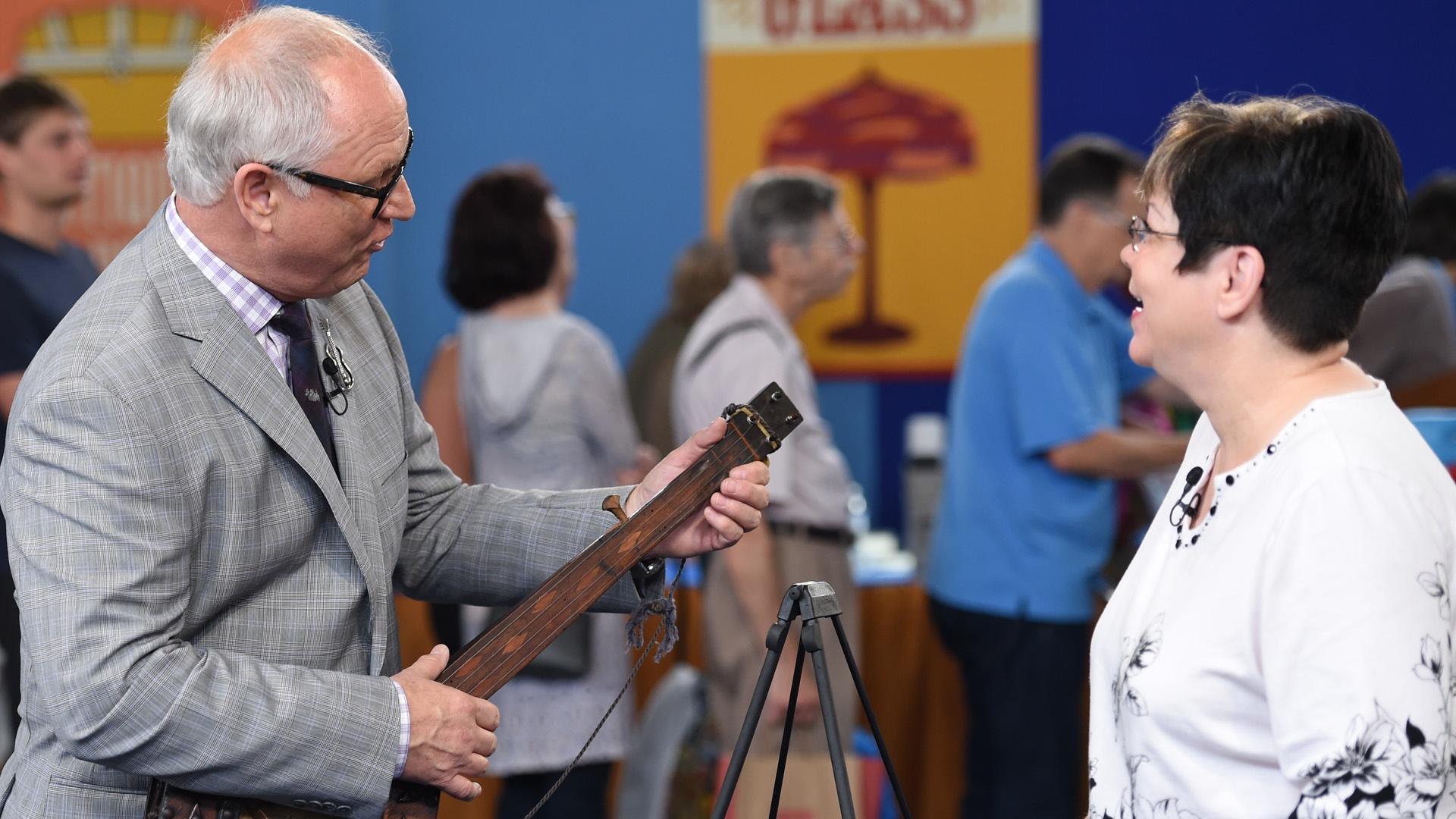
This comes from my in-laws' estate. They were downsizing several years ago and left a lot of things that they didn't want anymore. And it appealed to me, just appealed to my heart. I just really liked it. So I don't know much about it other than it just appeals to me. Well, it is beautiful, and it is a really great example of this artist's work, so it immediately caught my eye, too. This is a piece by an artist, Gene Kloss. Gene Kloss is a woman. Why the changing of the name to a man's name? Well, she was a sort of bohemian artist. I think she wanted to not be judged as a woman. That might have been part of it. As an artist working in the '20s, she moved to New Mexico from Oakland, California. She was born in 1904 and established herself as an artist as a young woman. She was a trail-blazer. She had a career as a painter and moved to New Mexico to Taos in the '20s, and she is known for doing things just like this. This is a wonderful example of her work. And what we're looking at is an etching, an aquatint, by the artist. It's atmospheric, it has these wonderful chiaroscuro dark shadows, and that's the result of her printmaking technique. Etched lines are the lines that define the pueblo outline, and the aquatint is this beautiful gradations of this dark umber, but it really gives it the look and the feel... The feel, right, uh-huh. Exactly. She signed here, low right, "Gene Kloss," so typical signature. And here on the left, you can see the title, "Indian Pueblo." Indian pueblo, of course, is what we see here, and it's set in the mountains of New Mexico. This is from the early '30s. She had a long career. She worked... And worked her whole life? Yeah, '50s, '60s, '70s. She's really one of the best-known New Mexican artists. Oh. Really captured the feel and the richness of the mountain landscape. I don't know if you've been to New Mexico. Well, my in-laws went to the University of New Mexico, so I don't know if that plays into it, but it may be what drew them to this. But I have been to New Mexico, but briefly. Well, likely they picked it up at a gallery in New Mexico at the time, because she had a very successful career and her work is very sought after. So this is a quintessential Gene Kloss print of New Mexico that is very scarce. This has only come to auction once before. So at auction, you could see prices estimated at $4,000 to $6,000. Oh, gosh! Well, I feel good that I appreciated it, and apparently I'm not the only one. This was home-made by a great-uncle of mine back around in the early 1900s, from 23 different pieces of wood, with a legend. He gave it to my grandfather in 1920, and my grandfather played it for years. He played by ear, but he could play any instrument, and he loved playing this old banjo. So do you actually remember him playing it? I do, yeah. And what kind of... Were they playing old-time? They played a lot of bluegrass, and he loved Christian music. It's kinda like the old Southern Baptist type music. The main woods I see are pine in the body, I see walnut in the neck, I see cherry with those diamonds in the neck. Mm-hmm. Somebody made this and gave it to your grandfather? Uh-huh, yeah, his uncle, my great-uncle, gave it to him. And your great-uncle made it earlier than that? Yeah. Oh, okay. Was this made by your relatives in West Virginia? No, they actually lived in Kentucky at that time. The thing that I want to talk about is how people like your great-uncle did things like this, and they would take what was really designed to be a utilitarian object, and then they'd turn it into a piece of folk art, a thing of beauty that 100 years later, a guy like me gets excited because it's got the inlay, it's got all these little diamonds tacked on it. He didn't just do it on the front. He did it on the back, too. Yeah. Put the little heart cut-outs in the back. Mm-hmm. And it probably gave it a little bit of a more sort of resonator sound. So is this your grandfather's information there? Yeah, that's my grandfather. Well, and you can tell it's all done with things that your great-uncle would have had around there, like these big tacks, like you see... big tacks like that on upholstery. And then everything else was carved by hand. This is a wonderful thing, and it doesn't matter really if it's playable or not. To me, it's like eye candy. Yeah. You know, whenever I see things like this, great folk art or anything, like a painting or whatever, when you look at it, it draws you in from across the room. Yeah. And that's what this does. Now, where do you have it in your house? I actually have it in a... kind of nestled in a basket, where it won't have anything rubbing on it and stuff. But you've got it out where you can see it? Yeah. Your grandfather put "1920" on the back of it, so it could be as early as the late 1800s, maybe 1900s. Mm-hmm. Which is really good. I think a value for this retail would be $3,000 or $4,000. Oh, now that's great. Probably gonna stay in the family, isn't it? Oh, yes, sir. Yes. My mother would kill me otherwise. (laughing) (playing banjo) To me, it's his love, so I want it to be seen. Well, my father was the commander with the National Chinese Army. He was the American advisor. And he was the commander of the off-shore islands of Matsu and Quemoy. They lived in Gaochun, my mother and dad did. When he arrived there, he went to an antique store and this plaque was there. Well, two years later, he went back and he brought the plaque and brought it back home with him. And I've inherited it from him. And when did your father purchase this? Probably in the mid-1950s. That period of time, the material was, like... Worthless. I wouldn't be surprised if he paid, like, five bucks for it, seven dollars or something like that. And this was from, like, a very scholarly family, and it's an ink screen. Oh, okay. Like, what you would have is, you would have an ink stone in front of it here, right, and you'd grind the ink, and this was to prevent the ink from spattering on the wall behind you. Well, that's interesting. Yeah, and the material is a type of slate that's called Tuan stone. And the Chinese particularly like it because they make ink stones out of it, but also that texture and the different colors that are there, that green and that purple. But the thing is handsomely carved, beautiful quality carving. This material's really soft. So this could actually be just a steel chisel and a wooden mallet. And that would all work. Yeah. This one is probably between, like, 1760 and probably no later than about 1820. Oh, okay. This is something that's Chinese for Chinese taste. This was never intended for export. When he purchased the thing, it was absolutely valueless. Now the Chinese market is hot as a pistol. Very, very strong market. And I would say at auction, I would expect this to result between $5,000 to $7,000. Oh, my goodness. That's... That's very nice to know. Thank you.
WALBERG
Glass manufacturing was once a big industry in West Virginia. The Mountain State is one of six in the Ohio River Valley where, at one time, hundreds of glass houses like this one made everything from utilitarian wares to fine art glass. The Huntington Museum of Art has a large collection of Ohio Valley glass, and Roadshow's Kathy Bailey was thrilled to show us some lovely art glass examples. Kathy, you've chosen two beautiful pieces to discuss today, and they're very similar if not identical in shape, and so I'm gonna assume they're from the same company? Yes, they are, Mark. They were made in Wheeling, West Virginia, by Hobbs-Brockunier and Company. It's a 19th-century fine art glass company. Also, they did a lot of pattern glass. How did this shape come to be?
BAILEY
This shape came from the sale of a Chinese porcelain vase in the Mary Morgan estate. It sold in 1886. When it came up for auction, it went for $18,000, which was shocking at the time. That caused an international stir, and Hobbs at Hobbs-Brockunier Company, they decided that they wanted to put one on the market as fast as possible.
WALBERG
The shape of this vase replicates the shape of that Chinese porcelain vase, but the color is different. Yes, this was called peach blow. Originally, it was called coral. They changed the name to peachblow, and today it's referred to as Wheeling peachblow glass. First of all, it would always be lined in a white lining. It's a two-layer glass. And then the deep mahogany to red, blending gently into the yellow gold base with the griffin pressed glass stand. And this is the peachblow version of this. Yes. But now we have this beautiful pink one here. Tell me about this. Well, this one is the Neapolitan line. It is a pink that is over ruby and over white. Now, you notice that it is exactly the same shape and size as the Wheeling peachblow, and that's where the rarity is between the two pieces. The experts believe that this is one-of-a-kind, this piece at Huntington Museum. They're in the search for more, but this is the only one so far. When was this one made? This one was made in 1887 for one year, just one year after this came on the market. I see, so we know that there are others of these that exist. Yes, there are. But we don't know of any of these that exist. We do not. Well, let's assume for a moment that one has survived and it's out there somewhere on somebody's shelf, quietly sitting, waiting to be discovered. Let's hope so. So how do we compare the values of these two pieces? Well, this particular piece, in a fine antique show, would sell for in the $2,000 to $2,400 range, dependent totally on color. Color will dictate whether this is a higher price or a lower price. So there are different color combinations made in those years. Yes. And is this the most desirable color combination? This is the most desirable, where it blends and it blends and it blends. It's beautiful. Now, this one, on the other hand, because there are no records, if one were to turn up, it would have to be tested in an auction market. And it would be $6,000 to $8,000 as an estimate. I could see why you chose these two vases to talk about, Kathy, they're just beautiful. Thanks for sharing them. Thank you, my pleasure. I don't really know much about it, just that it's a bronze lion. I think my dad called it a yawning, a yawning lion. So it was something that's been in the family, or...? Yeah, my grandfather purchased it-- according to my mother he purchased it at some gift shop years ago, and then after my grandparents passed away, then my dad ended up with it, and it's always been in our house as long as I can remember, and I always loved it. So, have you seen if it has a signature on it, or...? Well, I saw one of 'em, I didn't know there was two. So, it is... it is signed. It's signed right here, Anna V. Hyatt. That's the one I saw, yeah. And that's for the sculptor Anna Hyatt Huntington. Uh-huh. So, American sculptor, born in 1876 and died in 1973, so quite a long life. Yeah. The other mark... I'll show you here. Is actually for the Gorham Foundry in Providence, Rhode Island, so they would have been the company that cast the bronze. Okay. It's number 39, this is the 39th one to be cast. So this is actually not a lion, but a tiger. Oh, a tiger, okay. A tiger, so its title is "Yawning Tiger." Okay. And Anna Hyatt Huntington was very interesting, one of the most prominent woman sculptors of her generation, working in America. And really interested in animals, and spent a lot of time in parks and at zoos, observing animals and getting them their activity, and what's, you know, amazing about this is there's so much life and energy in the way it's been sculpted. You can really see that it's, you know, stretching from sort of tip to tail here. It was an early casting, probably cast in the 19-teens. And for viewers of Antiques Roadshow this is actually a familiar subject, because this same subject was filmed about eight years ago. Really? What's different is that that was a smaller version. This is larger. At the time, it was estimated at between $8,000 and $12,000. Really. The market for the one that was filmed has probably dropped a little bit. They've been selling more in the $5,000 to $7,000 range. Oh, okay. This size was cast... the records indicate that there were about 118 cast, the smaller version there were about 350 that were made in that size. So, in this case, size matters. I guess! So fewer, and I would estimate for auction in today's market this to bring between $25,000 and $35,000. Really? Oh, my gosh. Yeah. So, this is a fabulous, fabulous bronze statue. I would never have dreamed. And to play with. Oh, my gosh, that's exciting. I brought my great-grandfather's Civil War uniform. These are articles related to his service. And who did he serve with? He was with the 5th New York, which is also known as Duryee's Zouaves. In April 1861, a wealthy Manhattan lumber merchant, Abram Duryee, formed the regiment of Zouaves. Zouave regiments patterned their uniforms after the French Zouaves. And we notice it has a real flair to it. A fez... the small, short coat. How long did he serve? He served for two years, it was a two-year regiment. He mustered in spring of '61 and mustered out after Chancellorsville in '63. Well, during the war, most of the regiments had standard uniforms. These guys considered themselves elite. And they liked having something that was different than everybody else, which is why they wore this style of uniform. Did he serve again? Yes, he reenlisted in 1865 and served until '68, was discharged from Fort Laramie in Wyoming. And was he in regular Army then? Yeah, he was in the 4th Regulars. Okay. And that's probably why we have this coat today. When he mustered out, we notice he has the chevrons on the sleeves. What rank's that? He's a corporal. There you go. So we know he would have put this coat in the closet. When he enlisted in '64, being regular Army, he would have had a regular Army uniform. Right. Saved this one. It's one of the few that survive. It's one of the tougher coats to find in collecting. And it's pretty. It's one of those, when you look at it, you're like, that's real. We've got his coat, his fez, and we have a few other things. We have his discharge paper. These are reproductions of his service records. After the war, these guys were really proud of their service. They had veterans' organizations where they would have reunions. He was a member of the G.A.R., the Grand Army of the Republic, and this is his membership medal. It has the membership medal on a lapel pin. You could order these badges, they call them ladder badges, and you can order them in the back of the veterans' magazines. And the more you wanted to pay, the more rungs they put on your ladder. It's pretty, and being that regiment makes a lot of difference. Because it is one of the most famous of all New York regiments. As a group, it's something that, if it were my family, I would want to insure the group for about $16,000. Yeah, I thought it would be worth quite a bit. (chuckles) The coat and hat are about $15,000, and then we have about $1,000 worth of other pieces to go with it.
WOMAN
We lived in a small village in Ilo, Peru, and sometimes some of the Peruvians would bring things to see if we'd like them.
APPRAISER
Okay. And I purchased this. What did you pay for it? Probably about 20 soles, which is about ten dollars. And what year was that? It was 1989 or 1990. 1989, 1990. And, where is Ilo in Peru? It's on the coast, it's about 25 miles from Chile. So way in the south. Yes. I know that you watch this show. Yes. And I know that you know that I do a lot of fakes. Yes. And so, the good news is, it's not a fake. Oh, great. So that's great. That's great. So we're off to a good start. That's good. I want you to note here the elaborate headdress on this figure, and the nose ring, the very elaborate costume, and this sort of golden staff. This upper part is gold. What this is down here is a copper alloy. In my judgment, this dates between 300 to 900 A.D. Stylistically, this is something that we would expect more typically central to northern Peru. And an object like this, and I think this is a tool, but for an individual to own this, and have this sort of design on it, this sort of a figure, he would have to be extremely important, 'cause this represents a ruler or a deity. You can see that the costume, we've got another, sort of similar shape to the nose ring on the back. All of this indicates royalty. This is something that would set this off as a very important object. Now, having said that, it's a small figure, it's a tool, it's about as esoteric as you can get. And I can say on the Roadshow I've never seen one like it. Oh. So, when we consider what sort of values to put on it, we have to think about the marketplace-- certainly at a major auction house, which is where you'd have the sophisticated buyers to purchase something like this, and I'm gonna give you two prices. I'm gonna try to be conservative and say, at a good auction, $3,000 to $5,000. (chuckling): Wow. However, at one of these auctions, if you had a couple of bidders that were really excited, I wouldn't have any problems seeing $5,000 to $7,000. Oh, my goodness, that's amazing. This is the original stainless steel scale model of the jail cells of Alcatraz. It is a working model. It was made by the Stewart Iron Works Company in 1932, and they were eventually awarded the contract for Alcatraz and built all the jail cells there. This is an example of some of the bar stock that was used to build the actual bars at Alcatraz. This is actually what these would have been made out of. These are the verticals, yes... And they were made so you couldn't saw through them, but eventually, they actually did get sawed through. Well, that's fantastic. These, you brought along. These are actually the master keys to Alcatraz. We have about 20 of them. I brought in a sample of them today. I know that the one here opens up the mess room hall, and the other one opens up a typical jail cell door. When Alcatraz was closed, you came and you...? Actually, the company kept a master key of every jail cell that they made. Oh, so they could make copies. Mm-hmm, and they had a secret registry that they kept with the Department of Justice. Well, this is fantastic, I love this. Well, it's a model, but it's also what we'd also call a salesman sample, because it would be used when you wanted to demonstrate it for other jail, penitentiary places than Alcatraz. And the thing that I love about salesman samples is they are highly detailed because they really want to show exactly how this works. I mean, the other thing that's great about a salesman sample is when actually see the name of the maker on the object, which is this wonderful plate here. The whole thing with a jail cell door is that you can open one or a whole bank of doors, or just one individual. And there's a complex mechanism in here that... let's see, you've got the doors closed... And there we open the center door and these stay closed. With different adjustments in here, you can open the whole bank to let everybody go to the mess hall, when they opened it up. Whatever the warden wanted. It's just fantastic. We're gonna close up the... I know you've brought some other material here. I think it's neat that you also brought a photograph of Alcatraz, I guess the same period when this was put in, which was the mid-'30s. Yes. How did you come by all this? Because I'm head of design for the company, I've become really obsessed with the 150-year history of it. And I collect all things Stewart Iron Works. I collect furniture, I collect light fixtures, gates, fence, ornamental iron. When they stopped owning the company, the Stewart family themselves still had individual items, and Sherry is a very good friend of mine, and she gifted me this piece. Well, I think at auction I would fully expect it to bring, minimum, $15,000. Oh, wow! It's really terrific. It's got all... everything going for it. I think it's a mousetrap. You put a piece of cheese in it, and the mouse gets in, and don't get out. Well, either the mouse would have to be really large or one of the dimmer mice out there, but it could be. It's a piece of Weller pottery, and it says on the bottom, "Weller, Eocean Rose," those are all indicators of where it was made, when it made, and what it was intended to be. So, Weller Pottery in Zanesville, Ohio, would have been made around 1905 to 1910. Eocean means it's a hand-painted line, so rather than the later production ware, where the design was embossed in mold, these mice were actually painted on the surface of the pot. On the side is the signature of Claude Leffler, who was one of their best painters. Because of the chip on this piece and the little bit of damage, the value is somewhere between $500 and $750. It's not great value, but it's a really great little piece. It's a statement of a time and a place, and what Claude Leffler, the Zanesville artist, chose to paint on that day. Wow. Thank you.
WOMAN
This was my mother's violin, and she started playing violin when she was 18 months old. This is in 1917. Her father was a violin instructor in Canton, Ohio. And this is her first violin, which is a one-16th size violin. This is really unusual in that it's a small violin. It's made with spruce for the belly, and then maple for the back sides, neck, and the scroll. That's absolutely traditional, and it's made with a high quality of craftsmanship. It was carved beautifully. The other thing is the quality of the varnish. It's very typical of the French period, about 1860-1870, so this violin had some age when your grandfather found it for your mother. You can tell that it's been very well respected over the years. It's in amazingly good condition. Because it's so old and so rare, it's gonna have some value in the marketplace. Since the 1970s, there's been lots and lots of making of small instruments for children because of the Suzuki method of training. So for this period, to find something like this is quite unusual. In a retail setting, I would say that this violin has a value of $1,500 to $2,000. That is wonderful, but you know, it'll stay in the family. I paid five dollars for the bracelet at a flea market in Virginia. I thought the design was very, very unusual. I think the bracelet's very beautiful. I was just wondering if it was very valuable or whether it was only worth five dollars. When did you buy this piece? I bought that about a year ago. I had this bracelet looked at by a jewelry shop where they buy gold. If it was gold, I thought about selling it. They made me an offer and then they retracted it. They made me something like a $625 offer and then they retracted the offer because they weren't really sure if it was solid 14-karat gold or not. They tested it with 14-karat and 18-karat acid, but they still didn't seem to be real sure about it. Okay, well... It's beautiful, and that's a definite fact, and it's gold and that's another definite fact. We can see that they did test it. There's a file mark on the back of the bracelet. Unfortunately, they filed it where they shouldn't have. Yes. It could be restored to some degree. It will never be exactly perfect, but luckily they did it on the inside of the bracelet. Moving forward, if you take a piece to get tested for gold value, at a scrapper, it might be a good idea to have them test it on the tongue where it goes into the box clasp. Okay. Rather than on the body of the bracelet. When they cut through the exterior of the bracelet, because it's a bloom gold bracelet, they hit 14-karat gold. We tested it before. The piece seems to come up at around 15 karat. It's a bloomed finish, so it's a higher, brighter yellow on the outside. Oh, I had never heard of a bloomed finish. Okay. If you take a look at it, into the little cut area, you'll see that the gold underneath the surface is pinker than the gold on the exterior. The piece has been cleaned and it has been soaked in acids before the coral was put on and before this bright piece was applied, and that raises the surface assay right at the very surface, to an 18 karat or a higher... Oh, interesting. Higher finish. They offered you how much for it? Around $620-something. Okay. It was about six weeks ago. That's a reasonable offer when they have to pay their overhead. The bracelet weighs about an ounce and a quarter. I calculated that the scrap value here is around $1,000, but it's more than scrap. It is in fact a bracelet from the 1870s, or give or take. It's done in the archaeological revival style. I'm not really sure where this piece was made. It doesn't have any hallmarks on it. But it appears to be made by somebody who took their tutoring in England, or somebody who worked in England. The gems on it are coral buttons. That's natural coral? I thought they seemed a little hard for coral, so I'm interested... that's interesting that they are coral. No, they're natural coral, that's for sure. And if we take a look at it, the filigree work goes all the way around the bracelet. So the filigree work is concentric, which is an upgrade. Not all bracelets have work that goes all the way around the back. It's probably one of a pair originally. Oh, really? Interesting. They're pairs, they're worn as cuff bracelets, shirt cuffs, so they're worn on each wrist. I'm glad you didn't sell it for scrap. Okay, thank you. In an antique shop, I feel this piece of jewelry would sell for around $2,500. Very good. That's wonderful.
MAN
This was my grandmother's. I didn't notice it until the last day of her estate sale.
APPRAISER
Okay. Probably, however many people came to the estate sale, plus all the family, had their chance to collect this. At the last day of the estate sale, it was in the spare bedroom, and we were just packing up and all that, and my uncle said to me, "Why don't you take this?" Yeah. And it was the first I had noticed it. I'm glad that you brought the painting, because it's a pretty neat piece of artwork. It's illustrator art. Now, not only do you have this painting, but you have the actual magazine that it was used to illustrate. Battle Birds. Now, you said that you were able to find this copy of the magazine online. Can I ask what you paid for it? I believe $35. I think $35 was a fair price. We should say that the artist was a man named Frederick Blakeslee. He was born in 1898, he died, I believe, in 1973, and he was a very prolific artist. He was mainly working in what they call pulp aviation. He did images like this. Many of the images he did in the 1930s were biplanes from World War I. So, this was well into World War II. Artwork like this, because it was sent into a publisher, is rarely signed. But we're lucky in this instance, because we know the artist, and we also know the exact issue. It's a really dramatic photo, but the thing about illustrator artists is, they had to achieve a balance. Not only did they need to encapsulate a lot of action and a lot of activity, but they also had to do it in such a way so that text could be overlaid. Now, if you look at the difference between the painting here and then where they placed the text, up here in the sky and down here in the background, those negative spaces were left on purpose. Ah, I see. An editor would have said, "Okay, we're gonna put text here, we're gonna put a headline here," so that's what he was trying to achieve. Now, it's pretty dirty. Right. The painting would benefit from a light cleaning. I think that you would get a lot more color out of it, a lot more detail. It is really a wonderfully dramatic image. The market for this has changed dramatically just in the last decade or so. There have been several major collections that have come out, and so it's raised everyone's recognition of the value of illustrator art. There was a time when these paintings, after they were sent in to the magazines, were photographed and then thrown away. Right. This is a wonderful survivor. Even though it needs cleaning, even though it needs to be restored, I think in an auction, in a well-advertised sale, you'd be looking at a value on the painting of between $4,000 and $5,000. Wow, okay. That's a little bit more than I expected. It's a wonderfully dramatic painting. It's a great example of pulp aviation art. I'm so glad you brought it to Roadshow today. I... This made my Roadshow. (laughs) It is a journal of my great-uncle going from Boston to San Francisco on a ship, leaving in February of 1849 for the Gold Rush. They formed a mining company, leased the boat, and got on board and went around Cape Horn. That's amazing. This is his daily log of what happened and what his thoughts were and everything that went on in a six-month-- actually, seven month-- journey. They got there in October of 1849. To San Francisco. To San Francisco. And tell me some of what they encountered along the way. Well, it took them almost a week to leave Boston because of snow and ice. Everybody was sick on board. They couldn't get out of the harbor because the weather was so bad. Then the ship ran into foul wind, they couldn't go down towards Cape Horn easily, so they ended up going all the way out to the Azores to Pico Island. He talks about meeting people speaking Portuguese, and then resupplying the ship, and how the company back in Boston was concerned about how much food they were going through on the trip, because the trip was taking too long. And then they proceeded from the Azores back down to Cape Horn and continued on. When they got down towards Cape Horn, one of the members of the company died, and they had a burial at sea. Wow. And he says that he died well-- or easily, I guess he said-- and so they did the burial at sea, the captain said a prayer, and off he went. And they were talking about how they were gonna divvy up his clothes, and whether they were gonna sell them when they get to San Francisco and it was like, okay. The realities... The reality of sailing in 1849, going the long way around. This is basically an 1849 overland diary, but by sea, so it's called a ship's log. And in it, we begin with here, we've got a complete roster, a header, where they sail from Boston around Cape Horn, to the Cape Horn, and on into San Francisco in 1849. And then a complete roster of all of the personnel on the long voyage. And then, to the right, we have... we just opened it to a random page here of the actual diary itself. And it details in amazing and marvelous detail all the encounters that happened to them on every end of the ship. And as you said, they arrived more or less safely in San Francisco, after a seven-month voyage. Yeah, it's just incredible, and that, to me, that's only sort of the start of the story, because when they're on the boat, they're worried about whether there's going to be any gold left by the time they get there, and he basically finished saying, you know, "I'm giving this to someone who's going back," and sending it to his wife to let her know that he made it to San Francisco. Mm-hmm. He says, "I'm getting ready to go to the mines now," and that's it. Did they find gold? I don't believe so. That didn't make it down in the family. You know, that's one of those things where I think that would have made it in the family comments, "Oh, yes, your great-uncle struck gold." I would imagine that he was joining the majority of people and didn't. I think you're right. It's absolutely a marvelous, original, authentic piece. I can't tell you how uncommon it is to find genuine 1849 ship's logs. Have you ever had it appraised? No, never. It was sitting in a box, you know, in an envelope. When my parents passed, it ended up in a box in an envelope in my house. Thank goodness it was preserved. It was only luck, really. Sure. I believe at retail, this item would bring between $40,000 to $50,000. Wow. (chuckling): I had no idea.
LBERG
And now, it's time for the Roadshow Feedback Booth. I'm here with a Leica camera that my great-uncle bought after World War II. Smile, you're on the Roadshow. We came in today with $200 of his junk, and we're leaving with over $2,000 worth of my antiques. (chuckles) Our wildlife print is worth $2,000 to $3,000. And unfortunately, my aging lawn chair didn't make it through the Feedback Booth. So we get to throw it away, yes! And my World War II stopwatch was worth about $150! And my chamber pot isn't worth poop. And the appraiser said my Pendleton blanket was worth $300 to $400. But she said get it out and use it, so I'm gonna use it. We didn't strike it rich. Our items were a bust. But we're stopping at the casino on the way home. So, I brought a pipe that supposedly was from Napoleon Bonaparte, but I've learned now never to trust my family. And we brought our Spanish Colonial stirrups with silver inlay. We only paid $70 for them and they were appraised at $350. Yeehoo! (both chuckle) I'm Mark Walberg. Thanks for watching. See you next time on Antiques Roadshow. Hi, you guys, hello, how you doing? Good. What you got there? Captioned by Media Access Group at WGBH access.wgbh.org
Search Episodes

Donate to sign up. Activate and sign in to Passport. It's that easy to help PBS Wisconsin serve your community through media that educates, inspires, and entertains.
Make your membership gift today
Only for new users: Activate Passport using your code or email address
Already a member?
Look up my account
Need some help? Go to FAQ or visit PBS Passport Help
Need help accessing PBS Wisconsin anywhere?

Online Access | Platform & Device Access | Cable or Satellite Access | Over-The-Air Access
Visit Access Guide
Need help accessing PBS Wisconsin anywhere?
Visit Our
Live TV Access Guide
Online AccessPlatform & Device Access
Cable or Satellite Access
Over-The-Air Access
Visit Access Guide




Follow Us