If you’re not excited to learn about climate solutions happening in Wisconsin, you will be after a conversation with Ami Eckard-Lee.
The host of PBS Wisconsin Education’s new science series, Field Notes on Climate, Eckard-Lee is also an airplane pilot and creative director at Kelch Aviation Museum in Brodhead, Wisconsin. Her enthusiasm for inquiry and storytelling stems from a unique background in history, performing arts and a childhood spent exploring the environment and sustainable living with her family.
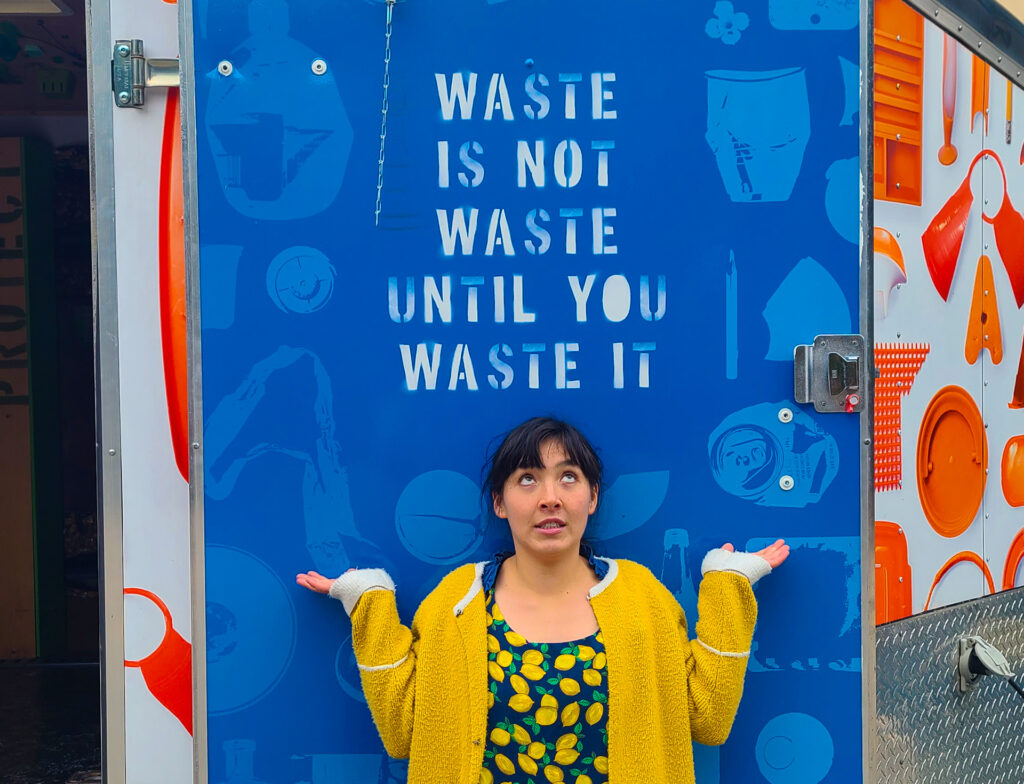
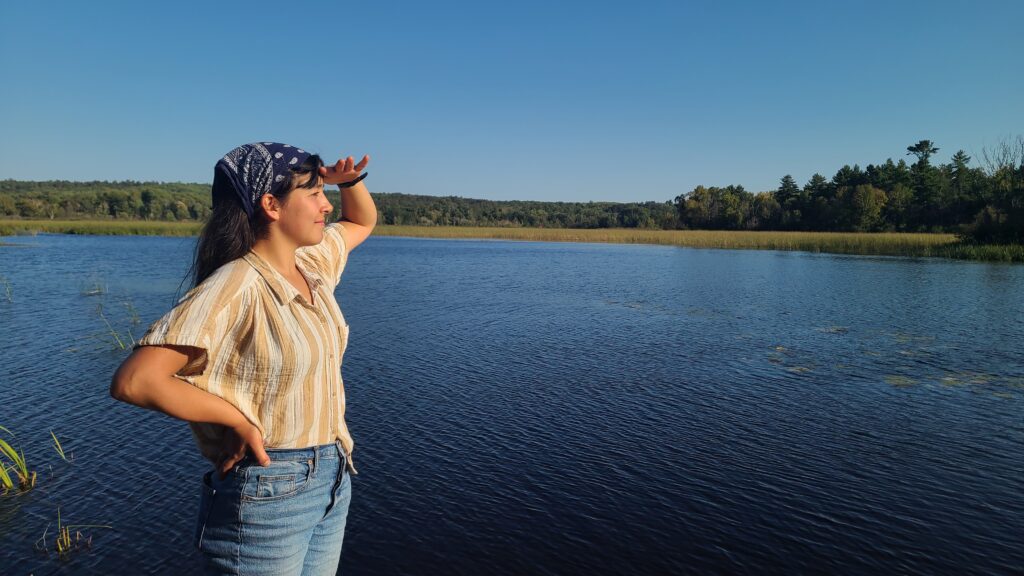
Eckard-Lee while filming on location in Madison, Wisconsin.
With a knack for embracing curiosity and connecting knowledge to real life, Eckard-Lee brings levity and humanity to the climate conversation as she meets researchers and changemakers around Wisconsin and shares what we can learn from them. While she’s a perfect fit for Field Notes on Climate, her work with PBS Wisconsin was initially sparked through her role as a historian.
‘Wow, he is never going to want to see me again.’
When Eckard-Lee learned about a possible opportunity for Kelch Aviation Museum to contribute to PBS Wisconsin Education’s history series The Look Back, “I got very excited because I thought that we could be part of it. So I reached out,” she said.
Education producer David Boffa visited the museum to learn more and see if there was a story that could fit the series. “He told me later that he thought that it might be lame,” Eckard-Lee laughed, “but he was very impressed.” It sparked an episode on airway beacons and early flight navigation.
She was thrilled with the collaboration and assumed that would be the end of it. But the production team at PBS Wisconsin Education had also viewed YouTube videos Eckard-Lee had created for the aviation museum during the pandemic. They were impressed with her communication style and ability to talk straight to the camera.
“They were talking about maybe changing some of the format for Wisconsin Biographies,” a popular series spotlighting influential historical figures, “and having a person do some of the narration so there would be less animation to create” she said. “And so they had me go into the studio for one day and record.”
“I am very weird and silly, as you may have discovered … And the thing about that is, I make those [YouTube] videos a lot and there’s just a camera and me, so I can be as weird as I want. And then I know I’m going to edit it. So there’s no inhibition, right?”
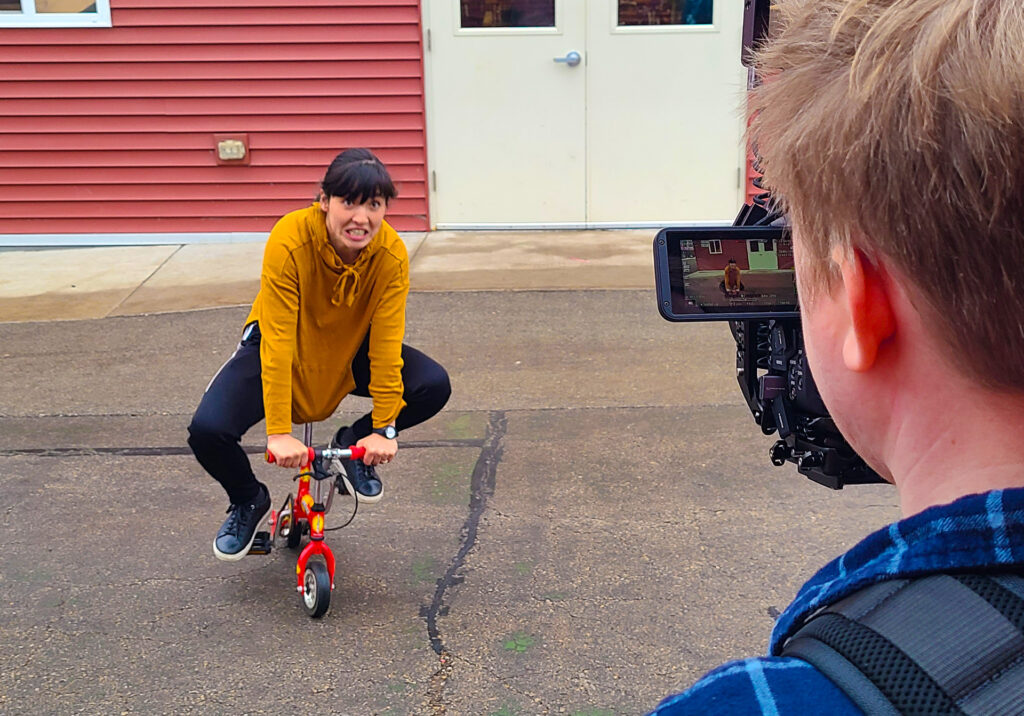
Eckard-Lee put her clown school skills to the test while filming at a small bike repair shop.
Recording with executive producer Ryan Hendricks felt like a different ballgame. “I was like, well, I should really make a good impression. And I remember I was hopping around, making weird noises because I had to get warmed up, and I was like — wow, he is never going to want to see me again!”
While the team decided not to add a host to the Wisconsin Biographies series, a few months later Hendricks emailed Eckard-Lee to see if she was interested in hosting Field Notes on Climate.
From straw clay house to series host
What PBS Wisconsin Education didn’t know at the time was that Eckard-Lee has a lifetime of connections to climate solutions and environmental education.
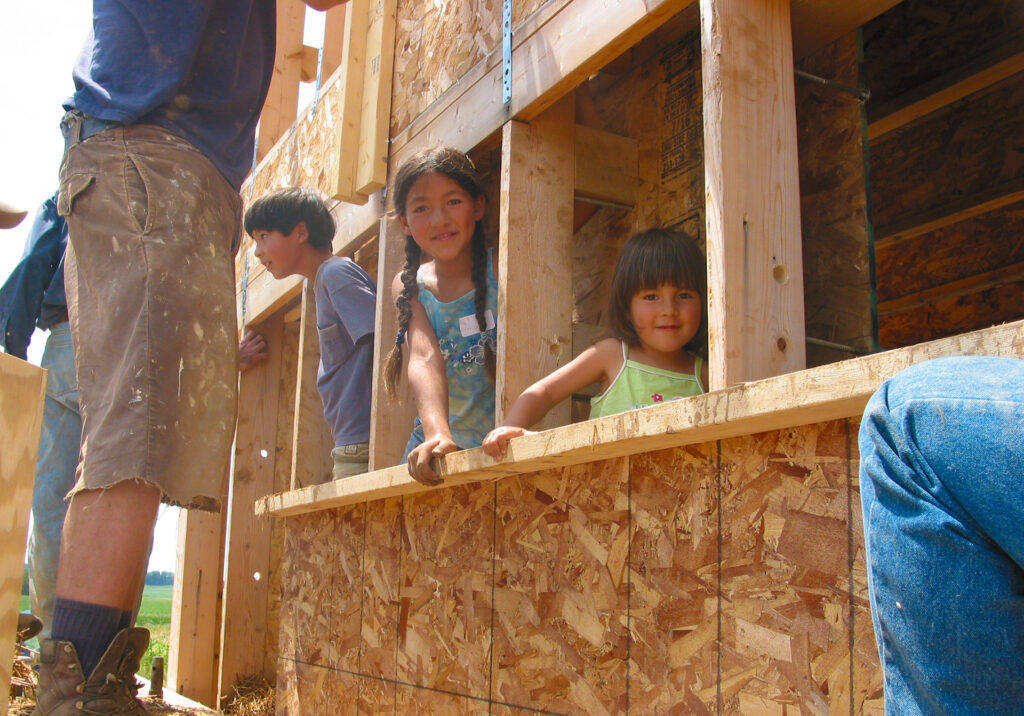
“I grew up in a very eco-friendly family,” she said. “My parents built the biggest straw clay home in the Midwest, or possibly in the United States, when I was between the ages of eight and 11. We were featured in all these eco-friendly home magazines, and we did all these workshops for eco-friendly construction. My family did a lot of the construction ourselves.”
Eckard-Lee (center) and her siblings helped with the construction of the family’s straw clay home in the mid-2000s.
“My parents both really care about the environment. My dad’s a doctor, and my mom homeschooled five kids. But she also runs an organic farm. So we’ve been involved with organic farming since as long as I can remember.”
With space on their 40-acre lot, Dr. Jonas Lee and Heather Eckard-Lee also nurtured their children’s love of horses. Eckard-Lee raised and trained her pony, Spec, who still lives on the family farm.
The family implemented other sustainable practices on their property, like planting trees and cover crops. When Eckard-Lee has an opportunity to fly over her family’s property, “you can see the difference in the color of the earth, especially at certain times of year.” It’s greener and looks healthier than the land surrounding it. Naturally, her family is thrilled about her role as the Field Notes on Climate host.
Perfection isn’t the point
Even with an environmentally conscious upbringing, Eckard-Lee said she’s not a perfect example of sustainable living. “The least environmentally friendly thing about me is that I fly airplanes, which waste gasoline.”
But perfection isn’t the point of being the host.
“I care deeply about climate change, our environment, the earth and the wellbeing of our communities, but I’m not a scientist or politician or activist. I haven’t devoted my career to climate change, and I sometimes feel I’m not contributing enough. My teenage and young adult years were full of artistic endeavors – just being me and doing the things that I was passionate about. I always wanted to help the environment, and though I drive an electric car, try to compost, donate to climate funds and other things, I always felt I could – and should – do more. I don’t have natural skills in sciences, and I don’t have a job that prioritizes climate care,” she said.
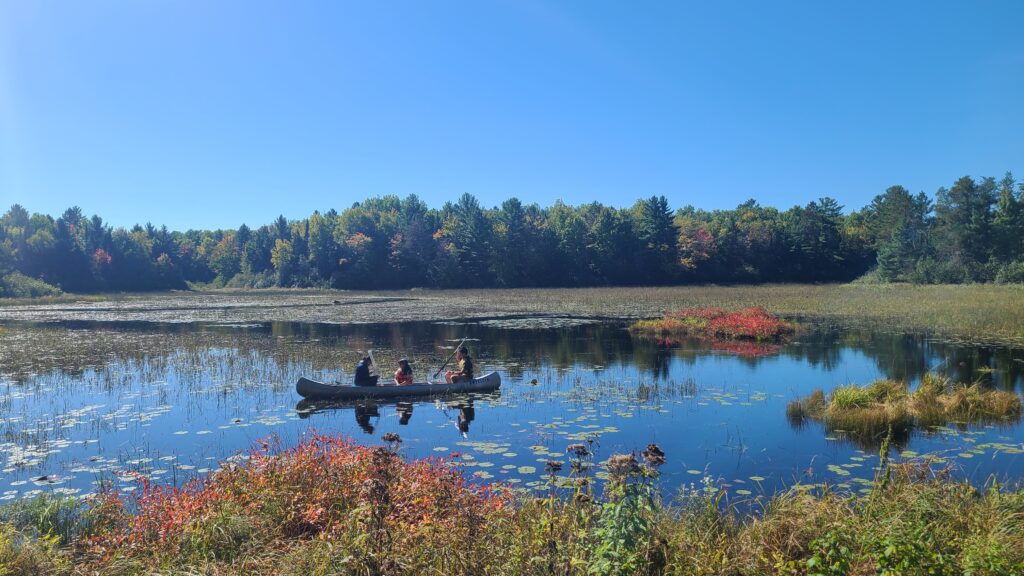
Eckard-Lee (center) with Field Notes on Climate guests Gretchen Gerrish (left) and Ray Allen (right) at Trout Lake Station in Boulder Junction, Wisconsin, operated by the University of Madison-Wisconsin Center for Limnology.
But with Field Notes on Climate, she gets to use her skills as a performer and communicator to help make climate science and solutions more accessible.
“I really hope above all [people] feel that I’m speaking to them as an equal and as a person. I don’t know about these topics either.”
Her style and the show’s format continue the legacy of public media teachers like Mister Rogers and LeVar Burton, who invited viewers to wonder and learn with them.
You’re the sequel
For Eckard-Lee, the series is a success if viewers come away with a new sense of curiosity about the world around them. “I would love to come into a room of people who had just watched an episode and hear them asking questions about anything. Even just ‘Why?’ over and over again.”
“I hope [the series] can inspire or reassure others with the realization that everyone can help with climate change by doing what they love or are already good at.”
Ami Eckard-Lee
Being part of the show has Eckard-Lee asking questions and examining what sustainability looks like in her own life. One example? Microplastics. “People talk about microplastics all the time, like don’t put your plastics in the dishwasher.” She spoke with a scientist for the series and learned, “the biggest cause of microplastics in the water is washing clothes.”
“As soon as I heard that, I was like, of course! It’s agitated in hot water. These are fibers. And they have to be fine. And then they disintegrate a little. So I stopped thinking about leaving the plastics out of the dishwasher as much and started thinking, ‘What actually does sustainable mean?’ I think the show provides a little bit more of those small, tangible things that do make more of a difference.”
But the scope of solutions go beyond individual actions, from smaller youth-led community programs to large-scale projects like collecting methane from landfills to produce energy. It speaks to the far-reaching impacts of climate change and the myriad ways people can contribute their time, talents and resources to solutions.
“I hope [the series] can inspire or reassure others with the realization that everyone can help with climate change by doing what they love or are already good at,” Eckard-Lee said. “The episode is the start, and then you’re the sequel.”
Field Notes on Climate premieres on Earth Day, Monday, April 22, on pbswisconsineducation.org and on PBS Wisconsin at 8 p.m. Monday, April 13.
Each episode is paired with an educator guide for grades 6-12. To stay up to date on the latest content from PBS Wisconsin Education, sign up for their newsletter.


 Passport









What do you think?
I would love to get your thoughts, suggestions, and questions in the comments below. Thanks for sharing!
Tawny Morrison