





PBS Wisconsin Passport
Watch this video with
PBS Wisconsin Passport
Become a member of PBS Wisconsin, support your local community, and get extended access to PBS shows, films, and specials, like this one.
Giraffes: Africa's Gentle Giants
05/05/17 | 52m 58s | Rating: NR
A population of rare Rothchilds giraffes are endangered due to poaching and oil drilling plans in the African Nation of Uganda. Dr. Julian Fennessy and the Uganda Wildlife Authority work out an ambitious plan to protect the species.


Copy and Paste the Following Code to Embed this Video:
Giraffes: Africa's Gentle Giants
NARRATOR
It's an animal you can't help but look up to. But what do we really know about giraffes? Somehow, these gentle giants have been overlooked. But not by one man. Dr. Julian Fennessy knows giraffes better than anyone. And what Julian has recently discovered is truly alarming.
JULIAN
This silent extinction, I'm absolutely amazed that no one has a clue.
NARRATOR
In an urgent effort to help, Julian will travel across Africa, from Namibia to the dangerous border of Ethiopia and South Sudan, and on into Uganda to launch a daring rescue mission with a determined team.
ADIOKAN
Giraffe is very beautiful. It has to be protected forever.
NARRATOR
Together they're standing tall for a remarkable beast.
JULIAN
Giraffe have gone extinct in at least seven countries in Africa. There's no giraffe going to go extinct on my watch.
NARRATOR
Weighing up to two tons, the giraffe is a colossal animal and unlike any other. But most of all, they are a mystery. For hundreds of years, we have known the lives of many other creatures in great detail, but giraffes have been neglected. Bizarrely, it is only very recently that we have learned almost anything about these giant animals, and the little we have discovered is extraordinary. We've found they don't need to drink in the desert, but can get enough water just from eating leaves. The trees have spikes, poisonous leaves, and have recruited ants to fight the giraffe off. In response, the giraffe's skin is tough. And they can even sniff out the poisonous leaves to pluck the softer, moister ones with their giant black, sunproof tongues. Most importantly, we've found that giraffes are vital pollinators and seed spreaders. Without the giraffe's landscape gardening, Africa would change for the worse. Surprisingly, many of these discoveries have come from an Australian. He fell in love with giraffes and has raised his family here in Africa.
JULIAN
You have to love something so big and weird and sort of, you know, out there. They're so funky-looking. They don't make sense.
NARRATOR
20 years ago, Dr. Julian Fennessy realized how little we knew about giraffes, and he set out to change that. He earned his PhD studying them in this desert in Namibia. His work has deeply changed our understanding of giraffe biology. In this remote valley, he has just found the skeleton of a very old male giraffe.
JULIAN
So you can see this old bull -- he's huge. He probably died of natural causes. There's no claw marks on him like from a lion or anything. Huge ossicones.
NARRATOR
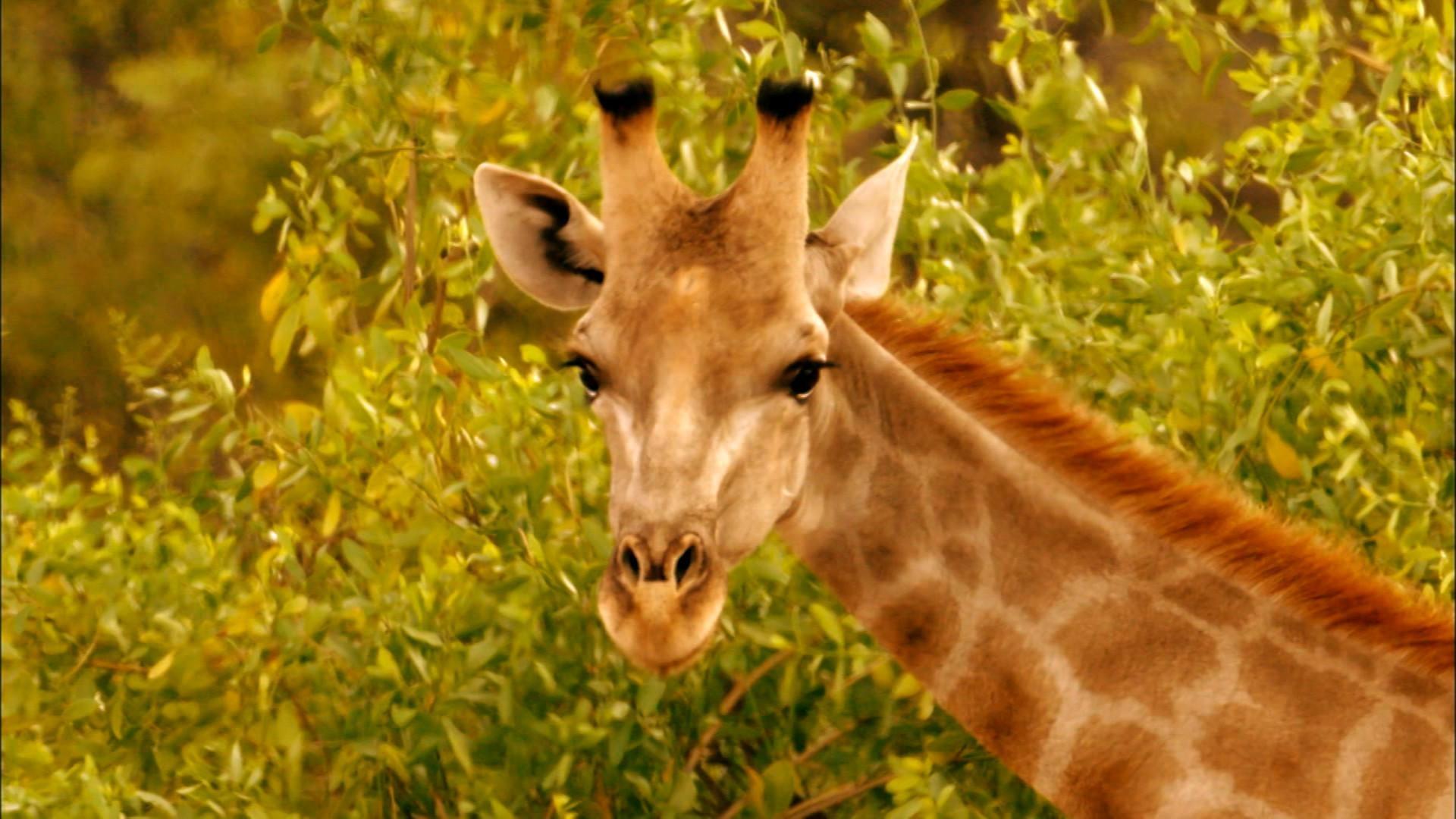
The massive bumps on a giraffe's head aren't horns or antlers. They're different, and they're called ossicones.
JULIAN
They actually are like cartilage, like in your ear, and when they're born, they're flat. And then they fold out, and they become bone and fuse to the skull.
NARRATOR
The male's ossicones are much larger and grow increasingly massive over their lives.
JULIAN
This is a couple of vertebrae here of the giraffe. But there's only seven vertebrae in their neck -- just like all humans and all other mammals. This is the lower leg bone. They kick out at lions and other predators. They just knock 'em for six. They're dead. It's about the same size as my daughter.
NARRATOR
Julian's kids, Molly and Luca, are 7 and 10. And just like their dad, they love giraffes.
LUCA
A giraffe is very tall.
MOLLY
They've got lots of dots.
LUCA
Has long legs and ossicones.
MOLLY
And long arm and a long neck.
LUCA
And a tongue as long as her arm.
NARRATOR
Julian and his wife, Steph, run the Giraffe Conservation Foundation, or GCF, from their home here in Windhoek, the capital of Namibia. It's the first giraffe charity in the world.
STEPH
It's more from Germany --
NARRATOR
From this base, they work with partners across the continent. Giraffes are in trouble, and their mission is to save them. The giraffes found here are called Angolan giraffes. They are one of nine different subspecies of giraffes spread across Africa. It's just two days' drive from Julian's home to a very special place called the Hoanib River. Julian has been studying the giraffes that live here for almost 20 years. This desert is protected. The giraffes here can roam safe from humans. It has given Julian and Steph a vital opportunity to study wild, undisturbed behavior.
JULIAN
We got a couple of females over there. And then we can try and I.D. them.
NARRATOR
They've been recording every detail of the giraffes' lives. Now all their research is finally starting to pay off.
Ooh. -STEPH
Found him. -See the black spot on its neck?
JULIAN
Yeah.
STEPH
Absolutely that one here.
JULIAN
Look at that. So, we saw this giraffe many, many years before you guys were even born. -How cool is that?
MOLLY
Very cool.
NARRATOR
This old bull giraffe was first seen at the very beginning of their studies. Back then, he was already an adult, which means that he's over 20 years old. As of this moment, he's the world's oldest recorded wild giraffe.
JULIAN
We don't know any giraffe that is as old as these in the world. You know, there just hasn't been the studies available to date.
NARRATOR
Until Julian and the GCF's work, many of the really basic facts about giraffes were missing -- how long can they live, how many there are, and even how far do they roam.
JULIAN
We're seeing giraffe move in distances that we never thought. Some of them in Namibia are going more than 1,100 square kilometers. It's absolutely amazing.
NARRATOR
For years, Julian has been working on his own dime with a camera, a car, and a notepad. Now he is turning to technology to push things further.
JULIAN
Wow.
NARRATOR
It's so dark, he can't see his own hand in front of his face, but his new camera can peel back the night.
JULIAN
This is like Christmas all at once. It's absolutely brilliant.
NARRATOR
Julian can now see that giraffes are surprisingly active at night.
JULIAN
I don't know anyone who's observed giraffe at night. And this is the first time it's ever been done. And you know, I know a little bit about giraffe, but I've never seen this.
NARRATOR
Then he sees something he's never seen before, just on the limit of what the camera can distinguish.
JULIAN
There is one sitting down, right in front here. I didn't see that. I thought it was a tree. Wow. This guy just put his neck -- he's just turned it around, and he's resting it on his bum.
NARRATOR
In the middle of the desert, where lions prowl, the giraffe has curled up on the ground and gone to sleep.
JULIAN
In zoos, they study it. And basically, when their neck is down, it's R.E.M. sleep. So maybe these giraffe are dreaming. I've never seen that in the wild.
NARRATOR
If they are dreaming, who knows what wild giraffes dream about. All this is new to Julian.
JULIAN
So, this female has just turned. That one just stuck its neck up straightaway. It sat down. It went down straightaway and stuck its neck back, started to sleep. I think they're talking to each other. There's got to be some communication. It's like they're taking turns to sleep.
NARRATOR
That we don't know for certain if these massive animals can communicate or how they sleep in the wild shows how neglected they've been. So much is new.
Giraffe lowing
NARRATOR
Giraffes were thought to be mute until this year, when these noises were recorded from giraffes in a zoo at night.
Lowing continues
NARRATOR
Discoveries like these, about how giraffes live together, give Julian vital information that may help him save them.
Animal growling
NARRATOR
But Julian's most jaw-dropping giraffe discovery is, alarmingly, the simplest. He's found that in just 20 years, the numbers of giraffes across all of Africa have dropped by almost 40%.
JULIAN
I don't know how else to explain it, but, you know, just everyone thinks they're everywhere and they're lovely and they're beautiful. So, of course, they can't be dwindling. The numbers can't be going. Numbers are plummeting. We have lost many animals before, and I just think it would be a really sad world without giraffe.
NARRATOR
To put this into perspective, it is well known that African elephants are in trouble. Their numbers are falling rapidly. There are just about half a million left. But what no one realized is that there are far fewer giraffes. There are just 90,000. Giraffes have already become extinct in at least seven countries. Easy targets for poachers, they are killed for their meat, and their habitats are being destroyed.
JULIAN
That's frightening. And I think, if we lost them, I don't know where I would be at. I really think I've lost. Me and so many people around us have just not done the job that we set out to do.
NARRATOR
Time is running out, and Julian knows we urgently need to take our understanding of giraffes to a new level. He has a revolutionary theory -- that there's not just one species divided into slightly different subspecies. There are many unique species. At the 11th hour, this most basic fact is really important. If we know how many species there are, we can identify which are in need of urgent help and take action to save those giraffes and their unique genes. Julian knows that only by discovering their genetic identities can he prove how diverse they are, so he has been taking samples of their skin. The DNA inside tiny plugs of hair and skin like this could give him the power to save whole species we didn't know we had. Julian has collected the DNA from almost every wild giraffe population in Africa. Before he can run a species analysis, he needs one final sample from a population called Nubian giraffes. There are perhaps just 650 left in the wild. This group lives far from Namibia, in Ethiopia, right on the war-torn border with South Sudan.
Helicopter blades whirring
NARRATOR
This is one of Africa's most remote national parks -- Gambela. Years ago, flying across Gambela, spotters recorded a wealth of wildlife. But since then, the situation has changed. All Julian has seen so far is fires and cows.
Cow mooing
JULIAN
This place is mad. When the population in Ethiopia is going up by two million a year, there's refugees pouring across the border.
NARRATOR
To get his sample, Julian must find the last surviving giraffes in the park. It takes three days to reach the rest of the international team. They've assembled to find and satellite-tag many different animals in the park. Julian can't follow these giraffes on the ground, but he can from space. He's brought four giraffe GPS collars designed to fit perfectly around their ossicones. We want to be able to monitor them, get some DNA, 'cause we really have no clue what giraffe they are. Almost nothing about this vast park is known. With no roads or fences, it only exists on paper. To even find the giraffes is going to be a huge challenge. The only solution is to use a helicopter. Now they have a rare opportunity to shed light on the animals that live in this remote land and begin to protect them. With Julian is vet Andre Uys.
UYS
This is a -- This is a once-in-a-lifetime job, really. We know very little about these animals. There's quite exciting and valuable data that will come out.
NARRATOR
They all know the stakes are high.
Elephants trumpeting
Elephant lowing
JULIAN
Okay, we've got her. She's in front of us. Thanks, Nick.
NARRATOR
The team sets to work satellite-collaring a range of animals.
JULIAN
That's perfect, huh? -Okay, you all set?
MAN
27, 27.
UYS
Generally, don't give you much warning before they wake up. She's starting to come out of the anesthetic. All guys, get back to the helicopter.
Helicopter blades whirring
UYS
NARRATOR
But the days tick by, and in all their flights, they have seen no giraffes. Now Julian has just two days left. To go home not having found even a single giraffe would be devastating. The team focuses on wooded areas, because giraffes can spend three-quarters of their time browsing. Then, in a patch of trees, right on the Sudanese border, Julian sees what he's come for -- a herd of 30 giraffes. Andre takes the shot.
Tranquilizer gunshot
UYS
You have to give them massively high doses to get them down, so it's critical for me to get to the giraffe as soon as possible after it's gone down, to administer an antidote and get its respiration back to normal.
NARRATOR
The giraffe is now totally awake. Just the team holds it down. They keep her calm with a blanket over her eyes. Time is critical for Julian to take his DNA sample from the least intrusive place.
JULIAN
You're fine if I take a tip off the ear? Just hold her a bit. Let's go.
Snip
JULIAN
Okay. Let's just... That's all right.
NARRATOR
Next, the team gently secures the GPS collar. Now they'll be able to track where this giraffe roams and see if she crosses the border into South Sudan. Time to let her go.
UYS
Okay, Pablo, get off, get off, get off.
Chuckles
UYS
She got me in the shins with her horns.
Oh. -UYS
Jesus!
Grunts
Oh. -UYS
I'm sore. That's like being beaten with a 10-pound mallet on your shin. Fantastic, guys.
Laughter
Little bit of DNA. -UYS
All right.
Let's get on with it. -MAN
Next one, yes, sir.
NARRATOR
Soon, Julian will know if his theory is correct. We've always known giraffes look different in different places across the continent. But are they as different as Julian thinks?
JULIAN
This is really exciting stuff. This is the first DNA sample. It's a little piece of tissue. That's all it is, but it's got a big mystery inside of it. We want to send it off to Germany, get analyzed, and who knows. This is the key to understanding giraffe.
NARRATOR
Now they can all be compared to each other.
Birds chirping
NARRATOR
Julian has just one last flight. He desperately wants to get a backup sample.
JULIAN
Sort of in a mad rush this morning. We were all ready to go, and we've just got another passenger from the wildlife party that we have to take with. Literally, this is my last day. I'm out this evening. So we've got to get out there and see if we can find these guys.
NARRATOR
Without warning, the government insists on an official accompanying the team on their last day, so there's no room for cameras. But the helicopter returns much earlier than expected, and it's soon clear why. They've been shot at.
JULIAN
We basically flew over some guys with some cattle in the park. Saw the two rifles point up, and then we heard, "Bang."
NARRATOR
The team is still in shock.
JULIAN
We all thought that, basically, the chopper had been hit somewhere, so we thought, "Well, we got to get out of here really quickly." Luckily, no one was hit. And that's the end of the collaring. That's the end of the giraffe collaring. That's just -- It's just too unsafe. It's a bloody war zone out there. It's crazy.
NARRATOR
The team can't find where the bullet hit, but it has ended Julian's mission.
JULIAN
Just trying to help giraffe. We're trying to help conservation. We don't even know what flavor giraffe it is out there. Let's hope the sample we've got...
Rattle
JULIAN
...we can take that and figure out who's who.
NARRATOR
Julian must leave. He carries a single precious cargo.
JULIAN
Nothing shakes you up more than having some AK-47s fired at you in a helicopter. It's scary. I'll tell you what. I'm happy to leave. I want to get home to family, get on with life.
NARRATOR
Within the last year, a helicopter was shot down and the pilot killed by poachers in Tanzania. In the last decade, it's estimated more than 1,000 rangers have been killed while protecting wild animals in a war with poachers, increasingly funded by organized crime. The early results from the DNA analysis are just coming in, and they are very significant. As Julian suspected, it looks like there isn't just one but perhaps four or five separate species of giraffe, and the Nubian giraffes in Ethiopia should be reclassified as one of the rarest species on earth. Their only other significant population is in Uganda. Here, the giraffes were already thought to be different and were called Rothschild's giraffes. But they're the same as Nubian. In total, there's just 2,150 survivors of this potentially new species left in the wild. This is Murchison Falls National Park, Uganda's largest and oldest conservation area. It's the last great stronghold of the Rothschild giraffe. Over 1,000 live here. They're very distinctive, with lighter coats, white stockinged legs, and not three but five ossicones. In the ground beneath their feet lie three-quarters of Uganda's oil deposits, and plans to drill are under way. Keeping this fragile population safe will now be Julian's and the team's biggest priority. An entire species of giraffe could rely on it.
STEPH
If something goes wrong here in Murchison Falls, Rothschild's giraffe could be extinct in no time.
JULIAN
The time is now. If we don't come together to save giraffe, it could be too late.
NARRATOR
Losing this unique species would be a disaster. Julian and the Uganda Wildlife Authority have a daring plan to protect these giraffes for generations. Currently, the giraffes all live on one side of the Nile. They can't cross it. The plan is more ambitious than anything they've done before. They're going to catch giraffes from the north side and start a new giraffe population across the river, away from the oil drilling. This is Tom Okello, Murchison Falls' park manager.
OKELLO
You know, you should not keep all your eggs in one basket. We first keeps some stock out of the oil area, so that in the event that some impacts may come out of oil and war, we have a set population somewhere else.
NARRATOR
To carry out this mission, the men and women in charge of caring for Uganda's wildlife have gathered from across the entire country -- gorilla doctors from the mountains, the chief vets from the other great parks of Uganda, rangers from Murchison Falls itself. And Julian has brought along a secret weapon -- vet, Dr. Pete Morkel.
MORKEL
I love giraffes. It's quite remarkable, that such a... strangely put-together beast functions so well.
NARRATOR
Catching and moving a wild giraffe is difficult and dangerous. Pete has done it hundreds of times.
MORKEL
It is an unusual type of capture. That animal is totally awake. It's a stressful situation, but it does work very well. It's the accepted way of catching giraffe here in Africa.
NARRATOR
Before the team has to tackle a real giraffe, Pete is training them on himself.
MORKEL
If that animals falls more than two or three times, it says, "That's it, I'm finished." It's not good for the giraffe.
NARRATOR
The team will have to guide any giraffe they catch into a trailer, using ropes.
MORKEL
We need someone giving good control. We need the people responsive. I will show you. You must still allow me to move forward. Otherwise, we will never load it. You must let me go. You must let me move. You must let me move, but I don't want to stay here all day.
Speaking indistinctly
MORKEL
So, what you want to do is stand a little to one side, yeah.
Indistinct conversations
MORKEL
Aagh!
Laughter
Indistinct conversations
JULIAN
You want to have these giraffe delivered safe and sound. That's the primary objective. That's what's most important to me.
It's 5
00 A.M., and the team is preparing for their first day.
Indistinct conversations
OKELLO
Did you sleep well?
MEN
Yes.
OKELLO
Are we ready to go?
MEN
Yes, sir.
OKELLO
All right.
NARRATOR
Three of the vets are also Christian pastors.
OKELLO
Muhangi, you lead us in prayer.
MUHANGI
Almighty Father, we thank you for your love for us. We surrender, every one of us into your care. We surrender all that...
NARRATOR
They have two weeks to catch and transport 20 giraffes.
MUHANGI
Protect us while we are in the wilderness.
Amen. -MAN
Amen.
NARRATOR
The group is inexperienced. But as Julian and Pete know, the only way to learn is to get your hands on a giraffe.
OKELLO
We are going into action now.
NARRATOR
The catching team moves ahead carefully. They are looking to create a breeding herd, so they're after young, healthy females and just three or four males. They hope the new population will quickly swell. The rest of the cars hang back, ready to run in, once they have caught a giraffe.
Tranquilizer gunshot
OKELLO
It's in. The drug is in.
NARRATOR
Even a small giraffe is so strong that no team could catch it just with ropes. The dart in its rump carries such a strong sedative that the animal must be given an antidote within 20 minutes. But it is also a waiting game, because if they try to catch it too soon, it could startle and run away.
WOMAN
Four minutes.
NARRATOR
Everyone knows their jobs...in theory.
MAN
Go, go, go!
NARRATOR
But the giraffe is extremely unpredictable, and the capture becomes chaotic. The team is wary. A giraffe's kick could decapitate a man.
Indistinct shouting
MAN
Up, up, up, up, up, up!
Indistinct shouting
MAN
Finally, they bring it down safely, but it's not a textbook capture. Julian and vet Pete step in. Pete is in charge of the antidote.
MORKEL
Give the antidote, gentlemen. Where's the antidote? Where is the antidote? Don't waste time. We poleaxe them with chemicals, really. So if you don't give the antidote immediately, it's going to die.
NARRATOR
The antidote is in, in time. Now the giraffe is wide awake. Julian keeps it from struggling by sitting on its neck.
JULIAN
Putting on the blindfold, it sedates her a lot. Now, hopefully, she's being a bit more relaxed now. Just measuring the ossicone. And by doing that, we can figure out -- There's hardly any research ever been done.
9. -JULIAN
Hopefully, we can just build up more information over time.
WOMAN
It's 9 1/2,
maybe. -JULIAN
Okay.
OKELLO
Hurry, guys!
Indistinct conversations
NARRATOR
The calmer they keep the giraffe, the easier the next stage will be.
MAN
Can we have some water?
NARRATOR
It's on the ground for over 10 minutes while the team takes measurements and samples and positions their trailer.
MAN
Who has it, huh?
JULIAN
Spray, please.
MAN
Spray, spray, spray!
JULIAN
That's all right. We don't have to shout. We can just talk nice and slow. Easy going.
NARRATOR
It's time to loop ropes around it, which they'll use, as Pete demonstrated, to guide the blindfolded giraffe into its trailer.
Indistinct conversations
STEPH
I think Julian is the last one to sit on the neck.
Indistinct conversations
Engine idling
STEPH
And now they're helping it up. They're pushing it up.
Indistinct conversations
MAN
Wait, wait, wait! Wait! Must wait. Must wait.
Indistinct conversations
MAN
A bit stressful for everyone. It's a big learning curve.
NARRATOR
For a giraffe to stand up is a huge effort. The team is wary of exhausting this one.
DRICURU
Let it go. Let this thing go.
MORKEL
Let it go?
DRICURU
Yeah.
MORKEL
Okay,
let this one go. -DRICURU
Can the pilot move?
NARRATOR
To be safe, vet Dr. Margaret Dricuru makes a call.
JULIAN
Everyone to one side, please. Everyone to one side.
MAN
Go on, now.
Indistinct conversations
DRICURU
I think it's not a good idea to keep trying. The welfare issues. So that's the reason we let it go.
Indistinct conversations
DRICURU
NARRATOR
Back at their base, the team has built a boma, an enclosure for the 20 giraffes to go into. But for now, it remains empty. It's not a great start. Undeterred, they are still aiming for two giraffes by sundown.
Birds chirping
Tranquilizer gunshot
NARRATOR
Ranger Francis Adiokan lives here, and he loves these animals.
JULIAN
At the end of the day, when you're capturing a giraffe, you just focus. It's all about having that giraffe come down safely and get up safely. I'm just totally focused.
NARRATOR
Although many of the team are wild-animal vets, few have actually touched a giraffe before, like Dr. Eddy Kambale. To push blood up their huge necks, to their brains, giraffes have the largest hearts of all land mammals. It can weigh over 20 pounds, and beats twice as fast as our own.
DRICURU
When it was running, the heartbeat was much higher. But right now, it's settling down, so the rate has reduced.
MORKEL
How's the breathing? It's good?
DRICURU
The breathing is fine. And it's very regular.
MORKEL
It's a very relaxed giraffe.
DRICURU
Yeah.
Chuckles
DRICURU
Yeah.
Engine idling
Animal squeals
MORKEL
Okay, everyone, I think let's let the animal properly stand up. Let it get up strongly onto its feet before we start to pull it, eh?
JULIAN
Catching the giraffe, you know, it's something that I learnt from Pete. Now if he says things can be done, you do it. And you're out there, and you're there for the giraffe.
NARRATOR
Giraffes use their powerful necks to batter other giraffes.
MAN
Oh!
NARRATOR
But Julian has to stay close to stop the giraffe from hurting itself.
JULIAN
When it's down, you know, you're sort of, "Okay, quick, rush. Let's get all the things done, let's make it safe, let's make it sound." And you're just waiting for that moment to get up safely.
NARRATOR
Slowly, the team is learning that to move a giraffe, you cannot pull it. Instead, you must gently guide it.
Indistinct conversations
JULIAN
Fantastic, eh?
Chuckles
JULIAN
Absolutely bloody brilliant. There she goes. Hopefully, uh, we'll see her soon at the boma. Bloody brilliant.
STEPH
This is actually -- it's my first translocation I'm actually involved in. I've heard lots of stories, but I've never been there. The reality of it is actually quite tough, because it's very intrusive for the animals. I think we just have to keep in mind why we are doing it.
NARRATOR
The blindfold calms the giraffe on the slow 10 miles back to the boma.
JULIAN
Don't take the blindfold off.
NARRATOR
Before she can be released, Pete needs to climb up and brave the giant neck to free the giraffe from her blindfold.
Indistinct conversations
NARRATOR
He knows it is vital to keep calm.
Indistinct conversations
MORKEL
Okay.
NARRATOR
Finally, the first giraffe is in the boma. Because giraffes are social animals, left alone overnight, this one might panic and hurt itself. The team is under pressure. They must now catch her a companion. The next giraffe is much bigger and stronger.
Indistinct conversations
NARRATOR
They hold their nerve as one ton of giraffe kicks out at them.
Indistinct conversations
NARRATOR
It's been a long day... but two healthy females are now safely in the boma. Just 18 more giraffes to go.
Indistinct conversations
STEPH
These two giraffe that are now out there in the boma, we don't know if they have feelings, if they have family bonds. Are they sad? I don't know.
NARRATOR
The team will now pull back to leave the giraffes alone overnight.
JULIAN
Let's hope the lovely ladies can have a good night, and we'll go from there.
Birds chirping
Indistinct conversations
NARRATOR
Determined to fill the boma in the little time they've got, the team starts at dawn every day and finishes after sunset. Their passion for this animal sustains their work.
Applause
MORKEL
We are learning. Thank you.
JULIAN
Well done, Pete. That's cool. That was much better.
MOLLY
It's really cool to see my dad save the giraffe, because there's not lots around. I want to be just like my dad is. And I want to help all the giraffe. And if there's only a couple left, I'll try to work harder.
NARRATOR
The tired team knows the end is in sight.
JULIAN
You're all right, mate. You're all right, mate. That way, that way. You'll be good, mate.
NARRATOR
The pioneer giraffe colony is complete. Five of the giraffes are special. They have been fitted with satellite tracking collars. But one young male is special for a different reason.
LUCA
There's one giraffe that I like the best, and he just has the funny lip.
MOLLY
Yeah, I can see it just there.
LUCA
And his name is Melvin. He just looks so hilarious. And his head looks like a seahorse head. And every time he eats, he looks very grumpy.
Chuckles
NARRATOR
Stage One is complete. The team can now rest before their final challenge as the night falls. Soon these giraffes will go where no giraffes have gone before.
Animals grunting
NARRATOR
Throughout the mission, the rangers have also been carrying out their other duties...
Hyena grunting
NARRATOR
...patrolling the park to protect the animals here.
Indistinct conversations in distance
NARRATOR
Murchison Falls is next to Lake Albert. On the other side is the Democratic Republic of Congo. The human populations all around are growing. And some people cross into the park with metal snares to trap and poach the wild animals. By Tom's office, two large huts are stuffed full of poachers' equipment that his rangers have found here in the last year alone. If an elephant or giraffe becomes trapped, this is the result. It is a stark reminder of how vulnerable the Rothschild's giraffes are, with over half of their entire population in just one place. Now it's time. The team is preparing for the final stage of the mission. The giraffes will be split into three groups. They'll be driven for many hours and, finally, ferried across the Nile. To distract them on the journey, the rangers cover the truck in delicious leaves. This specially prepared vehicle has been paid for with the donations of hundreds of people from across the world.
JULIAN
You've got giraffe in the boma, you don't relax until they're released. I still get worried until that last giraffe runs out of a truck and is off safe and sound.
Indistinct shouting
NARRATOR
Murchison Falls has never seen anything like it. The giraffes are seeing the world from an angle even higher than they're used to. Because of its precious cargo, the convoy heads out slowly. The team has put bars between the giraffes to help them stay upright. It's such a delicate situation that eight men must ride up with them to keep constant watch, at the risk of being licked with a giant tongue. Melvin is in the middle, so he has to be handed his traveling snacks. After four slow hours of driving, they reach an obstacle no truck or giraffe can cross without help... the Nile. The water here will flow for over 4,000 miles -- across the Sudan and into Egypt -- before it finally meets the sea. Just a few miles upstream, the torrent is so strong, it can cut through mountains. But here, the river becomes calmer. The banks and the water are havens for wildlife. And the current is gentle enough for a ferry to drive across it.
Hippopotamus grunting
Birds chirping
Hippopotamuses grunting
NARRATOR
All the years of hard work from Julian and Steph are paying off in a truly extraordinary sight.
STEPH
How often do you see giraffe on a boat, eh?
NARRATOR
If anything goes wrong here, it would be a catastrophe.
STEPH
You can count one, two, three, four, five... six. Where's Melvin?
At the end. -STEPH
Ah. He's looking where he's going. He's checking out.
NARRATOR
No giraffe has ever seen anything like this before.
Ferry scrapes dock
NARRATOR
The ferry pulls in safely, and the passengers enter a foreign land.
JULIAN
We're on the way. We've just crossed over the Nile River with six giraffe. I've never been so stressed in my life.
Animals grunting
NARRATOR
This side of the river is wilder. Nothing as tall as a giraffe has eaten the trees here, so the rangers and Julian clear the way for the world's tallest living load. None of this would have happened if Julian's life hadn't suddenly changed course over two decades ago.
JULIAN
As I grew up, I really wanted to be a stock broker. Unfortunately, my dad died when I was 16. So it was tough. I realized that I didn't want to spend my life behind a desk. I wanted to do something more than make a few bucks. I'm really happy that I changed my game. And now I think I have the most amazing life in the world.
NARRATOR
If Julian and Steph can show that translocation works...
JULIAN
Okay, that is great. Okay.
NARRATOR
...it will be the beginning of even bigger missions to save giraffes. But they cannot do it alone.
STEPH
What we need, and what we'll always need, is money.
JULIAN
I've been doing giraffe for 15 years without being paid a cent. Things can be done, you do it. And you're out there, and you're there for the giraffe.
NARRATOR
Everyone, apart from the giraffes, knows that their long journey is finally at an end.
STEPH
We have to open. Stop.
MORKEL
Open the door first, Alan.
NARRATOR
There's no time for hesitation. The longer they're inside, the more chances of an accident.
JULIAN
Kennedy, you come out. Out. Let us pull.
STEPH
Are the bars all gone?
JULIAN
The bars are all gone.
Indistinct conversations
NARRATOR
The team creeps back so the nervous giraffes can see it's clear ahead.
JULIAN
Come on, Melvin. Be the man.
NARRATOR
Melvin and the others make their move.
JULIAN
Well done, guys! See them all go? When it happens, it's amazing. All the guys we've worked with, it's been an amazing effort. You know, and super proud. Super proud that we've been able to do an amazing job together.
DRICURU
We are feeling great. This is a great success! All the animals are released. They're all alive. No problems. Hey, sing properly!
NARRATOR
Giraffe after giraffe runs off into a new life.
LUCA
Goodbye!
MOLLY
Bye-bye!
NARRATOR
The team can finally celebrate. In this historic moment, Dr. Andrew Seguya, the head of the Uganda Wildlife Authority, has come to join them.
SEGUYA
I'm very, very proud of them. Look at them. These guys have worked for the last three weeks. They have put in everything. They have left their families. They have come here, they have slept in the bush, they have -- Most important, they have shown their love for the giraffe. They have handled them with a lot of care, with a lot of love, with a lot of professionalism. I'm very, very proud of them. But also, it's really one of those exciting days for conservation.
NARRATOR
This is just the beginning. The Ugandan team will now continue their mission to save giraffes and other endangered animals across the entire country.
Team singing upbeat song in native language
NARRATOR
For Julian and Steph, it's a very personal moment. After 15 years of hard and dangerous work, they can finally see the tide starting to turn.
JULIAN
If you had that moment every day, I don't reckon you'd be able to sustain yourself. My heart wouldn't be able to survive, let's be honest.
LUCA
Melvin was the funny one with the funny lips. I miss him now, but at least he's not in a zoo.
STEPH
We did that. We actually made a difference here. And I think that is something really amazing, and not too many people can say that in their life that they actually have made a difference.
NARRATOR
Over the coming months, the giraffes range far and wide. The readings from their GPS collars show them traveling hundreds of miles as they explore their new home. The team is planning more translocations to further expand the colony. And soon, they hope that new giraffe calves will be born on both sides of the Nile. All across the continent, Julian and the team are working closely with African governments and the people who live alongside these gentle giants to secure a better future for all giraffes. To learn more about what you've seen on this "Nature" program, visit pbs.org.
Search Episodes
Related Stories from PBS Wisconsin's Blog



Donate to sign up. Activate and sign in to Passport. It's that easy to help PBS Wisconsin serve your community through media that educates, inspires, and entertains.
Make your membership gift today
Only for new users: Activate Passport using your code or email address
Already a member?
Look up my account
Need some help? Go to FAQ or visit PBS Passport Help
Need help accessing PBS Wisconsin anywhere?

Online Access | Platform & Device Access | Cable or Satellite Access | Over-The-Air Access
Visit Access Guide
Need help accessing PBS Wisconsin anywhere?
Visit Our
Live TV Access Guide
Online AccessPlatform & Device Access
Cable or Satellite Access
Over-The-Air Access
Visit Access Guide




Follow Us